
Ube matcha earns a place on a café menu when the purple yam flavor and tea both survive the first sip. A purple cap over a green drink may photograph well, but color alone cannot tell a buyer whether the syrup tastes like ube, whether the matcha remains clear, or whether staff can build the same cup during a rush. Oatly’s ube matcha recipe uses cold matcha, oat milk and ube cold foam as one possible format. Use it as a reference, then test ingredients, dose, sweetness, allergens and service time for your own operation.
Contents
- 1. What should ube contribute to the drink?
- 2. Which ube ingredient should a café buy?
- 3. How should you choose the matcha?
- 4. What is a sensible first trial recipe?
- 5. Should ube sit in foam or the milk?
- 6. How do you keep tea and ube balanced?
- 7. What must staff know about allergens?
- 8. How can you make service repeatable?
- 9. What does the finished cup cost?
- 10. When is the recipe ready for a menu?
1. What should ube contribute to the drink?
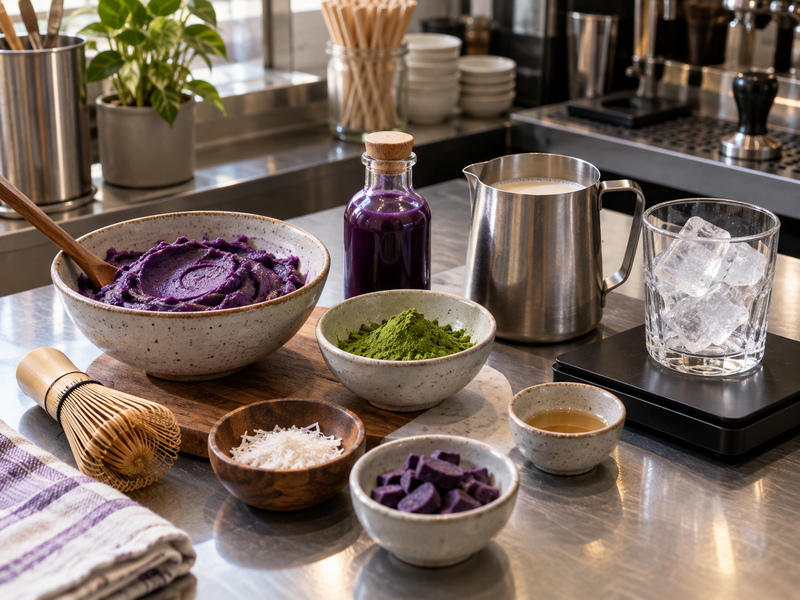
Decide on flavor before choosing the shade of purple
Ube is a purple yam used in many Filipino sweets. In a drink, a prepared ube ingredient may bring a soft yam note, vanilla-like sweetness or a dessert flavor depending on its formulation. Do not assume every purple syrup contains the same amount of ube or tastes the same. Define the target before shopping: should the drink taste lightly of ube with tea in front, or behave like a dessert latte with ube as the first note? Ask tasters to describe the finished cup without seeing the ingredient list. If they mention only sugar and color, the recipe may need a different ube product or lower sweetness.
Keep cultural wording accurate. A purple color does not by itself justify calling a drink “ube” if the ingredient is merely a generic flavor or coloring. Check the supplier’s ingredient declaration and use menu wording it supports. The tea should also have a job: a green, slightly savory note can keep a rich ube component from tasting flat. If both flavors are hidden under a large volume of sweet milk, the drink is expensive to build without delivering its name. Taste the ingredients separately, then together at full serving size.
| Target style | Ube role | Matcha role | First sensory check |
|---|---|---|---|
| Tea forward | Gentle finish | First sip | Can tea be named? |
| Balanced latte | Equal presence | Clear middle | Do flavors compete? |
| Dessert drink | Rich lead | Contrast | Is sweetness controlled? |
2. Which ube ingredient should a café buy?
Compare the ingredient list and service behavior
Ube may arrive as cooked puree, jam, powder, flavoring or syrup. Each behaves differently. A puree can add body but may be hard to mix into a cold drink; a syrup may disperse quickly while adding sweetness that limits further recipe choices. Request the full ingredient list, allergen statement, storage directions, shelf life and lot code for every candidate. Ask how much ube material the product contains if that affects a planned menu claim. Do not infer it from color intensity.
Test each product in the format you intend to sell. Measure the amount needed to make the flavor noticeable, then see whether the drink becomes too sweet or thick at that dose. A syrup that works in foam may sink or streak when mixed through milk. A puree that tastes vivid in a spoonful may leave sediment at the bottom of a tall glass. Check whether staff must heat, strain or blend it and cost that work. If a supplier changes formulation or packaging, retest. Choosing an ube ingredient is a sourcing decision as well as a flavor decision, especially for a café that wants a named seasonal drink across locations.
| Form | Trial advantage | Operational question |
|---|---|---|
| Syrup | Easy dosing | How sweet at useful flavor dose? |
| Puree | Clear ingredient character | Does it mix cold? |
| Jam | Body and dessert taste | Can it be dispensed consistently? |
| Powder | Storage flexibility | Does it dissolve or settle? |
3. How should you choose the matcha?
Taste it after ube and milk are added
A delicate plain-tea sample may disappear in an ube latte. Prepare candidate matcha powders at the same measured dose with fixed milk and ube amounts. Look for a clear tea note after the first sweet impression, a pleasant finish and a texture that survives the service method. If one powder needs far more grams to be noticed, compare its cost per finished cup rather than its bag price. Keep the test blind if marketing names or prices might bias the group.
The powdered tea should be traceable to a lot and have the documents your operation needs. Ask for a sample from the commercial product, not a show sample that cannot be reordered. The matcha green tea powder buying guide outlines general lot and sensory checks. For this recipe, focus on whether the matcha still tastes like tea after a purple foam or sweetened milk reaches the cup. Do not force a drink to work with the supplier’s most expensive grade. Choose a powder whose actual flavor and service behavior fit the product brief.
4. What is a sensible first trial recipe?
Build a small dose ladder, not a final standard
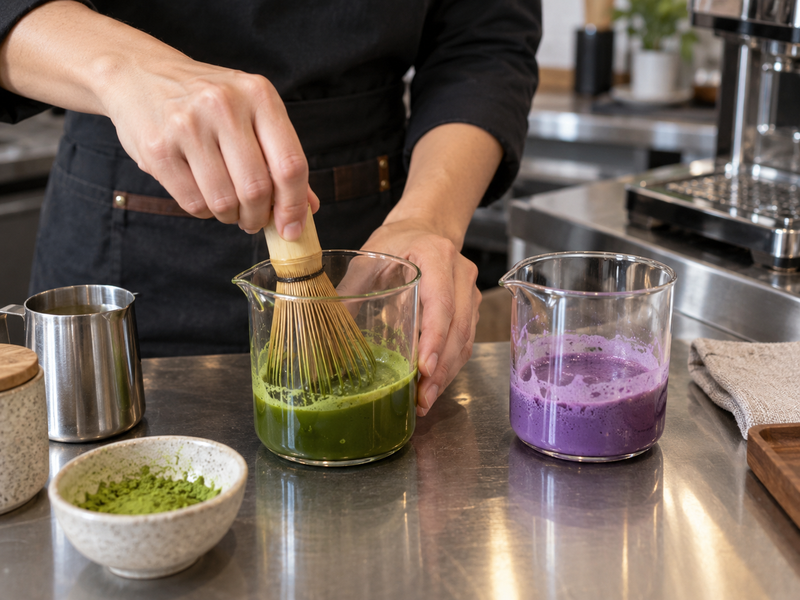
Oatly’s published version combines a cold matcha preparation with oat milk and ube foam. For an in-house trial, choose one cup and write down every quantity. As an example, test 2, 3 and 4 grams of matcha in the same measured amount of water, with a fixed volume of milk, ice and a measured ube component. Those dose figures are a trial ladder, not universal serving advice. Make each cup completely before judging it. A concentrate that tastes strong in a bowl may be weak after milk and ice.
Taste at assembly and after a typical customer wait. Record whether ube and matcha remain distinct as the foam mixes in. If the drink is too sweet, reduce the ube product or change to an ingredient with less added sugar before cutting matcha. If the yam note is missing, increase the ube component in small measured steps and check texture. Change one variable per round. Keep a photo under consistent light to compare layering, but approve the recipe by taste and repeatability. A purple top can help a guest recognize the drink; it cannot carry the entire product.
| Trial | Matcha powder | Ube component | What to compare |
|---|---|---|---|
| A | 2 g | Fixed dose | Tea presence |
| B | 3 g | Fixed dose | Balance and finish |
| C | 4 g | Fixed dose | Harshness and cost |
5. Should ube sit in foam or the milk?
Choose a format staff can execute
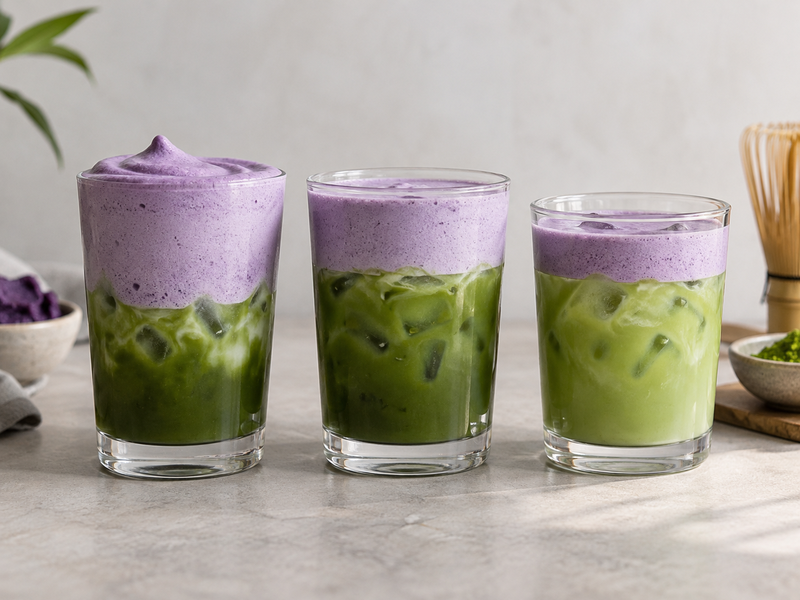
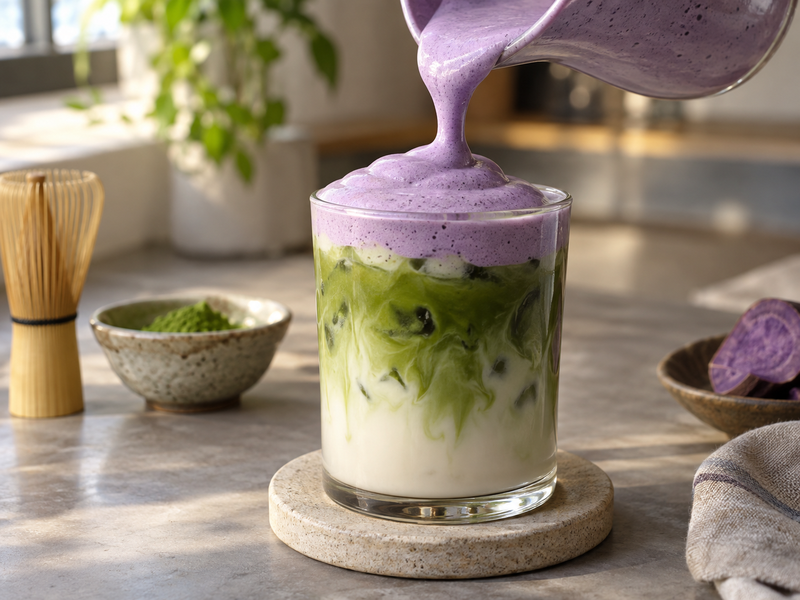
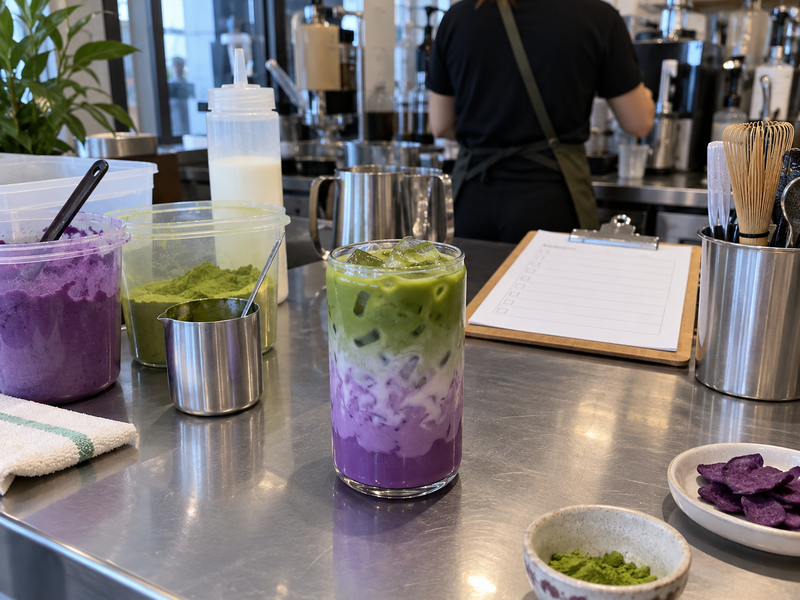
Ube cold foam creates a visible purple layer and lets a guest encounter ube before tea. Oatly’s recipe uses that structure. The price is another preparation step and a separate component to store, dispense and clean up. Mixing ube into milk reduces the layered effect but can simplify service. Build both versions in the same cup and taste them at the same temperature. A foam that looks attractive in the first minute may collapse or mix into the drink by the time a delivery reaches its customer.
For foam, test the actual base and tool: dairy cream, oat product or another approved ingredient may behave differently. Document how much ube syrup or puree the foam contains, how it is aerated and what serving amount goes on each cup. For a mixed milk version, make sure the ube ingredient does not leave a heavy paste on the bottom. Do not assume the two formats are interchangeable in allergen information or costing. A layered drink can be a strong seasonal special if the extra step is reliable; a blended version may be better for a high-volume counter. Let the pilot decide.
6. How do you keep tea and ube balanced?
Taste the first sip and the stirred drink
Layering changes the order of flavors. A guest who drinks through purple foam may taste sweet ube first, then milk, then matcha. A guest who stirs may get a uniform drink with a weaker tea impression. Test both. Ask whether either version still deserves both words in its name. If matcha disappears after stirring, raising the powder dose is one option, but test for astringency and cost. Reducing foam thickness or syrup may do more good.
Work from a short sensory brief: identifiable ube, identifiable tea, acceptable sweetness and no heavy residue. Evaluate the drink as the guest receives it, including straw or lid if that changes the sip. In a large cup, a vivid green band may look impressive while the top half tastes almost entirely of ube. Use the same glass and ice load for all trials. Keep the ube ingredient and matcha lot fixed while changing amounts. If two powders behave differently, make a new recipe card for the approved one rather than assuming the old dose remains valid.
| Cup check | What to notice | Possible adjustment |
|---|---|---|
| First sip | Is ube recognizable? | Foam or syrup dose |
| Stirred cup | Is tea still present? | Matcha or milk amount |
| Finish | Harsh or over-sweet? | Powder or sweetener |
| Last third | Residue or dilution? | Mixing and ice |
7. What must staff know about allergens?
Read each component, including the foam
The allergen answer depends on the exact milk, foam base, syrup or puree, and any toppings used. A dairy version and an oat version are separate recipes. Request supplier ingredient and allergen statements and keep them with the approved card. In the United States, the FDA’s food allergen guidance explains the major allergen framework; the business still needs to check its own ingredients and local requirements. Do not promise “dairy free” because the drink uses oat milk if the foam contains cream or the preparation area creates a relevant cross-contact issue.
Write an ingredient matrix for every menu variant. Include the matcha product, ube product, milk or cream, syrup, toppings and any prep tools shared with other drinks. Tell staff which substitutions have been tested and which require a new allergen review. If a guest asks a question the card cannot answer, staff should check the current ingredient record instead of guessing. A visually striking drink invites substitutions, but a casual swap can change its allergen profile, sweetness and texture at once. Make the approved options explicit before launch.
8. How can you make service repeatable?
Build from measured components in a fixed order
List the powder weight, water amount, milk amount, ice fill, ube dose, foam volume and build sequence. Give the foam a separate prep card if it is batched. Define its storage and hold controls under the operation’s food-safety plan. The FDA Food Code is a model for retail food safety in the United States, but local adopted rules and the ingredients used determine exact handling. Avoid inventing a universal hold time for a house-made foam.
Have a second barista make the drink from the card without coaching. Watch where judgment sneaks in: “a splash” of syrup, “enough” foam and “one scoop” of matcha are not reproducible. Measure those steps and test whether the drink still looks and tastes right after a short rush. If the foam requires a tool unavailable at another site, approve an alternate build or limit the product to equipped sites. The service test should include cleanup and waste, not only the thirty seconds captured in a product video.
9. What does the finished cup cost?
Include the purple component and its waste
Calculate the cost of matcha at the dose that passed the tasting, then add ube ingredient, milk, foam base, sweetener, ice, cup and lid. Account for batch foam left at the end of service and any extra labor or equipment. A small bottle of ube syrup may seem inexpensive until the drink needs a large dose to taste of yam. Likewise, a higher-priced matcha may cost less per cup if it remains clear at a smaller dose. Use the delivered price and actual yield.
Run the margin calculation for the base drink and approved variants. A dairy foam may have a different cost from an oat foam, and an extra-large cup may require another recipe rather than a proportional pour. If the target price cannot cover the best-tasting version, adjust the format or ingredients deliberately. Do not thin the tea or reduce ube until the color survives but the named flavors vanish. A seasonal drink can carry a higher ingredient cost when the menu price supports it; that is a business choice visible in the worksheet, not a reason to hide the formula.
| Cost line | Unit to record | Common omission |
|---|---|---|
| Matcha | Grams per cup | Extra dose in large cup |
| Ube | Syrup or puree mass | Batch residue |
| Foam | Finished volume | Unsold batch |
| Milk and packaging | Per serving | Alternate milk |
10. When is the recipe ready for a menu?
Approve the cup, the paperwork and the shift test
Launch when the actual ingredient declarations support the drink’s name and allergen information, the finished cup passes a blind or semi-blind taste, and another barista can reproduce it during a normal service window. Keep an approved photo, recipe card, supplier lots and costing worksheet together. Test a pickup delay if the product will travel. Ask a few staff members to explain the flavor without relying on “purple and green”; their descriptions will reveal whether the cup communicates its ingredients.
Set recheck triggers for a changed ube syrup, matcha lot, milk product or foam method. A new syrup can change sweetness and color even at the same pump count. Retaste and update the card before the substitution reaches all locations. If the product remains an occasional special, plan how unopened ingredients and prepared components will be handled at the end of the run. The final decision is simple: sell the version whose ube and matcha taste clear, whose recipe can be repeated, and whose ingredient information staff can answer with confidence.
Frequently asked questions
Q1. Is ube the same as purple sweet potato?
No. Ube is a purple yam. Check the ingredient declaration before using “ube” on a menu.
Q2. Must ube matcha have purple cold foam?
No. Foam is one format. Ube can be mixed through milk if that version tastes and serves better.
Q3. How much matcha should a café use?
Use a measured dose ladder in the finished cup and choose the amount that keeps tea recognizable without an unwanted finish.
Q4. Can an oat-milk version be called dairy free?
Only after reviewing every component and relevant cross-contact practices. A dairy foam would change the answer.
Q5. What should be retested when syrup changes?
Flavor, sweetness, color, allergen information, serving cost and the written recipe.