
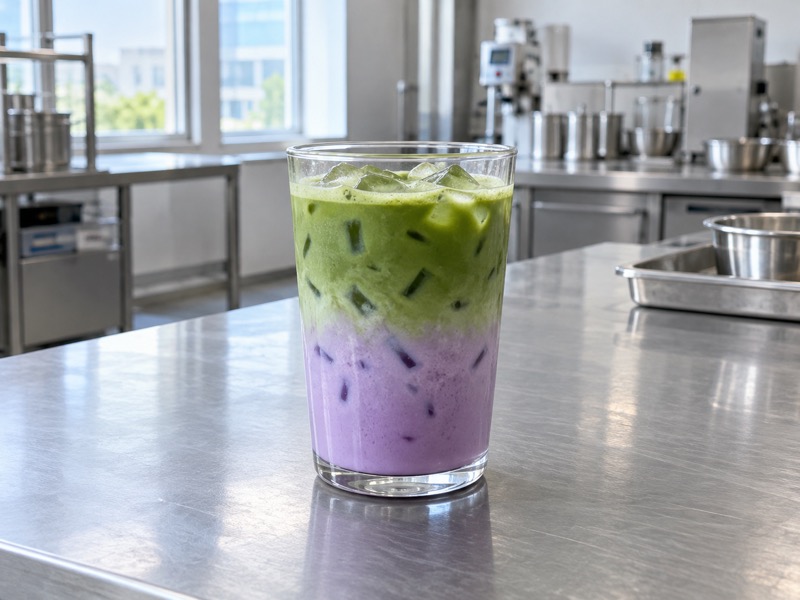
An ube matcha latte pairs a purple ube component with matcha and milk in one cold drink. It can look ready for a menu photograph while hiding two costly problems: a starchy purple deposit and a tea layer that tastes thin after a customer stirs the cup. A café needs a written formula for the finished serving, a clear account of what supplies the ube color and a build that staff can repeat during a rush. The checks below are designed for beverage developers and buyers who must approve the drink they can actually serve, rather than a carefully staged sample.
Jump to definition, service route, ube format, tea selection, formula, build, defects, handling, cost or pilot.
1. What should an ube matcha latte taste and look like?
Write a promise that survives stirring
The intended cup usually shows purple milk beneath a green matcha pour. That visual is useful, but customers will stir or drink across the boundary. Describe the flavor of the mixed drink as carefully as the untouched layers: an identifiable tea note, a recognizable ube character and sweetness that suits the chosen milk. Some purple syrups or extracts provide color and flavor without much actual ube. If the menu says ube, the ingredient declaration and staff explanation should reflect what the operator buys. A practical test: photograph a standard staff-made cup at handoff, then stir another serving and taste from top, middle and bottom. If the top tastes like tea while the bottom tastes like dessert syrup, a prettier pour will not repair the recipe. Specify the cup volume, ice fill and expected mixing advice so the photo, menu copy and drink agree. An attractive rim is only one moment in a longer drinking experience. Ask a tasting panel to name the two dominant flavors without seeing the ingredient card. If nobody detects tea in a stirred cup, the visual promise and drinking experience disagree. A menu developer can then reduce ube sweetness or change the tea dose while holding the other variable steady.
2. Which service format is the formula for?
Choose the route before choosing the layer
A counter order, a drive-through handoff and a bottled drink expose the same formula to different movement and waiting times. A dramatic interface between purple and green may suit an immediate clear-cup sale. A sealed bottle will be shaken, transported and stored; its color and sediment need evaluation after those events. Decide whether customers should stir before drinking or whether the cup must taste balanced without instructions. A delivery drink also needs a lid that keeps the tea layer in place when a courier turns the bag. Put the route on the brief: note who assembles the drink, the longest normal wait before a customer receives it, the expected drinking window and the pack it travels in. Test that complete route. Avoid borrowing a chilled shelf life from the milk or ube ingredient alone; the finished mixture has its own handling needs. For a store rollout, specify the same route separately at locations with different equipment.
| Service route | Cup behavior to check | Operational decision |
|---|---|---|
| Immediate counter service | Layer at handoff and flavor after stirring | Staff pour and customer instruction |
| Drive-through or delivery | Boundary after lidding and movement | Lid, fill level and menu photo |
| Packaged sale | Sediment and flavor through proposed storage | Separate validated product program |
3. Which ube format belongs in the base?
Compare what the supplier actually sells
Ube puree, halaya-style sweetened paste, powder and flavor extract behave differently. Puree can bring body and visible particles; a sweetened paste contributes sugar before the barista adds any syrup. Powder needs enough liquid and mixing time to hydrate. An extract may deliver strong color or aroma in a small dose, but its declaration can differ substantially from a puree. Ask suppliers for the full ingredient list, color sources, sweetness and preparation directions before making a purchasing comparison. Prepare each candidate in the intended milk at the same finished drink size. Do not compare equal spoonfuls: the water and sugar content will differ. Watch the bottom of the cup. If purple solids collect below the ice during a normal wait, change dispersion or format before raising the matcha dose. A smooth, labeled base is easier for a second site to reproduce than an improvised scoop of jam. Keep a retained sample of the chosen ube lot for incoming comparisons.
4. How should matcha be chosen for the ube base?
Taste tea in the complete drink
A tea that tastes lively in water may disappear behind sweet ube milk. Make a fixed ube base, then compare identified matcha lots at equal grams per finished cup. Use the same water volume and mixing method for each tea. Taste the green shot alone to identify obvious defects, but make the purchase decision after it meets the purple base. Note bitterness, grassy impressions and how much tea remains recognizable once the cup is stirred. Color matters for the initial impression; it should not drive a dose that makes the last sip harsh. Keep one control cup. When a new tea sample seems weaker, compare it beside the approved lot before altering sugar, milk and tea together. Record supplier lot, opening date, powder appearance and mixed-cup comments so a later color shift can be traced to either tea or ube. Price comparisons should use the approved dose rather than the same price per kilogram.
| Comparison | Hold fixed | Record in the mixed cup |
|---|---|---|
| Matcha lot A versus B | Ube base, milk, ice and tea mass | Tea clarity, bitterness and green appearance |
| Ube puree versus powder | Tea lot and finished volume | Body, sediment and sweetness |
| Milk option | Ube and tea masses | Flavor balance and layer movement |
5. What should a cup specification record?
Weigh the formula as served
Write ingredient masses for the purple base, matcha, mixing water, milk, sweetener and ice. Include the target finished volume and the actual liquid added; a large ice fill can make two cups look identical while their beverage content differs. If a puree already contains sugar, list that contribution separately from added syrup. Record the ube base yield after straining or bowl transfer, not just the starting mass. A prep batch may leave a meaningful film on a blender jar, and that loss changes servings per pack. Make the drink card usable: state a permitted range for each weighed component, the sequence, tools, cup size and appearance at handoff. Pumps and scoops can be convenient during service only after staff have checked their delivered mass with the specific syrup or powder. A supplier change calls for a new comparison, even if the label uses the same ingredient name. Put the revision date on each card to keep old methods out of service. Keep one signed reference cup record with actual measured ingredient masses. When a second store reports that the drink is too sweet, compare its measured milk and syrup additions with that record before changing the central formula. This separates a local dispensing problem from a recipe problem.
6. How can staff build clear layers repeatedly?
Separate dispersion from presentation
Hydrate ube powder or blend puree into its liquid base until no dry pockets remain. Sift or disperse matcha into a small measured amount of water before it meets cold milk; dumping dry powder onto ice commonly leaves green clumps. Add the purple base and ice according to the tested cup card, then direct the matcha stream against ice or the cup wall if a gentle pour makes the required boundary. The exact order depends on the densities of the two prepared liquids, so test it with the purchased ingredients. Time the real build. A method that needs an extra blender wash for every cup may fail at peak service even if its layers look excellent. Have staff prepare several cups consecutively, and inspect the initial and final pours from each prep vessel. If the last cup carries more purple sediment, adjust mixing during service or reduce the batch size. Tell staff when a prepped base must be remixed.
| Step | Written control | Visible fault if missed |
|---|---|---|
| Prepare ube base | Hydration and mixing endpoint | Grit or purple streaks |
| Prepare matcha | Tea mass, water and dispersion | Green specks on ice |
| Assemble | Ice fill, pour point and sequence | Muddy boundary or uneven volumes |
7. Which defects appear during a normal drinking window?
Inspect the mixed cup as well as the layers
Set observation points around the actual handoff and likely drinking time rather than around a photo shoot. Record purple sediment, green flecks, separation, a gray interface and whether the tea flavor fades as ice melts. A gray line is not automatically a tea-quality problem: it can result from two colored liquids mixing at their boundary. A dense puree can sink even when the color remains attractive. Use a clear cup for the development check, then repeat in the sellable cup and lid. Change one variable at a time. If sediment appears, compare the same ube formula with a longer hydration or finer dispersion. If the tea disappears, taste at a fixed dilution before increasing matcha. The staff sheet should describe a reject cup in plain visual and sensory terms, so a shift lead can catch defects before sale. Photograph the same cup position and light at each checkpoint.
8. How should ingredients and finished cups be handled?
Set rules for the actual components
An opened ube pack, prepared ube milk, dispersed matcha and a finished milk drink need handling rules based on their complete formulations and the shop’s food-safety plan. Record preparation time, storage condition, container label and discard decision for each prepared component. The visual layers do not make a mixed dairy or plant-based drink shelf stable. A team considering bottled distribution needs a separate validated process and shelf-life study for that packaged formula. The counter-service cup should be assessed through its realistic handoff window, with staff checking flavor and appearance at the end of that window. Review the supplier file: ube identity, added colors, sugar and allergens belong beside matcha lot and milk documentation. When a product uses ube flavor instead of a substantive ube ingredient, the menu description should say so plainly rather than relying on purple color as proof. Staff should know which prepared container belongs to each recipe version.
| File item | Ask the supplier or team for | Use in approval |
|---|---|---|
| Ube component | Full declaration and color sources | Menu wording and formula balance |
| Matcha | Lot identity and product specification | Repeatability across deliveries |
| Prepared base | Time, storage and discard record | Site handling instruction |
9. What does the sellable cup cost?
Include the material staff leave behind
Divide purchased ube and tea cost by accepted finished servings, not by ideal recipe yield. Dense puree left in a pouch or blender jar, matcha spilled during sifting, and a purple base discarded at closing all belong in the unit calculation. Add milk, syrup, cup, lid and the labor time of any extra blending or wash step. Ice can change drink volume and customer perception even when its purchase cost seems small. Compare the price of a puree route and an extract route only after tasting both and checking their honest menu descriptions. Track remakes during a trial. If a barista pours the matcha too fast and muddies one cup in a short run, that loss belongs in the launch estimate. A quick photograph may justify a premium price, but only a cup that tastes balanced and survives normal service can sustain it. Report both the ingredient cost and the accepted-cup cost. For a prep batch, subtract the base discarded at close from the theoretical yield before calculating cost per cup. Then compare days with different sales volumes. A formula that works only when the entire batch sells is a poor fit for a quiet location. Smaller batches may cost more staff time but waste less ube.
10. What should a launch pilot prove?
Use ordinary staff and the final cup
Give several baristas the same written card, stocked ingredients and normal equipment. Have each prepare the drink during a realistic service period; note build time, cup mass, color boundary and any rejected units. Taste one serving immediately and another after a customer-like wait, both before and after stirring. Ask staff where the instructions force judgment calls: puree scoop, ice level, pour speed or when to remix a base. Fix those points in the card and repeat the limited run before approving a second location. The release question is concrete: can a new operator produce the agreed taste and appearance without a developer beside them? Once the pilot meets the written criteria, the purchasing team can link the approved ingredient lots, formula version and supplier files. Keep one photograph from the approved pilot beside the service card. It gives shift leads a concrete reference for color and fill without pretending every cup must reproduce a studio image. For adjacent tea pairing ideas, see matcha flavors; a home ube matcha latte example shows a different, small-batch context.
| Pilot observation | Record | Decision it supports |
|---|---|---|
| Cup at handoff | Mass, photograph and taste | Menu appearance and serving spec |
| Cup after normal wait | Layer change, sediment and mixed flavor | Service window |
| Staff-built series | Time, variation and remakes | Training and unit economics |
FAQ
Q1: Does an ube matcha latte need real ube? The recipe should identify whether it uses ube puree, powder, sweetened paste or a flavor product. The name and menu description should match that declaration.
Q2: Why does the purple layer settle? Puree particles or incompletely hydrated powder may sink. Compare the chosen ingredient after better dispersion and through the intended drinking window.
Q3: Should matcha go above or below ube milk? Choose the pour that works with the tested liquids and cup. Record the sequence and verify both appearance and mixed flavor.
Q4: Can a layered café cup be bottled unchanged? Bottling changes movement, storage and safety requirements. Treat it as a separate product requiring validation for its complete formulation.
Q5: What belongs on the approval sheet? Keep the weighed formula, ingredient lots, service method, sensory criteria, handling instructions and accepted cost per finished cup.
Reference: Easy Ube Matcha Latte is a consumer recipe used for topic context; the café controls above are original operating guidance.