
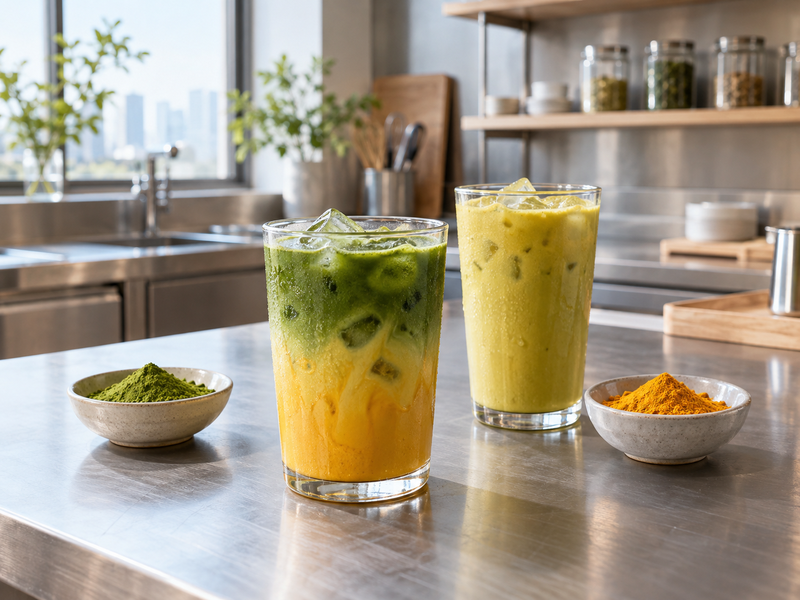
Turmeric matcha combines finely milled green tea with turmeric in a drink or dry blend. The pairing sounds simple until a café chain or beverage brand has to serve the same color and taste across many sites. Turmeric can dominate the cup, matcha can clump, and both powders can settle. A recipe that looks good in one test glass may fail after five minutes on a counter. This guide turns turmeric matcha into a repeatable product brief: define the sensory target, select powders, test dispersion, build a service method, and price the finished serving. We work from a matcha supplier’s perspective, where the useful question is what a buyer can verify before committing to a larger order.
1. What is turmeric matcha in a commercial product?
For a menu team, turmeric matcha is usually a prepared drink: matcha brings a grassy tea note and green color while turmeric adds an earthy spice note and yellow pigment. For a packaged-goods buyer, the same phrase may mean a dry powder blend, a sweetened latte mix, or a ready-to-drink beverage. Those are different products with different labeling, storage, and manufacturing questions. Write the product form on the first line of the brief. A purchaser who requests only “turmeric matcha” may receive samples that cannot be compared fairly.
Decide whether the drink should read as matcha with a small spice accent or as a golden spiced latte with tea in the background. That sensory decision controls the ratio, milk choice, and level of sweetness. It also gives evaluators a common target. The US search term has modest volume in the supplied research, but a focused recipe can still earn a place on a menu if it fits the customer and station workflow. A useful trial compares an unsweetened base with a lightly sweetened version under the same serving conditions.
| Product form | Primary buyer question | First practical test |
|---|---|---|
| Made-to-order café drink | Can staff serve it consistently? | Time a five-drink rush. |
| Dry powder blend | Will powders remain uniform in the pack? | Sample top and bottom after handling. |
| Ready-to-drink beverage | What happens during storage? | Run a defined stability trial. |
2. How should matcha and turmeric be balanced?
Start with the cup, not an arbitrary percentage on a specification sheet. Matcha has its own bitterness, umami, and green aroma. Turmeric can taste woody or slightly bitter. In a dairy or oat base, these characteristics soften; in water, they stand out. Make three small prototypes that hold the total powder weight constant while shifting the matcha-to-turmeric ratio. Taste them blind at the intended service temperature. Record which ingredient leads on aroma, which finishes on the palate, and whether sweetness masks a weak tea sample.
Do not decide by powder color alone. Turmeric can tint a drink strongly at a level that contributes less flavor than expected, while a darker green does not guarantee better matcha. The same recipe also changes with syrup, milk fat, acidity, and ice dilution. Keep a one-page formula sheet for each trial, with weights rather than spoon measures. If a spiced profile is the goal, test ginger or cinnamon as separate variables; adding them during the first comparison makes it harder to identify the cause of a good or bad result.
3. Which matcha grade works for turmeric matcha?
Use the grade that meets the finished drink’s sensory target at a workable cost. A vivid, delicate matcha can be wasted under heavy spice and syrup, while a very bitter powder may push the team to over-sweeten. Request samples at two or three price points and evaluate them in the actual recipe. A plain-water tasting still helps identify defects, but the menu decision belongs to the completed cup. Compare color immediately after mixing and again after the planned hold time.
Ask the supplier how each sample is intended to be used, how fine it is, and whether the quoted product is available in the quantities your rollout needs. Terms such as ceremonial and culinary vary between sellers; they are not a substitute for a sample, current specification, and batch documentation. Matcha Village offers several matcha grades and blends, so a buyer can request application samples against a stated target instead of accepting a grade name as the answer. Keep the approved sample reference when ordering; it is the benchmark for the next delivery.
| Test drink | What it reveals | Decision rule |
|---|---|---|
| Matcha in water | Tea aroma, bitterness, particles | Reject obvious off-notes. |
| Final milk recipe | Balance against spice and sweetness | Choose the preferred cup blind. |
| Five-minute iced hold | Color and visible settling | Set a realistic service limit. |
4. What should a buyer ask about the turmeric ingredient?
Specify food-grade turmeric powder for the intended market and application. Request its ingredient statement, origin information, particle-size range if available, lot identification, and relevant test documents from the seller. Evaluate the powder in isolation and in the finished drink. Its color can vary between lots; so can the strength of the earthy note. If the product is a preblended retail mix, check whether the supplier includes any carrier, flavor, sweetener, or color in addition to turmeric. Those additions affect both label copy and formulation.
Turmeric and matcha come from different supply chains. A matcha supplier may supply the tea and blend the two ingredients, but the buyer still needs traceability for each input. Ask how the blending line controls cross-contact, how the blend is sampled, and which party owns release testing. Avoid medicinal language on menus or packs. “Turmeric matcha latte” tells customers what is in the cup; claims about treatment, inflammation, or immunity require separate substantiation and regulatory review.
5. How can a café prepare a smooth turmeric matcha latte?
Build a small, smooth concentrate before adding the main liquid. Weigh the powders, sift if needed, then mix with a modest volume of water at a temperature the chosen matcha can tolerate. Whisk or use a suitable small mixer until no dry islands remain. Add sweetener and milk afterward. For a cold drink, pour the concentrate over measured ice and milk rather than shaking loose powder directly into a full cup. The sequence matters because dry powder is harder to disperse once it floats on a large surface.
Write a station recipe with gram weights, water volume, milk volume, cup size, ice weight, and service order. Then ask two staff members who did not develop the drink to make it. If their cups differ, fix the instruction or tools before adjusting ingredients. A batch concentrate might speed a busy bar, but only after a site-specific food-safety and quality review establishes a reasonable hold period. Keep the concentrate covered and follow the operation’s cleaning and temperature rules. A handoff test is more informative than a polished recipe card.
| Step | Operator control | Typical failure to watch |
|---|---|---|
| Weigh | Use grams for both powders | Inconsistent spoonfuls |
| Pre-disperse | Make a smooth concentrate | Dry clumps in finished cup |
| Finish | Measure liquid and ice | Flavor diluted by guesswork |
6. What changes when the drink is served iced?
Cold liquid slows powder wetting and can expose grit that a warm latte hides. Ice also melts while customers carry the drink, so the first sip and the tenth sip are different tests. Prepare the matcha and turmeric in a small amount of water first, then combine with the cold base. If the concept calls for a layered appearance, test whether the layers survive the expected handoff time. A pretty photograph taken seconds after pouring can hide a muddy cup at the pickup counter.
Set a practical acceptance window: immediate appearance, appearance after five minutes, and taste after partial ice melt. Photograph each sample under the same light. Check the bottom of a clear glass for sediment and ask tasters whether a quick stir restores the intended texture. If the drink is sold through delivery, repeat the trial in the actual lidded cup over the route duration. These checks may lead to a slightly different formula for delivery than for counter service. Document the difference rather than hoping staff will compensate by eye.
7. How should a dry turmeric matcha blend be packed?
A dry blend is convenient for multi-site service, but it introduces a uniformity problem. Matcha and turmeric can differ in particle size, density, and flow. A pouch that passes a bench taste test may separate during transport or repeated scooping. Ask the blender for its mixing process and sampling plan. Open trial packs after simulated handling, take material from the top and bottom, and make drinks with the same weighed dose. The two cups should be close enough in color and taste for your specification.
Protect both ingredients from moisture, light, and odors with packaging appropriate to the proposed shelf life. The package should state a net weight, ingredients, lot code, storage instructions, and any market-required information after label review. Choose serving sachets when dosing consistency matters more than packaging economy; choose bulk packs when trained staff and accurate scales are already in place. An unopened-shelf-life estimate is only meaningful with a defined pack, storage condition, and test plan. Ask for evidence behind the stated period.
| Pack format | Operational benefit | Trade-off to check |
|---|---|---|
| Single-serve sachet | Fixed dose across stores | More packaging per cup |
| Bulk pouch | Flexible portions and less handling cost | Requires scale and stock rotation |
| Retail tin or jar | Easy shelf presentation | Repeat opening may affect freshness |
8. How can a buyer price a turmeric matcha serving?
Cost the complete served drink, not only the matcha line item. Include turmeric, milk or plant base, sweetener, cup, lid, ice, waste, and prep labor where the business tracks it. Use the actual grams in a tasted formula. If a cheaper matcha requires extra sweetener or a larger dose, its lower price per kilogram may not lower the cost per acceptable cup. Keep a small spreadsheet with ingredient prices and yield assumptions so procurement and product development can test alternatives together.
Model at least three cases: target recipe, a higher-cost tea that improves flavor at a lower dose, and a blended sachet that cuts preparation time. For retail powder, add blending, packaging, label review, freight, channel margin, and expected returns. A sensible pilot sets a maximum ingredient cost per serving before requesting quotes. It also records a minimum acceptable taste score from blind trials. A price comparison without that sensory floor invites a false saving that staff later repair with extra syrup.
9. Which quality checks matter before rollout?
Check identity, food safety documentation, sensory consistency, and in-cup performance. For tea, request a current specification, a lot-linked certificate of analysis where available, and any testing needed for your destination market. For the finished blend, verify ingredients and allergens from every input, package integrity, and net contents. The buyer should decide which tests are contractual and which are internal development checks. The supplier can propose a program, but a generic certification badge does not answer whether this lot performs in your recipe.
Keep retain samples from an approved pilot and the first production order. Run the same drink test with each incoming lot: identical water, milk, powder dose, cup, and tasting sheet. Record deviations with photos and lot numbers. If color shifts, do not assume fraud; growing season, storage, and processing can also change appearance. Investigate against agreed specifications. This routine is especially helpful when several stores report different cups, because it separates an ingredient change from preparation drift.
| Checkpoint | Evidence to retain | Who acts on a failure? |
|---|---|---|
| Incoming lot | Lot code, specification, sample | Procurement and quality |
| Recipe cup | Photo, sensory sheet, weights | Product development |
| Store execution | Station method, timed trial | Operations lead |
10. What belongs in a supplier request for turmeric matcha?
Give the supplier an application brief that can be answered. State whether you need matcha alone, a custom dry blend, or a finished consumer pack. Include destination market, forecast range, intended liquid base, target serving dose, sweetness preference, color target, packaging format, and any required documentation. Send a benchmark cup description or a retained sample if practical. Ask for separate prices by quantity and pack format so a quote does not hide a change in product specification.
Request enough sample for a short production-style trial, not only one tasting. Decide who supplies turmeric and who owns final blend quality. Confirm lead time, minimum order quantity, lot coding, and the process for approving a reference sample. If the product will carry a brand claim, route that claim through the brand’s legal review. Matcha Village can discuss matcha grades, blends, and private-label formats through its website. The useful first conversation is a concrete cup or pack brief with the limits that matter to your operation.
Frequently asked questions
Q1: Does turmeric matcha need milk? No. Water-based versions are possible, but milk or a plant base often softens the earthy spice note. Test the exact base you plan to sell.
Q2: Can a café premix the powders? Yes, with a documented mixing and storage procedure. Check dose uniformity after transport and repeated scooping.
Q3: Why does an iced cup show sediment? Fine powders do not dissolve like sugar. Pre-dispersion, particle size, and a service stir can improve the customer experience.
Q4: Should a buyer choose ceremonial matcha? Taste candidate grades in the finished formula. Grade names alone cannot predict value under turmeric, milk, and sweetener.
Q5: Can a menu promise health benefits? Review any proposed claim with qualified regulatory counsel and supporting evidence for the market. Ingredient naming alone is a clearer starting point.
Turmeric matcha works commercially when its tea-spice balance survives real service. Approve a reference cup, set a repeatable method, and test the chosen pack after handling. Bring those results to a supplier so the next sample addresses the actual gaps.