
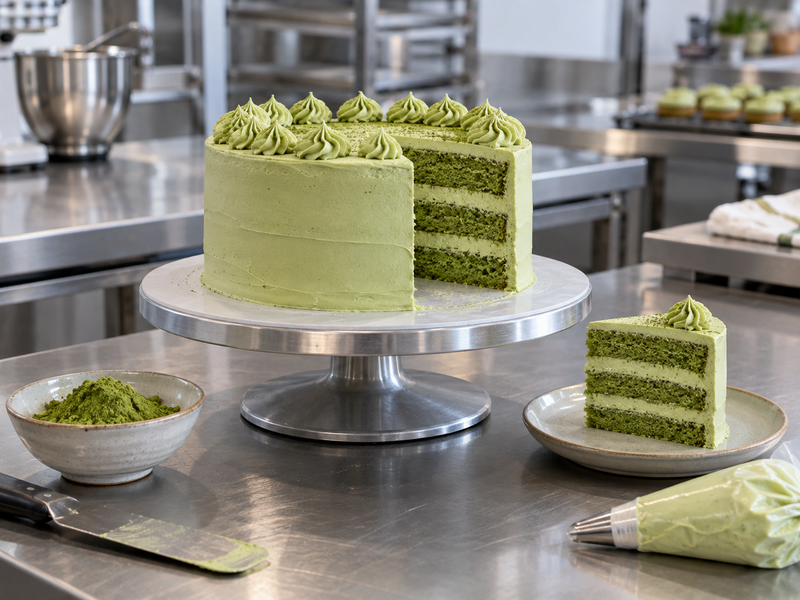
Matcha Swiss meringue buttercream is a butter-based frosting made by folding butter into cooled Swiss meringue and then adding matcha. Its silky texture works well on cakes, but a bakery has more to solve than flavor. A frosting that pipes beautifully at one room temperature can split in a warm kitchen, fade under display light, or taste dull after a night in storage. This guide gives bakery buyers and production leads a workable trial plan: choose the matcha, set a formula, control the emulsion, test color and flavor on the actual cake, and document handling before a wider rollout. From a matcha supplier’s side, the best sample is one tested in the customer’s own buttercream rather than in water alone.
1. What makes matcha Swiss meringue buttercream different?
Swiss meringue buttercream begins with egg whites and sugar heated together, whipped into a meringue, cooled, and emulsified with butter. Matcha adds tea solids and flavor to that base. The result is usually less overtly sweet than a powdered-sugar buttercream, with a smoother mouthfeel and a cleaner place for the tea note. That difference matters on a full slice of cake. A frosting that seems pleasantly restrained on a spoon may be overshadowed by a strongly flavored sponge or filling.
For commercial production, define the application before the matcha percentage. An outer coat needs spreadability and a stable finish. Sharp piping needs a somewhat firmer working texture. A filling needs enough structure to resist squeeze-out under stacked layers. The same formula may serve all three, but the production team should prove that in a cake trial. Record the serving temperature because cold butter can mute both sweetness and matcha aroma. A sample tasted straight from a refrigerator gives a different judgment from one served at the intended point of sale.
| Use | Performance question | Trial sample |
|---|---|---|
| Outer coat | Does the finish stay smooth? | Frost and hold a full cake. |
| Piped detail | Do edges remain defined? | Pipe a standard border. |
| Layer filling | Does the filling squeeze out? | Stack the heaviest planned cake. |
2. Which matcha should a bakery test?
Choose against the finished buttercream. Butter carries aroma and softens bitterness, while its pale color makes any brown or yellow cast in the tea powder visible. Request samples that differ in sensory profile and cost, then use the same dose in identical base batches. Taste each sample alone, on the intended sponge, and after the planned display period. Good results are a balanced tea note and a green that suits the brand’s visual standard. An intensely green powder that tastes harsh may be a poor buy.
Ask for ingredient identity, a current specification, lot coding, and relevant market testing. Fine, uniform powder usually distributes more easily than coarse material, but a sieve and mixing method still matter. Do not treat “ceremonial” or “culinary” as a universal technical grade; suppliers use those labels differently. Define the needed color, taste, and performance in a written acceptance sheet. If a bakery expects repeated seasonal orders, retain an approved sample and compare incoming lots in the same buttercream formula. A water tasting can screen obvious defects, but it cannot predict the complete cake.
3. How should a production team set the matcha dose?
Use weighed test batches and change one variable at a time. Begin with a known Swiss meringue buttercream formula that already runs well in your kitchen. Divide it into equal portions and add measured matcha to each. Record matcha as a percentage of finished frosting weight as well as grams per batch; the percentage helps when production scales. Make a plain control. Taste immediately, after a short rest, and at service temperature. A dose that looks vivid in the bowl may overwhelm the cake or leave a dry tea finish.
Check how matcha affects texture. Adding more dry powder can thicken the buttercream or create speckling. Adding too much water in an attempt to dissolve it can destabilize the emulsion. If the team needs stronger color without more tea flavor, decide whether that remains a matcha-led product or needs separate coloring and corresponding label review. The answer belongs in the brief, not in a last-minute production adjustment. Set a sensory range rather than a single abstract “green enough” instruction.
| Trial | Keep constant | Record |
|---|---|---|
| Tea-dose ladder | Base frosting, cake, serving temperature | Tea taste, color, firmness |
| Day-two check | Pack and storage condition | Color shift, aroma, texture |
| Full-cake trial | Layer thickness and filling | Spread, piping, slice quality |
4. What controls the Swiss meringue base?
Egg handling and temperature are central. The bakery should use a validated food-safety procedure for heating egg whites and sugar, including the temperature and time required by its jurisdiction and ingredients. The FDA egg-safety guidance is a useful US starting point for reviewing raw and pasteurized egg handling. Pasteurized whites may simplify some operations but still require the process the bakery has approved. Whisk the mixture as it heats so sugar dissolves evenly; undissolved grains can damage the final mouthfeel. Whip to the required volume, then allow the meringue to cool before butter is added. Warm meringue can melt the fat and leave a loose mixture.
Butter temperature matters as much as meringue temperature. Pieces that are too cold can make a curdled appearance; overly soft butter can produce a soupy frosting. Neither look automatically means the batch is lost. The correction depends on actual temperature, so measure and document it. Use the same bowl size, mixer attachment, batch weight, and mixing schedule in scale-up trials. A small test batch often cools faster than a production bowl. Matcha should enter only after the base is stable enough to take another dry ingredient consistently.
5. How should matcha be added without clumps?
Sift the powder before it meets the frosting. One approach is to blend matcha with a small portion of finished buttercream until smooth, then fold that concentrate back into the main batch. This keeps the added moisture low and makes visible dry pockets easier to catch. Another approach is direct addition through a fine sieve while the mixer runs slowly. Compare both in the production equipment; bowl shape and batch size affect how well powder distributes. Scrape the bowl and paddle before declaring the mix complete.
Do not use a large water slurry merely because it worked in a beverage. Buttercream is an emulsion, and added water changes its balance. If a slurry is necessary for the desired appearance, test a measured amount and repeat the trial after holding. Inspect frosting spread thinly on a white card and inside a cut cake. Small dark flecks can be acceptable for a natural tea look, but hard powder pellets are a process defect. Write the successful order of addition into the batch sheet so different shifts reproduce it.
| Method | Best reason to try it | Check before approval |
|---|---|---|
| Sift into mixer | Fast on a suitable batch | Powder stuck at bowl edge |
| Preblend with frosting | Better control of dry pockets | Even recombination |
| Measured slurry | Possible for a specific formula | Emulsion and hold stability |
6. Why does matcha buttercream split or turn soft?
Temperature is the first suspect. A mix that looks curdled may have cold fat pieces that have not joined the emulsion; a glossy soup may be too warm. Check bowl temperature and the state of the butter before changing the formula. Work in small adjustments under the bakery’s established procedure, then note what restored a smooth texture. Matcha powder itself can make the frosting seem thicker, but it rarely explains a major collapse of an otherwise sound base. Repeated failures after tea addition may indicate too much added liquid or an inconsistent mixing sequence.
Separate sensory defects from structure defects. A bitter or stale tea note calls for a different matcha or dose, not more whipping. Yellow-green color after display may reflect ingredient choice or exposure conditions, not an emulsion problem. Build a short fault log with photographs, temperatures, batch numbers, and corrective actions. That log will show whether a failure follows a specific ingredient lot, a warm afternoon shift, or an overfilled production bowl. It also prevents each operator from inventing a different rescue procedure.
7. How should the frosting be tested on a finished cake?
Use a cake that represents the actual sale. A light vanilla sponge, chocolate sponge, and fruit filling will change how matcha tastes. Pick the intended cake and apply normal frosting thickness. Assemble and transport it as a store would, then inspect the exterior and slice. Look for bulging layers, smearing at the knife, and color transfer onto packaging. If the cake is sold by the slice, photograph a standard slice after the typical display time. A bowl tasting cannot reveal these issues.
Hold one cake under the proposed store conditions and another under the worst realistic condition allowed by the bakery’s safety program. Taste the frosting at the planned eating temperature. If the product is for weddings or events, include setup and serving time in the plan. Avoid assuming a safe or attractive ambient hold from a single successful kitchen test. A quality trial and a food-safety validation answer different questions; both must be complete before a public launch.
8. What storage and shelf-life questions need answers?
Because the frosting contains egg and butter, use the bakery’s approved food-safety controls for preparation, cooling, storage, transport, and display. The safe period depends on the exact recipe, process, packaging, and temperature history. Matcha does not create a universal shelf life for buttercream. Run a defined trial with the finished cake or packed frosting under the intended conditions. Check microbiological requirements through a qualified food-safety team where applicable, alongside sensory and appearance checks.
Light and oxygen can alter the visual appeal of green frosting. Test the actual display cabinet, not a dark refrigerator alone. Keep retain photographs under consistent lighting so a new batch is compared fairly. If freezing is part of production, assess thawed spreadability and emulsion texture; do not assume an attractive fresh batch will behave identically after thawing. Record whether the approved use is same-day piping, chilled cake finishing, frozen component supply, or another route. Every extra handling step creates a different validation question.
| Condition | Question | Evidence |
|---|---|---|
| Chilled hold | Does texture recover at service? | Timed taste and piping test |
| Lit display | Does green shift visibly? | Same-light photo series |
| Freeze and thaw | Does emulsion stay smooth? | Thawed batch comparison |
9. How can a bakery cost a matcha frosting?
Calculate the tea contribution per cake from the approved dose, then add the full buttercream cost. Include egg whites, sugar, butter, matcha, trim loss, labor, packaging, and any special storage. A higher-priced matcha may cost little per slice if the dose is small and flavor is clear. A cheaper powder can become costly if the bakery doubles the dose or discards dull-looking cakes. Use a fixed cake size and frosting weight when comparing samples so procurement sees the true cost per sellable unit.
Build a second scenario for production yield. If a formula pipes slowly or breaks frequently, labor and waste can outweigh ingredient savings. Ask decorators to rate spreadability alongside flavor; their time belongs in the economics. For a multi-store chain, note whether the frosting is made centrally or at each location. Central production changes shipping and handling costs, while local production puts more weight on simple instructions and supply consistency. Quote comparisons should use the same pack size, delivery terms, and forecast horizon.
| Cost line | Unit to compare | Hidden risk |
|---|---|---|
| Matcha | Cost per finished cake | Different dose needed for flavor |
| Decorating labor | Minutes per cake | Slow piping or extra rework |
| Waste | Rejected cakes per batch | Color or emulsion failures |
10. What should the matcha supplier receive in a bakery brief?
Share the cake format, frosting formula at a useful level of detail, target tea intensity, preferred green, batch size, forecast, and destination market. State whether the product must work in a fresh bakery, a central kitchen, or a frozen supply chain. Request small samples plus enough material for a production-scale trial. Ask for a specification, lot identification, relevant certificates, lead time, minimum order quantity, and prices at forecast volumes. Keep the approved trial lot as a reference rather than relying on a verbal grade description.
Matcha Village supplies matcha grades and application support; its website is the starting point for a sample conversation. Send the bakery’s acceptance sheet with the request. Describe what failed as well as what worked: a yellow cast on white frosting, grainy spots, muted tea behind chocolate, or color loss under display lights. Those observations let a supplier recommend a different sample intelligently. Matcha Swiss meringue buttercream becomes easier to buy when the brief describes a cake customers will actually receive.
Frequently asked questions
Q1: Can matcha be added directly to Swiss meringue buttercream? Yes. Sift it and test distribution in the production mixer; a small frosting preblend can reduce clumps.
Q2: Why did the buttercream look curdled? Check temperature and mixing before changing matcha dose. Cold fat can produce a broken-looking texture.
Q3: Does a brighter powder always taste better in frosting? No. Taste it on the finished cake because color and flavor do not always track together.
Q4: Can the frosted cake sit at room temperature? Follow a validated food-safety and quality plan for the exact recipe and service setting.
Q5: Should matcha grade determine the purchasing choice? Use an approved cake trial, specification, and cost per sellable cake rather than the grade label alone.
The best matcha Swiss meringue buttercream trial ends with a cake, a batch sheet, and a clear acceptance standard. Once texture, taste, color, and handling have passed under real conditions, procurement can compare suppliers on the same basis.