
Matcha zenzai is a dessert built around sweet azuki beans and matcha, often served with chewy shiratama dumplings or another mochi-style element. It looks simple on a menu, but an operator has to coordinate three textures, a serving temperature, and a repeatable tea flavor. Beans can dominate a weak matcha base; dumplings can toughen or soften with poor holding; a careless green drizzle can turn the dish into a photo prop. This guide helps cafés, restaurants, and dessert brands build a version that suits their equipment and service volume. We take an ingredient-supplier view: choose matcha by how it tastes beside azuki and how consistently staff can prepare it.
1. What belongs in a matcha zenzai bowl?
Keep the core elements recognizable
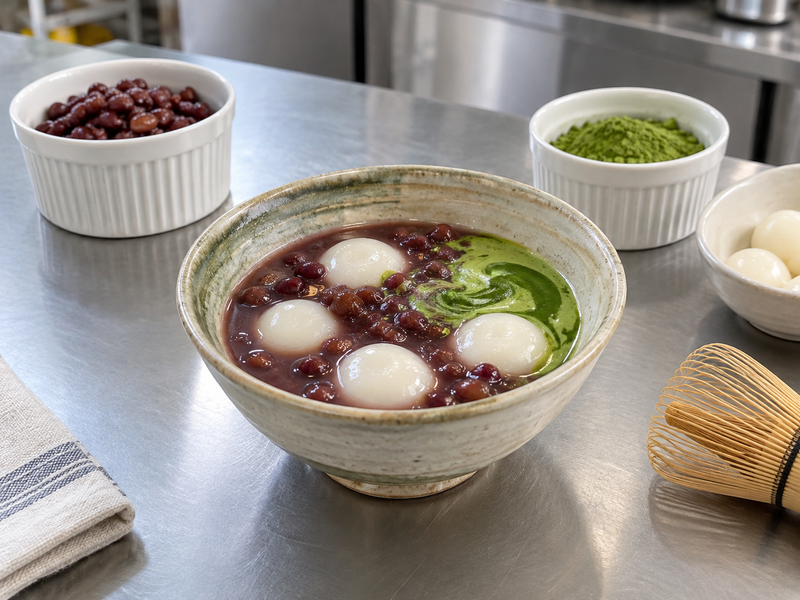
Zenzai is commonly presented as a sweet azuki bean dessert, with chewy rice-based pieces in many versions. A matcha variation may use a matcha liquid, a matcha-flavored dumpling, or a measured matcha finish. There is room for menu design, but a guest should be able to taste the beans and tea separately. Define your house version in the recipe card rather than relying on a name that different kitchens may interpret differently.
Describe texture as well as ingredients. Should the beans retain some shape or become a smooth paste? Is the tea a light broth or a thicker sauce? How many dumplings go in one serving, and are they placed hot or cold? Answering those questions helps purchasing and service teams source the right components. Use a reference bowl: photograph the approved serving from above and at table height. It gives chefs a target for proportion, not merely decoration. A bowl that looks generous in a development kitchen may be impractical when made during a lunch rush.
2. Which menu format fits the outlet?
Decide how much assembly happens at service
A tea café can make a composed bowl to order. A chain may need portioned beans and a fast matcha base. A packaged dessert producer must test the entire assembled product after storage. Each format changes texture and food-safety controls. Begin with the customer moment: a seated dessert served warm, a chilled grab-and-go cup, or a takeout kit the customer assembles. Price and pack it around that moment.
| Format | Suitable channel | Operational question |
|---|---|---|
| Warm made-to-order bowl | Restaurant or tea café | Can staff coordinate components quickly? |
| Chilled assembled cup | Grab-and-go case | Will dumpling texture hold? |
| Two-part dessert kit | Retail or delivery | Can customers assemble it cleanly? |
| Seasonal menu special | Multi-unit café | Can ingredients be shared with other SKUs? |
For a first commercial test, a short seasonal menu may reveal demand without committing to a complex packaged item. Track orders and waste by daypart. If the dessert sells mainly after lunch, prep volumes and staff training should reflect that pattern. A good concept can fail when offered in a format that does not fit the outlet’s service speed.
3. How should a buyer choose matcha for zenzai?
Choose for contrast with sweet beans
Sweet azuki can mute a delicate tea note. Test candidate powders in the actual liquid or garnish recipe at the intended serving temperature. Taste the matcha alone, then with one spoonful of beans and dumpling. A powder that seems assertive in water may be balanced in the dessert; another may leave a rough or dull finish. Evaluate color under the light used in the dining room or display case, not only in a bright lab.
| Sample | Taste question | Visual question |
|---|---|---|
| Matcha liquid alone | Is the tea note clean? | Is dispersion even? |
| With azuki | Does tea remain distinct? | Does bean color muddy the bowl? |
| With dumpling | Does the bite stay balanced? | Are portions recognizable? |
| After service delay | Does flavor drift? | Does sediment collect? |
Ask for a product specification and batch samples if the concept is moving beyond a small test. Price matcha by grams per sold bowl and usable yield. A high-priced powder might make sense for a premium plated dessert but not for a heavily sweetened retail cup. Matcha Village can help shortlist powders for dessert applications when a buyer shares the target recipe, flavor intensity, and cost ceiling.
4. How do azuki beans shape sweetness and texture?
Specify the bean component as carefully as the tea
Azuki may be served as whole sweet beans, a chunky preparation, or a smoother paste. Those forms change the dessert’s sweetness, thickness, and appearance. If purchasing a prepared bean component, request the ingredient list, pack size, storage instructions, and a sample from normal production. Taste it at the temperature and dilution used in the final bowl. A spoonful straight from a jar can seem more intense than it will when matcha liquid is added.
Control portion by weight. Staff who scoop by eye may serve very different amounts of syrup and beans even from the same container. If the bean preparation contains a lot of free syrup, decide whether it enters the bowl or is drained. That single choice can change sweetness enough to require a different matcha dose. For menu consistency, define the bean-to-liquid ratio and visual distribution. The dessert should not alternate between a thick bean pudding and a watery soup from one shift to the next.
5. What role do shiratama or mochi-style pieces play?
Make chew a controlled part of the experience
Shiratama dumplings bring a soft, chewy contrast to beans and matcha. They also add preparation and holding decisions. Define diameter, cooked weight, pieces per bowl, and target texture at service. Test the exact rice-flour product and cooking method your kitchen will use; different recipes and frozen components may behave differently. If the pieces sit in liquid before service, check whether they become too soft or alter the appearance of the matcha component.
| Control | How to check | Guest impact |
|---|---|---|
| Piece size | Weigh and measure a small sample | Consistent bite and portion |
| Cooked texture | Cut and chew at service time | Avoid dense centers |
| Holding method | Trial under approved kitchen procedure | Avoid tough or mushy pieces |
| Count per bowl | Assembly card | Reliable value perception |
For takeout, test texture after the expected travel time. A component that works at the pass may disappoint in a delivery cup. If the operator cannot maintain acceptable dumpling texture, consider a different garnish rather than pretending the issue is cosmetic. That decision changes the identity of the dessert, so describe it honestly on the menu.
6. How can a developer balance tea, beans, and sweetness?
Use a small matrix of complete bowls
Start with one bean component and one serving size. Make three matcha strengths and, if needed, two sweetness levels in the tea component. Taste the complete bowls blind. Record which version lets the tea remain clear without making the beans taste flat. Do not change powder grade, bean product, and garnish at once; the result will be impossible to interpret. Use a measured portion of each component so a panel is comparing formula choices rather than random assembly.
| Trial axis | Keep fixed | What to decide |
|---|---|---|
| Matcha dose | Bean and dumpling portions | Tea intensity |
| Bean sweetness | Matcha dose | Total sweetness |
| Liquid volume | Solid portions | Soup versus composed dessert |
| Serving temperature | Same formula | Best eating experience |
Also taste after a realistic service delay. Matcha can settle in liquid, and hot and cold versions may seem different even with identical ingredient weights. A clean recipe card should state assembly sequence and whether the guest should stir. If visual layering is part of the product, test whether it survives carrying the bowl from kitchen to table.
7. What preparation routine works during service?
Separate safe component holding from final assembly
Write a station map: where beans, prepared matcha, dumplings, bowls, and utensils sit. Use the establishment’s food-safety plan and local requirements to set preparation, storage, and discard limits for each component. The limits may differ. A preportioned dry matcha dose may be convenient while a prepared liquid needs more active control. A hot bean component must also fit the kitchen’s approved holding procedure. Avoid one blanket “make in the morning” rule for everything in the dessert.
Time ten consecutive bowls, including replenishment. If the station must stop to cook dumplings every third order, the menu may need a smaller batch strategy or a different ingredient format. Train staff to weigh or portion beans consistently, mix matcha the same way, and place dumplings without touching food-contact surfaces unnecessarily. Photograph accepted and rejected bowls. A short, testable assembly card beats a descriptive recipe that leaves all quantities to judgment.
8. Can matcha zenzai work as a packaged dessert?
Validate the complete pack, not isolated components
A retail cup or kit can widen distribution, but it raises questions about texture migration, appearance, and shelf life. Matcha liquid may settle; beans can bleed into a green layer; dumplings may change texture. A two-compartment pack may protect separation but add cost and assembly steps. Test what the customer actually opens, including how cleanly the components combine and whether a spoon is needed. Do not assume that a café recipe transfers unchanged into a sealed cup.
| Pack concept | Benefit | Validation focus |
|---|---|---|
| Single assembled cup | Convenient eating | Texture and visual drift |
| Two-part cup | Component separation | Seal integrity and easy mixing |
| Dry kit plus wet component | Flexible storage design | Customer instructions and preparation |
| Frozen dessert pack | Controlled distribution route | Thaw quality of every component |
Have a qualified processor establish the relevant safety and quality validation for the final formulation, pack, and market. Artwork and claims need their own review. For a small café, an in-store bowl may be more sensible than a packaged SKU until demand is proven. The packaging should protect the experience, not merely make the concept look shippable.
9. How should a restaurant price and forecast the dessert?
Cost every component and the work of assembly
Calculate ingredient cost per bowl from actual weights, including matcha, bean syrup, dumplings, garnish, and any ice or milk. Add packaging for takeout and labor for preparation and service. Record waste separately for each component. A large batch of beans may be economical, while unused dumplings or prepared matcha may erase that saving. Try a small menu test over several dayparts before committing to a permanent SKU.
Menu price should reflect the customer proposition, not only food cost. A composed bowl served at a table can justify different labor and presentation from a grab-and-go cup. Compare sales with another dessert that uses the same station and staff. If demand is seasonal, plan how ingredients can be used elsewhere without forcing the same matcha flavor into every menu item. Forecast by accepted servings, not by total footfall. That gives purchasing a realistic weekly quantity and makes supplier discussions more precise.
10. What should a launch pilot prove?
Test the bowl from prep bench to customer
Pilot one clearly defined version before adding flavors. Have different staff prepare it from the recipe card and compare weight, color, texture, temperature, and assembly time. Serve it in the actual bowl or takeout pack. Collect feedback on tea intensity, bean sweetness, dumpling chew, and perceived portion value. Keep those questions separate; “liked it” does not tell a developer what to change. Track discarded ingredients and remakes during the same test.
For a chain or private-label project, document ingredient specifications, lot codes, allergen information, quality checks, and change approvals. Send the finished recipe and intended process to ingredient suppliers when requesting samples. Matcha zenzai can offer a distinct dessert built around matcha rather than merely coloring a familiar sweet. Its success depends on controlled components and a serving method staff can repeat. If your team needs application samples for a bowl or packaged concept, contact Matcha Village with the target serving, ingredient matrix, and planned volume.
FAQ
Q1. What is the difference between matcha zenzai and a matcha latte?
Zenzai centers on sweet azuki beans and a dessert texture, often with chewy rice-based pieces. A latte is a beverage.
Q2. Must matcha zenzai be served hot?
No. Hot and chilled versions are possible. Test the complete recipe at the intended temperature.
Q3. Can prepared beans be used in a commercial recipe?
Yes. Specify their sweetness, texture, pack, storage instructions, and portion weight.
Q4. Why did the dumplings change texture in takeout?
Time, temperature, and contact with liquid can affect texture. Test the actual delivery period and approved holding method.
Q5. What should a buyer include in a matcha sample brief?
Share the bean component, matcha application, serving temperature, target flavor, dose range, and cost target.