
Single origin matcha can give a brand a specific sourcing story, but “origin” may mean a country, region, garden, or one production lot. A buyer cannot compare quotes or approve packaging until that scope is clear. This guide shows how to turn the phrase into a traceable specification, test it against blends, and plan for year-to-year supply. We write from a supplier’s B2B perspective: a useful origin claim must survive a document check and a repeatable cup test.
1. What does single origin matcha mean?
In trade conversation, single origin matcha usually means matcha tied to one stated geographic source rather than intentionally assembled from multiple sources. The phrase alone does not say how narrow that source is. A supplier may mean one country, one tea-growing district, one garden, or one producer’s selected lots. It also does not necessarily mean one cultivar, one harvest date, one grade, or one milling batch. Ask the supplier to define the claim in writing for the exact product being quoted.
That definition should include the tea material and finished-powder process. Where were leaves grown? Where were they processed into the material later milled? Where was milling performed? Those answers can differ. A matcha from a named growing area might be milled elsewhere without losing the truth of its growing-origin claim, provided the label says precisely what it means. A clear internal definition protects purchasing, marketing, and sales teams from telling three versions of the same story.
2. How narrow should a single origin matcha specification be?
Choose the narrowest scope you can verify and maintain at the required volume. A single garden can offer a focused story and a distinctive sensory profile, but supply may vary more by season and crop yield. A regional source may allow multiple growers under a defined boundary while keeping a credible place-of-growth claim. A country-level claim is broad and may be easier to supply, though it gives the buyer less information about a specific lot. None of these scopes is automatically better for every application.
Write the scope in terms a supplier can document. “Tea leaves grown in the named region” is clearer than “inspired by an ancient village.” If a product uses leaves from several gardens within one region, disclose that internally even if marketing uses a regional origin. Decide whether harvest years can be blended and whether that still fits the brand story. A retailer launching a premium tin may choose a narrower scope; a beverage chain seeking a stable base flavor may prefer a well-managed regional supply.
| Scope | What to verify | Commercial trade-off |
|---|---|---|
| One garden or estate | Garden identity and lot flow | Specific story, constrained volume |
| One district or region | Boundary and grower controls | Broader volume, still place-specific |
| One country | Country of leaf growth | Supply flexibility, broad claim |
| One production lot | Lot definition and records | Precise release, limited repeatability |
3. Which records support a single origin matcha claim?
Ask for a traceability map from incoming tea leaves to finished matcha lot. For a broader model of record keeping, see the Japanese agriculture ministry’s food traceability guidance. It need not reveal every commercial secret, but it should identify the claimed growing area, receiving lot, processing steps, milling lot, and pack lot. Review how the supplier prevents commingling with material from outside the claimed scope. A sample bag marked with a region is not enough on its own; the production record must connect that bag to the source statement.
Request the current specification, lot-specific certificate of analysis, and any documents required by your import market. If organic or other certification is part of the sales claim, check that the certificate applies to the exact product and transaction; origin and certification are separate questions. Keep a retain sample linked to the quoted lot. If the supplier later substitutes a lot, ask for a traceability and sensory comparison before approval. This process is especially useful for private-label brands, where an unsupported origin statement can spread across packaging, marketplace listings, and distributor catalogs.
4. How should the buyer evaluate its sensory profile?
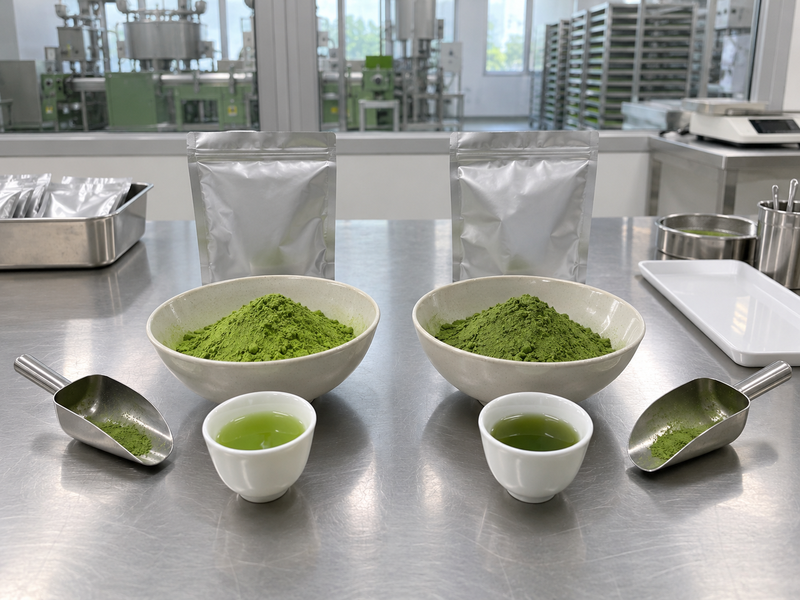
Origin can influence flavor, but the cup also reflects cultivar, shading, harvest, processing, milling, storage, and age. Blind taste the proposed single origin beside your current matcha at the same dose, water temperature, and preparation method. Record color, aroma, perceived sweetness, bitterness, umami, texture, and finish. Then repeat in the finished application. A subtle difference that stands out in water may disappear in a sweet latte or bakery filling.
Give the panel a concrete brief. For a straight matcha tin, a long clean finish and low astringency may matter. For an iced oat latte, green color and a tea note that survives milk may carry more value. Do not let the place name determine the score. A buyer should also taste at least two lots or harvests where possible, because a single appealing sample does not tell the whole supply story. Preserve a reference sample and written sensory range, not just a memory of the first cup.
| Stage | Keep constant | Judge |
|---|---|---|
| Water tasting | Dose, water, temperature, whisking | Tea character and texture |
| Final application | Milk, sugar, recipe, serving time | Fit and flavor visibility |
| Lot comparison | Same preparation on one day | Range of variation |
| Storage check | Pack and opening age | Color and aroma retention |
5. When might a blend be the better choice?
A blend can combine tea lots to meet a stable color, flavor, and price target across seasons. That is a valid product design, especially for a chain or manufacturer that needs the same drink in many locations. Single origin may offer clearer provenance and a distinct taste, but a narrower supply can make it harder to hit a fixed sensory target at high volume. Compare the two against the business need rather than treating one label as a universal quality ranking.
Run both candidates through the same application trial and cost model. In a sweet bottled latte, customers may value consistent tea strength more than a detailed estate story they never see. In a premium plain matcha tin, provenance and lot variation may be part of the appeal. Some brands carry a single origin product for retail and a controlled blend for foodservice. Keep their names, inventory, and claims separate. A supplier should explain the intended role of each sample instead of calling every green powder “ceremonial” or assuming a single source always commands a better cup.
6. What quality checks still matter beyond origin?
Origin does not replace food safety, identity, or performance testing. Request the testing and documentation required for your market and use, such as relevant contaminant and microbiological results, along with the supplier’s lot release criteria. The exact limits should be set by your quality and regulatory teams. Check particle behavior in the intended recipe, packaging barrier, and storage guidance. A well-traced powder can still be the wrong grade for a high-sugar bakery product or a fast café build.
Review the sample against the product description. A green color claim should be tested under consistent light. A fine-grind claim should be judged by mouthfeel and dispersion, not only by a number on a sales sheet. If you request organic material, verify certificate scope and chain-of-custody requirements separately. Matcha Village describes traceability and application selection as part of its supplier offer; buyers should ask for the documents specific to the selected lot rather than relying on a general company profile.
| Question | Evidence | Buyer owner |
|---|---|---|
| Is the lot safe for the market? | Applicable test and compliance records | Quality / regulatory |
| Does it work in the recipe? | Application trial | R&D |
| Will color and taste repeat? | Reference and lot range | Quality / sensory |
| Will the pack protect it? | Packaging and storage review | Operations |
7. How can a brand plan around harvest variation?
Ask when the source is harvested, when lots are milled, and how stock is allocated. A narrow origin with finite output needs a volume plan: forecast, reservation window, safety stock, and an agreed process if a lot sells out. Do not assume that the exact shade or sensory profile of one harvest can be repeated indefinitely. Define acceptable variation for the brand and a decision process when the next lot falls outside it.
For a café chain, run a transition tasting before the old lot is exhausted. If the new lot is acceptable but slightly stronger, a controlled recipe adjustment may be possible; document it and train stores. For packaged retail, changing the formula or origin claim may require a label review and inventory planning. Ask the supplier for lead times by pack size and destination, not a generic shipping promise. A good supply plan lets buyers keep the story honest while avoiding a surprise gap on the shelf.
8. How should a procurement team compare prices?
Compare accepted matcha at the dose required in the finished product. A more expensive single origin may need fewer grams for the same tea impact in a latte; a less expensive powder may win in a bakery application where color is the main target. Include testing, documentation, packaging, freight, and the risk of unavailable replacement lots. Price per kilogram matters, but it is not the only cost line in a branded launch.
Ask for quote validity and the volume tier that matches your forecast, not an unrealistic annual commitment. Clarify whether different harvest lots can be pooled against the same price and specification. If a claim requires one garden or season, the supplier may need to reserve inventory. That commitment should appear in commercial terms and purchasing records. Keep a plain comparison table so marketing enthusiasm about a place name does not hide a weak sensory result or an unworkable minimum order.
| Line | Single origin option | Blend option |
|---|---|---|
| Tested dose | Grams per finished unit | Grams per finished unit |
| Supply scope | Defined place and lots | Approved component range |
| Change control | New harvest approval | Blend adjustment approval |
| Cost | Ingredient plus reservation | Ingredient plus consistency work |
9. How should marketing describe single origin matcha accurately?
Use words that match records. “Tea leaves grown in [named region]” makes a specific statement that can be checked. “Produced in [country]” may refer to processing or packing, so the brand should know what the phrase means. Avoid imagery or cultural cues that imply a different country from the documented leaf source. The country of origin required on an import label can also follow rules distinct from a voluntary marketing story; ask qualified advisers to review both for the destination market.
Do not infer organic status, superior health effects, or ceremonial suitability from a single-origin claim. Those are separate questions with separate evidence. If several gardens within one region supply the product, avoid saying “one estate.” Keep the approved copy connected to the current specification and lot plan. A story can still be appealing when it is exact: named growing area, processing approach, flavor notes from an actual tasting, and the use the powder suits best. Precision gives a distributor something concrete to explain to its customers.
10. What makes a single origin matcha purchase ready?
Approve the purchase when the origin definition, traceability evidence, sensory range, application result, and supply plan agree. Document the exact sample lot and the product that will ship. A source claim without lot records is not ready for packaging; a traceable lot that fails the intended recipe is not ready for the menu. Have purchasing, quality, and marketing sign off on the same description before a large order or a print run.
Set a reapproval trigger for a new growing area, processing site, major grade change, or new harvest outside the accepted range. Store a retain sample and record the test method so future lots can be evaluated fairly. If a blend is selected instead, describe it honestly and focus on the consistency it gives the application. Single origin matcha is valuable when its specified source translates into an approved product that the business can keep supplying.
| Gate | Retained evidence | Trigger to revisit |
|---|---|---|
| Origin | Written scope and lot trail | Source changes |
| Cup | Reference sample and tasting notes | New harvest or sensory drift |
| Application | Approved recipe trial | Formula or base changes |
| Supply | Forecast, quote, allocation terms | Volume or lead-time change |
Frequently asked questions
Q1: Does single origin mean one farm?
Not necessarily. Ask whether the supplier means one garden, region, country, or production lot.
Q2: Is single origin automatically higher quality than a blend?
No. Judge each product against its intended application, specification, and sensory target.
Q3: Can one origin contain several cultivars?
Yes, depending on the supplier’s definition. Ask for the composition detail you need.
Q4: Does origin prove organic status?
No. Organic certification requires separate, product-specific documentation.
Q5: What should change with a new harvest?
Review traceability and compare the new lot with the approved sensory and application reference.
Share your origin scope, application, and expected volume with Matcha Village to request a documented matcha sample. A precise brief makes the single origin matcha claim testable before it reaches a label.