
Shizuoka matcha wholesale can be difficult to compare because a prefecture name tells a buyer very little about one delivered lot. A café or brand needs to know which tea was milled, where it was grown and processed, how it tastes in the intended product, and how much repeat stock can be supplied. Use a lot-specific trial and a written origin definition before paying for a region claim. Shizuoka’s own tea information identifies both tencha and matcha among teas produced in the prefecture; that supports the region’s presence in this market, but it does not verify a seller’s individual pack.
The search results also include Best Japanese Matcha Supplier for Small Business (2026), a buyer’s article about matching source, minimum order and use. This guide narrows that decision to Shizuoka. It does not rank producers or assume that a named origin is better for every recipe. The useful question is whether a particular Shizuoka lot works for your business and whether a supplier can repeat that result.
1. What does a Shizuoka matcha origin claim actually cover?
Separate where the leaf grew from where the powder was packed
Ask for a map in words. “From Shizuoka” might refer to a farm, a processor, a milling site or a merchant’s address. Those are different claims. Request the prefecture and, where available, the producer or cooperative for the tencha leaf. Ask where tencha was processed, where it was milled, and whether the offered product is a single-region lot or a blend. The invoice address cannot settle origin by itself.
For a single-origin retail tin, the answer needs enough support for the label you intend to print. Decide which level you require before sampling. A blend that uses Shizuoka tea may taste more stable than a single small lot, but it should not be described as a single-origin product without evidence. Keep the supplier’s origin statement with the specification and lot number.
| Claim on offer | Ask the supplier | Buyer use |
|---|---|---|
| Shizuoka-grown leaf | Producer or region and lot trail | Specific origin claim |
| Shizuoka-processed tea | Where leaf was grown | Processing statement only |
| Shizuoka-packed powder | Source of all ingredients | Pack location, not leaf origin |
| Regional blend | Composition and change policy | Qualified blend wording |
2. Is the offered powder made from tencha rather than ground sencha?
Confirm the leaf and process behind the product name
Tea type comes before grade. The Japan Tea Central Association’s English tea pamphlet describes tencha as the base for matcha and explains its shaded cultivation and fine milling. A supplier should be able to identify its tea material and processing route, even if it keeps some production details confidential. Ask a direct question: is this lot milled from tencha, and does the specification say so?
Do not rely on “ceremonial” or “premium” alone. Ask for the product code, ingredient line, and milling or particle description relevant to your use. Check the sample in water before hiding it in milk; strong astringency or coarse texture can reveal a mismatch with an unsweetened tea offer. A bakery may deliberately choose a different balance from a tea shop. The point is honest naming and a powder fit for the stated use. If the buyer’s own label will say matcha, its regulatory and quality team should approve that wording for the destination market.
3. How can a buyer trace a Shizuoka production lot?
Connect sample, certificate and shipped pouch
Follow one code across four items. The sample pouch, product specification, certificate of analysis and commercial carton should identify the same product and a traceable lot or batch. Ask how a supplier links incoming tencha to finished powder when material is blended or milled on different dates. A single photograph of a farm proves very little about the powder in your hands. A buyer does not need every private field record, but it needs a credible chain that can support a quality investigation and any origin statement used in selling.
Test the record with an ordinary question: if a customer reports an off-flavour cup next month, which other cartons share this lot? Ask who can answer and how quickly. Keep a sealed reference sample under the supplier’s storage guidance. When shipments arrive, record lot numbers by warehouse location and sales channel. A distributor serving multiple cafés may need to identify which sites received each carton.
| Record | Must match | Use later |
|---|---|---|
| Trial sample | Product code and lot | Sensory reference |
| Specification | Composition and pack | Purchase approval |
| Lot certificate | Batch on shipment | Quality review |
| Receiving log | Cartons and locations | Hold or recall scope |
4. What do harvest and cultivar details tell a wholesale buyer?
Use them to explain variation, not to guarantee flavour
Ask what changed. Harvest timing, cultivar, shading, processing and blending can influence aroma, colour and taste. Request a production period and the supplier’s description of how it maintains a target profile across seasons. If the product is blended for consistency, ask which parameters are held steady and what substitutions require approval. If it is a small single-producer lot, ask what happens when that lot sells out.
That breadth is a reason to ask for lot details rather than to assume a uniform regional taste. Compare samples blind at the same dose, and note differences in sweetness, bitterness, aroma and colour after preparation. For a product sold with a named-farm story, procurement and marketing need the same documents. For a café house blend, a stable flavour target may matter more than a single cultivar. Define the tradeoff before paying a premium.
5. How should Shizuoka matcha wholesale samples be compared?
Test the application at a costed dose
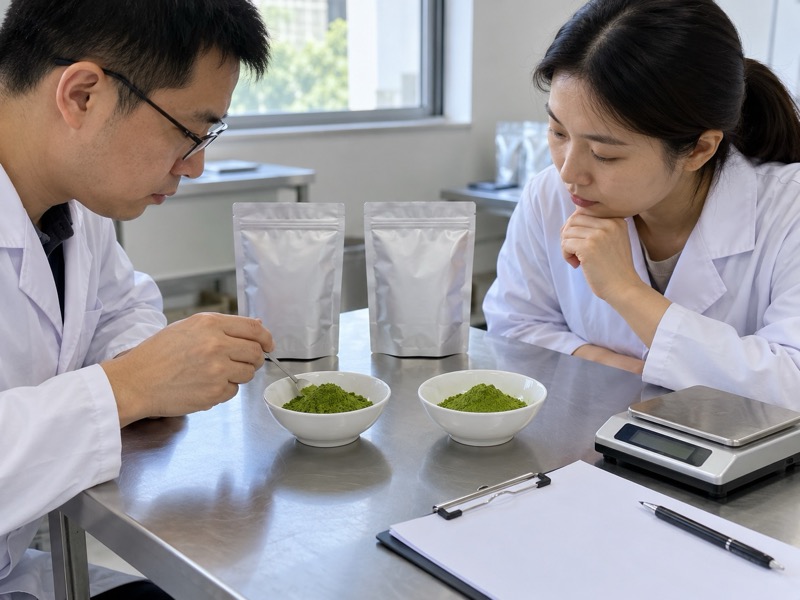
Use the same cup twice. Blind-code candidate samples and make a plain-water preparation, then the actual café drink or food product. Weigh powder and water rather than relying on scoops. Use the brand’s milk, sweetener, ice and glass. A powder that tastes smooth in water can become faint under dairy; another that is too sharp in water may carry a sweet latte. Taste immediately and after the usual service delay. Check residue at the bottom, clumping during preparation and any colour change after the drink is stirred.
Have at least two staff members prepare each sample. Record an accepted dose, the time taken and the finished cost. Keep a sealed sample of the winner and send the accepted recipe to the supplier with the purchase order. The site’s café matcha selection guide discusses broader use cases; this trial should be specific to the Shizuoka lot you might buy. If a supplier cannot supply a normal production sample, treat the decision as provisional rather than assuming the display sample represents commercial stock.
| Test | Hold constant | Record |
|---|---|---|
| Water cup | Grams and temperature | Aroma, texture, finish |
| Menu drink | Milk, syrup, ice | Tea presence and colour |
| Service build | Tools and station | Time and remakes |
| Delayed tasting | Wait interval | Residue and flavour shift |
6. Which specification fits a café, retailer or food maker?
Write down the use before choosing a lot
There is no universal grade. An unsweetened tea bar needs a pleasing cup in water. A café chain needs the powder to remain present through milk and to disperse at the bar. A retailer needs a consistent label, small-pack shelf life and a product story it can substantiate. A bakery may care most about flavour after baking and the cost of the approved dose. Give suppliers an application brief with the intended recipe, annual range, pack size and any documented testing or certification requirements. Ask for a product code rather than a generic “Shizuoka matcha” quotation.
A café can approve a milk recipe and a preparation time. A retailer can approve a water tasting, pouch and label. A food maker may run a small production trial, not just a bench sample. Keep ingredients and allergens explicit if a supplier offers a premixed powder alongside pure tea. Confirm that any claimed certification covers the specific product and supply chain. A specification that tries to satisfy every customer at once often omits the criterion that matters most to yours. Narrow the brief, then compare offers that meet it.
7. Can a small business secure enough Shizuoka stock?
Separate available inventory from a future promise
Ask for the next carton. A seller may have enough of one lot for a trial yet no committed supply for a café’s next three months. Request current available kilograms, minimum order, normal reorder lead time and whether future lots will keep the same product code. Ask whether the stock is held by the producer, an exporter or a local distributor. Those routes have different replenishment times and responsibilities. A small business should also check whether a supplier will split a larger reservation into deliveries, which can reduce opened-stock age without losing a place in the production plan.
Put volume estimates in a range. Calculate powder usage from menu sales and approved grams per cup, then add a realistic allowance for training and remakes. Ask what the supplier will do if the named lot ends before a scheduled reorder. A backup lot may be acceptable, but it needs a fresh sample and a clear approval step. Do not print a permanent single-lot story on packaging if the commercial plan depends on substitutions. For a limited release, a small named lot can be an advantage. For a permanent menu item, consistent access and advance notice may matter more than a narrow origin narrative.
| Supply question | Evidence | Buyer decision |
|---|---|---|
| Current stock | Kilograms and lot | Trial and launch size |
| Reorder timing | Production plus delivery | Buffer stock |
| Future profile | Change-control plan | Menu or label promise |
| Reservation | Written quantity and dates | Cash and storage plan |
8. How should buyers judge a Shizuoka quote?
Compare accepted servings and delivered terms
Price the product you tested. Ask each supplier to quote the exact sampled code, pack and lot status. Set the same destination, quantity, currency and delivery term for comparison. Add freight, import costs where applicable, inland delivery and likely loss from opened packs. Then calculate powder cost at the accepted dose. A lower kilogram price can be more expensive if the tea needs a heavier dose or causes more remakes. A small pack premium can pay for itself when weekly turnover is low. Keep that arithmetic visible rather than treating price per kilogram as the whole decision.
Do not pay for the Shizuoka name unless the claim adds value to your channel and the supporting trace is sound. A retailer may earn that value through a verified origin story and a good water cup. A busy café might benefit more from a reliable house blend. Ask what changes at a larger volume and whether the quoted price is tied to one harvest lot. Review any supplier estimate against your own accepted cup, not against an untested sample. The most useful quotation shows exactly what will arrive and how the buyer can approve it.
9. How can a buyer control the next Shizuoka matcha lot?
Agree on a change notice before the first order
Plan for variation. Even when a supplier retains the same product name, a new harvest, grower or blend can change the cup. Put the accepted specification and reference sample into the purchase record. Ask for written notice before changes to tencha source, formula, milling process or primary packaging. Set a simple approval route: supplier sends an identified production sample, buyer repeats the accepted recipe, then the purchase order names the approved version. Without that step, a new lot may reach stores before anyone notices the flavour shift.
On delivery, inspect cartons and seals, match codes to the invoice and certificate, and make one controlled cup before releasing stock across sites. Do not silently mix suspect stock into the prior batch. Track customer feedback by lot after release so purchasing can separate recipe problems from supply changes. The supplier change guide covers the general process; for this purchase, the specific origin claim and accepted sensory profile belong in the change notice. A stable relationship is measured by how a supplier handles the second shipment.
| Change | Ask for | Buyer action |
|---|---|---|
| New harvest | Identified sample | Repeat cup test |
| Different tencha source | Origin statement | Review label claim |
| Blend adjustment | Revised specification | Approve or reject profile |
| Pack change | New material details | Check handling and artwork |
10. How should a brand present Shizuoka origin to customers?
Make the claim no wider than the evidence
Write what the records prove. If the leaf was grown and processed in Shizuoka and the lot trail supports that, a brand can consider a specific origin statement after its local label review. If only the company or packing plant is in Shizuoka, describe that role accurately instead. If the recipe uses a regional blend, say so rather than implying a single farm. The Japan Tea Central Association publishes information on Japanese tea naming and geographical indication; businesses using protected wording or marks should check the current rules before artwork is approved.
Connect the claim to an actual customer benefit. A tea shop can tell guests why it selected this lot in a water tasting. A café can say the powder was chosen for its balance in an iced drink, without promising every harvest will taste identical. A wholesale buyer can put the lot code on receiving records even if no consumer-facing origin claim is made. Keep marketing, procurement and quality teams on one approved statement. When a later lot changes source, update the wording before old labels or menu cards cause confusion. Origin is useful when it remains true after the reorder.
Frequently asked questions
Q1: Is all matcha sold by a Shizuoka company grown there?
No. Check the tencha leaf origin for the specific lot. A supplier’s office or packing address alone does not establish where tea was grown.
Q2: Is powdered sencha the same as matcha?
Do not assume so. Ask whether the product is milled from tencha and confirm that the description suits the intended market and label.
Q3: Should a café choose a single producer or a blend?
A single producer can support a focused story; a controlled blend may support steady supply. Test the actual cup and define acceptable changes.
Q4: What is the most useful sample test?
Use a blind-coded water cup and the finished menu product at measured doses, then repeat after a service-style preparation.
Q5: What happens when the original lot sells out?
Ask for notice and a replacement production sample. Reapprove flavour, documents and any origin claim before selling the next lot as the same product.