
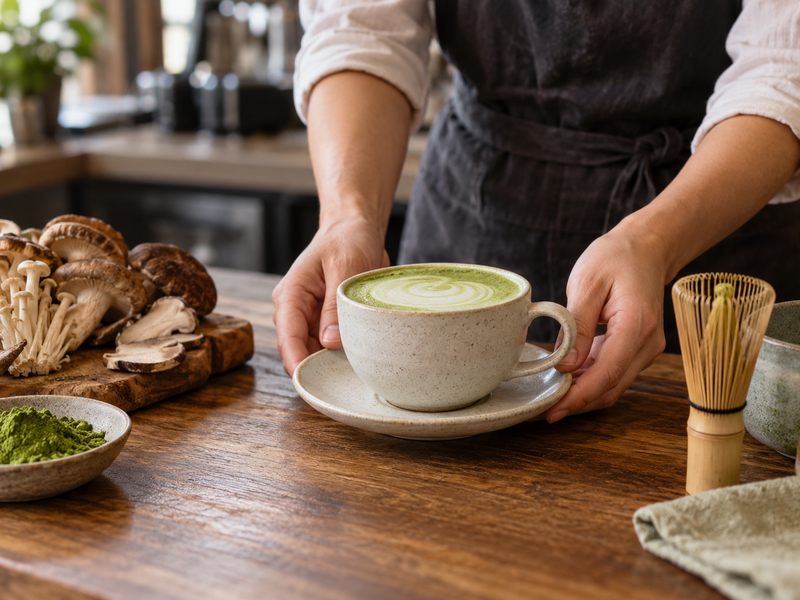
A mushroom matcha blend can be easy to name and hard to specify. “Mushroom extract” leaves buyers asking which species, which part, how it was prepared, how much is in a serving and whether the tea is still recognizable. A café needs a drink that tastes good and can be made the same way on every shift; a private-label brand also needs an ingredient file and reviewed claims. AURI’s mushroom matcha article shows the consumer-facing category. This guide approaches it as a formulation and sourcing project, without assuming that adding a mushroom powder produces a health effect.
Contents
- 1. What belongs in a mushroom matcha product brief?
- 2. How should the tea base be selected?
- 3. What must be known about the mushroom ingredient?
- 4. How should a first formulation trial be designed?
- 5. Which sensory problems appear in the cup?
- 6. How can powder handling be tested?
- 7. What changes between café and retail formats?
- 8. Which safety and supplier records are needed?
- 9. How should the label and claims be reviewed?
- 10. What should a launch pilot measure?
1. What belongs in a mushroom matcha product brief?
Name the format and buyer first
Decide whether the product is a café drink base, an unsweetened powder, a sweetened latte mix or a ready-to-drink beverage. Each format changes the serving size, mixing method, packaging and labeling work. State the intended selling market and whether customers will prepare it with water, dairy milk or a plant drink. A “wellness matcha” mood board does not tell a formulator how many grams go into a cup or what taste the buyer wants.
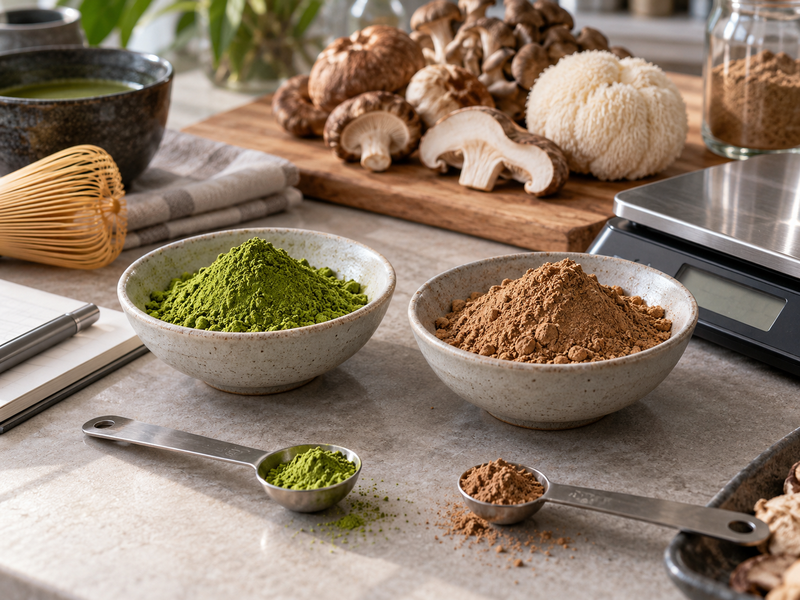
Write a short brief with target tea flavor, acceptable mushroom note, color, sweetness, texture and cost per serving. Keep any proposed claims in a separate review column until regulatory staff approve them. List what is fixed, such as a chosen mushroom species or no added sugar, and what can change during trials. Define the control product: plain matcha prepared the same way. This allows tasters to judge what the mushroom ingredient contributes or obscures. The site’s matcha blend product information may help a buyer describe the base format, but the final product needs its own exact formula and records.
| Brief field | Decision to record | Why it matters |
|---|---|---|
| Format | Café base, retail powder or RTD | Drives process and label |
| Serving | Grams of blend and liquid | Controls dose and cost |
| Tea profile | Visible green, aroma and bitterness | Sets matcha selection |
| Mushroom note | Desired intensity and aftertaste | Sets ingredient trial |
| Market | Country and channel | Determines review path |
2. How should the tea base be selected?
Test matcha in the final drink
Select tea by finished-product performance rather than grade name alone. A delicate powder that tastes clear in water may disappear under oat milk, sweetener and mushroom extract. Conversely, a strong culinary powder may dominate an unsweetened drink. Prepare two or three matcha candidates at the same measured dose, using the proposed serving method. Compare aroma, green color, astringency, sediment and cost. Keep the tea lot fixed while testing the mushroom ingredient so changes are interpretable.
Ask suppliers for product identity, lot documentation and a sample large enough for repeated trials. A public description of Uji matcha from Japan’s MAFF explains the tencha-to-powder route, but it does not predict how a particular tea will taste in this blend. If the product will be sold as matcha, make sure the tea ingredient and any naming claim are accurate for the relevant market. Record the proportion of matcha in the final dry formula. A green label image cannot compensate for a product that contains too little tea to satisfy the brand’s promised flavor.
3. What must be known about the mushroom ingredient?
Ask for identity beyond a common name
Request the scientific name, common name, part used, cultivation source, whether the material is whole powder or extract, extraction solvent or process where relevant, carrier ingredients, concentration basis and lot-specific documents. “Lion’s mane extract” from one supplier may differ greatly from another product sold under the same common name. A fruiting-body powder, mycelium preparation and concentrated extract are different materials for both formulation and label review. Do not assume their serving amounts are interchangeable.
The supplier should explain identity testing, contamination controls, intended food use and available safety evidence for the exact material. FDA guidance on mushroom identification notes that reliable identification requires expertise when toxic or nonedible species may be involved. The category also includes materials with different legal status: the FDA specifically warns that Amanita muscaria and certain constituents are not authorized as ingredients in conventional U.S. food. Check the chosen ingredient and destination market with a qualified specialist before trials become a purchase order. Avoid substituting a cheaper mushroom material without repeating that review.
| Supplier question | Evidence to obtain | Red flag |
|---|---|---|
| Which organism? | Scientific name and identity method | “Mushroom blend” only |
| Which material? | Part, powder or extract | Unclear mycelium versus fruiting body |
| What else is present? | Carrier and processing-aid details | Undeclared additions |
| What is the use? | Intended food application and market | Generic “safe for all foods” claim |
4. How should a first formulation trial be designed?
Change one variable at a time
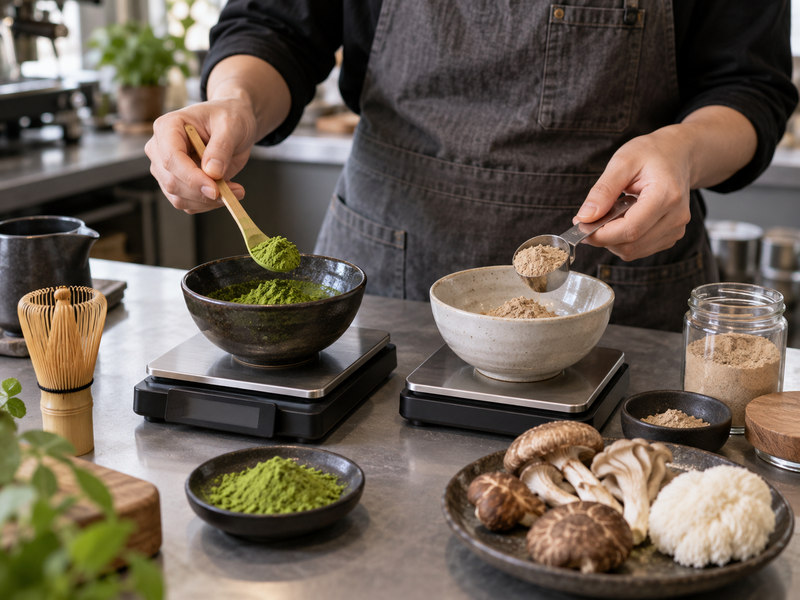
Begin with a plain-matcha control and a small matrix of mushroom inclusion levels. Keep liquid, serving volume, sweetener, mixing time and temperature constant. Choose trial levels from the ingredient supplier’s documented intended use and regulatory review, not a number copied from a competing label. Weigh every ingredient. Record actual grams per serving and proportion in the dry blend, then code the samples so tasters do not know which has the highest mushroom dose.
Evaluate immediately after mixing and again at a realistic drinking interval. Matcha and mushroom particles may settle differently, and a note that seems mild in a hot cup may intensify as it cools. If sweetener is part of the product, run a separate sweetness trial after deciding a workable mushroom level. Otherwise extra sugar can hide an ingredient problem and distort cost. For each sample, record matcha clarity, mushroom note, bitterness, mouthfeel, color and visible sediment. Repeat the best formula with a second ingredient lot if the product will be scaled. The numerical test grid is an internal experiment, not evidence of a health effect or a universal recipe.
5. Which sensory problems appear in the cup?
Taste the whole serving, not the powder
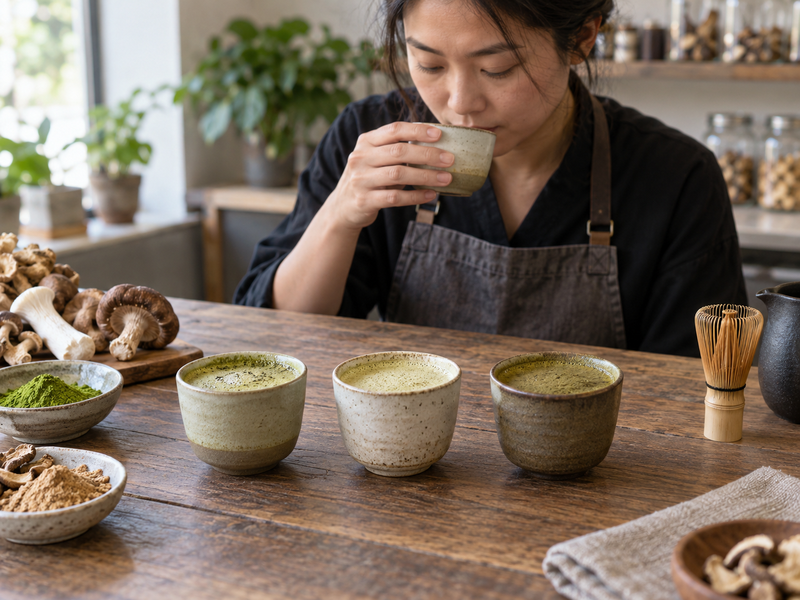
Mushroom preparations can bring earthy, woody or bitter notes, depending on species and processing. Matcha itself can be astringent, so the combination may produce a harsher finish than either ingredient alone. A powder may also darken or dull the drink’s green color. Use a descriptive panel rather than a simple “liked it” vote. Ask tasters to note the first aroma, mid-palate tea flavor and aftertaste. Compare the blend with plain matcha at the same serving temperature.
If a trial fails, identify the cause before increasing sweetener. Test a different mushroom material or lower inclusion, a tea with a different flavor profile, or a preparation method that disperses the powder better. For a café, the best formula may be one that needs no special syrup beyond the menu’s standard options. For retail, the blend must still taste acceptable when prepared according to the instructions on the pack, not only by a skilled developer. Keep the accepted sample and preparation record. Without them, “less earthy next time” is too subjective to guide a supplier or another production shift.
| Sensory issue | Possible cause to test | Controlled comparison |
|---|---|---|
| Tea disappears | Mushroom or milk dominates | Same tea dose, lower inclusion |
| Bitter finish | Ingredient choice or dose | Alternative mushroom lot |
| Dull green | Powder color or formulation | Plain-tea control in same liquid |
| Grit | Particle size or mixing | Sift and method comparison |
6. How can powder handling be tested?
Observe mixing and storage together
Two fine powders may segregate when blended, transported or scooped. Check whether a small dry mix looks uniform at the top, middle and bottom of a container after ordinary handling. A visual check is only a first screen; choose an appropriate analytical or process marker if uniformity is a release requirement. Observe dust during pouring and whether the blend cakes after exposure to the normal service environment. Do not add a flow agent merely because one bench jar clumps; investigate humidity, pack closure and ingredient properties.
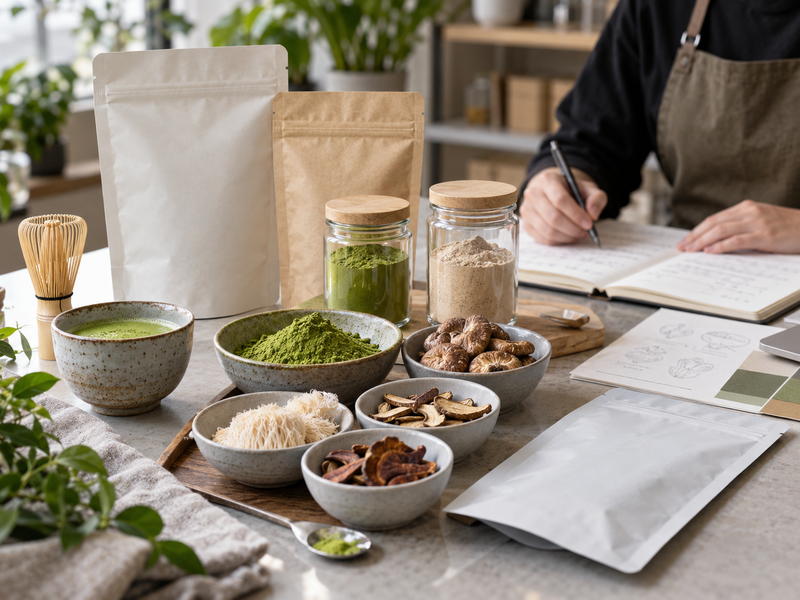
Test the customer preparation: whisking, shaking or machine mixing with the intended liquid. Note lumps, foam, sediment and cleanup time. A café staff member should prepare several cups from the written recipe while a developer observes. If each cup needs a different stirring sequence to look acceptable, the method is not ready for a multi-site launch. For a premix line, record mixer load, time, discharge and pack weight. Validate the selected packaging and shelf period with product-specific testing; neither matcha nor mushroom extract has a universal “fresh for twelve months” rule. The site’s matcha powder packaging guide offers format choices, but the blend’s own stability must govern the final choice.
7. What changes between café and retail formats?
Design for the actual operator
A café can keep tea and mushroom components separate and adjust a drink to order, but this increases measuring and training tasks. A premixed café powder reduces steps if it stays uniform and matches the recipe. A retail sachet needs clear consumer instructions, controlled serving mass and a label that identifies its ingredients. A ready-to-drink format adds processing, stability, packaging and distribution requirements beyond a dry blend. Treat each format as a separate qualification, even if the flavor target is similar.
Run a cost model by saleable serving. Include ingredient loss, packaging, labor, rejected sachets and minimum order size. A premium extract may be affordable in a limited café menu but difficult in a low-price retail pack. Also test the preparation with real equipment. An espresso bar’s hot-water tap, a home whisk and an RTD filling line will not create the same cup. Record the exact recipe and training method for each channel. If a brand later converts a café favorite to a sachet, it should repeat sensory, uniformity and label review rather than assuming the original success transfers automatically.
| Format | Main operating question | Key record |
|---|---|---|
| Made-to-order café | Can staff dose consistently? | Recipe and training test |
| Café premix | Does blend stay uniform? | Mixing and service trial |
| Retail sachet | Can consumers reproduce it? | Fill and preparation test |
| Ready-to-drink | Is process and shelf life validated? | Product-specific safety plan |
8. Which safety and supplier records are needed?
Keep files for both ingredients
Approve matcha and mushroom suppliers separately, then review the combined product. Request specifications, lot traceability, certificates of analysis where appropriate, allergen declarations, microbiological and contaminant controls, and documentation relevant to the intended market. For the mushroom material, include identity and extraction details. For the finished blend, assess whether shared equipment introduces allergens from milk, soy, nuts or other products. A “clean label” design still needs a real hazard assessment and process controls.
The FDA’s preventive-controls overview explains risk-based supplier controls for hazards that need control in the supply chain. The exact legal duties depend on the facility and jurisdiction. A supplier COA can support a decision but is not a blanket assurance for every possible hazard. Link each incoming lot to the blend batch and finished packs. If a later identity or contaminant concern arises, the brand should be able to find the affected units without relying on staff memory. Keep the review proportionate but complete enough to explain why the ingredient was accepted.
9. How should the label and claims be reviewed?
Separate ingredient facts from benefit promises
List ingredients accurately for the product and market, including carriers or sweeteners in an extract or premix. State serving instructions that match the tested formula. Review the common and scientific mushroom names and ensure “extract” is used accurately. If the pack emphasizes a species or amount, verify that the ingredient records and formula support that statement. A label should not imply a quantity of mushroom that the serving does not contain.
Health and performance claims need a separate evidence and legal review. The FDA describes categories of food and supplement claims; the rules differ by product type and market. Do not copy claims about focus, immunity or stress from a consumer blog and place them on a conventional food pack. Do not suggest that tea plus mushroom produces a proven combined effect without product-specific evidence. The FDA’s mushroom mycelium labeling policy also shows why naming and ingredient form deserve care. Send final artwork, web copy and retailer descriptions through the same review so the pack and product page do not contradict each other.
| Proposed statement | Evidence question | Review owner |
|---|---|---|
| Species name | Is identity documented? | Quality and regulatory |
| Extract amount | Is dose per serving verified? | Formulation and quality |
| “No added sugar” | Does full formula support it? | Regulatory |
| Health benefit | Is claim permitted and substantiated? | Legal and regulatory |
10. What should a launch pilot measure?
Run the smallest meaningful commercial test
Choose a limited pilot that uses the intended ingredient lots, pack, equipment and sales channel. For a café, train staff on a written recipe and observe service across normal busy periods. Measure preparation time, re-makes, dose variation where feasible, customer feedback about taste and the amount of powder discarded. For retail, check fill weights, seal integrity, preparation comprehension and stability at planned checkpoints. Use defined feedback questions rather than asking whether people “like wellness products.”
Set go/no-go conditions before the pilot begins. A blend might pass flavor but fail uniformity; the team should know whether that means reformulation, packaging change or a stopped launch. Track ingredient and finished-product lots so results can be tied to the actual material. Ask procurement for a second-lot plan before declaring the formula scalable. Keep marketing copy within the evidence already reviewed. The next action should be a specific decision: approve the formula, repeat a trial with changed powder, or drop the concept. A small, well-recorded pilot can prevent a large launch from inheriting an unresolved ingredient or service problem.
FAQ
Q1: What is mushroom matcha? It is a product combining matcha with a specified mushroom ingredient, often as a beverage powder or prepared drink.
Q2: Is one mushroom extract interchangeable with another? No. Species, part, extraction, carriers and intended use can differ; review each material.
Q3: How should a café test the blend? Compare coded formulas at measured doses using the actual milk, tools and service method.
Q4: Can a brand claim cognitive or immune benefits? Only after qualified review of the exact claim, evidence, product category and market rules.
Q5: What documents should a buyer request? Identity, specification, lot records, relevant test results, allergen information and intended-use evidence for both ingredients.