
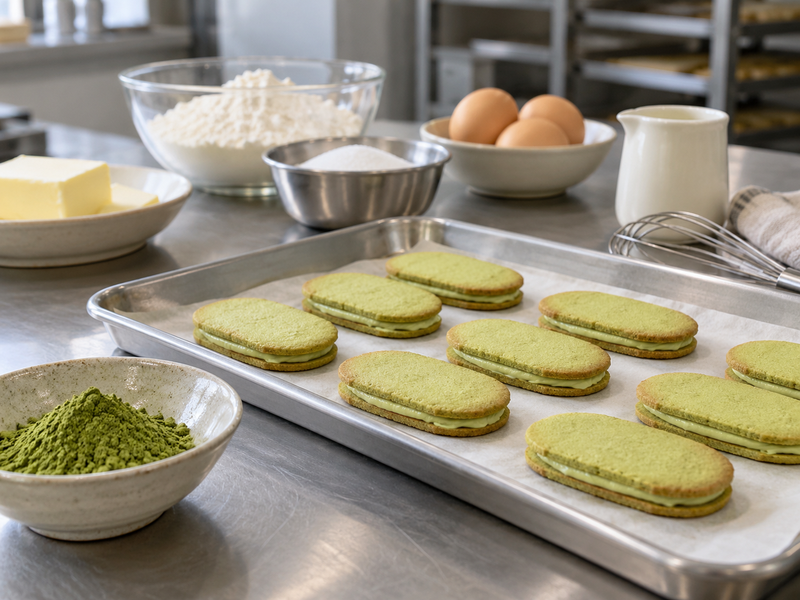
Matcha langue de chat is a thin, crisp matcha-flavored biscuit, often paired as a sandwich with a cream or chocolate filling. It can work as a gift-box item, café add-on, or private-label snack. Yet the format exposes small manufacturing errors: uneven piping creates mixed bake colors, too much moisture softens the shell, and a filling can overwhelm the tea note. This guide is for bakery developers and buyers who need to move from a pretty sample to a repeatable packaged product. We focus on matching the matcha ingredient to a delicate baked shell, then controlling shape, color, filling, and pack performance through a pilot.
1. What makes a matcha langue de chat different from a standard cookie?
The thin shell leaves little room to hide variation
Langue de chat describes a slender, delicate biscuit style. In a matcha version, the shell carries powdered tea, which contributes flavor and color but also changes the visual standard. A thick shortbread can tolerate a little uneven browning. A thin green shell shows it immediately, especially beside a pale cream filling. Buyers should define the intended format: single biscuit, filled sandwich, or chocolate-dipped piece. Each version has a different target weight, breakage risk, and pack count.
Before developing a formula, write down the customer’s eating experience. Should the first bite snap cleanly? Is the matcha note mild enough for a broad retail audience or pronounced for a tea-specialist shop? Does the filling provide sweetness or a second flavor? The answer affects powder dose and supplier selection. Use the finished cookie: a matcha that tastes pleasant in water may taste faint after baking and filling. Develop against the finished product, not the powder’s grade name.
2. Which ingredients control shell texture and spread?
Track each ingredient by function
A typical thin biscuit depends on fat, sugar, flour, and egg white or another binder. Matcha becomes an additional dry component, so increasing it without adjustment can affect flow and bite. Formula development should specify weights rather than cups or scoops. Record mixing order and ingredient temperature, because a batter that flows smoothly at the start of a shift may pipe differently later. When changing flour or fat supplier, repeat the spread test rather than assuming the same oven setting will work.
| Component | Primary role | Development question |
|---|---|---|
| Fat | Tender bite and spread | Does it stay consistent across room temperatures? |
| Sugar | Sweetness, structure, browning | Does edge color arrive before center dries? |
| Flour | Shell structure | Does the cookie hold a thin shape? |
| Egg white or binder | Film and cohesion | Is breakage acceptable after cooling? |
| Matcha | Tea flavor and green color | What dose survives baking and filling? |
Keep a small development log with formula, batter temperature, deposit weight, bake setting, and finished observations. A bakery can then diagnose whether a fragile cookie came from ingredient balance, inconsistent deposition, or handling after bake. Without that log, teams often change several variables at once and cannot reproduce their favorite sample.
3. How should a buyer select matcha for a baked biscuit?
Test performance after heat and with the filling
Bright powder color may matter, but the goal is a finished shell with an acceptable green tone and identifiable tea flavor. Bake a small set with at least two candidate matcha powders at a fixed dose. Compare shells before and after filling. A more expensive powder can be wasted if its subtle notes disappear under white chocolate. A lower-cost culinary powder may be appropriate if it stays balanced and does not turn the biscuit harsh. Price comparisons should use cost per accepted packed cookie, not price per kilogram alone.
| Evaluation point | Sample condition | What to record |
|---|---|---|
| Raw powder | Opened ingredient pack | Color, aroma, lot |
| Fresh shell | After cooling | Tea note and edge color |
| Filled cookie | Normal serving condition | Flavor balance |
| Packed cookie | After trial storage | Color and crispness |
Ask suppliers for application samples and product-specific specifications. If the retail brief includes an organic claim, verify the required chain of documents for the exact market and finished product. Matcha Village offers grades and blends for different applications; the useful request is a bakery brief with target color, flavor, dose, and cost range. A supplier cannot select the best ingredient from the word “premium” alone.
4. How can mixing keep the batter uniform?
Disperse matcha without overworking the base
Dry matcha can form small pockets in a batter, leaving dark specks and uneven flavor. Test whether premixing it with flour or another dry ingredient gives better distribution under your mixer and batch size. Use the same mixing sequence and scrape schedule for each trial. A bench bowl can be scraped by hand in seconds; an industrial mixer may need an explicit wall and paddle check. Do not assume a longer mix solves every streak, since the batter’s texture may change with extra work.
At the end of mixing, sample from the top, middle, and bottom of the bowl. Pipe a few test pieces from each sample and compare color and spread. If variation appears, look at addition order, powder lumps, and mixing geometry. Record how long batter can wait before depositing under your quality plan. Temperature drift can change piping, which then changes bake time. For contract manufacturing, specify the acceptable batter appearance with photographs; “mix until smooth” is too vague for a new production team.
5. What shaping controls keep biscuits consistent?
Manage deposit weight, length, and spacing
Thin cookies have a narrow margin between underbaked center and dark edge. A depositor that varies by a small amount can yield visibly different pieces. Set a target deposit weight and shape template, then check trays from the start, middle, and end of a run. Measure spread after baking, not only raw strip length. Leave enough spacing for the batter’s actual spread pattern; touching pieces become scrap or require trimming.
| Control | How to check | Risk if missed |
|---|---|---|
| Deposit weight | Weigh a sample of raw strips | Mixed bake colors |
| Length and width | Use a simple tray template | Uneven pairs in sandwiches |
| Spacing | Inspect baked trays | Joined cookies and scrap |
| Cooling transfer | Count broken shells | Hidden yield loss |
For a sandwich product, the pairing rule matters. If two shells differ greatly in size, filling may show at the edges and the pack looks untidy. Count how many baked shells become complete saleable pairs. A pretty tray photograph can conceal a poor pairing yield. Build that yield into the cost model before quoting a retail customer.
6. How do baking and cooling affect matcha color?
Use a color window, not a single oven number
Thin shells can move from pale green to browned edges quickly. Oven type, load, tray material, and deposit size all change the result, so a recipe’s published temperature is only a starting point. Establish a bake window in your own equipment: enough drying for crispness without pushing edge color beyond the approved standard. Place reference samples or calibrated photographs near the line for operators. Compare center and edge color under one lighting setup.
Cooling is part of the process. Pack or fill shells before they have reached a stable condition and trapped moisture may soften them. Leave them exposed too long in a humid room and they can pick up moisture from the air. Determine a transfer window for your facility, using measured product condition and sensory checks. Watch for breakage during conveyor or tray handling. A batch can taste right and still fail: if half the shells crack before pairing, the bake and handling method is not commercially ready.
7. Which filling works without hiding the tea flavor?
Balance flavor, sweetness, and moisture movement
White chocolate, buttercream, and other fat-based fillings can pair with matcha, but they differ in sweetness, melt behavior, and moisture. Test the cookie as a complete sandwich. A filling that tastes restrained on a spoon can dominate a thin shell. Set the filling weight per pair and measure the finished ratio. If the plan is a single unfilled biscuit, make that choice deliberately: the shell’s tea flavor then carries the product alone.
| Filling route | Product advantage | Trial question |
|---|---|---|
| White chocolate style | Familiar sweet contrast | Does sweetness mask matcha? |
| Matcha cream | Stronger tea identity | Does it keep the shell crisp? |
| Fruit or flavored cream | Distinctive SKU | Do aroma and moisture fit the shell? |
| No filling | Simple ingredient and pack line | Is the shell satisfying alone? |
Trial texture after packing, not just immediately after assembly. Water can migrate between components over time. The manufacturer should validate the finished product’s quality and safety shelf life under its actual pack and storage conditions. Do not borrow a date from an unfilled biscuit. Buyers also need a clear allergen statement for both shell and filling.
8. What packaging protects a fragile matcha sandwich?
Test breakage and crispness in the shipping route
Choose a pack that protects thin pieces from compression and limits moisture pickup. Individual wraps can reduce handling damage but add material and packing labor. A tray inside a box helps presentation yet can consume shipping space. Compare options by filled case, not empty retail box. Run a realistic distribution trial, then count whole, chipped, and broken pieces. Retailers may reject a box if visible damage is common even when flavor remains good.
| Pack format | Useful for | Test before approval |
|---|---|---|
| Individual wrap | Single café sale | Seal and opening experience |
| Tray in carton | Gift presentation | Breakage after shipment |
| Multi-pack pouch | Value retail | Crumbs and moisture after opening |
| Bulk foodservice case | Counter service | Staff handling and portion control |
Matcha color can also shift with light exposure. Test the intended display condition, especially if a windowed carton is proposed. Artwork should show the actual cookie size and count accurately. A buyer should request packed samples after the pilot line, because hand-packed development pieces can survive a journey that production cases cannot.
9. How should a buyer calculate yield and unit cost?
Follow the product from batter to saleable pack
Begin with ingredient and packaging cost, then add labor, energy, overhead, freight, and expected losses. Track usable shells after baking, matched pairs after filling, and accepted packs after sealing. A small improvement in breakage may save more than negotiating a tiny discount on powder. Conversely, an expensive matcha might be justified if it permits a lower dose while preserving flavor and color; demonstrate that in a controlled test rather than assuming it.
Set a target retail or wholesale price and work backward to an allowed manufacturing cost. Gift boxes may carry higher packaging cost but support a different selling proposition from loose café cookies. Run a second scenario for damaged units and promotional discounts. Ask co-packers how minimum runs and changeovers affect price. For a private-label product, secure agreement on who owns the formula, artwork, and unused packaging if demand changes. A credible quote names the pack count, net weight, quality tolerance, and shipping terms.
10. What should a pilot prove before a retail launch?
Qualify the cookie, line, and supplier together
Run a production-representative batch. Compare start, middle, and end samples for color, size, snap, filling amount, and seal quality. Keep samples from each stage of the proposed shelf-life study. Record ingredient lots, batch code, and packaging lot so a later complaint can be traced. Have a panel taste the product in its final pack at normal serving conditions. A cookie sampled warm from the line is not the product a customer buys weeks later.
Ask the supplier for product specifications, allergen information, applicable test results, and a documented change-control process. Agree on what happens if color moves outside the reference window or breakage exceeds the contracted tolerance. Matcha langue de chat is a promising way to bring tea into a small, giftable bakery item, but the commercial win comes from repeatable texture and yield. For matcha powder samples suited to baked applications, contact Matcha Village with your shell formula, bake process, and target price.
FAQ
Q1. Is matcha langue de chat always a sandwich cookie?
No. Thin matcha biscuits can be sold alone, paired with filling, or partly coated. Specify the intended format before costing.
Q2. Can any matcha powder be used for the shell?
Many powders can be trialed, but flavor and color after baking differ. Compare candidates in the finished cookie.
Q3. Why do the edges brown while the center stays green?
Thin edges heat and dry differently from the center. Review deposit shape, oven load, and bake settings on your line.
Q4. Why does a crisp sample soften after packing?
Moisture from filling, the room, or packaging conditions may be involved. Test the complete product through its proposed shelf life.
Q5. What matters most in a private-label quote?
Define pack count, saleable yield, breakage tolerance, ingredient specification, documentation, and shipment terms.