
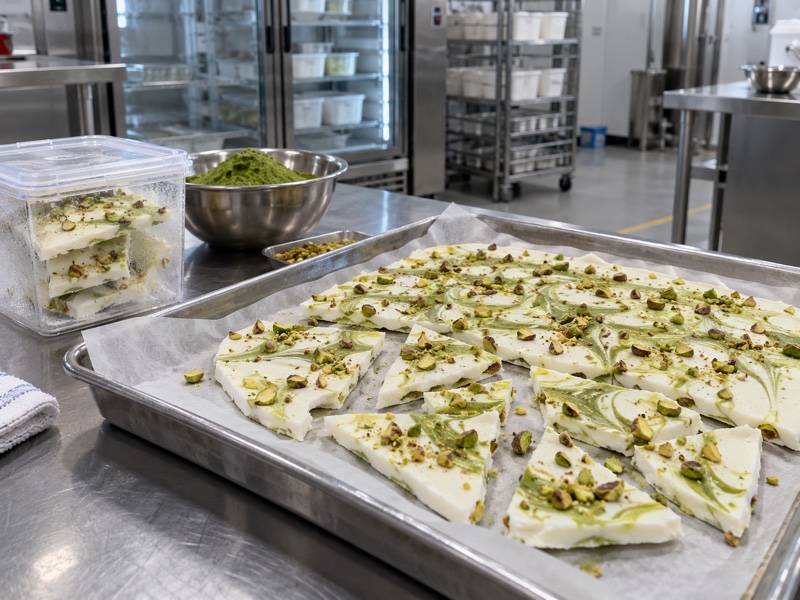
Matcha yogurt bark is a frozen slab of yogurt-based mix with matcha, portioned into pieces for serving or sale. A kitchen tray may break neatly when first frozen but become icy, sticky, or fragmented after packing and shipment. Treat the idea as a frozen product development project: define the yogurt base, disperse powder evenly, control slab geometry, and test packed pieces through the intended cold chain. Those steps address quality at the point of sale, where a recipe photograph offers little evidence.
Contents: 1 · 2 · 3 · 4 · 5 · 6 · 7 · 8 · 9 · 10
1. What is matcha yogurt bark as a commercial product?
Define what customers will receive
The name describes a format, not a validated formula. A manufacturer must decide whether pieces are sold as loose frozen snack portions, a packed single-serving tray, or a foodservice topping. The planned channel determines pack size, handling, shelf presentation, and how much irregularity is acceptable. Define the base, matcha dose, inclusions, target piece dimensions, and net mass in a draft specification. Use masses rather than spoon measures so a future line can repeat the mix.
Draw the boundary. A frozen yogurt slab remains vulnerable to thawing, surface moisture, and breakage. Ask what the customer will see when opening the pack after normal distribution, not only when the tray leaves a blast freezer. A hypothetical pilot can compare two pack formats while keeping the same recipe and freezing process. Record appearance, breakage, and eating texture after a defined tempering step. Qualified food safety staff should review the actual product and process before any sale.
| Product decision | Question to settle | Pilot evidence |
|---|---|---|
| Channel | Retail pack or foodservice bulk? | Handling and portion trial |
| Shape | Irregular shards or cut pieces? | Breakage and serving consistency |
| Base | Dairy or plant yogurt? | Flavor, texture, label review |
2. Which yogurt base should a developer choose?
Look at structure and flavor
Yogurt bases vary in solids, acidity, protein, sweetness, and stabilizers. These differences influence how a frozen slab fractures and whether it tastes pleasant straight from a freezer. A watery base may form a hard, icy piece; a thicker base may spread less evenly or feel pasty. Compare candidate bases at a fixed matcha mass and slab thickness. Record viscosity or spread behavior with the site’s available method, then taste after a consistent tempering interval. A plant yogurt should be assessed as its own formula rather than substituted at the end.
Check the ingredient file. Request current specifications and ingredient statements for each base. Dairy brings milk allergen and refrigerated raw-material handling needs; plant bases may contain other allergens or flavor notes. The finished product’s labeling and food safety controls follow the actual ingredient system and destination market. If a base already contains sugar, count it in the full formula before adding syrup or fruit. A tasting that ignores built-in sweetness cannot isolate matcha balance.
3. How can matcha disperse without green streak defects?
Wet powder before full blending
Matcha can form dry cores when added directly to a thick yogurt base. Compare a measured premix with direct addition under otherwise identical conditions. The premix liquid should be part of the recorded formula, because extra water changes frozen texture. A small controlled trial can use yogurt itself or another permitted liquid to wet powder before bulk mixing. Check the mixture immediately, after spreading, and on cut pieces. Green streaks may look attractive in a photograph but can create uneven flavor and dose.
Use the production mixer. A laboratory blender may remove clumps that the intended mixer leaves behind. Record powder addition order, mixer load, time, and speed. Inspect corners of the vessel and a spread sample for undispersed material. If a batch shows flecks, change one process variable before raising matcha dose or changing supplier. An even color does not prove complete sensory uniformity, so taste pieces sampled from several tray positions.
| Trial route | Possible benefit | What to inspect |
|---|---|---|
| Direct powder addition | Fewer steps | Dry cores and streaks |
| Measured premix | Easier wetting | Added liquid and texture |
| Longer mixing | More uniformity | Air incorporation and warming |
4. What slab thickness and portion shape should be tested?
Geometry drives handling
Thin slabs may break easily during demolding and shipping. Thick slabs can be hard to bite and slower to freeze through. Rather than adopt a recipe’s tray depth, trial several measured thicknesses with the same mix and freezing conditions. Weigh finished pieces and record the distribution of portion mass. If pieces are intentionally irregular, set a practical range for saleable appearance and net weight. A cut or scored portion may improve consistency but adds labor or equipment requirements.
Test the weak point. Check fracture during removal from the tray, placement in the primary pack, sealing, and normal handling. Use the actual lining or mold material, since release can change breakage more than the recipe does. Photograph pieces on a neutral surface and count fines or crumbs after each step. A pilot should define whether fragments are included in the saleable pack or treated as loss. That decision affects label net mass, cost, and customer experience.
5. How should inclusions be selected and handled?
Add only what survives freezing
Fruit, nuts, cereal, and chocolate each bring a different failure mode. Wet fruit can release moisture and form icy spots. Nuts may remain firm but raise allergen and supplier-control questions. Crisp cereal can lose texture against a moist yogurt base. Chocolate pieces can change bite hardness at low temperature. Screen inclusions in the finished frozen format, not on a fresh yogurt bowl. Start with one inclusion at a time so a failed tray has a clear explanation.
Place them deliberately. Toppings left only on the slab surface may detach during cutting and packing. Inclusions stirred into the base may sink or disappear visually. Compare placement routes while holding inclusion mass per 100 grams of mix constant. Record attachment, distribution, piece breakage, and flavor after storage. Ask suppliers for specifications, allergen information, and suitable storage conditions. The product’s ingredient declaration must match what goes into the pack, including any carrier or coating on an inclusion.
| Inclusion type | Main quality risk | Pilot check |
|---|---|---|
| Fruit | Moisture and ice spots | Surface after storage |
| Nut pieces | Allergen and hard bite | Distribution and label review |
| Cereal | Soggy texture | Crispness at sale |
6. What freezing process gives a clean break?
Control the path through freezing
Freezing rate, tray loading, slab thickness, and the temperature at demolding can change fracture. A warm tray held too long before freezing may let toppings migrate or permit quality loss. A slab removed before it is adequately frozen can bend and smear. Define a pilot sequence from mixing to spreading, freezing, demolding, cutting, and packing. Record actual product and equipment conditions at each stage rather than copying a household freezer time.
Compare repeat runs. Run the same formula on at least more than one tray position in the intended freezer. Check whether edge and center pieces differ in firmness or release. Record dwell time and product temperature with the site’s validated measurement method. If clean breaks occur only under a narrow condition that production cannot maintain, adjust geometry or handling. Food safety controls for raw yogurt ingredients and post-process handling still apply; freezing itself should not be treated as a kill step.
7. Which defects appear during frozen storage?
Inspect the packed piece
Ice crystals, surface frost, color dulling, freezer odors, sticking, and brittle fragmentation can appear after the attractive day-one trial. Build a storage plan using the actual pack and target distribution temperature. Compare samples at defined intervals and after a realistic, documented temperature excursion. Standardize tempering before sensory checks. A piece tasted straight from one freezer beside a warmer piece from another gives a poor comparison.
Trace the defect. If a sample turns icy, review base solids, added water, freezing route, package seal, and temperature logs. If pieces stick together, examine surface moisture and pack layout. If matcha color fades, compare powder retain, fresh mix, and packed samples under the same light. Keep batch and ingredient lot records so a change can be located. Shelf-life statements require actual product, pack, and safety evidence; a successful week of visual inspection is only an early screen.
| Defect | Likely area to review | Controlled follow-up |
|---|---|---|
| Large ice crystals | Base and temperature cycling | Fixed-pack storage comparison |
| Sticking | Moisture and pack contact | Tray or separator trial |
| Green fading | Powder, light, oxygen | Retained-stage comparison |
8. How should the product be packed and shipped?
Protect pieces from the route
Primary packaging should limit moisture transfer, prevent pieces welding together, and reduce mechanical breakage. Compare a compartmented tray, separated layers, and a simple pouch using the same frozen pieces. Count intact portions after normal handling and a defined distribution simulation. Confirm that sealing equipment can handle cold product without trapping moisture or damaging pieces. A pack that displays the snack beautifully in a pilot may waste too much product on a production line.
Document the cold chain. Identify storage, picking, transport, and retail-display conditions before setting a best-before period. Use temperature records and qualified shelf-life work for the final formula and pack. If the product is sold for immediate café service, define the maximum time out of freezing and the serving condition. If it is sold frozen for home storage, the label instructions need review under local rules. Do not use a cold-chain claim as a substitute for measured performance.
9. What do cost and label reviews need to cover?
Price intact saleable pieces
Calculate cost from the full yogurt mix, matcha, inclusions, packaging, labor, and actual yield. Shards lost during demolding and packing matter more than theoretical tray output. Track net mass per pack and rejected pieces in a pilot. If one slab geometry lowers breakage, its slightly higher ingredient use may still improve unit economics. Compare candidate matcha powders by effective dose in the finished frozen product, not only by price per kilogram.
Review wording early. Ingredient naming, allergens, nutrition information, claims, storage statements, and date coding depend on the actual formula and destination market. “Yogurt” and “frozen yogurt” may carry local definitions. A plant-based base needs its own naming review. Request supplier documents for matcha, yogurt base, and inclusions before artwork is finalized. A claim that sounds harmless in a recipe blog can become a regulated statement on a retail pack.
| Cost or label item | Evidence to gather | Decision affected |
|---|---|---|
| Saleable yield | Intact pieces per batch | Unit cost |
| Ingredient list | Supplier specifications | Artwork and claims |
| Frozen life | Product and pack tests | Date code and stock plan |
10. How should a pilot team decide whether to launch?
Set release criteria before tasting
Approve a master formula by mass, ingredient identities, mixing and freezing route, slab geometry, pack, and storage condition. Establish a physical reference sample and a short acceptance sheet covering tea flavor, sweetness, color, ice crystals, fracture, and intact piece yield. For the color check, use controlled light and sampling time as described in our matcha green color guide. Include relevant safety and label reviews. Decide the pass limits from repeated pilot results; a single successful tray cannot define production tolerance. Record the matcha and yogurt lots used in every test.
Make the pilot decisive. Run the product through intended equipment, pack it, and follow a documented storage and distribution challenge. Have quality, operations, commercial, and procurement teams review the same evidence. If a defect appears, change one variable and repeat the relevant test. The next buyer action is to request lot-linked matcha and yogurt samples, then schedule a controlled small production run. For broader U.S. labeling context, consult the FDA food labeling guide with the rules applicable to the destination market.
Reference: Matcha Frozen Yogurt Bark. The source page was inaccessible during research, so its contents were not verified; its title supplied topic context only.
FAQ
Q1: What is the primary quality check for matcha yogurt bark?
Inspect packed pieces after the intended frozen storage route. Taste and appearance on day one cannot establish sale quality.
Q2: How should a team choose matcha for matcha yogurt bark?
Compare lot-linked powders at fixed dose in the selected yogurt base, then test finalists in frozen packed pieces.
Q3: Which defects should a pilot record for matcha yogurt bark?
Record ice crystals, streaks, color change, sticking, breakage, and uneven portion mass.
Q4: How should matcha yogurt bark be stored or served?
Use storage and service conditions established by product, pack, safety, and stability testing for the intended channel.
Q5: What must a supplier document for matcha yogurt bark?
Request ingredient specifications, lot identity, relevant quality and allergen information, packaging, and storage guidance.