
Matcha with creamer can give a café a richer drink without building a full milk recipe from scratch. It can also create a surprisingly inconsistent cup. Creamers differ in sweetness, fat source, viscosity, and behavior in hot or iced service. A liquid creamer that pours beautifully in a sample may mask the tea after dilution; a powdered version may leave specks when staff rush. This guide helps café operators, beverage developers, and ingredient buyers choose a formula, test it against service conditions, and price the finished drink. Our supplier perspective begins with the matcha powder and the cup customers actually receive, rather than a promise that any creamy ingredient will work.
1. What does “matcha with creamer” mean on a menu?
Define the drink before choosing a creamer
The phrase might describe a hot matcha latte made with a liquid coffee creamer, an iced matcha topped with a splash of flavored creamer, or a dry matcha latte mix containing a powdered creamer. These drinks need different ingredient ratios and can carry different allergen or labeling requirements. A café should write one finished-drink specification: cup size, matcha dose, liquid volume, creamer type and dose, sweetness target, serving temperature, and visual presentation.
Start with the guest promise. Is the creamer replacing milk, providing flavor, or acting as a finishing layer? If it replaces milk, it must carry more of the body and balance. If it is only a finish, the matcha base should still taste complete underneath. A branded product should not leave staff to interpret “add a little creamer” during a rush. The useful question: which role does this ingredient play in the drink? Once that is clear, procurement can compare products on the same basis and operations can train a repeatable pour.
2. Which creamer format suits the outlet?
Compare storage and service work, not just taste
Liquid chilled creamer is convenient for a bar station with reliable refrigeration and predictable demand. Shelf-stable liquid portions may suit dispersed sites but add packaging per cup. Powdered creamer can simplify dry storage and preblended mixes, though dispersion needs close testing. Some products are dairy-based; others use plant-derived fats or other ingredients. “Non-dairy” wording alone should never substitute for reading the actual ingredient and allergen statement.
| Format | Good fit | Trial concern |
|---|---|---|
| Chilled liquid | Busy café bar | Opened-pack handling and waste |
| Shelf-stable liquid portion | Small or distributed outlets | Pack cost and serving size |
| Powdered creamer | Dry mix or compact storage | Clumps and mouthfeel |
| Flavored creamer | Seasonal menu item | Sweetness and matcha masking |
Count the steps from receiving to finished cup. A cheap bulk tub can become costly if staff must measure, dissolve, and clean extra tools. A portion pack may cost more per serving but reduce dosing errors. Trial at the actual outlet, including the available refrigeration and storage space. The winning format is the one that supports the intended flavor and can be used correctly by an ordinary shift team.
3. How does creamer change matcha flavor and color?
Test the tea note after the drink is finished
Creamer can soften matcha’s bitterness and add body, but it can also mute its aroma. A vanilla creamer may make a drink approachable while turning the tea into a background color. A high creamer dose can lighten the cup so much that staff add extra powder to restore green color, raising cost and sometimes creating an unbalanced taste. Compare samples by finished serving weight and matcha dose rather than by their color in separate photographs.
| Test cup | Keep fixed | Question |
|---|---|---|
| Matcha base alone | Powder and water | Is the tea clean and balanced? |
| Low creamer dose | Same base and cup size | Does creaminess help without hiding tea? |
| Target dose | Same matcha dose | Would a guest recognize matcha? |
| After ice melt | Same preparation | Does flavor remain coherent? |
Run a blind tasting with at least one unsweetened or lightly sweetened reference. Sweetness can make a sample popular without solving the matcha brief. Record tea intensity, sweetness, aftertaste, texture, and color separately. For a chain, choose an acceptable range rather than one perfect cup made by a developer. The range should survive normal variation in ice and pour technique.
4. How should staff mix matcha with creamer?
Build a base that does not depend on a photo swirl
Matcha is powdered leaf held in suspension, so mixing method matters. A practical iced process often disperses matcha in a measured portion of liquid before adding ice and creamer. That gives staff a chance to catch dry clumps. A hot drink may use a different temperature and addition order. Follow equipment and ingredient instructions, then test the chosen sequence with the exact matcha and creamer products. Do not assume a process developed for milk will perform identically with a thick flavored creamer.
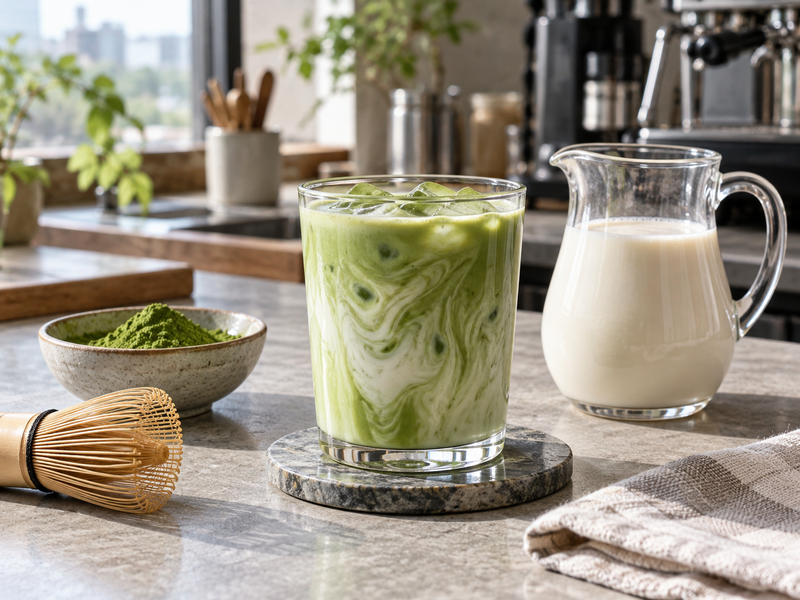
Make the finished drink twice: once by the developer and once by a new staff member using only the recipe card. Compare clumps, foam, fill level, and taste. If one cup depends on a slow, careful pour to look good, decide whether the visual layer is worth the labor. A drink can show a beautiful white-green marble pattern for a moment and become too sweet when fully stirred. Serve the cup as guests will drink it. Specify whether staff should stir before handoff and whether the guest needs a mixing instruction.
5. What should the ingredient list and allergen review cover?
Review the complete formula for each market
Creamers may contain milk ingredients, plant oils, sweeteners, flavorings, emulsifiers, or stabilizers. Those components affect taste, texture, customer claims, and labeling. Read the current specification rather than a front-of-pack claim. If the menu says vegan or dairy-free, have the operator’s quality and regulatory teams verify every ingredient and the relevant handling practice. A creamer described as “plant-based” in marketing may still need careful allergen review for the full drink.
| Document | Use in approval | Common gap |
|---|---|---|
| Ingredient statement | Understand formula and claims | Outdated sales sheet |
| Allergen statement | Menu and staff guidance | Only one component reviewed |
| Nutrition data | Required disclosures where applicable | Wrong serving volume |
| Storage instructions | Receiving and opened-pack SOP | Unclear after-opening rule |
Check the matcha ingredient as well. A pure powder and a sweetened matcha blend produce different finished labels and cost calculations. If a supplier changes a creamer formula, the drink may need fresh sensory and document review. Agree on notification of ingredient changes before a chain launches packaging or prints a menu. Procurement should keep the approved specification tied to the SKU actually ordered.
6. Does the recipe work in hot and iced drinks?
Qualify each serving condition separately
Cold liquid can make a powdered creamer harder to disperse. Heat can change foam, aroma, and the way a liquid creamer appears in matcha. Ice introduces dilution. Test hot and iced versions with the same target serving size only if the menu calls for both; do not assume one recipe will serve every temperature. A hot cup should be tasted at handoff and after a short drinking delay. An iced cup should be tasted fresh and after some ice has melted.
| Condition | Observe | Possible adjustment |
|---|---|---|
| Hot service | Foam, aroma, visible separation | Addition order or dose |
| Iced service | Clumps and initial balance | Pre-dispersion step |
| After delay | Sediment and sweetness | Serving method or recipe |
| Takeout travel | Layering and cup appearance | Stir instruction or pack choice |
Keep test conditions simple and documented: measured ingredient weights, water volume, ice weight, cup, and time before tasting. Change one variable at a time. A recipe adjustment to fix a hot drink might make the iced version too thick. If the two conditions need separate recipes, publish separate station cards and cost sheets. A little extra preparation on paper avoids a great deal of improvisation on the bar.
7. Can matcha with creamer be prepared in batches?
Distinguish a dry blend from a wet finished drink
A dry blend of matcha and powdered creamer may reduce measuring steps, provided it is mixed uniformly and packed under appropriate conditions. A wet base or complete latte adds storage and holding questions. There is no universal safe holding time for every formula. Milk ingredients, sugar, water activity, processing, temperature, and local rules all matter. Operators should set procedures under their food-safety plan, using the FDA Food Code as a U.S. reference where relevant, while manufacturers should validate the finished product’s shelf life and storage conditions.
For a café trial, compare a freshly mixed cup with the planned last cup from a batch. Record color, aroma, clumps, sediment, and taste after the exact remixing step staff will use. Label each batch with recipe, preparation time, and the approved use-by rule. Track leftover volume. If a wet batch saves ten seconds per cup but half is discarded on quiet days, dry preportioning may be the better answer. Watch the last pour: matcha can settle, leaving the final serving stronger than the first unless the procedure accounts for it.
8. What does matcha with creamer cost per saleable cup?
Include add-ons, waste, and service time
Calculate matcha powder, creamer, water or milk, ice, cup, lid, and labor per accepted drink. Some creamers are marketed in large containers but dosed in small volumes; compare the actual cost per recipe rather than container price. Include an allowance for opened-pack waste and remakes. A flavored creamer may replace a syrup, so the fair comparison is against the current complete recipe, not against plain matcha powder alone.
| Cost line | Measure | Why it can move |
|---|---|---|
| Matcha | Grams per cup | Dose may rise when tea is masked |
| Creamer | Milliliters or grams per cup | Portion accuracy and pack size |
| Other ingredients | Milk, syrup, ice | Creamer may replace or add to them |
| Loss | Discarded base and remakes | Demand and training variation |
Run an ordinary-week and slow-week scenario. A busy site can empty a chilled bottle quickly; a small site may not. If a premium drink commands a higher menu price, check whether guests actually choose it and whether it cannibalizes a simpler matcha latte. The goal is a profitable, repeatable cup, not the cheapest ingredient quote.
9. What should buyers ask suppliers for matcha with creamer?
Send a precise drink brief and request comparable samples
A useful brief names the serving size, target matcha dose, creamer format, desired sweetness, dairy or plant-based requirement, service temperature, and cost range. Send suppliers the existing menu recipe if one exists. Ask for product specifications, ingredient and allergen statements, storage instructions, and lot identification. For a powder or dry blend, request guidance on dispersion and pack protection. For a liquid creamer, ask for handling after opening and samples from normal production.
Evaluate matcha and creamer together. If the matcha powder changes, repeat the tasting because color and bitterness can shift in the same cream base. Matcha Village can discuss powder and blend options for café applications, including samples for development. The buyer still needs to qualify the chosen creamer separately and verify any finished-drink claims. Agree on acceptable sensory range and a change-notification process before rolling the drink out. That turns a supplier conversation into an approval record rather than a pile of attractive samples.
10. How should a café launch a matcha with creamer drink?
Start with one clear SKU and a measured pilot
Choose one recipe with an obvious reason to exist beside the regular matcha latte: a richer unsweetened option, a specific flavor, or a fast-to-make signature drink. Train staff on weights and sequence, then watch several ordinary shifts. Photograph an accepted cup under fixed light and keep the recipe card at the station. Track ticket time, remake rate, creamer waste, customer comments, and repeat orders. A beautiful launch photo cannot tell you whether the drink survives a busy afternoon.
Refine the formula only after identifying the real complaint. If guests say the drink tastes too sweet, adjust the creamer or syrup before increasing matcha. If color varies, check dosing and ice before changing powder. If the final sip is gritty, revisit mixing and sediment. Matcha with creamer can be a useful menu extension when the tea remains recognizable and the line can make it consistently. For matcha samples suited to your target creamer and serving method, contact Matcha Village with the complete drink brief.
FAQ
Q1. Can coffee creamer be used in matcha?
It can, but test its sweetness, flavor, ingredient statement, and performance in the finished matcha recipe.
Q2. Is powdered creamer better than liquid creamer for cafés?
Neither is universally better. Compare storage, dispersion, staff steps, cost per cup, and waste at the intended outlet.
Q3. Why does the matcha flavor disappear after adding creamer?
The creamer may mask the tea through sweetness or flavor intensity. Test a lower dose or a different matcha and compare complete cups.
Q4. Can the same recipe be served hot and iced?
Possibly, but test both conditions independently for texture, taste, and dilution.
Q5. What should a supplier sample request include?
Give the serving size, matcha dose, creamer format, sweetness target, temperature, ingredient restrictions, and price target.