
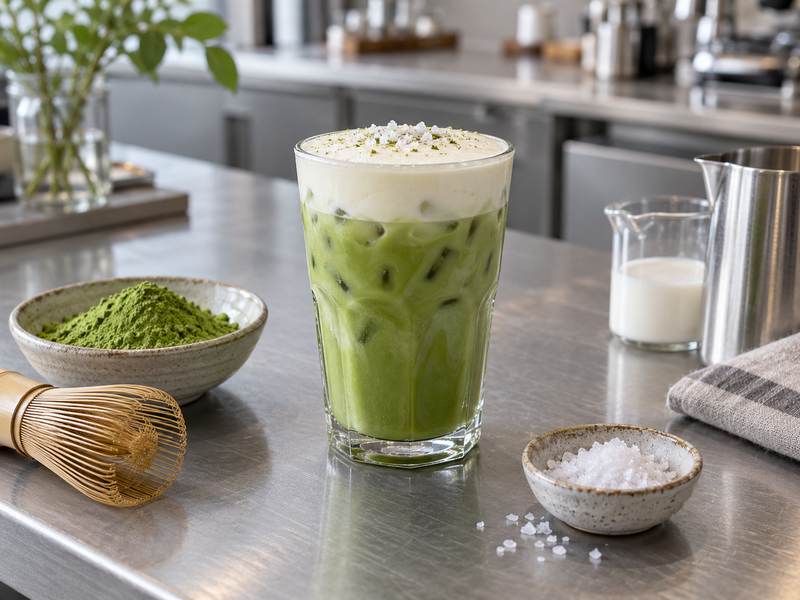
A sea salt matcha latte often looks simple in a menu photograph: green tea, milk and a white cap of foam. In service, the salt can end up in the wrong place. Too much in the base tastes briny. A coarse finishing flake gives one salty sip and several unsalted ones. A salted foam can collapse before the order reaches the customer. A cafe needs a controlled recipe, not just the instruction to add sea salt.
The same issue affects purchasing. A matcha that tastes excellent in water may disappear behind sweet cream, while a powder chosen only for its bright color may leave bitterness in the last sip. This guide shows how to test the matcha, salt and dairy components as one product. It is written for beverage developers and cafe buyers who need a drink that staff can reproduce and cost accurately.
1. What makes a sea salt matcha latte different from a plain latte?
Salt changes perception even when the amount is small. It can make sweetness seem rounder and reduce the impression of some bitter notes, but it will not make poor matcha fresh. The appeal of the drink is a short sequence: matcha aroma, creamy body, then a subtle salty finish. If the first sip tastes like salted cream and the tea appears only after stirring, the build order or layer proportions may need work. Decide whether the menu promises a mixed latte or a layered salted-foam drink; customers experience them differently.
Write a sensory target before choosing ingredients. Ask testers to describe the tea note, salt intensity, sweetness, foam texture and finish at two moments: immediately after service and after a normal pickup delay. A drink that photographs well but separates after five minutes is not a dependable menu item. Use the same cup, ice and milk during tests so the panel compares salt placement rather than unrelated variables. This also gives the buying team a usable benchmark for matcha samples.
2. Which matcha should a cafe buy for this drink?
The powder must keep a clear tea identity through milk and the salted topping. Do not rely on a grade label alone; grade terms are used differently by suppliers. Ask for samples from the intended commercial line, prepare them at the same dose, and taste them first in water, then in the complete latte. The second test matters most for buying. A fine tea with delicate aroma can be lost in sweet cream, while another sample may hold up better and cost less per cup.
Inspect the drink after a realistic hold. Some powders disperse smoothly and remain visually even; others settle or leave dark specks. A salted foam also changes how the tea reaches the nose, so taste without a straw and with one if customers normally use both. Record the supplier lot, storage condition and preparation method on the sample sheet. If a future lot changes color or flavor, these records show whether the powder or the bar process moved.
| Check | Test condition | Acceptable signal |
|---|---|---|
| Tea identity | Finished drink, standard foam | Matcha remains clear after the salted first sip |
| Color | Actual cup under service light | Green remains appealing without color edits |
| Dispersion | Normal bar equipment | No persistent clumps or heavy base layer |
| Hold | Normal pickup delay | Flavor and appearance remain within spec |
3. Where should the salt go: base, syrup or foam?
Placement determines whether each sip tastes balanced. Salt dissolved in the base gives the most even distribution but is easy to overdo and hard to correct. Salt in a syrup is measurable if the syrup is made or purchased consistently; it also changes the sugar profile. Salt in cold foam gives a strong first impression and a distinctive layered appearance, but the dose has to be controlled because the foam may not spread evenly. A finishing flake is visually clear yet can land on one spot and produce a harsh first sip.
Test one placement at a time. Do not put salt in the base and the foam during the first trial; the team will not know which part drives the flavor. Use a fine, food-grade salt that can be measured accurately, and document the form used. “Sea salt” on a menu does not tell a barista what size crystal to use. A controlled batch recipe for foam or syrup is safer than asking each person to pinch from a container.
| Placement | Strength | Watch for |
|---|---|---|
| Dissolved in base | Even flavor | Over-salting the whole cup |
| Measured syrup | Repeatable dosing | Extra sugar and batch consistency |
| Cold foam | Distinctive first sip | Foam stability and uneven pickup |
| Finishing flake | Visible ingredient cue | Isolated salty bursts |
4. How can a small test batch find the right salt level?
Begin with a plain matcha latte that the team already approves. Prepare a separate salted topping or syrup and make three coded cups at low, medium and high salt intensity. Keep matcha, milk, sweetener and serving temperature unchanged. The aim is to identify the lowest level at which the drink has a recognizable salted finish without tasting briny. Weight is more useful than a pinch; for very small amounts, make a measured salt solution or batch topping so the scale can resolve the dose.
Have tasters score the first sip and the last sip separately. Stir one set of drinks and leave another layered to see which presentation holds up. If the salt seems to disappear after ice melt, check sweetness and foam dilution before simply adding more. Note the time between production and tasting. In a busy cafe, a drink may wait on the pass; a recipe approved only at second zero gives a false sense of readiness.
| Cup | Matcha, milk, sweetener | Salt setting | Question |
|---|---|---|---|
| A | Identical base | Low | Is the salty note perceptible? |
| B | Identical base | Medium | Does salt frame the tea? |
| C | Identical base | High | Where does brininess begin? |
5. What milk and foam choices hold up in service?
A salted foam needs a texture that stays pleasant long enough to reach the customer. Dairy cream may offer body, while a plant-based alternative can suit a different menu; neither is automatically stable with every matcha and syrup. Test the exact branded input the cafe will stock. Changing from one oat product to another may alter foam volume or introduce a sweetness that shifts the salt balance. Also test whether the topping can be prepared in a small batch without compromising the cafe’s food-safety plan.
Foam height is not the only measure. A thick cap can block the tea aroma and make the first few sips too salty. A thin cap may vanish before pickup. Photograph the approved cup from the customer viewpoint, then repeat it with a barista who did not develop the recipe. Include an alternative milk in the test only if the menu will offer one. Otherwise, a long list of hypothetical substitutions slows development without improving the actual drink.
6. Should the latte be served hot or iced?
An iced format makes the layered green and white contrast easy to see and can keep a cold foam distinct. It also dilutes as ice melts. Prepare the matcha concentrate first, add milk in a documented sequence, and test how the salted topping moves through the drink. The first sip through the foam and the final sip from the base should both be acceptable. Adjusting only the photograph-ready top layer leaves the last third of the cup untested.
A hot format is possible, but the topping behaves differently and the salt may be perceived more strongly as aroma rises. Do not copy the iced quantities into a hot cup without trial. Prepare matcha with water at a temperature appropriate for the selected powder, then combine with heated milk. If the topping is whipped cream or a hot foam, measure its melting and mixing behavior. The choice of format should follow demand and bar capacity, not merely visual appeal.
7. How should the bar’s recipe card be written?
Record the matcha weight, water volume, milk amount, sweetener dose, salt form, topping batch formula, cup size and build sequence. State whether the drink is stirred before handoff and whether a straw is standard. “Top with sea salt foam” leaves too many decisions to the barista. A short card with exact measures is easier to follow than a long paragraph with qualitative directions. If the topping is made ahead, include batch yield, labeling and the holding limits set by the business’s own food-safety procedure.
During training, make two staff members prepare the cup independently. Compare the result side by side. If one cup is saltier, look at the tool or batching step before criticizing technique. Pump output, spoon fill and foam portion can vary. Build order matters too: syrup placed under ice may stay at the bottom. A stable recipe is one that ordinary staff can reproduce during peak service, not one that depends on the developer standing beside the machine.
| Field | Why it matters | What to record |
|---|---|---|
| Matcha base | Flavor and dispersion | Powder weight, water, mixing tool |
| Milk and sweetener | Body and salt perception | Exact product and dose |
| Salted component | Consistency | Form, batch recipe, portion tool |
| Handoff | Customer experience | Layered or stirred; straw policy |
8. What does the drink really cost per cup?
Use actual doses rather than the headline price of a bag of matcha. Multiply the matcha cost per gram by the tested amount, then add milk, sweetener, topping ingredients, cup, lid and reasonable waste. A salted-foam drink can require an extra preparation step and dedicated storage. Estimate the labor effect during a busy hour: if the drink takes much longer than a standard latte, the menu price may need to reflect that or the recipe may need simplification.
For a seasonal offer, account for leftover specialty ingredients. The matcha may be used across the menu, but a specific sea salt topping might not. Procurement should ask for pack size, replenishment lead time and quality documents before launch. A seemingly inexpensive ingredient can be costly if it expires in the back room. Do a second calculation for an alternative milk if it is a standard option; do not assume the same margin.
| Cost line | Input | Check |
|---|---|---|
| Matcha | Price per gram × approved dose | Compare lots at the same recipe |
| Salted topping | Batch cost ÷ usable portions | Include prep loss |
| Milk and syrup | Measured amount per cup | Include substitutions |
| Packaging and labor | Cup, lid, time | Recheck at peak volume |
9. What should a matcha supplier know before sending samples?
Share the final application: iced or hot, cup size, milk type, sweetener, salted component and target ingredient cost. A supplier can then recommend powders that remain clear in the finished drink. Ask for a sample from the same line available for routine orders, and request relevant lot and packaging details. Blind-taste several candidates with the exact cafe recipe. The cup, not a generic tea description, is the test.
When negotiating, discuss how lot changes are communicated and what support is available if color or taste moves. Matcha Village works with B2B buyers on application fit, but a cafe should approve the powder in its own process. Keep the selected lot’s tasting notes and recipe version together. If a customer later says the drink tastes saltier, the team can check the topping and the tea rather than guessing.
10. When is a sea salt matcha latte ready to launch?
It is ready when the approved cup can be made repeatedly without improvisation. Run a shift test with staff who did not design it. Check flavor at pickup and after a short hold, foam stability, cup appearance and food cost. Confirm the menu description is plain: matcha, milk, sweetener and sea salt topping, with any relevant allergen information handled under the cafe’s normal policy. Do not promise a health effect from sea salt or matcha to justify the price.
After launch, track remakes and the reasons for them. If customers ask for less sweetness, adjust the sweetener choice rather than hiding it with more salt. If foam collapses, investigate batch age and mixing method. A short weekly tasting can catch changes in matcha lots or milk suppliers. The best version is the one the team can make consistently and the customer wants again, not the one with the tallest foam in a test photograph.
Frequently asked questions
Q1. Does sea salt remove matcha bitterness?
A small amount may change how bitterness is perceived, but it cannot correct stale powder or a weak recipe. Test the matcha by itself first, then decide whether salt improves the finished latte.
Q2. Can coarse sea salt be sprinkled on top?
It can be used as a visual finish, but coarse flakes may create a sharp, uneven first sip. Run a side-by-side test against finely measured salt in foam or syrup.
Q3. Is salted foam necessary?
No. A cafe can make a more uniform drink by dissolving a controlled salt amount in the base or syrup. Foam adds a distinct first sip and visual layer, with extra preparation and holding requirements.
Q4. Can the iced recipe be served hot?
Only after a separate test. Heat changes aroma and foam behavior, so the same salt and sweetener amounts may taste different.
Q5. What information should a buyer send a matcha supplier?
Send the serving format, milk, sweetener, cup size, matcha dose target and expected order volume. That lets the supplier suggest a sample that can be tested in the actual drink.
Businesses developing a sea salt matcha latte can contact Matcha Village with their recipe brief and sample requirements. A useful discussion starts with the finished cup and the operating conditions around it.