
A Saudi café group can approve a beautiful matcha sample and still buy the wrong product. The colour may change in milk, the accepted pouch may differ from the production lot, or the person responsible for local entry may never see the pack artwork until the order is on its way. A search for matcha wholesale saudi arabia often begins with a supplier list. A useful purchase decision begins with the drink, the importer, and a document trail that follows the actual lot.
The first organic result we checked was Matcha Wholesale Saudi Arabia: Japanese Supplier, MOQ, Price & Import Guide. It raises the right commercial questions, but any market overview should be tested against a buyer’s own product category and current local advice. These ten checks are a working brief for café buyers, distributors, and private-label teams rather than a substitute for the importer or broker.
1. Who will buy, import, receive, and approve the matcha?
Name the people before requesting a final quote
A purchasing manager may choose the powder while a separate company imports it and several outlets receive it. Put those roles on a single page. Record the purchasing entity, importer of record, freight contact, receiving site, food-quality reviewer, and person who signs off on the finished drink. A quotation addressed to a café does not tell you which party will clear the shipment. When a seller promises a delivered price, ask exactly where delivery ends and which charges remain with the buyer.
The buying route changes the sensible order. One Riyadh café may need a distributor with small, frequent deliveries. A multi-city chain may have enough stable demand to compare a direct order from a processor. A private-label brand needs artwork approval and a production schedule that a café buying plain foodservice pouches does not. Do not force all three through the same price list. Write the route first, then compare offers that can actually serve it.
| Buying model | Useful when | Question to settle |
|---|---|---|
| Local distributor | Small and frequent replenishment | Which lot and origin will arrive? |
| Direct import | Predictable recurring volume | Who handles local entry? |
| Private label | Own retail or café brand | Who approves pack and claims? |
2. What must the powder do in the finished drink?
Specify the cup, not a vague grade
Write down the drink that matters most: cup size, grams of matcha, water amount, milk, sweetener, ice, and serving time. A powder tasted straight with water may behave differently in a cold milk drink. If the business sells both plain tea and sweetened lattes, test the uses separately; one powder may not be the best choice for both. Decide whether the quoted item is pure matcha or a premix. A premix can look inexpensive per bag while delivering much less tea per serving.
Ask a barista from an ordinary shift to prepare each sample with the tools the stores already use. Record preparation time, clumps, colour after the normal handoff delay, and how many grams produce an acceptable cup. Keep the recipe fixed for the first comparison, then adjust dose only for finalists. The matcha powder for cafés guide explains the cup-level trial; the Saudi buying brief should add the number of stores and monthly use so a supplier can quote a suitable pack.
3. How should a Saudi buyer compare supplier samples?
Use blind labels and a production-lot follow-up
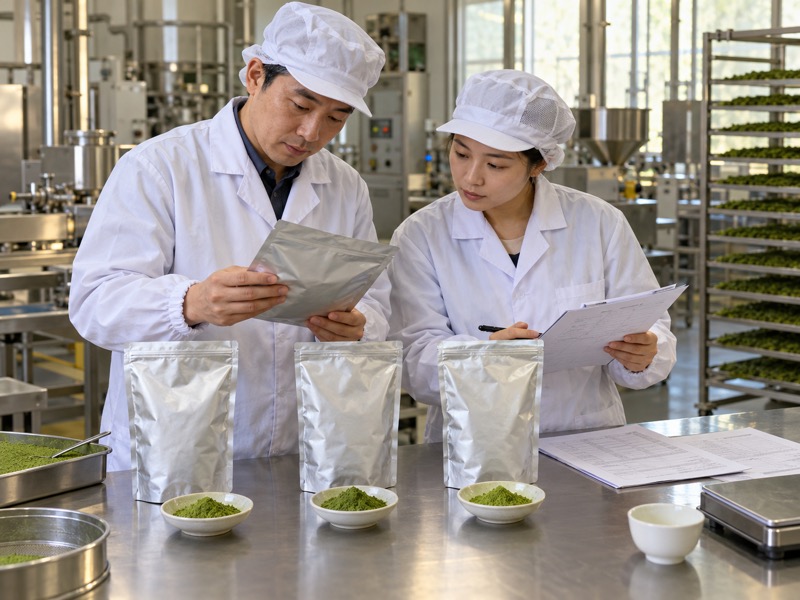
Request two or three candidates in plain, coded pouches with a specification for each. The tasting team should not know the supplier or price during the first round. Mix each candidate with the same water and milk, using the same scale and service method. Record sensory notes in plain language: fresh or stale aroma, brightness through milk, bitterness at the intended dose, and sediment after a few minutes. A numerical score is useful only when the team agrees what each score means.
Once a candidate wins, ask whether the trial pouch came from the same product and production process that the order will use. Marketing samples are sometimes packed separately from a commercial run. Keep a sealed reference pouch and its lot number; request a production-lot sample if the bulk lot will differ. A buyer who cannot link a good cup to a product code has approved a taste, not a supply program.
| Trial stage | Keep constant | Record |
|---|---|---|
| Plain cup | Water and dose | Aroma, texture, finish |
| Menu latte | Milk, size, sweetener | Colour and accepted dose |
| Service shift | Usual bar equipment | Prep time and waste |
| Lot follow-up | Approved recipe | Difference from reference |
4. Can the supplier prove origin, ingredients, and lot identity?
Check the product behind the story
Ask where the tea was grown and milled, whether the product is pure matcha or a blend, and how the lot code connects the pouch to production records. A Japanese-origin promise needs supporting records; a Chinese-origin product should be identified just as clearly. Neither origin alone tells a café how the powder will taste in its latte. Origin matters because the business must be able to substantiate what it says on menus, cartons, and invoices.
Grade names vary between sellers. Ask for an actual specification and a sample rather than accepting “ceremonial” or “premium” as a global standard. Keep product code, ingredient statement, net weight, date coding, storage advice, and the approved sample in the purchase file. If a supplier changes the origin or blend, require notice before dispatch. A silent substitution can alter both the cup and the claims the buyer has already printed.
5. Which documents must be ready for the exact shipment?
Have the local importer review a sample packet early
Ask the supplier for a product specification, ingredient statement, lot-linked test record or certificate of analysis where appropriate, commercial invoice draft, packing-list format, and any certification it intends to cite. The importer should review the proposed product and current Saudi requirements before the buyer commits to printed packaging or a large order. The Saudi Food and Drug Authority is the primary authority to consult for current food requirements; the named importer and its broker must confirm the route that applies to this product.
Check whether the product is plain foodservice powder, a retail pack, a flavoured mix, or something sold with a special claim. Those are not interchangeable dossiers. If a supplier says a certificate is available, request the actual document and confirm its scope, validity, and link to the item being purchased. Do not assume a factory-wide logo on a brochure proves a shipment-specific attribute. Use a document checklist with owner and deadline so the first missing paper is found before the goods depart.
| Record | Prepared by | Buyer check |
|---|---|---|
| Product specification | Supplier | Matches sample and pack |
| Lot test record | Supplier or lab | Lot and date align |
| Label proof | Brand or packer | Importer approves |
| Invoice and packing list | Exporter | Quantity and description align |
6. How should packaging and label proofs be checked?
Review the pouch that will be shipped
A mock-up is useful only if it represents the final food-contact pack. Confirm material, barrier properties, seal, unit size, case count, lot marking, and how cartons identify the product. A large pouch may lower packaging cost while exposing open matcha to air for too long at a low-volume store. A chain may prefer smaller sealed inner pouches inside a larger case so each store opens stock at a manageable pace. Ask the supplier to demonstrate the packed product, not just send a flat artwork PDF.
Send every claim and language version to the local reviewer before printing. The importer should check current Saudi labeling requirements for the product category. Confirm that the name, ingredients, net quantity, dates, origin statement, and any certification claim agree across the pouch, carton, invoice, and test record. If a brand will repack locally, decide which business keeps the link from the incoming lot to the finished packs. Traceability disappears quickly when bags are opened and relabeled without a batch log.
7. What order size fits the business rather than the supplier’s price ladder?
Turn cup sales into a realistic purchase schedule
Estimate monthly matcha demand from actual drinks sold and the accepted grams per cup. Add waste from bar trials and training, then compare that figure with pouch size, minimum order, supplier lead time, and remaining shelf life on arrival. A discount for a six-month purchase is weak if the last pouches may lose their best flavour before use. Ask whether the MOQ can be split by grade or pack, and whether a recurring purchase agreement can hold pricing without forcing one oversized shipment.
Test a slow month as well as a busy one. New menu launches often overestimate demand; a successful promotion can do the opposite. State the reorder trigger in kilograms on hand and expected weeks of cover, rather than waiting for the last pouch. Include time for supplier preparation, shipping, local entry, and store distribution. A buffer should be based on those measured stages, not a generic “two weeks.”
| Planning input | Example method | Decision it supports |
|---|---|---|
| Accepted dose | Grams per menu cup | True powder demand |
| Monthly cups | Store sales records | Order rhythm |
| Pack life after opening | In-store pilot | Inner pouch size |
| Observed lead time | Pilot shipment | Reorder point |
8. What is the landed cost per accepted cup?
Put all quotes on the same delivery basis
Ask each supplier for currency, price per net kilogram, pack size, MOQ, lead time, delivery term, and what the quotation includes. Ask the local importer or broker for current freight and entry charges for the proposed route. Do not copy a duty or tax figure from an article into a purchase budget; classification and treatment should be confirmed for the actual product. Include testing, storage, and any local distribution cost when comparing direct import with a delivered distributor quote.
Divide the landed cost by accepted servings at the tested dose. If one powder needs three grams and another gives the same accepted cup at two grams, a simple kilogram comparison can reverse the result. Add waste from clumped drinks and pouches that cannot be used before the approved quality window. This is a working estimate, not a guarantee of margin; recalculate it after the pilot shipment with actual invoices and drink records.
9. What should the first commercial shipment prove?
Run a pilot with clear acceptance steps
Set a pilot quantity that several stores can use without creating months of exposure. Before it ships, agree on the lot, pack, documents, expected transit window, and how the receiving team will record damage or discrepancy. On arrival, check the outer cases, seals, lot codes, and quantity against the papers. Taste a sample from the arriving lot using the approved recipe. A paper-compliant shipment may still produce a drink that the team would not have chosen.
Keep a short issue log: what happened, affected lot, photographs of the pack where useful, who was notified, and how the supplier resolved it. If the pilot arrives late, identify whether the delay came from production, transport, documentation, or local receiving. That distinction matters when setting the next reorder point. A successful pilot gives the buyer evidence that the whole route works, not merely that a carton can cross a border.
10. How can a buyer keep the second and tenth orders consistent?
Turn approval into a repeatable specification
Maintain a one-page scorecard for flavour, accepted dose, traceability, document completeness, seal condition, delivered cost, and response time. Weight the fields according to the business. A signature unsweetened drink will be highly sensitive to a change in tea profile; a distributor may need more pack flexibility and reliable documentation across several clients. Give points only for evidence already seen. Ask the supplier to notify the buyer before changes in origin, blend, packaging, processing site, or test method.
Review the scorecard after each early lot. If the cup drifts, hold a sealed sample and compare it with the approved reference under the same recipe. If cost rises, separate powder price, freight, and dose changes before renegotiating. A strong supplier relationship still needs an exit plan: a second qualified source or a temporary menu adjustment protects the business if a lot fails. The best wholesale program is one the stores can keep serving consistently without a fresh investigation every month.
| Measure | Proof to keep | When to revisit |
|---|---|---|
| Cup performance | Approved and arriving-lot samples | Every lot early on |
| Documentation | Shipment packet | Before dispatch |
| Cost per cup | Invoices and tested dose | Each quote change |
| Reliability | Dispatch and receipt dates | Each reorder |
Frequently asked questions
Q1: Should a small Saudi café import matcha directly?
Compare the full delivered cost, minimum order, storage capacity, and administrative work with a local distributor before choosing.
Q2: Is “ceremonial grade” enough to approve a supplier?
No. Taste the exact product in your menu drink and keep a lot-linked specification and reference sample.
Q3: Who confirms Saudi import and label requirements?
The named local importer should check current official requirements for the exact product and route, with its broker where needed.
Q4: How do I compare a direct quote with a distributor price?
Compare landed cost per accepted cup, including freight, local charges, pack waste, and the dose that makes the finished drink work.
Q5: What should trigger a supplier change?
Repeated lot drift, missing documents, damaged packs, or a failure to resolve problems against the agreed specification justify a review.