
Matcha white chocolate chip cookies combine powdered green tea, a butter cookie base, and white chocolate pieces. For a bakery buyer, getting color, flavor, spread, and chip distribution to hold across batches takes a written specification. This guide gives a pilot formula and a testing process based partly on King Arthur Baking’s cookie spread guide. Final acceptance ranges must come from your line trials.
Contents
- What defines a good commercial matcha cookie?
- Which ingredients belong in a starting formula?
- How should you choose matcha for cookies?
- How do you mix dough without losing control?
- How do you control spread and portion weight?
- What bake profile protects texture and color?
- How do you test shelf life and packaging?
- Which variations suit different sales channels?
- What should a supplier specification include?
- How should a buyer approve the cookie for launch?
1. What defines a good commercial matcha cookie?
Decide what the customer should notice
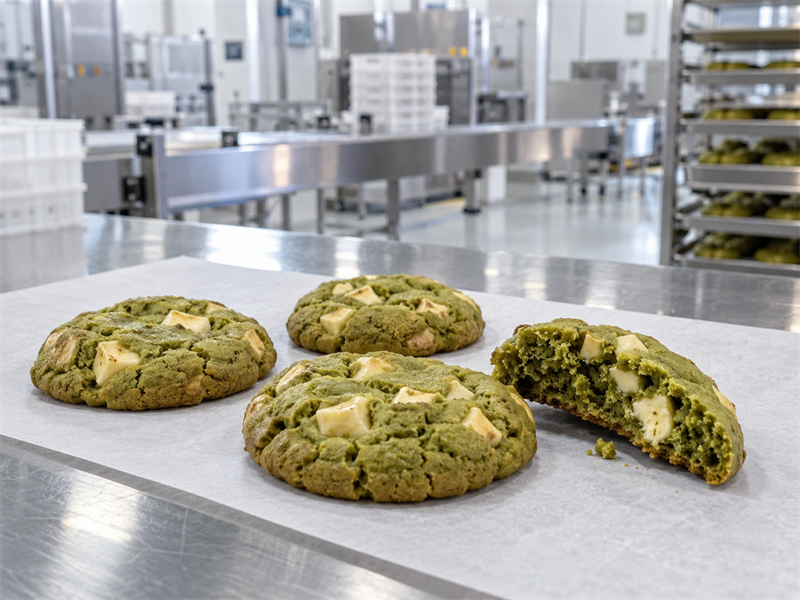
A useful target has four parts: visible green crumb, recognizable tea flavor, clean butter aroma, and white chocolate that adds sweetness without burying the matcha. Write those targets down before adjusting ingredients. A café may want a soft center and a large cookie that holds in a display case. A packaged snack brand may favor a drier bite that survives shipping. Both products use the same keyword, yet they need different moisture and packaging decisions.
Here is the practical test: Cut a cookie in half after it cools. Record outer and inner color, spread diameter, center texture, and whether chocolate sits evenly across portions. Taste it on day one and after the proposed sale period. A photograph under fixed lighting exposes color drift that memory misses.
Set an acceptance range instead of an attractive description alone. Choose a target piece weight, diameter window, and reference color sample after pilot runs. These are project specifications, not universal matcha cookie standards. If the team cannot distinguish a good trial from a failed trial using written criteria, the specification needs another round.
| Buyer channel | Desired bite | Main failure to watch | Approval sample |
|---|---|---|---|
| Café counter | Soft center | Staling on display | Same-day and next-day cookie |
| Packaged retail | Stable texture | Moisture pickup or breakage | Packed shelf-life samples |
| Frozen dough | Repeatable bake | Spread variation | Multiple oven trays |
2. Which ingredients belong in a starting formula?
Use a controlled pilot
A pilot formula lets a development team compare matcha lots without changing every other variable. Start with a conventional drop-cookie base: flour, butter, sugar, egg, leavening, salt, matcha, and white chocolate. This table gives trial quantities per 1,000 g flour. It is a development example, not a validated commercial recipe. Adjust it for local flour, chip size, equipment, and finished product targets.
| Ingredient | Pilot amount per 1,000 g flour | Function |
|---|---|---|
| Butter | 700 g | Flavor and spread |
| Sugar, total | 650 g | Sweetness, browning, texture |
| Whole egg | 250 g | Binding and structure |
| Matcha | 45 g | Tea flavor and green color |
| Baking soda | 8 g | Spread and lift |
| Salt | 12 g | Flavor balance |
| White chocolate pieces | 650 g | Sweet inclusions |
Keep one variable moving: Compare 35 g, 45 g, and 55 g matcha while holding everything else steady. Then test chocolate loading or sugar. This isolates the cause of a bitter finish, weak green color, or excessive sweetness. Record ingredient brands and lots; switching white chocolate can change sweetness and melt behavior even when its weight stays the same.
Weigh the mix rather than relying on cups. A small bakery can use the ratios as a worksheet. A factory should convert them into an approved batch sheet with ingredient tolerances, mixing order, and yield checks. Do not call the formula production ready until it passes sensory, safety, and shelf-life review.
3. How should you choose matcha for cookies?
Compare performance in the baked matrix
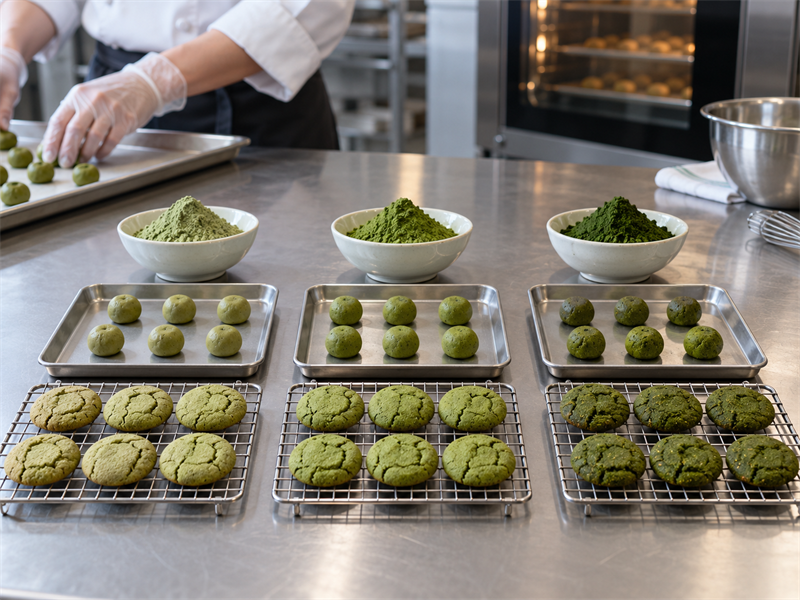
Dry powder color alone does not predict cookie color. Butter, sugar, flour, oven heat, and chocolate all change what a buyer sees. Prepare the same dough with two or three candidate matcha lots and bake them together. Compare top surface and broken crumb after complete cooling. A deeper raw green can still appear dull once baked, so visual checks belong in the finished cookie.
Ask for the evidence behind the sample: Request ingredient identity, country of origin, lot code, storage guidance, certificate of analysis, and the testing scope relevant to your market. Matcha Village’s stated portfolio includes culinary and premium grades, but grade names are commercial labels rather than guaranteed baking results. Choose through trials against target color and flavor.
Research on Tencha color characteristics links processing conditions and chlorophyll to color quality in matcha’s raw tea material. It does not establish a fixed color outcome in every recipe. Use it as background and rely on bake trials. Store samples away from light, heat, moisture, and strong odors during evaluation so handling differences do not distort a supplier comparison.
Build a sensory scorecard
Have several consistent tasters score appearance, tea aroma, bitterness, aftertaste, and chocolate balance. Blind-code samples. If sales prefers vivid green while bakery prefers gentler tea flavor, keep both scores visible.
4. How do you mix dough without losing control?
Write a repeatable sequence
Bring butter to a temperature your mixer can cream consistently. Mix butter and sugar to an agreed appearance rather than using an arbitrary time alone. Add eggs gradually, scraping the bowl between additions. Preblend matcha with flour and leavening before adding dry ingredients so powder does not gather in bitter green pockets. Fold in white chocolate near the end to avoid crushing pieces or overworking dough.
Watch the mixer, not just the clock: Bowl loads and paddle speeds change the result. Record starting and finishing dough temperature; photograph mixed dough. If portions slump before baking, investigate butter temperature and mixing energy before adding flour. More flour may fix shape while leaving the cookie dry.
Compare immediate baking with dough held under intended production conditions. King Arthur Baking describes chilling as one way to control spread in its cookie dough guidance. Your product needs its own rest-time window.
| Control point | Pilot record | Action if result drifts |
|---|---|---|
| Butter condition | Temperature and appearance | Reset preparation method |
| End dough condition | Temperature and consistency | Review mixing time and load |
| Chocolate distribution | Pieces per sample portion | Review fold-in method |
| Rest interval | Time and holding temperature | Compare spread by interval |
5. How do you control spread and portion weight?
Treat portioning as part of the recipe
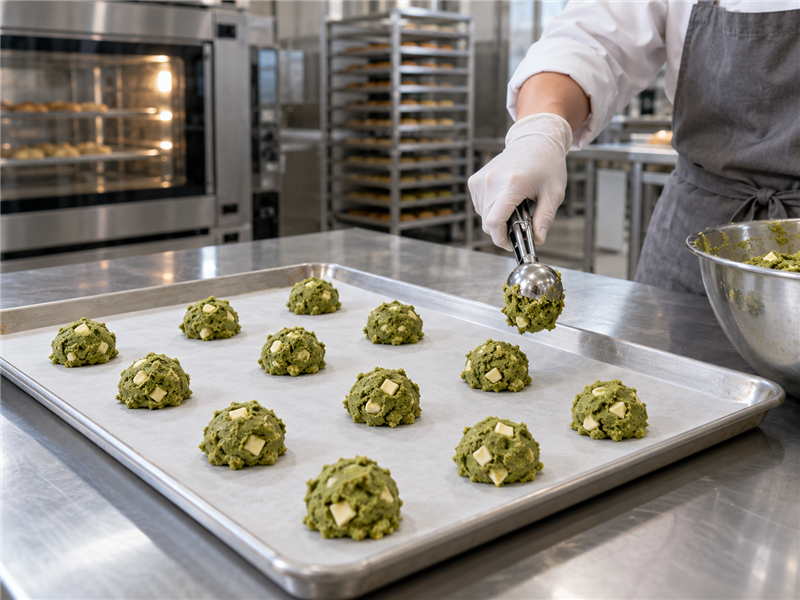
Two cookies made from one dough can look like different products if one weighs substantially more. Use a scoop or depositor setting, weigh several consecutive portions, and check the spread of weights. Inspect whether larger chocolate chunks cause some portions to carry more inclusions. Do not judge a batch from one photogenic cookie.
A quick diagnostic: Bake one tray with measured portions at even spacing. Log dough temperature, pan type, liner, rack position, bake time, and final diameter. Repeat on another tray and another day. If a cookie spreads too far, test chilled dough or cooler starting dough before changing the formula. If it stays too thick, check whether dough was overchilled, portions too large, or flour measurement inconsistent.
King Arthur Baking lists several spread drivers in its troubleshooting guide. Use that as a checklist, not a substitute for line data. For frozen dough, validate the bake instructions from frozen and after thawing if both routes will be offered. A café operator needs a simple instruction card with portion size, tray spacing, oven setting, and visual endpoint.
6. What bake profile protects texture and color?
Measure what comes out of your oven
Start with a bake that sets the edge while leaving the center at your specified texture. Matcha cookies can brown around the rim even when the middle stays green. Write down both signals. A temperature and time copied from a home recipe may fail in a convection rack oven, where airflow and tray load change heat transfer.
Do one change at a time: Compare two temperatures with equal portion weights, then compare bake times within the better temperature. Cool every trial on the same rack for the same interval before measuring diameter or texture. Warm cookies often seem softer than the packed product. Inspect bottoms as well as tops because dark pans can produce a browned base while the surface remains pale.
Use a check that a production operator can carry out: edge set, center appearance, a weight-loss range established by trials, and an agreed defect photo. A validated food-safety plan may require controls depending on ingredients and process; appearance alone cannot establish microbiological safety. Retain records for each approved bake profile. When a supplier changes flour, fat, matcha, or chocolate, repeat enough of the bake test to confirm the profile still works.
| Bake observation | Possible process cause | Next trial |
|---|---|---|
| Brown rim, dull green center | Excessive heat exposure | Reduce bake intensity, verify doneness |
| Pale, fragile cookie | Underbake or weak structure | Check time and formula |
| Dark underside | Pan or rack effect | Compare lighter pan or rack position |
| Uneven diameter | Portion or dough temperature | Audit both before reformulating |
7. How do you test shelf life and packaging?
Design a test around the route to sale
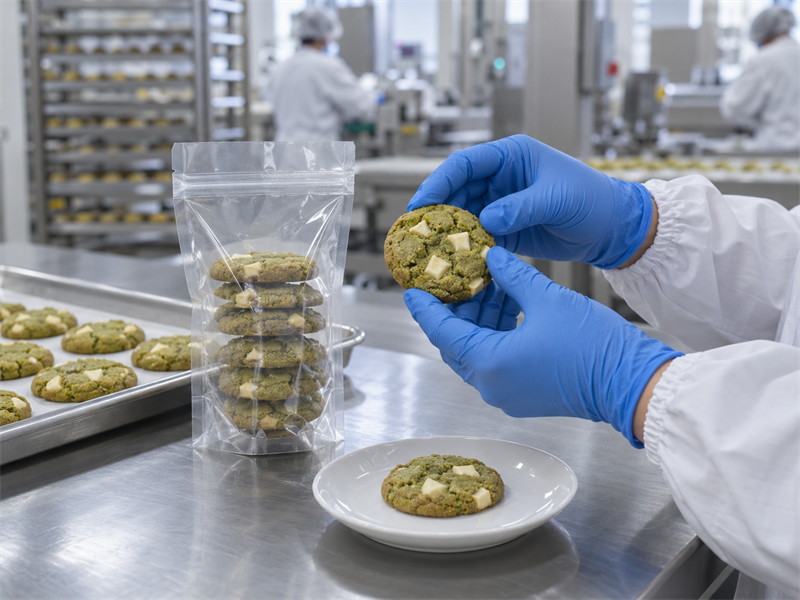
A shelf-life statement needs evidence from actual packaging, storage, and distribution. Pack pilot cookies in proposed film or cartons, then inspect them at planned intervals for texture, aroma, appearance, breakage, and food-safety criteria set by your quality team. Keep a retained control under intended conditions. Do not infer a month-long shelf life from a cookie that tastes fine the next morning.
Look at the whole pack: A clear window may showcase green color, yet light exposure can change how the product looks on shelf. A loose tray can create chipped edges in transit. An overly tight pack can damage white chocolate decoration. Run a transport simulation or actual route sample with the retail format rather than choosing packaging from a catalog image.
This example formula includes wheat, milk, and egg. The U.S. FDA allergen guidance identifies them as major allergens for U.S. labeling. White chocolate may introduce soy through lecithin, depending on its specification. Confirm the actual ingredient list and cross-contact controls with your regulatory team for every destination market. A supplier’s generic ingredient sheet cannot replace final label review.
8. Which variations suit different sales channels?
Change one business constraint at a time
A café cookie can carry large white chocolate chunks because the customer sees and eats it quickly. A packaged snack may need smaller chips for reliable portioning and less breakage. A frozen dough program needs portions that bake consistently at customer sites. A private-label brand may need an allergen and organic claim strategy before design work begins.
Use this decision grid: Specify channel, pack, target price, portion weight, and desired shelf life before asking for flavor variations. Lemon zest, toasted nuts, or darker chocolate can be attractive, but each changes sourcing, labeling, and sometimes moisture behavior. Nuts bring additional allergen considerations. Do not add a variant because it looks good in a photograph if it complicates a launch near its cost ceiling.
For an organic claim, ingredient and final-product rules need review. The USDA organic labeling page explains that a finished packaged product making an organic claim generally needs certification and approved labeling. Buying certified organic matcha alone does not automatically make the cookie organic. Test the commercial value of an organic line separately from the base formula.
| Channel | Format choice | Formula question | Operational question |
|---|---|---|---|
| Café | Large fresh cookie | How much tea flavor survives service? | Can staff bake consistently? |
| Retail bag | Smaller pieces | Does texture hold in pack? | What breakage rate is acceptable? |
| Frozen dough | Preportioned pucks | Does frozen bake match pilot? | Are instructions simple? |
| Gift box | Decorated pieces | Does color remain attractive? | Does packing protect edges? |
9. What should a supplier specification include?
Ask for a comparable sample pack
A matcha quotation without an application target leaves too much to guess. Tell the supplier you are making matcha white chocolate chip cookies. Share desired color, flavor intensity, inclusion range, estimated volume, destination market, and organic documentation needs. Ask for identified lots and the documents needed for approval.
Make the paperwork useful: Request a current specification, lot-linked certificate of analysis, allergen statement, origin statement, shelf-life and storage instructions, and market-specific testing agreed with your quality team. If you plan to import into the United States, coordinate with your importer on applicable FDA Foreign Supplier Verification Program requirements. Requirements vary with importer role and product, so review belongs with the importer.
Matcha Village describes a portfolio covering bulk matcha, blends, and private-label products. For this cookie, begin with bulk powder and a bake test. Ask the supplier to explain lot consistency and lead time against your forecast. Treat its stated capacity and certifications as claims for procurement verification: request current documents tied to the supplied product and facility before putting them into customer-facing copy.
10. How should a buyer approve the cookie for launch?
Build a small approval gate
Give product development, quality, purchasing, operations, and sales the same pilot batch record. Development checks taste and texture. Quality reviews ingredients, allergens, and shelf-life protocol. Purchasing confirms price, minimum order, lead time, and backup supply. Operations checks whether a normal shift can hit portion and bake targets. Sales confirms the finished cookie fits the channel promise.
Before signing off: Repeat the approved formula with a separate matcha lot and, where possible, a normal production crew. A result that works only with one sample bag or one expert baker is not a stable product. Record any allowed adjustment, such as a narrow matcha inclusion range, and specify who can authorize it. Photograph accepted and rejected cookies under the same lighting.
The next purchase order should reference a product code and agreed specification, not a chat description of “bright green matcha.” Request a retained sample for the incoming lot and check it against the approved bake. Once the bakery sees consistent results, expand volume in planned steps. Matcha Village can discuss matcha grade and documentation with a buyer, but the commercial cookie formula and label remain the buyer’s responsibility.
For a launch decision, compare finished cookies from identified matcha lots under the same recipe and bake conditions. Then ask Matcha Village for samples and lot-specific documents that match your market. A cookie that passes that test gives purchasing and production a shared basis for the next order.
FAQ
Q1: Can culinary matcha work in matcha white chocolate chip cookies?
Yes, if a finished-cookie trial meets color and flavor targets. Grade names alone do not guarantee performance.
Q2: Why did my matcha cookies spread too much?
Check portion weight, dough temperature, butter condition, pan, and bake profile before altering flour.
Q3: How much matcha belongs in the dough?
Use a controlled trial range; the 35–55 g per 1,000 g flour range above is a pilot example, not a universal specification.
Q4: Does organic matcha make the finished cookie organic?
No. Review final-product composition, handling, certification, and labeling rules in the destination market.
Q5: What should I send a matcha supplier?
Send your application, target color and flavor, expected volume, destination market, and required quality documents.