
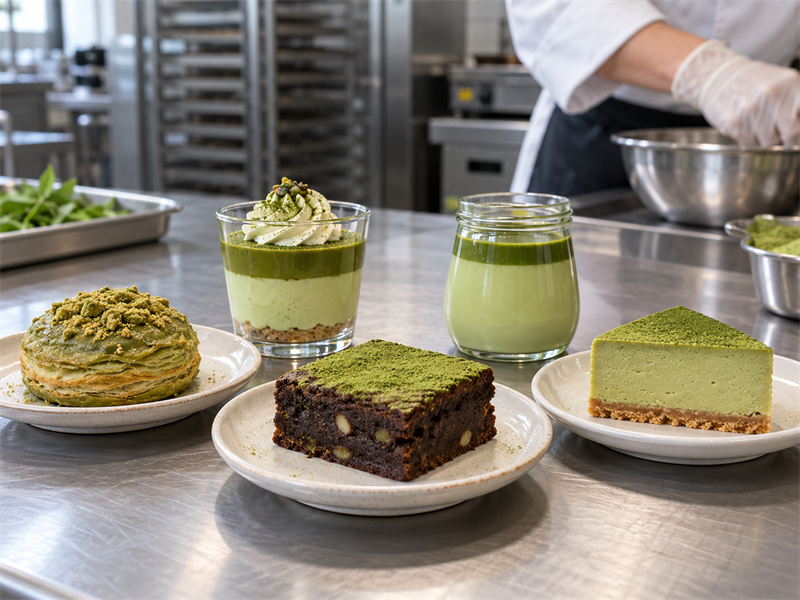
Matcha dessert recipes use powdered tea for green color and tea flavor. For a bakery, dessert chain, or packaged-food buyer, the best recipe works in its production and sales channel. These five pilot concepts help a team move from an idea to a documented trial.
Set the brief before the menu: Choose format, serving size, expected storage, target cost, and intended market before requesting samples.
Contents
- What should a matcha dessert brief contain?
- Which matcha suits each dessert process?
- How can a bakery pilot matcha shortbread?
- How can a café pilot a matcha mousse cup?
- How can a manufacturer pilot matcha brownies?
- How can a dessert shop pilot matcha custard?
- How can a brand pilot matcha cheesecake bars?
- How should teams evaluate sweetness and color?
- What safety and label checks follow recipe approval?
- How should a buyer brief a matcha supplier?
1. What should a matcha dessert brief contain?
Define the selling situation
The same matcha dessert can be excellent in a plated service and poor in a sealed retail cup. A chef can correct presentation at the pass; a manufacturer needs every portion to survive filling, sealing, storage, and distribution. State whether the product will be baked, chilled, frozen, or displayed ambient. Then state portion weight, target sale period, serving temperature, packaging, and a sensory description specific enough for tasters to score.
A useful buyer question: What failure would make this dessert unsellable? For a mousse, it may be water separation or weak tea flavor after chilling. For a shortbread, it may be breakage or dull color. For a cheesecake bar, it may be a cracked surface after freeze-thaw. Writing those risks beside the recipe keeps development work focused.
Treat these quantities as unvalidated bench-trial starting points. Run controlled trials, retain samples, and approve a version after quality and operations review. Decide whether matcha leads the flavor or supports it; that choice changes inclusion rate and sweetness balance.
| Brief item | Record it as | Why it changes the trial |
|---|---|---|
| Channel | Café, foodservice, or retail | Service and pack conditions differ |
| Process | Baked, chilled, or frozen | Heat and storage affect color and texture |
| Sensory target | Color reference and flavor notes | Prevents subjective sign-off |
| Sale period | Tested duration and temperature | Guides shelf-life study |
2. Which matcha suits each dessert process?
Test powder inside the finished matrix
Matcha labeled “ceremonial” is not automatically the best choice for a baked dessert. Grade labels differ among suppliers and do not define a universal processing standard. A rich cream filling can mute delicate tea notes; an oven can change green appearance. Prepare the same base with identified matcha lots, keep inclusion constant, and compare finished products at the temperature customers will experience.
Run the comparison blind: Score color, tea aroma, bitterness, sweetness balance, and mouthfeel. Put cost per finished serving beside sensory scores. A more expensive powder may make sense in a lightly sweetened mousse but offer little visible benefit in a cocoa-rich brownie. The opposite can also happen if a lower-cost powder turns brown or tastes harsh.
Research on Tencha processing and color helps explain why raw-material handling affects green color. It does not predict the outcome in your custard or cake. Ask suppliers for lot codes, storage advice, current specifications, and application samples. If the product will be sold with an organic claim, confirm the claim route for the finished dessert rather than assuming an organic matcha ingredient settles it.
| Dessert | Matcha challenge | Best comparison point |
|---|---|---|
| Shortbread | Heat and butter can mute green | Broken, cooled cookie |
| Mousse | Dairy can soften tea flavor | Chilled cup at service temperature |
| Brownie | Cocoa can dominate | Center after cooling |
| Custard | Powder can clump | Smooth spoonful after chill |
3. How can a bakery pilot matcha shortbread?
Begin with a simple ratio
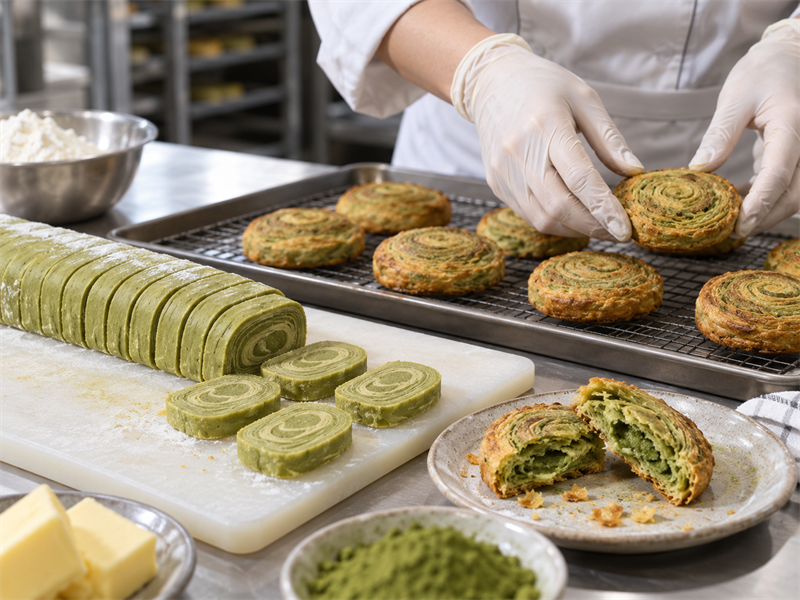
A workable bench concept uses 1,000 g flour, 650 g butter, 350 g powdered sugar, 35–50 g matcha, and salt adjusted to the bakery’s base recipe. Mix matcha with flour before it meets butter. Cream or rub the fat and sugar using a consistent method, then mix dry ingredients only until the dough comes together. Shape to a fixed thickness, chill if the dough softens, and bake on the same pan type for every comparison.
Check the broken biscuit: Its center color, aroma, and short bite matter more than raw dough appearance. Compare edge browning and breakage after cooling. If cookies spread or lose definition, test dough temperature and pan conditions before adding extra flour. King Arthur Baking’s cookie spread guide offers useful diagnostic variables, though a shortbread still needs its own line trial.
For retail, test the proposed sleeve or tray because brittle shortbread may break in transit. For cafés, compare a fresh cookie with one held under counter conditions. White chocolate drizzle changes sweetness, labor, and milk-allergen labeling. Keep the plain version as a control.
4. How can a café pilot a matcha mousse cup?
Protect dispersion and chilled texture
For a bench concept, start from an approved plain mousse base rather than inventing a stabilizer system. Trial 20, 30, and 40 g matcha per 1,000 g finished base. Sift powder, disperse it in a small measured portion of liquid, then blend it into the main base before aeration or filling. This sequence helps avoid visible specks. Record mixing order because the same ingredients can give different texture when added differently.
Taste it cold: Tea flavor and perceived sweetness can shift after chilling. Fill several cups at the intended weight; compare top color, airiness, liquid separation, and spoon texture after the planned display period. A café may add fruit or white chocolate, but each topping should be tested for water transfer and color contrast. Strawberries, for example, can release juice into a mousse layer; keep them separated or validate the assembled cup.
Because mousse often contains dairy and may contain egg, refrigeration and handling require a documented food-safety procedure. The USDA temperature guidance explains why perishable food cannot be left warm for extended periods. Set your actual cooling, holding, and discard rules under local requirements and product validation. Do not borrow a shelf life from another café’s cup.
5. How can a manufacturer pilot matcha brownies?
Keep cocoa and matcha in balance
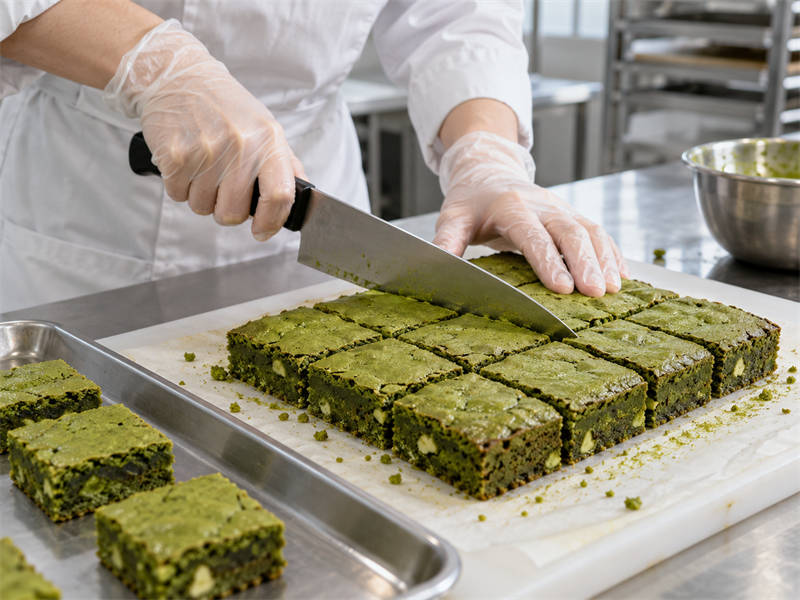
A conventional dark chocolate brownie can overpower subtle tea flavor. A blondie-style base gives matcha more room: use an approved butter, sugar, egg, and flour formula, then trial 30–50 g matcha per 1,000 g flour. White chocolate can reinforce a sweeter profile; a dark chocolate swirl creates visual contrast but may mask tea in every bite. Run each version separately rather than changing chocolate and matcha at once.
Check the center after cooling: Brownies firm as they cool. Measure portion dimensions and weight loss after a fixed cooling time. Look for green streaks, dense pockets, and uneven inclusions. The product should be scored at its selling temperature, especially if it will be shipped chilled or frozen. A warm tasting at the bench can misrepresent the final packaged bar.
Test cutting and packaging early: a soft center may stick to knives, while a dry bar may crumble. Decorative swirls can slow a production line. Review the final allergen declaration for nuts, milk, egg, wheat, or soy. The FDA’s U.S. allergen list is a starting reference; each destination market needs its own check.
| Brownie choice | Likely benefit | Trial risk |
|---|---|---|
| Blondie base | Tea flavor remains clear | Can taste too sweet |
| Dark cocoa base | Familiar chocolate profile | Matcha may disappear |
| White chocolate pieces | Visible sweet contrast | Uneven portioning |
| Matcha swirl | Strong visual cue | Extra mixing and labor |
6. How can a dessert shop pilot matcha custard?
Make a smooth control before flavor changes
Use a house custard whose cooking and cooling process already works. Sift matcha into sugar or a small portion of cool liquid before adding it to the batch. This reduces dry clumps. Trial several inclusion levels, such as 15, 25, and 35 g per 1,000 g finished custard, while holding egg, dairy, starch, and sugar constant. Those numbers are development points, not a published standard.
Check it after the chill: A smooth hot custard may separate or form a skin after filling. Inspect spoon texture, surface color, and flavor at the planned serving temperature. If matcha settles, review dispersion and viscosity before raising inclusion. Higher matcha may increase visible particles without improving consumer preference. Compare opaque and clear cups because packaging changes how green the custard looks.
For service, write a cooling and holding plan with the quality team. Keep filling equipment, cup seals, and any toppings in the study. If a biscuit crumb sits on top, test whether it stays crisp. If fruit sits beneath the custard, look for liquid migration or color bleeding. The formula is only one part of a saleable dessert; the assembled cup must pass the same review.
7. How can a brand pilot matcha cheesecake bars?
Test baked and no-bake paths separately
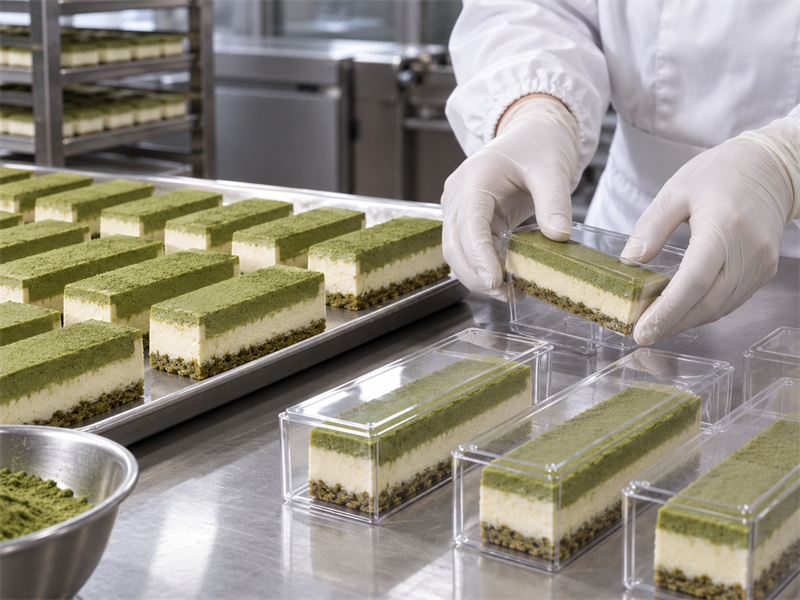
A baked cheesecake and a no-bake cheesecake are different products. The baked version faces oven color change and crack risk; the chilled version depends on setting and cold-chain control. For a baked bench trial, add 20–40 g matcha per 1,000 g plain filling and compare fully cooled bars. For a chilled version, begin with a validated house base and test matcha at the same measured inclusion range. Do not treat either range as final without sensory work.
Look after portioning: Matcha cheesecake often looks attractive as a whole slab but gives uneven edges when cut. Record cutting temperature, knife condition, bar weight, and crust adhesion. If the product will be frozen, run a freeze-thaw test in its real pack. A creamy bar that weeps after thawing will not be rescued by a brighter powder.
Crust choice affects claims and allergens. A wheat biscuit crust, a nut base, and a gluten-free certified crumb carry different purchasing and label requirements. The FDA allergen guidance outlines U.S. major allergens and cross-contact concerns. Request exact specifications for crusts, fillings, and toppings before approving artwork. Matcha itself should be evaluated as an ingredient in the whole bar, where cream cheese and sugar can soften its aroma.
8. How should teams evaluate sweetness and color?
Use the same scoring conditions each time
Taste all samples at the intended serving temperature and in the same order or a randomized order agreed by your panel. A chilled mousse, room-temperature shortbread, and frozen bar will not express flavor alike. Score sweetness, tea aroma, bitterness, texture, and aftertaste separately. Ask tasters to describe what they perceive rather than vote only for a favorite.
A score without context can mislead: A very sweet sample may win a quick spoon tasting but feel heavy as a full portion. Serve the planned portion size before approval. Photograph color under fixed light and with a neutral background. Digital images are useful records, but a printed or physical reference should guide a supplier conversation when screen settings differ.
Changing matcha grade, matcha dose, sugar, dairy, and bake profile together makes results hard to interpret. Keep a batch sheet with version numbers and one primary change per trial. If a dessert improves, the team should know why. If a batch fails, that record prevents the same mistake at the next factory trial.
| Score | What the panel should describe | Decision trigger |
|---|---|---|
| Tea flavor | Clear, weak, harsh, or grassy | Adjust matcha sample or dose |
| Sweetness | Balanced across full serving | Adjust base before topping |
| Color | Inner and surface green | Compare process and storage |
| Texture | Crisp, creamy, dense, or separated | Review method and holding |
9. What safety and label checks follow recipe approval?
Review the final product, not only the tea
Matcha dessert recipes combine multiple suppliers and processes. Before launch, quality should review ingredient specifications, allergen sources, process controls, storage, shelf-life evidence, and packaging. Wheat, milk, egg, soy, and nuts can enter through bases or toppings. Their presence depends on the actual recipe; do not copy an allergen statement from a different product.
Put the claim on trial too: “Organic matcha” on an ingredient sheet does not automatically permit “organic cheesecake” on a pack. The USDA organic labeling rules explain how final-product composition and certification affect U.S. claims. Other markets use their own rules. Assign the label review to the team responsible for the destination market before packaging artwork is approved.
If the company imports matcha into the United States, the importer should determine whether FDA Foreign Supplier Verification Program requirements apply. Request lot-linked documentation from the tea supplier and retain it with the production record. If a supplied lot changes in aroma or color, hold it for an application check before using it in a finished batch. Claims about health benefits or nutrient content require their own substantiation and should not be improvised from matcha’s reputation.
10. How should a buyer brief a matcha supplier?
Send the application and the decision criteria
Tell Matcha Village which dessert will be made, its process temperature, intended inclusion range, target color, flavor profile, packaging, expected volume, and destination market. Ask for two or three identified matcha samples with current specifications and certificates relevant to your approval process. If the dessert needs a blend or private-label pack, say whether you need ingredient supply, a mixed base, or finished packaging; these are different commercial requests.
Make sample feedback actionable: Instead of saying “not green enough,” send a fixed-light image and the recipe version, bake or chill condition, and comparison sample. Note whether the problem appeared immediately or after storage. The supplier can then recommend a different grade, while your team checks whether process changes are the real cause.
Matcha Village’s company materials describe culinary and premium matcha, blends, and OEM support. Treat stated capabilities and certifications as procurement claims to verify with current facility and product documents. Agree on minimum order, lead time, sample-to-production continuity, and the rule for approving a new lot. A clear brief will save more development time than a long list of dessert ideas with no channel or price target.
| Supplier question | Document or test to request |
|---|---|
| Will production match the sample? | Identified lot and change procedure |
| Can the volume be supplied? | Lead time and order terms |
| Is the ingredient suitable? | Application trial and specification |
Choose one matcha dessert recipe for a controlled pilot, then test it in the pack and service conditions customers will see. Send Matcha Village that application brief and ask for identified samples. The best next step is a measured trial, not a larger collection of untested flavors.
FAQ
Q1: Which matcha dessert recipe is easiest for a bakery to pilot?
Shortbread is a practical starting point if the bakery already controls a plain shortbread formula and pack.
Q2: Should every dessert use the same matcha grade?
No. Compare identified lots in each finished matrix and choose against color, flavor, cost, and supply targets.
Q3: How much matcha should a pilot use?
Use measured ranges like those above, then adjust through controlled trials. No single inclusion rate fits all desserts.
Q4: Can organic matcha make an organic dessert claim?
Only if the finished product meets applicable composition, handling, certification, and labeling rules.
Q5: What documents should a supplier provide?
Ask for a current specification, lot-linked analysis, origin and allergen statements, storage guidance, and market-specific documents.