
A matcha mille crepe cake wins attention through its thin, even layers. That same structure makes the dessert labor-intensive and sensitive to crepe thickness, filling amount, chilled holding, and powder choice. A bakery buyer needs more than a home recipe: the team must define a repeatable cake, control food safety, and cost each sellable slice. This guide turns the dessert into a practical production brief for cafés, pastry shops, and dessert chains.
Contents
- What is a matcha mille crepe cake?
- Which matcha powder fits crepes and cream?
- How should a bakery define the finished cake?
- How can crepe thickness be kept consistent?
- Where should the matcha flavor go?
- How should cream and assembly be controlled?
- Which food-safety and allergen checks apply?
- How should the cake be stored and served?
- What does the real cost per slice include?
- What should a bakery ask its matcha supplier?
1. What is a matcha mille crepe cake?
Many thin crepes, with a distinct tea profile
A mille crepe cake stacks thin crepes with a light filling between layers. Matcha can flavor the crepes, the filling, or both. “Mille” means a thousand in French, but a cake does not contain a thousand layers. Just One Cookbook describes a typical range of about ten to twenty layers in home-style examples. Teak & Thyme’s version uses sixteen. Those examples show the range of recipe choices, not a production standard that every bakery must copy.
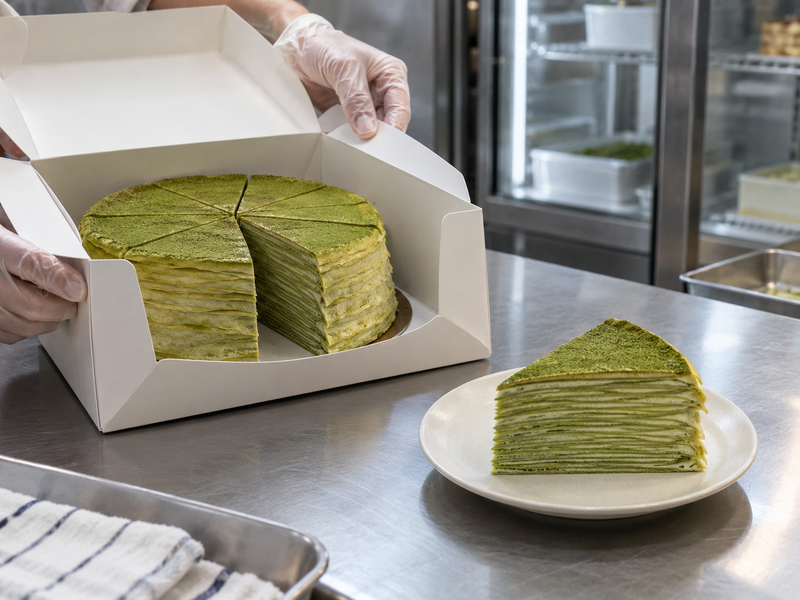
For commercial work, specify a target layer count or finished cake height, diameter, slice count, filling style, and intended service format. A tall cake with thick filling may look generous yet slide under a knife. A very thin filling can yield tidy layers but weak matcha flavor. Define the desired bite and photograph the approved cross-section. A bakery serving by the slice also needs a clean cut after chilled storage and a slice that holds its shape on a plate or in takeaway packaging.
2. Which matcha powder fits crepes and cream?
Test powder after cooking and chilling
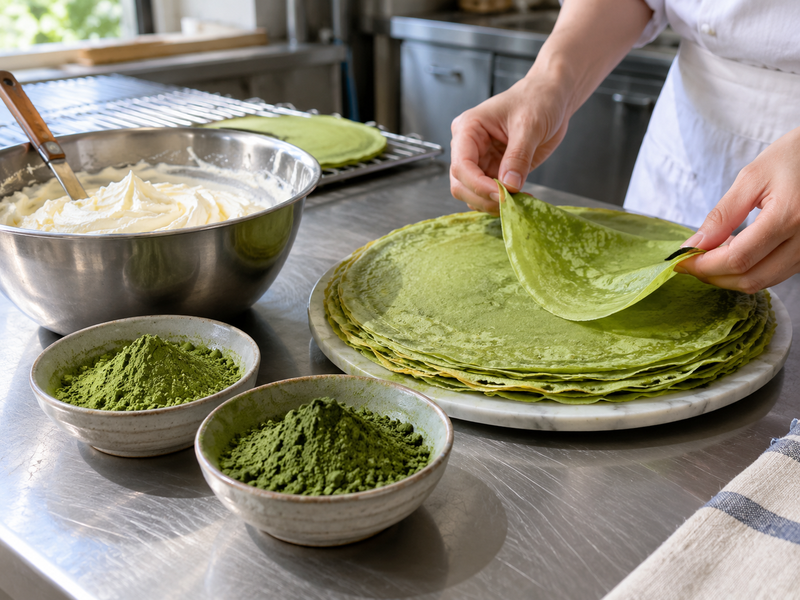
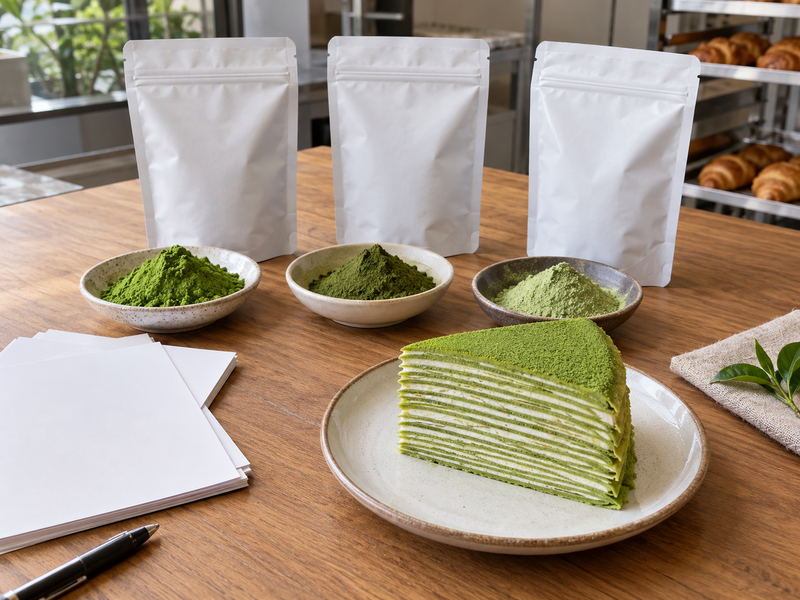
Tea powder in crepe batter faces heat, while powder in whipped cream is tasted cold and uncooked. The two positions can expose different weaknesses. Compare candidate powders in both components using the same base recipes. Rate green color after cooking, tea aroma, bitterness, and how the flavor reads beside cream and sugar. A powder selected only from dry color may disappoint after its crepe browns. Another powder may taste pleasant in cream but show specks if it is mixed poorly. A split test reveals whether one SKU can serve both components.
The Yamamasa Koyamaen processing description shows how tencha is prepared and evaluated before grinding. For procurement, request the actual candidate’s specification and lot-linked sample. “Culinary” and “ceremonial” are supplier labels, not a substitute for testing. A bakery can choose a different powder for cake than for its premium whisked tea, especially when cost and heat performance matter. Keep the tested lot and written recipe together for later comparison.
| Powder trial | Judge after | Main question |
|---|---|---|
| Crepe batter | Cooking and cooling | Does color and tea taste survive? |
| Cream filling | Chilling | Is flavor clean without clumps? |
| Complete cake | Full set time | Does the slice taste balanced? |
| Second lot | Same process | Does result remain in range? |
3. How should a bakery define the finished cake?
Write an acceptance standard that staff can see
The standard should name diameter, height range, layer-count target, portion count, slice weight or size, visible color, and acceptable layer alignment. Include a photograph taken under consistent light. A cake can meet a weight target but still look uneven if some crepes are thicker or filling gathers near the center. Define what counts as a sellable edge slice and whether the top receives a matcha dusting. Loose powder on top can look bright at service yet absorb moisture during display, so test that finish under real conditions.
Use the standard to separate quality from decoration. The cake should have tender crepes, a filling that holds between them, and a clear matcha flavor. Fruit, chocolate, or glaze are optional product variants and should receive their own tests. A chain may choose a less ornate cake that can be assembled consistently at a central kitchen. An artisan shop may accept more handwork for a plated dessert. The specification should support the business model rather than mimic a social media image.
4. How can crepe thickness be kept consistent?
Control batter, pan, and portion
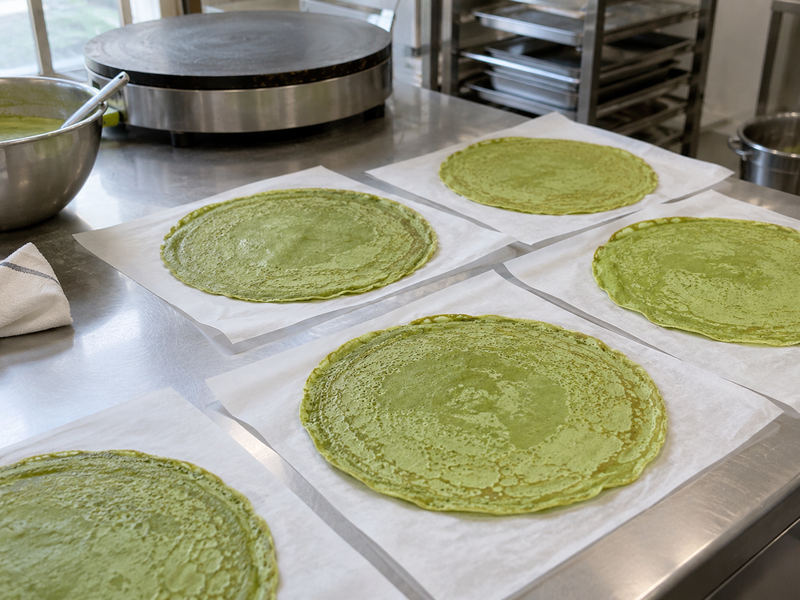
Thin crepes begin with a measured batter portion and a repeatable pan or machine setting. Record the pan diameter, batter mass per crepe, rest conditions, cooking endpoint, and cooling method. A thick crepe can turn a delicate slice rubbery; an over-thin or undercooked crepe can tear during assembly. The Teak & Thyme recipe describes sieving batter and chilling it before cooking. That is a home recipe method worth evaluating, not proof that the same time and process fit every commercial line.
Test crepes at the center and edge of the production run. Batter viscosity can change as it rests, while a pan may run hotter after prolonged use. Weigh a sample of cooked crepes and inspect diameter and browning. Staff can log rework and rejects rather than hiding them in a final stack. If crepes are made centrally and shipped chilled or frozen, validate that handling separately. Assembly staff should receive crepes that are fully cooled and easy to separate without tearing or condensation.
| Process variable | Target to define | Common defect |
|---|---|---|
| Batter portion | Mass per crepe | Uneven thickness |
| Pan or machine | Heat and diameter | Browning drift |
| Batter rest | Time and cold handling | Viscosity shift |
| Cooling | Surface and stack method | Sticking or condensation |
| Inspection | Weight and diameter sample | Hidden rejects in assembly |
5. Where should the matcha flavor go?
Choose a deliberate distribution
Matcha in the crepes creates visible green layers and gives every bite tea flavor, but heat can change the profile. Matcha in the cream delivers a fresher, more direct tea note but may show clumps if added poorly. Using both can work, as the Teak & Thyme example demonstrates, yet the bakery must balance bitterness and cost. Run three trials: crepes only, cream only, and both. Hold finished cake weight and sweetness as steady as possible so the team can attribute differences to tea placement.
Sift or disperse powder according to the tested cream process. Record how powder is incorporated, because adding it all at once to cold cream may produce flecks. If a matcha syrup is proposed, assess the extra moisture and sugar it introduces between layers. Too much liquid can soften crepes and reduce slice stability. The final cake should be tasted after its planned chill, not while components are freshly made. A buyer may find that one lower-dose design is more enjoyable than a darker green cake packed with tea.
6. How should cream and assembly be controlled?
Filling thickness affects yield and stability
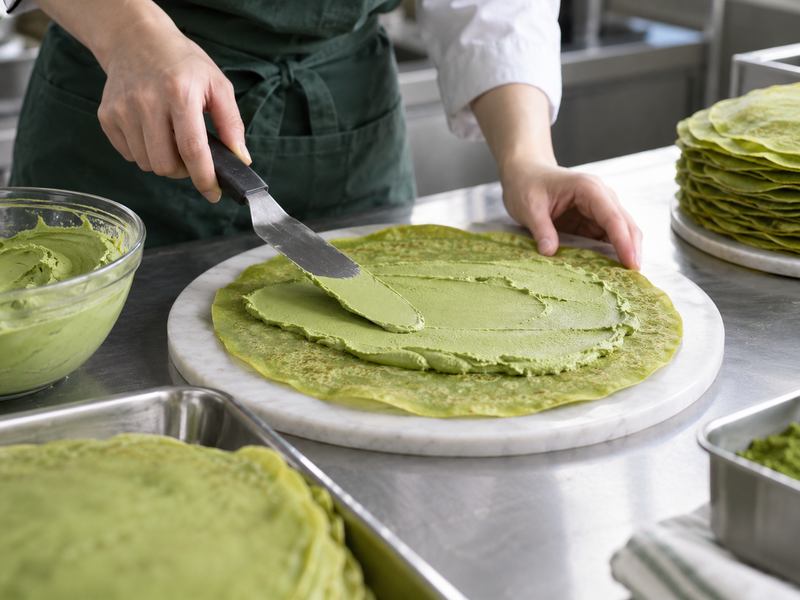
Define filling mass per layer and the number of complete layers. An offset spatula, depositor, or piping method can be standardized, but staff need a visual and measured target. Leave a deliberate edge margin if the filling spreads under the next crepe. Assemble on a stable board and check level periodically. Pressing too hard can squeeze cream to one side; too little contact leaves air gaps that weaken a slice. Photograph a cut reference slice with acceptable and unacceptable examples for training.
The filling formula also determines holding behavior. Whipped cream, custard, and stabilized cream have different texture and handling requirements. Do not swap one for another without retesting taste, stability, allergens, and shelf life. Just One Cookbook describes a whipped-cream style dessert; a commercial kitchen may need a modified process to meet its distribution window. Any modified formula must be validated under actual chilling, slicing, display, and transport conditions.
| Assembly check | Measurement | Why it matters |
|---|---|---|
| Filling dose | Mass per layer | Yield and balance |
| Layer count | Count per cake | Portion and height consistency |
| Alignment | Edge offset limit | Sellable presentation |
| Set time | Chilled hours under SOP | Clean slicing |
| Final slice | Weight and cross-section | Customer-facing quality |
7. Which food-safety and allergen checks apply?
Treat this as a chilled dessert with several ingredients
Typical recipes use eggs, wheat flour, milk, and cream, all of which need careful ingredient and allergen review. The FDA’s allergen guidance lists milk, eggs, and wheat among major U.S. food allergens. The exact formula may contain others. A supplier’s pure matcha specification is only one part of the finished cake review. Check packaged label wording, menu information, cross-contact controls, and destination-market rules with the appropriate regulatory team.
Cook crepes under a validated process and manage filling according to the food-safety plan. The FDA Food Code provides a model for U.S. retail foodservice; local adopted codes and the business’s hazard analysis govern actual practice. Cream preparation, assembly time outside refrigeration, cold holding, transport, and display must have documented limits. A bakery should not copy a home recipe’s refrigerator-life statement as its commercial shelf life. That requires a product-specific assessment under its own conditions.
8. How should the cake be stored and served?
Validate the slice at the end of its planned life
The cake needs enough chilled set time for clean slicing. Store it protected from odors and drying, then test appearance and eating quality through the proposed display period. The top may darken or become damp; filling can weep; crepes may soften. These changes may appear before a microbiological limit is reached, so quality and safety need separate acceptance standards. Record the actual refrigeration conditions at the kitchen, distribution point, and store. A chilled transport leg can be more demanding than a stable test refrigerator.
Test packaging with a full cake and individual slices. A box must protect layers from lateral movement without pressing into the top. If staff plate slices, define any short tempering step under the food-safety plan rather than leaving cakes at room temperature indefinitely for softer texture. Frozen distribution is a separate project: thawing can alter cream and crepe texture, so validate a thaw protocol before claiming it extends reach. The goal is a cake that looks and tastes like the approved sample when the customer receives it.
| Stage | Quality check | Safety check |
|---|---|---|
| After assembly | Level and layer alignment | Assembly time control |
| After chilled set | Clean cut and filling texture | Documented cold holding |
| After transport | Box damage and slippage | Temperature record |
| Display endpoint | Color, weeping, taste | Approved discard time |
9. What does the real cost per slice include?
Count labor and sellable yield
Ingredient cost includes matcha, eggs, flour, milk, cream, sugar, butter, and decoration. Add labor for batter preparation, crepe cooking, cooling, assembly, cleaning, slicing, and packaging. Then divide by sellable slices, not theoretical slices. Trimmings, torn crepes, uneven edge portions, and transport damage all affect actual yield. A higher-cost matcha may still be justified if it delivers the desired color and flavor at a lower dose, but that needs a measured formulation comparison.
Separate central-kitchen and in-store costs. A cake assembled centrally may reduce store labor while adding chilled transport and packaging costs. An in-store build might give a fresher finish but demand trained staff and equipment. Calculate both at pilot volume and forecast volume. A product can look profitable in a single chef-led demonstration yet fail when crepe rejects and assembly time are recorded honestly. Use the approved portion count and actual reject rate in the margin model before setting a menu price.
10. What should a bakery ask its matcha supplier?
Brief the powder for both visual and flavor roles
Tell Matcha Village whether matcha goes into crepes, cream, or both. Share the finished cake style, batch size, target green color after cooking, desired tea strength, sweetness, production site, destination country, and expected order volume. Request candidate powders with lot identifiers, ingredient statements, technical specifications, COAs, storage directions, pack sizes, and quotations. If an organic claim is planned, verify that the offered powder and finished cake can support it under the relevant rules. A supplier may recommend different grades for batter and filling; test whether the added inventory complexity pays for itself.
Approve powder through a cake trial, not just a bowl of tea. Keep the sample lot, formula, production notes, sliced cross-section photos, and costing sheet together. Define the sensory range for later lots and how changes will be communicated. A matcha mille crepe cake is a repeatable commercial item only when the powder, layer process, chilled handling, and sellable yield are approved as one system. Send the application brief to Matcha Village before asking for bulk pricing.
| Supplier brief item | Detail to provide | Approval output |
|---|---|---|
| Application | Batter, cream, or both | Relevant sample choice |
| Color target | Cooked crepe and chilled slice | Visual standard |
| Flavor target | Tea intensity after set | Sensory score |
| Documents | Market and claim needs | Lot-linked file |
| Volume and pack | Pilot and scale range | Cost and supply plan |
Start with a measured cake specification, then test matcha in the exact crepe and cream system you will sell. Matcha Village can supply powder candidates and lot documents; the bakery should sign off the finished slice, food-safety plan, and true cost before scale-up.
FAQ
Q1: How many layers should a matcha mille crepe cake have? There is no mandatory count. Set a target that gives the desired height, texture, portion yield, and assembly time.
Q2: Should matcha go in the crepes or cream? Test crepes only, cream only, and both. The best placement depends on cooked color, cold flavor, and cost.
Q3: Is ceremonial matcha necessary for this cake? No grade word guarantees performance. Compare powders after cooking, chilling, and slicing.
Q4: Can a bakery copy a home recipe’s storage time? Commercial shelf life needs assessment under the bakery’s actual formula, hygiene, packaging, and distribution conditions.
Q5: What should buyers request from the supplier? Request lot-linked samples, specifications, COAs, full ingredient information, storage guidance, pack options, and pricing for the projected volume.