
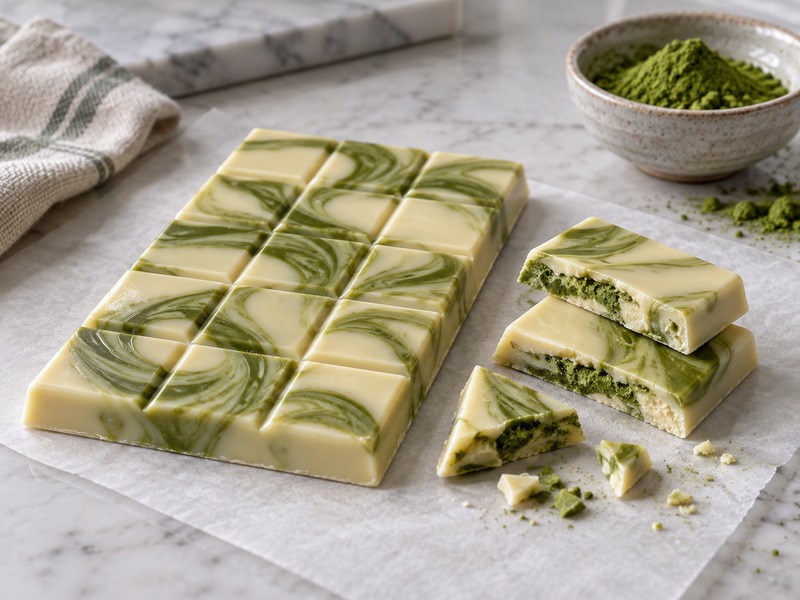
Matcha white chocolate brings powdered green tea into a cocoa-butter, sugar and milk-solids system. The pairing can taste balanced, but a promising bench sample may change after tempering, baking or a week in its pack. Sugar can flatten the tea; moisture and poor dispersion can leave specks; light can change the visual appeal. Cooking Therapy’s brown butter white chocolate matcha cookies provide one familiar application. A commercial team needs to decide whether the intended product is a bar, coating, inclusion or finished bakery item before it buys tea or sets a recipe.
For: confectionery developers, bakers, café teams and ingredient buyers. Decision: which matcha and process give a distinct, stable tea note in the chosen white-chocolate format.
1. What counts as matcha white chocolate for this product?
Name the format and label route
A solid bar, a ganache, a cookie chip and a green drizzle may all be called matcha white chocolate in conversation, yet their formulations and handling differ. A bar depends heavily on crystallization and snap. A coating must flow at a working temperature. A bakery inclusion has to survive heat without disappearing into the dough. A ganache contains additional liquid and needs a different stability program. Start the brief with the exact format, serving size, expected appearance and destination market. Label rules for the term “white chocolate” vary by jurisdiction and composition; have the intended ingredient statement reviewed before printing the name.
Fix the eating target. Decide whether the tea should lead the first bite or arrive after the dairy sweetness. A cookie may need a stronger matcha note than a plain square because flour and brown butter compete with it. Prepare a reference sample and write a short sensory description that mentions tea, sweetness, melt and any unacceptable bitterness. Use that standard through development instead of judging each green sample by appearance alone.
| Format | Tea challenge | Process challenge |
|---|---|---|
| Solid bar | Sweetness can bury tea | Temper and bloom control |
| Coating | Thin layer can taste weak | Viscosity and set |
| Bakery chip | Dough masks flavor | Baking and shape retention |
| Ganache | Dairy changes flavor | Moisture and shelf-life control |
2. Which matcha should be screened first?
Taste in the intended matrix
A high-priced powder is not automatically the best choice in sweet fat. White chocolate can round the edges of a slightly stronger matcha, while a delicate tea may be hard to find after the sugar melts. Request several food-grade samples with clear lot identity. Mix equal doses into the same white-chocolate base, using the same equipment and cooling route. Compare the resulting color and flavor after full setting, not only while melted. For a baked inclusion, repeat the comparison after the actual bake because heat and surrounding dough can rearrange the ranking.
Ask beyond grade names. Terms such as “ceremonial” and “culinary” are often used commercially but do not replace a specification. Ask for origin information appropriate to the claim, moisture and particle guidance if available, pack size, storage instructions, lot traceability and required food-safety documents. Keep a retained sample from the approved lot. If future lots differ slightly, that reference helps the team judge whether the change matters in its actual chocolate.
3. How can tea powder be dispersed without grit?
Work within a dry fat system
Matcha is a powder rather than a flavor extract. Its particles must be distributed evenly through the fat phase, and any added water can cause chocolate to seize. Avoid the common kitchen shortcut of making a water slurry for a solid chocolate product. Sift compacted powder if the trial shows clumps, then preblend it with a small measured portion of warm white chocolate or cocoa butter before returning it to the main batch. Record the preblend ratio and mixing time. A high-speed mixer can disperse powder yet also trap air or raise temperature, so assess the finished surface and viscosity.
Check the last piece. Sample from the top, middle and bottom of the vessel and from early and late deposits. Cut a set piece to inspect the interior. Visible dark-green islands, chalky mouthfeel or inconsistent color suggest that the mixing route needs work. Finer is not always better if the tea introduces other processing issues; compare the finished eating quality, not a dry-powder label.
| Observation | Likely variable | Next controlled trial |
|---|---|---|
| Green specks | Preblend or sifting | Change dispersion step |
| Grainy melt | Powder behavior | Compare tea samples |
| Thick flow | Tea dose or fat balance | Hold dose, adjust base |
| Color gradient | Agitation during depositing | Sample vessel positions |
4. How much matcha gives a recognizable flavor?
Express dose by finished mass
Set several trial doses as a percentage of the finished chocolate mass, not as “one spoon per bowl.” Keep the white-chocolate base and processing conditions identical. Taste blind after the pieces have set, and again after the planned storage period. Record the dose at which tea becomes clear, where bitterness starts to dominate, and where color becomes marketable. A green bar with no tea flavor disappoints; an intensely bitter bar may need more sugar, which changes both label and cost. The right range is specific to the powder and format.
Price the flavor threshold. Calculate grams of tea per sale unit. A cheaper matcha requiring a much higher dose can cost more than a stronger, cleaner powder. In a cookie, account for both tea in the dough and tea in the white-chocolate inclusion; otherwise the project may pay twice for a flavor the consumer still cannot identify. If a flavor extract is considered, run it as a separately labeled concept and do not present it as equivalent to matcha powder.
5. What does white-chocolate sweetness do to matcha?
Compare bases, not only powders
White chocolates vary in sugar, milk solids, cocoa butter and added flavors. A vanilla-heavy base can make matcha read like candy. A sweeter base may suppress the tea at first and leave a bitter aftertaste once the sugar fades. Test at least two commercially available bases with the same matcha dose. Evaluate the plain chocolate, then the intended application. The winning base for a bar may not win inside a cookie where salt, butter and bake notes add another layer.
Build a simple sensory grid. Ask tasters to rate sweetness, tea clarity, dairy note, melt and aftertaste separately. Let them describe the first and last impression in their own words. If both bases obscure the tea, consider reducing vanilla or changing the inclusion size before adding more powder. If the finish is harsh, check matcha quality and dose before adding another sweetener. A useful formulation choice explains the perceived change, rather than merely making the sample greener.
| Sensory result | Possible adjustment | Check for tradeoff |
|---|---|---|
| Tea disappears | Less flavored base | Dairy balance |
| Bitter finish | Different powder or lower dose | Color loss |
| Clawing sweetness | Less sweet base | Flow and label |
6. Which temperature controls matter during production?
Record the full thermal route
Chocolate handling depends on the base, equipment and whether the finished product needs temper. Matcha adds a new solid and can alter flow, so an established plain-white-chocolate setting is a starting point rather than proof. Record melt temperature, tea addition point, working temperature, deposit temperature and cooling conditions during each pilot. For a bar or coating, inspect gloss, snap, release from the mold and bloom after storage. For a chip or cookie piece, inspect shape and tea flavor after baking.
Look for hidden heat damage. A powder can remain green while its aroma becomes flat or cooked. Compare a sample with a shorter heat exposure against one that follows the planned production hold. Taste both after they reach the same serving temperature. If the process requires a long warm hold, decide whether smaller working batches preserve quality without disrupting throughput. Any revised heat route must still meet the confectionery team’s food-safety and process requirements.
7. How should the product be tested for stability?
Challenge the actual pack
Keep samples in the proposed wrapper, pouch or bakery pack under the intended distribution and retail conditions. Inspect color, odor, surface bloom, texture and tea flavor at scheduled intervals. Light can matter for a pale green product, while temperature cycling may expose temper or fat-migration problems. A cookie with matcha white-chocolate chips adds moisture movement and crumb contact to the test. Do not set a shelf life from the plain chocolate supplier’s documentation alone; the full product, process and pack need review.
Track what changed. Use consistent photographs and a retained launch standard. Note whether color changes uniformly or only on the exposed surface. A dull bar could be a bloom issue, pigment change or both; those require different corrections. Taste alongside visual inspection. If the product is sold in a clear window pack, assess the exact window material and display lighting. A successful opaque-pack test cannot stand in for a brightly lit retail shelf.
| Hold check | Evidence | Release question |
|---|---|---|
| Surface | Fixed-light photos | Is bloom or fading visible? |
| Bite | Snap or melt notes | Has texture changed? |
| Flavor | Blind comparison | Does tea remain identifiable? |
| Pack | Seal and odor check | Does packaging protect quality? |
8. What changes when the chocolate enters a bakery item?
Test the finished bake
A matcha white-chocolate chip may melt into a cookie rather than remain as visible pieces. A drizzle can fracture or turn sticky on a chilled cake. A filling may migrate into pastry layers. Run the chocolate in the exact dough or dessert format, using the planned portion size and bake or holding route. Check distribution across several units; a few chips in one cookie and many in another produce inconsistent value. Taste both the inclusion alone and the finished item to understand where the tea is lost.
Measure waste. Count broken chips, smears, rework and cleaning time. A base that tastes excellent in a plain bar may be too soft to deposit cleanly at bakery speed. If the product is a cookie like the reference example, assess brown-butter and salt levels alongside the chocolate. Those ingredients can improve balance, but they can also leave the tea as a visual cue only. Set a finished-item standard before ordering a production-scale inclusion.
9. How should a buyer compare suppliers and costs?
Compare usable product
Ask each supplier for an identical sample quantity, dated specification and pack format. Record lead time, minimum order quantity, storage needs and the process for lot changes. Price the tea and chocolate base per finished sale unit after process loss, not only per kilogram. If the bar needs an expensive opaque wrapper to protect its appearance, include that cost in the comparison. A supplier able to document consistent lots may be more useful than one offering a striking sample without repeatability.
Keep claims supported. Origin, organic status and other on-pack statements need appropriate documents for the selling market. Matcha in chocolate does not make the confection a health product. Avoid implying a caffeine-free treat or a measured antioxidant effect without evidence and label review. A straightforward ingredient and flavor description is easier to maintain across product changes.
| Buyer comparison | Ask for | Why it matters |
|---|---|---|
| Lot continuity | Change-notification process | Protects approved flavor |
| Pack size | Sealed unit and storage guidance | Limits moisture exposure |
| Commercial terms | MOQ and lead time | Fits production cadence |
10. What pilot justifies a launch?
Make the sale unit, not a spoon sample
Produce a small pilot through the intended mixing, tempering or baking line and its real package. Take units from early, middle and late production. Compare color, mass, tea distribution, appearance and taste. Put the units through a realistic distribution and retail hold. Document defect rates, labor and ingredient use. Have a cross-functional review that includes development, production, quality, purchasing and the person responsible for labeling. A single attractive prototype does not answer whether the line can reproduce it.
Make the decision explicit. Approve a specified powder, base, dose, addition point and release checks. Record what triggers a re-test, such as a new tea lot, chocolate base or wrapper. If the planned product is a cookie, the best next action is a pilot bake with two candidate matcha lots and the actual white-chocolate inclusion. It will reveal more than another tasting of melted chocolate.
Reference: Brown Butter White Chocolate Matcha Cookies is a consumer application reference. The manufacturing checks here are independent recommendations.
FAQ
Q1: Can matcha be stirred into melted white chocolate? Yes, but preblending a measured powder portion can reduce clumps; avoid introducing water into a solid chocolate formula.
Q2: Is culinary-grade matcha automatically best? No. Compare identified powders in the finished chocolate and its intended application.
Q3: Why did the bar lose its bright green appearance? Examine powder lot, heat exposure, light, pack and possible chocolate bloom before changing dose.
Q4: Can the same matcha white chocolate be used for bars and cookies? Sometimes, but test flow, setting, bake survival and flavor separately.
Q5: How should the team set shelf life? Use product-specific stability and safety work with the final formula, process and package.