
The matcha whisk vs electric frother choice looks like tradition against speed, but a café needs a more useful comparison: finished drink, full preparation time, cleaning, tool life, and guest experience. A bamboo chasen and a powered frother can both disperse matcha, yet they behave differently in a bowl, a narrow cup, and a milk-based drink. Use the same recipe and service conditions to decide which belongs at each station. These ten checks make that comparison concrete. For powered-tool upkeep, see our matcha frother guide.
Contents
- 1. What drink is the tool making?
- 2. How should you compare texture?
- 3. Which method controls clumps?
- 4. What is the full preparation time?
- 5. Which vessel does each tool require?
- 6. How do cleaning routines differ?
- 7. What can fail during a busy shift?
- 8. How does guest presentation matter?
- 9. What is the real cost per usable drink?
- 10. When should a café use both?
1. What drink is the tool making?
Split tea service from latte concentrate
For tea served directly from a chawan, preparation is visible and the bowl’s surface is part of the experience. For an iced latte, matcha may be whisked into a short concentrate and poured over milk. The two drinks do not need the same foam or equipment footprint. Write down the powder dose, water volume, service vessel, and desired finish for each before comparing tools. A method should be judged by the menu item it must produce.
The Nio Teas comparison introduces the two methods, but a business needs its own service trial. If a station prepares both straight matcha and lattes, test both. Do not choose one tool across the menu because it wins a single demonstration. A frother may suit a narrow concentrate cup; a chasen may suit a bowl service where the act of whisking is visible. Either conclusion needs observation with the actual recipe.
2. How should you compare texture?
Taste at the moment the customer receives it
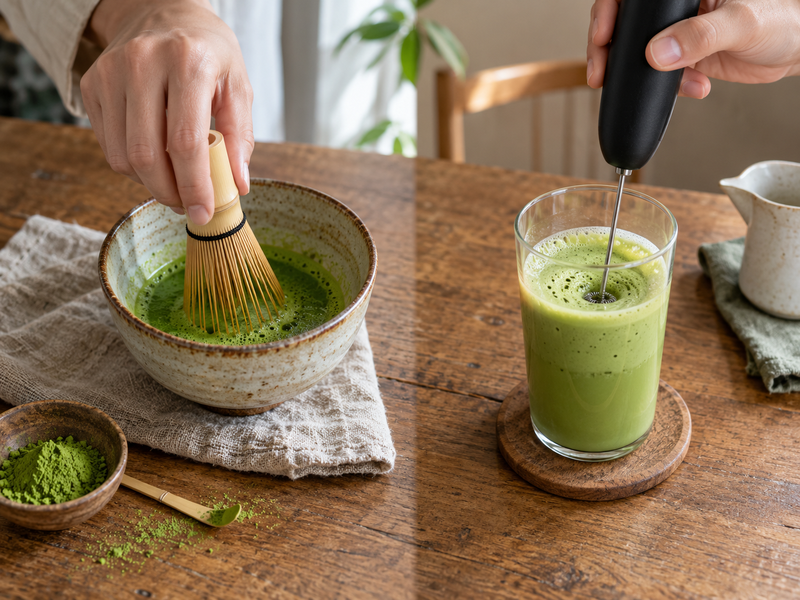
Prepare drinks with the same matcha lot, weighed dose, water amount, temperature, and serving vessel. Alternate tool order to reduce a first-run advantage. Photograph the surface under the same light, then have tasters compare mouthfeel without knowing which tool made each sample if possible. Record visible bubbles, foam distribution, and any sandy impression. Do not award a point simply for more foam if the menu brief calls for a smooth latte base rather than a foamy bowl.
Repeat after the normal waiting time before handoff. A drink may look different after it has sat while milk is poured or an order is called. For a latte, evaluate the finished glass, not only the concentrate. A narrow frother head can introduce a different bubble pattern from a chasen, but the relevant result is what the guest sees and tastes. Describe the outcome of your own trial rather than making a universal claim about texture.
| Texture check | Straight tea | Latte |
|---|---|---|
| Surface | Foam pattern at serving | Appearance after milk added |
| Mouthfeel | Direct bowl sip | Finished mixed drink |
| Clumps | Bottom and rim | Glass bottom and straw |
| Wait | Short table delay | Pickup delay |
3. Which method controls clumps?
Keep powder preparation constant
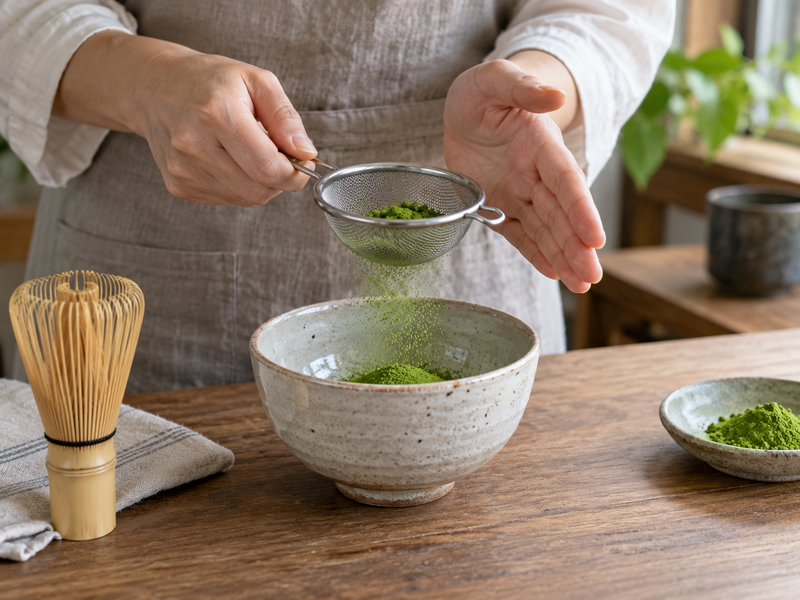
Clumps can come from damp powder, an inconsistent dose, insufficient liquid, or a tool that never reaches the corners of its vessel. Weigh and, if part of the recipe, sift the same matcha for both methods. Add water in the same sequence. Then observe how each tool disperses powder at the bottom and wall. A frother that spins in the center may leave a dry ring in a wide bowl; a chasen may struggle in a narrow cup that restricts its stroke. The vessel and tool must be evaluated together.
Look at the drink after pouring into a clear glass. If one method leaves residue, change only one variable in a follow-up trial: cup shape, water addition, or tool motion. Do not blame tine count or motor speed before checking the process. A fair comparison can show that both tools make a smooth drink when used with their suitable vessels. The purchase question is which system staff can repeat with less correction.
4. What is the full preparation time?
Count setup and cleanup, not just mixing
Time from retrieving the tool through a clean station ready for the next order. Include weighing, sifting, water addition, mixing, pouring, rinsing, and storage. An electric device may mix in seconds yet require extra care around a shaft joint. A bamboo whisk may take longer to work but rinse quickly under the maker’s instructions. The result depends on the station and local cleaning process. Run multiple drinks at realistic pace rather than timing a single leisurely demonstration.
Also count interruptions. A frother may require charging or a spare head; a chasen may need replacement when tines break. Record whether one person can work while another prepares milk or whether the tool occupies the same hand and counter space. Throughput matters only if the drink remains within its quality standard. A method that saves seconds but increases remakes or splashes may not be faster for the business.
| Time segment | Bamboo whisk | Electric frother |
|---|---|---|
| Setup | Bowl and whisk ready | Device charged and cup ready |
| Mixing | Manual stroke | Powered run within manual limits |
| Pour | Depends on bowl | Depends on cup |
| Cleaning | Bamboo care routine | Head and housing limits |
| Reset | Drying position | Storage and charging |
5. Which vessel does each tool require?
Pair each tool with a safe working space
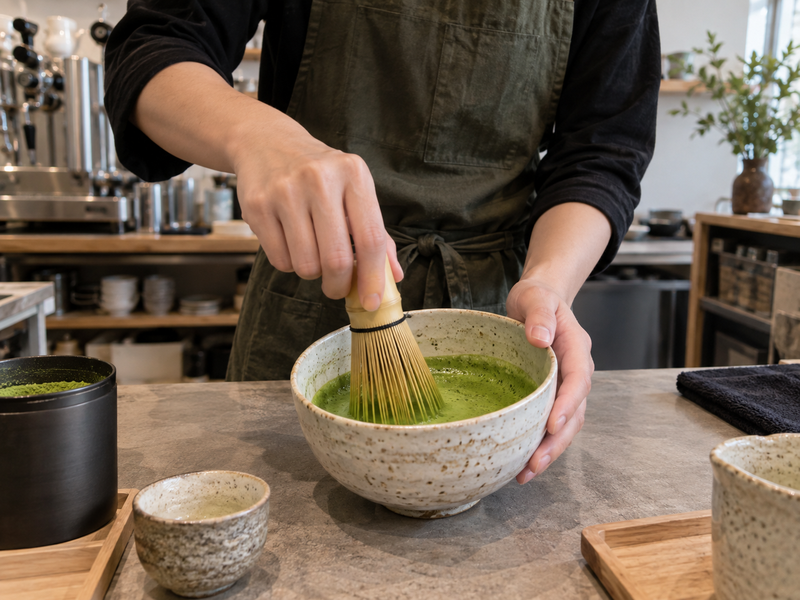
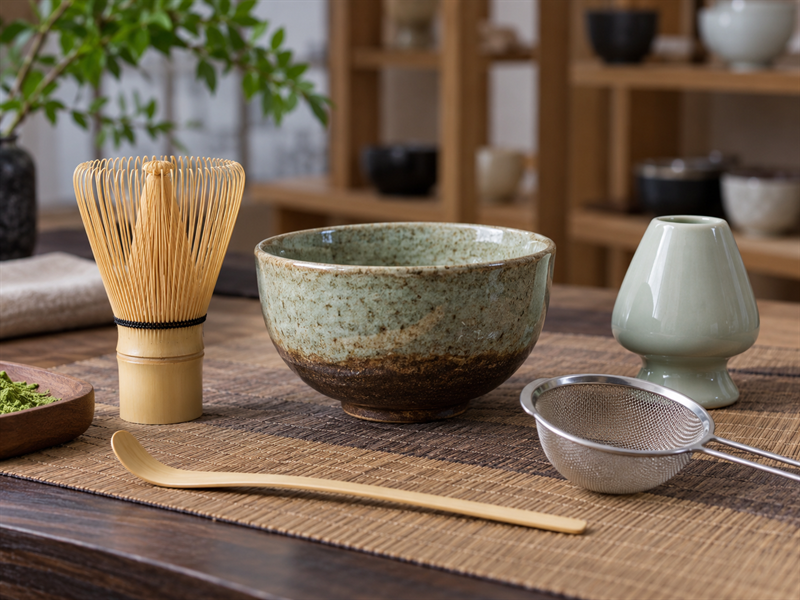
A chasen needs a bowl with enough clear floor and wall flare for its tines. A small electric head often works better submerged in a cup deep enough to contain a vortex. Test both pairings at the intended liquid volume. Record wall contact, splashing, grip, and how easily the matcha pours into the service cup. The best tool can become an awkward choice when forced into the wrong vessel.
Include the vessel in purchasing cost and shelf space. A spouted chawan may support a bamboo-whisked latte concentrate; a narrow jug may support an electric frother. For straight tea, the chawan may also be the serving vessel, reducing transfer. For a tight takeaway counter, a cup that stacks efficiently may matter more. Do not compare a chasen in a poor bowl against a frother in its ideal cup and call the result objective.
6. How do cleaning routines differ?
Read both makers’ instructions
The Ippodo chasen care guide describes gentle treatment of bamboo tines. An electric frother’s manual should specify which head or attachment may be rinsed, detached, or immersed. Never assume the motor body can go under a tap. For each tool, prepare a drink, wait the longest realistic interval before washing, then clean by the permitted method and inspect for trapped green residue.
Commercial operations also need a process consistent with applicable local requirements. The FDA Food Code is a US model for cleaning and sanitizing utensils and equipment. If either tool cannot fit the operation’s approved method, that matters more than its mixing speed. Train staff on the exact SKU, since two frothers can have different immersion limits and two bamboo whisks may have different care recommendations.
| Cleaning question | Bamboo chasen | Electric device |
|---|---|---|
| Food-contact area | Tines and handle edge | Head, shaft, possible joint |
| Main limit | Maker’s bamboo care | Manual’s immersion limits |
| Inspection point | Between tines | Wire bends and attachment |
| Storage | Dry without crushing | Store and charge as instructed |
7. What can fail during a busy shift?
Plan for ordinary faults
A bamboo whisk may develop broken tines or lose its usable head shape. An electric frother may run out of charge, lose an attachment, or show reduced performance under load. Neither tool should be treated as maintenance-free. Keep a short removal rule and a spare method so service does not depend on one fragile item. A second device or whisk should be stored where staff can reach it without searching through retail stock.
Track faults by station and date. If chasen damage clusters at one rough bowl, fix the bowl pairing. If frother heads bend against a narrow cup, change the cup or technique. If the device repeatedly stops under the normal recipe, check its manual duty limits before ordering more. Failure data can reveal a workflow problem that a brand switch would not solve. Avoid promising a fixed lifetime for either tool without your own use record.
8. How does guest presentation matter?
Decide whether preparation is part of the product
In seated tea service, watching a chasen work in the bowl may be part of what the customer pays for. At a high-volume takeaway counter, the guest may care more about a consistent drink and short wait. Do not make cultural claims beyond the actual service offered. Describe an electric method as a practical preparation choice when it is used; do not stage a bamboo whisk for photographs while every drink is made elsewhere.
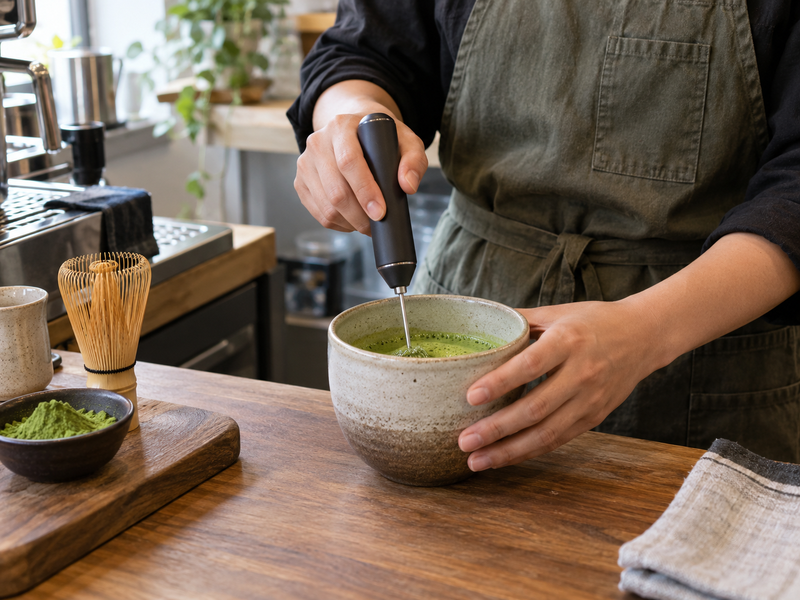
Ask whether the tool will be visible. A noisy device at an open bar can affect the atmosphere even if it is fast. A chasen may require staff training that becomes part of a thoughtful tea presentation. For retail sets, show the method the customer can reasonably repeat at home. The choice should align with the menu promise and the operator’s capacity, not with a generic idea that one method is more “authentic” for every customer.
| Service format | Guest-facing factor | Trial question |
|---|---|---|
| Seated tea | Visible preparation | Does method support the offered experience? |
| Takeaway latte | Speed and consistency | Is finished drink repeatable? |
| Open bar | Sound and splash | Is operation comfortable nearby? |
| Retail demo | Ease of learning | Can a new user reproduce it? |
9. What is the real cost per usable drink?
Include the parts that disappear from the receipt
Price the whisk or device together with its required bowl or cup, holder or stand, charger or batteries, cleaning time, spares, and observed replacements. Divide by usable drinks made during a representative trial, not a manufacturer’s claimed lifetime. Record remakes caused by clumps or splashes. A higher purchase price may be justified by reliable service, while a cheap tool can be expensive if it repeatedly interrupts the station.
Separate capital cost from the guest proposition. A ceremonial service may reasonably use a hand-made chasen despite greater training needs. A latte line may use an electric frother if the full workflow passes. Keep assumptions visible: number of drinks per day, replacement triggers, and labor time. Recalculate after a few weeks rather than presenting one trial estimate as a permanent truth. Cost is meaningful only beside drink quality and cleaning feasibility.
10. When should a café use both?
Assign a tool to each menu promise
Using both can be sensible when the café offers direct bowl tea and a separate high-volume latte line. Specify which recipes use which tool and why. Train staff on both cleaning routines and keep equipment at the relevant stations. Do not allow improvisation to make one drink vary by operator without a quality check. A concise station card can state powder dose, water volume, vessel, method, finished appearance, and tool storage.
If both methods produce indistinguishable finished lattes and one is easier to maintain, simplify the latte line. If the chasen provides a distinct tea-service experience, keep it for that product. The decision can also change when menu volume, vessel, or staffing changes. Retain controlled trial notes so the next buyer understands the reason for the split. A mixed setup should be a deliberate design, not an accumulation of gadgets.
| Menu item | Candidate method | Approval evidence |
|---|---|---|
| Straight bowl tea | Chasen or tested alternative | Guest and texture trial |
| Iced latte concentrate | Chasen or frother | Finished glass comparison |
| Retail demonstration | Tool sold in kit | New-user repeatability |
| Backup service | Alternate method | Staff can make same standard |
FAQ
Q1. Does an electric frother make better matcha? It may suit a particular recipe, but judge the finished drink, cleaning, and repeatability in a controlled trial.
Q2. Is a bamboo whisk too slow for a café? Not necessarily. Time the complete service cycle at the intended station rather than the mixing step alone.
Q3. Can both tools make iced lattes? Yes. Compare dispersion and appearance after milk and ice are added.
Q4. Which is easier to clean? It depends on the exact models and the operation’s approved process. Follow the maker’s instructions and inspect food-contact areas.
Q5. Should a café stock both? Stock both when they serve distinct menu or backup roles that justify separate training and maintenance.
Let the finished drink decide
The matcha whisk vs electric frother decision should follow the recipe, vessel, cleaning method, and service promise. Keep the tool that makes a consistent drink through a complete shift, and document why it belongs at that station.