
A matcha frother is a powered mixing tool used to suspend matcha in water or another drink base. A fast green vortex can look convincing while dry powder remains at the bottom. For a café, the purchase question is whether an ordinary operator can make the same cup repeatedly and reset the tool before the next order. Compare candidate devices with a fixed tea dose, liquid, vessel and service card. Judge residue, splashing, foam, cleaning and cup quality after the normal customer wait.
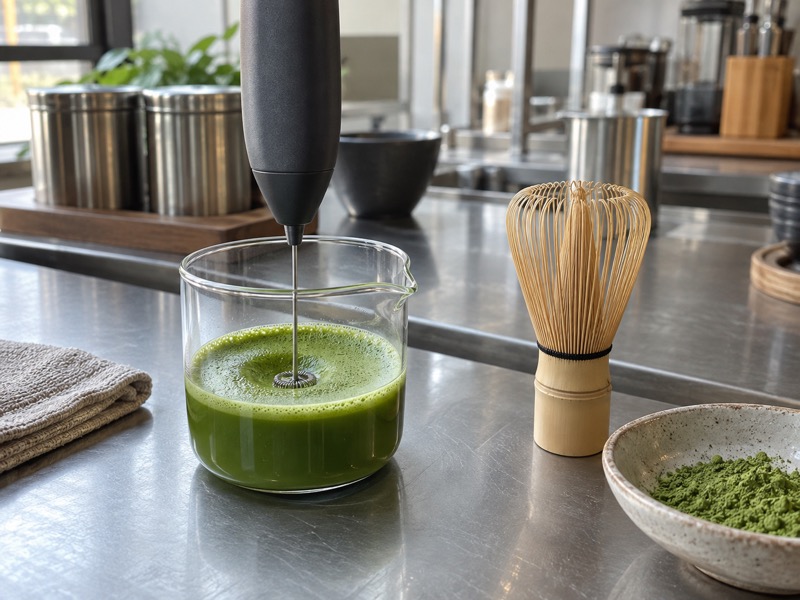
For: café operators and beverage equipment buyers. Decision: whether the device improves a defined preparation step at a viable cost.
1. What job should a matcha frother actually perform?
Separate tea dispersion from milk aeration
Write the equipment brief around the drink, not a product photograph. Some cafés need a small tool to wet and disperse matcha before adding milk. Others want a device that aerates a milk base. A motorized whisk can be used in either workflow, but success in one does not prove success in the other. State the tea mass, water or milk volume, serving vessel, desired surface texture and time available at the station. Then inspect the bottom of the prepared cup. Start there: a tall foam cap can hide undissolved tea that customers meet in the last sip. Taste the top and bottom portions after the planned handoff delay.
Set a baseline using the café’s current whisk or mixing routine. A traditional bamboo chasen works in a bowl with a different motion and cleaning method, so the comparison should focus on accepted cups and labor, not identical hand movements. Define whether fine bubbles matter for the menu item or whether a smooth latte base is enough. A ready-to-drink development kitchen may care more about settling after a hold than a café serving immediately. The useful specification says what a customer receives and what staff must repeat. It does not promise that a faster spinning head makes better matcha in every formula.
2. Where will staff use the frother?
Trace the tool through a shift
Counter space, cup shape, water access and a place to dry the tool all affect its value. A handheld device can be compact on a demonstration bench yet awkward if staff have to walk to a distant sink between drinks. A shared unit can create a queue when two baristas prepare matcha orders at once. For catering, batteries or charging and protected transport matter. A packaged-drink test kitchen may prefer a larger repeatable mixer but still use a handheld unit for small prototypes. Stand at the station: watch where the operator holds the cup, parks the tool, discards rinse water and reaches for the next order.
Test the intended vessel. A narrow cup may not provide enough clearance around the whisk head and can throw liquid over the rim. A shallow bowl gives the operator a different view of clumps and surface bubbles. If the drink is built over ice, decide whether matcha is dispersed in a smaller liquid portion first. A device used only in the final iced cup may stir the surface while leaving powder below. Document the complete cycle from clean tool to clean tool, including any extra jug or rinse container. A service method that looks fast until cleanup begins can slow the counter.
| Use setting | Constraint to observe | Test in that setting |
|---|---|---|
| Café counter | Space, rinse access and order flow | Full ready-to-ready cycle |
| Catering | Power and safe transport | Repeated drinks away from base station |
| Product development | Small-batch consistency | Residue and settling in target formula |
3. How should buyers compare frother candidates fairly?
Use matched cups and a known control
Use one matcha lot, one recipe, one liquid temperature and the same cup for each candidate. Weigh tea rather than relying on a scoop. Randomize the order in which staff try devices if practical, since operators often improve with practice. Run a control with the current approved method. Look at dry powder after initial wetting, residue on the cup wall and sediment after the normal drinking window. Keep the tea fixed: changing powder at the same time as equipment makes a device comparison hard to interpret. Taste coded cups when the appearance does not reveal the method.
Record any pre-sifting or premixing required. If one device only works after staff make a paste while another disperses tea directly, include those steps in total time. Use the same liquid volume and target finished portion for milk-based drinks. A foam head can differ between dairy and plant bases; test the one actually sold. Try both a careful operator and someone trained only from the written card. If a candidate vibrates, stalls or splashes under the proposed load, log that as equipment behavior rather than quietly changing the recipe. A fair trial compares repeatable drink quality and work per accepted cup, not motor speed printed on packaging.
| Trial factor | Hold constant | Judge in each cup |
|---|---|---|
| Tea | Lot and weighed dose | Clumps and flavor |
| Liquid | Type, volume and temperature | Dispersion and foam texture |
| Vessel | Shape and fill level | Splashing and head clearance |
4. What should the test log record?
Capture failures as well as average time
Write the preparation card before timing anyone. Record tea grams, liquid volume, cup type, whether powder was sifted, insertion depth, mix duration and any finishing step. Note the device’s age and battery or charge condition. An old unit that slows during a shift can produce a different cup from a fresh demonstration model. Log the reset: the stopwatch should cover preparation, cleaning and getting the station ready again if the purchase case claims a labor saving. Retain separate mix and reset times so staff can identify where the delay occurs.
Score residue, clumps, bubble size and taste at defined observation points. A photo of the surface at handoff can be useful, but inspect the cup bottom and the drink after waiting too. Record splashes, remakes and interruptions as events rather than smoothing them into an average. If a device needs a battery change or head replacement, note the date and number of drinks since its last service without inventing a universal lifespan. The maker’s instructions can guide maintenance for that model; the café’s usage record will show whether those instructions suit its workload. Keep operator names or codes on trials so training gaps do not get mistaken for hardware faults.
| Log field | Record | Decision supported |
|---|---|---|
| Recipe and device state | Dose, liquid, vessel, power state | Fair comparison |
| Cup observations | Residue, foam, taste and wait | Customer quality |
| Workflow events | Mix, reset, splash and remake | Service cost |
5. How should staff operate it at the counter?
Make the movement teachable
Train to a sequence staff can perform during a queue: measure tea, wet or sift as specified, place the head fully in liquid, mix within the approved vessel, stop the motor before removal and inspect the cup. Head clearance matters; in a narrow cup, an operator can accidentally strike the side or spray the station. Do not write “froth until smooth” without an observable endpoint. The endpoint may be no visible clumps, a specified surface texture and a cup bottom free of dry powder after pouring. Watch a second operator: a method that relies on the developer’s wrist angle is not a usable service card.
The manufacturer instructions for Aerolatte’s Original tell users to insert the head near the base and switch the motor off before removing it from liquid. That is model-specific guidance, so buyers should obtain instructions for each shortlisted device. Train staff not to bend a shaft or immerse a powered handle if its manual prohibits it. If matcha is premixed before milk enters, specify the transfer step and rinse vessel. For iced drinks, check whether ice blocks head movement or traps powder. A brief observation during peak service often reveals extra motions that a tidy bench trial missed.
6. Which failures should end or redirect a trial?
Inspect the final sip and the device
Separate drink faults from equipment faults. A layer of tea at the cup bottom can reflect poor wetting, insufficient motion or a tool that cannot reach the lower liquid. Coarse bubbles may be acceptable in a blended drink and unacceptable in a delicate straight matcha service. Splashing wastes product and creates cleaning work. A head that sheds material, a bent shaft or an unstable handle should leave service under the site’s equipment procedure. Taste after waiting: a cup that looks uniform at handoff can reveal clumps or fast foam collapse by the customer’s second sip. Use the menu’s normal wait as the observation window.
When a trial fails, change one factor at a time. Try a wider vessel or a defined pre-wetting step before declaring that all motorized frothers are unsuitable. Conversely, do not keep adjusting the recipe until an awkward tool seems workable. Log whether problems cluster by operator, cup or device age. Check for rattling, unexpected noise and loose parts according to the maker’s instructions. Replace or retire components using a written rule, not an improvised judgment made during a rush. Quality staff should review any sanitation or foreign-material concern before equipment returns to service.
| Failure | Inspect next | Trial decision |
|---|---|---|
| Dry residue | Wetting and head reach | Retest one controlled method |
| Splashing | Vessel fill and head position | Change vessel or reject device |
| Loose or damaged head | Maker guidance and inspection | Remove from service |
7. How should the frother be cleaned and stored?
Follow the exact model’s instructions
Clean food-contact parts under the café’s sanitation plan and the manufacturer’s care instructions. Do not assume a powered handle can be washed like a detachable whisk head. Aerolatte’s Original manual, for example, instructs users to clean the steel shaft and whisk, wipe the handle, keep water out of the motor and battery housing and avoid the dishwasher. Other models may have different removable parts and cleaning methods. Inspect after rinsing: dried matcha at the joint or behind a head can survive a hurried dip. Train staff on the approved cleaning sequence and where the tool dries between uses.
Store a clean device so the head is protected from bending and can dry as its manual requires. Keep batteries, chargers and replacement parts according to the supplier’s guidance. A tool returned wet to a closed drawer may be ready physically for the next order but fail the site’s hygiene procedure. Assign inspection at opening and closing, including the shaft, head attachment and power behavior. If multiple units rotate through a counter, label them so a recurring fault can be traced. Count cleaning time in the service trial; it is part of the work the equipment creates. A device that disperses tea well but cannot be maintained on the site has not passed procurement review.
8. What should procurement request from a supplier?
Buy a maintainable device
Ask for the exact model number, food-contact material information, operating instructions, cleaning method and replacement-part list. Check dimensions against the intended cup or jug. Ask about power source, charger compatibility where relevant, warranty scope and any terms that differ for commercial use. Aerolatte’s published warranty language, for example, refers to normal domestic use; a café buyer should not assume the same coverage applies behind a counter. Read the manual before ordering cases: care restrictions and spare-part availability affect total cost more than a marketing claim about foam speed.
Request a sample from the same specification that would ship to sites. If accessories or heads vary by market, record the actual item code. Check who supplies parts and whether a damaged unit can be removed and replaced without disrupting service. Keep purchase date, serial or batch identifier if provided, and maintenance history. A short warranty is only one factor; a low-cost tool may still work if it is easily replaced and produces a good cup. A costly unit may be justified if its measured accepted-cup cost is lower. Procurement should make that call from trials, not from a generic “professional” label.
9. What is the cost per accepted drink?
Include power, cleaning and remakes
Start with purchase cost spread over a defensible service period, then add batteries or power, replacement heads, cleaning supplies and staff time. Use the café’s own observed service count rather than an unverified number of uses from a product page. Measure tea and milk lost through splashes or remakes. Count accepted cups: a device that works quickly on most orders but creates a few messy remakes may save less than its mix time suggests. Keep setup, active mix and reset times separately so a manager can see how workflow changes the calculation.
Compare the new method with the existing routine using the same drink and quality standard. If a frother needs a special vessel, add that purchase and its washing workload. If stations require duplicate devices to avoid a queue, include them. Replacement frequency will remain an estimate until the café has enough operating history; state the assumption and update it after a pilot. A small trial can reveal whether residue, splashing or foam collapse materially affects labor and guest experience. It cannot support a broad claim that one device class is always cheaper than bamboo whisking.
| Cost line | Pilot evidence | How to use it |
|---|---|---|
| Equipment and power | Units purchased, batteries or charging | Cost per service period |
| Labor | Mix, rinse and station reset | Cost per accepted cup |
| Waste | Splashes, remakes and rejected drinks | Corrected margin |
10. What pilot should approve a multi-site order?
Run it at normal service pace
Select a small group of ordinary operators and use the final recipe, vessel and care card. Include a quiet period and a busy one. Inspect fresh and used devices, record drink quality at handoff and after the intended wait, and time the full ready-to-ready cycle. Set written pass rules for residue, foam, splashing, cleaning and equipment condition before seeing results. Make the shift visible: if staff skip an awkward rinse step under pressure, the purchasing decision must address the workflow rather than pretend the step always happens.
Review results with baristas, quality and procurement. Retest a controlled adjustment when the fault has a plausible fix. Approve a limited rollout only when the method repeats across operators and the cost per accepted cup meets the site’s target. Keep the product code, sample device, manual and training card together for later reorders. The matcha flavors guide can help define the tea flavor target. The independent matcha whisk versus milk frother comparison offers background on the choice; a café still needs its own measured trial. Recheck performance after devices have seen real use, since opening-day success cannot show how a head behaves later in service.
FAQ
Q1: Can a milk frother mix matcha? It can be tested for that job, but judge the finished cup for clumps, residue and taste with the actual recipe.
Q2: Is foam height enough to choose a device? No. Inspect the drink’s bottom, flavor and texture after the normal customer wait.
Q3: Should staff mix matcha directly over ice? Trial that route against pre-dispersing tea; ice may block the head or hide dry powder.
Q4: Can the whole frother be washed? Follow the exact model’s manual. Powered handles often have different care limits from food-contact heads.
Q5: What should a pilot measure? Measure accepted cups, full service time, cleaning, remakes and equipment condition across operators.