
Matcha waste can hide in a scoop that grows heavier, a batch made before the rush that never arrives, and a drink remade because its base clumped. Cutting the powder dose in every cup would damage the product customers paid for. A better matcha waste reduction plan starts with a simple mass balance, records where loss occurs and fixes one process at a time. Forest Cloud’s café service article lists common losses; this guide turns those observations into a purchasing and operating method that a manager can measure across shifts.
Contents
- 1. What should count as matcha waste?
- 2. How can a café establish its baseline?
- 3. Where does loose powder disappear?
- 4. How do you prevent clump-related remakes?
- 5. When does prebatching create more loss?
- 6. How should stock and working tins rotate?
- 7. Which drink-build errors waste a good base?
- 8. How can purchasing reduce waste upstream?
- 9. What should staff record after a remake?
- 10. How do you prove a change worked?
1. What should count as matcha waste?
Follow powder into the customer cup
Separate three categories: powder lost before preparation, matcha inside a discarded base or drink, and product that expires or deteriorates before use. A spill has a visible weight. An oversized scoop is less obvious because the extra powder reaches the customer, but it still consumes more inventory than the approved recipe. Count both. Also record a wrong milk order or cup size that causes a full matcha drink to be remade. If managers track only the powder swept from the counter, they miss the most expensive losses.
Start with definitions: call a drink “sold” only when it reaches the customer. Keep staff tastings, promotional samples and training drinks in separate categories. That protects the integrity of the yield calculation and stops teams from treating every difference as a staff mistake. A café can then compare grams of matcha issued with grams expected from sold recipes. The US EPA’s wasted food guidance recommends tracking both amount and reason; apply that same logic to powder, base and finished cups.
| Loss category | Example | Best unit to log |
|---|---|---|
| Handling | Powder spilled during transfer | Grams |
| Recipe drift | Heavy dose in sold drink | Grams per drink |
| Remake | Wrong milk or clumped base | Cup plus estimated grams |
| Unsold preparation | Discarded matcha base | Milliliters and grams |
2. How can a café establish its baseline?
Use a mass balance that staff can complete
For each shift, weigh matcha in the working tin at opening. Add any top-ups. Weigh the remainder at closing. The difference is powder used, including spills and unsold drinks. Calculate expected powder from the sales record: each drink count multiplied by its approved powder dose. Add known training, sample and remake doses. The unexplained gap deserves investigation, but do not label it theft or error without checking scale accuracy, tare weight and inventory transfers. In a busy shop, a consistently small gap may come from powder left in a sieve or shaker.
A sample worksheet: 400 g at opening plus 200 g refill minus 250 g at close gives 350 g used. If sold drinks account for 300 g and documented samples and remakes for 25 g, 25 g remains unexplained. The figures are a calculation example, not a normal loss allowance. Record at least two ordinary weeks before setting a target. The EPA offers foodservice waste tracking tools that illustrate why a baseline should include daily quantities and reasons, not a single snapshot after a tidy shift.
3. Where does loose powder disappear?
Look at the physical transfer points
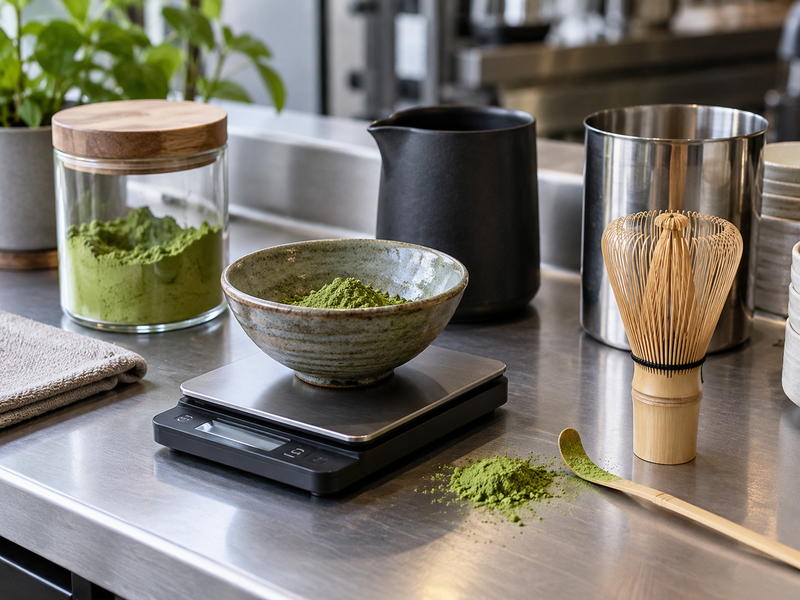
Powder can stay on a scoop, collect in the sifter rim, spill from an overfilled tin or dust the counter during a rushed transfer. Watch a real shift without interrupting service. Note how often staff open the main pouch, whether the scoop is dry and whether the receiving bowl sits below the sifter. A narrow scoop poured into a small cup may waste less than a large spoon transferred across the counter. Do not choose tools by appearance; weigh the difference after 20 normal orders.
Keep the recipe fixed: the aim is to deliver the intended grams with less handling loss. Test a small working tin, a scoop calibrated by weight and a stable preparation station. Some cafés will still need a scale for every drink; others can use a measured scoop after checking it against a scale at opening and when staff or powder lots change. Powder density and a heaped scoop can vary, so a “one spoon” rule without a weight check invites drift. Record any dropped container separately. One accident can distort a week’s average and hide a useful improvement in routine service.
| Transfer point | Check | Trial change |
|---|---|---|
| Main pouch to tin | Powder on seal and rim | Smaller dry funnel |
| Tin to scoop | Heap size varies | Weight-calibrated level scoop |
| Scoop to sifter | Visible dusting | Shorter transfer distance |
| Sifter to vessel | Powder left behind | Approved tap or rinse method |

4. How do you prevent clump-related remakes?
Separate powder condition from preparation technique
Clumps may come from a damp scoop, humid working tin, poor wetting or insufficient mixing. Open a new pack and compare it with the working tin. If only the working tin clumps, inspect storage and wet tools before changing suppliers. If both clump under the approved method, test a different mixing sequence or powder sample. Ask staff to note whether dry pockets appear before milk is added or only in the finished drink. That locates the problem in the base or cup assembly.
Run a controlled cup: weigh the same powder, water and milk into several drinks. Vary one preparation step, such as sifting or adding water in stages. Assess visible clumps, mouthfeel and service time. Keep the test recipe that performs acceptably at a realistic speed, not a method that works only when a trainer watches. A remake should trigger a reason code rather than a blame conversation. If wet tools repeatedly cause the problem, a dry spare scoop may reduce waste more cheaply than a new blender. Powder that has contacted water or returned from a customer’s cup should never go back into saleable stock.
5. When does prebatching create more loss?
Forecast the period you can actually sell
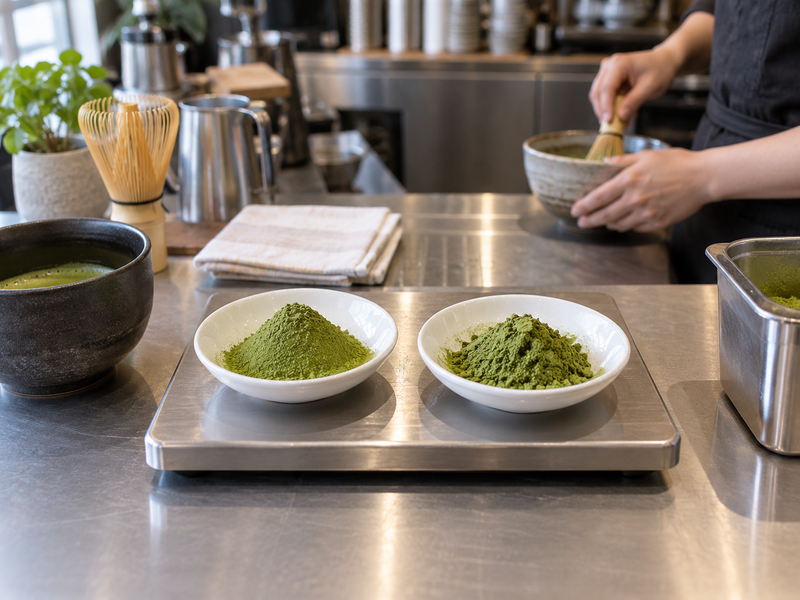
Prepared base can cut ticket time, but matcha particles settle and the drink can change during holding. Calculate how many servings a batch yields, how many normally sell during the relevant period and what remains when the batch is discarded. Test a smaller batch alongside the current size. Record prep time, idle time, re-mixing steps, flavor and discarded volume. A prebatch that saves 20 seconds per cup may still lose money if half its powder is thrown out after a slow afternoon.
Do not borrow a holding claim: the safe holding procedure depends on the full recipe, temperature, container, sanitation and local food code. Matcha mixed only with water needs a different review from a base containing milk or fruit. Follow your food-safety plan and the FDA Food Code where applicable; appearance alone cannot establish safety. Make the first pilot deliberately small and track actual demand. If sales vary sharply by day, batch only for predictable rushes and make the remaining cups to order. A staff member should have clear authority to discard a batch once its approved limit is reached.
| Batch question | Record during trial | Decision signal |
|---|---|---|
| How much was prepared? | Powder grams and base volume | Recipe yield |
| How much was sold? | Number of cups | Demand fit |
| How much was discarded? | Base volume and time | Avoidable loss |
| Did quality change? | Taste and settling notes | Acceptability |
6. How should stock and working tins rotate?
Reduce repeated exposure of the main pack
The main pouch should not spend a whole shift open beside steam and ice wells. Issue an amount the team can reasonably use during a service block into a clean, dry working tin. Mark its source lot and fill time. Close the main pack promptly under the supplier’s storage instructions. Keep the working tin away from splashing, heat and strong odors. A few small transfers may be better than one large exposed stockpile, but each transfer adds handling and a chance of spillage. Measure both effects.
Track the lot: use the stock with the appropriate remaining life while preserving its identity. If two lots are mixed in one tin, complaint investigation becomes harder. Return only unopened, properly controlled stock to the reserve area; do not pour an exposed working tin back into its original pouch. Ask Matcha Village which lot records and packaging sizes are available for your order. Buyers should specify pack size against actual weekly turnover rather than choosing the lowest unit price for an oversized bag. A cheaper pack that sits open for weeks may produce more quality complaints and discarded powder than smaller units.
7. Which drink-build errors waste a good base?
Audit the cup after matcha preparation
A correctly whisked base can still end up in the sink. Wrong milk, an oversized ice scoop, syrup added twice or a mislabeled cup can all require a remake. Map where tickets are read, where modifications appear and who checks the handoff. Distinguish a drink returned by a customer from one caught at the bar; the latter may indicate that a final check is working. Count both for waste purposes, but do not collapse them into a single failure rate.
Use visible measures: line-marked jugs, a specified ice scoop and a recipe card can cut variation. Test whether an order sticker stays attached through preparation and whether non-dairy choices are visibly clear. Allergens require particular care: the FDA’s food allergen guidance explains US labeling duties for packaged foods, while local foodservice procedures govern your counter. A café should have a separate check for milk and tree-nut or soy ingredients. Do not salvage a wrong-allergen cup by moving garnish; follow the shop’s discard and remake procedure. Good handoff controls protect guests as well as matcha yield.
| Remake reason | Likely process point | Action to test |
|---|---|---|
| Wrong milk | Ticket or jug selection | Visible modifier check |
| Weak taste | Dose, volume or ice | Recipe measurement |
| Wrong sweetness | Syrup station | Marked pump count |
| Long wait | Queue or base prep | Ticket timing |

8. How can purchasing reduce waste upstream?
Buy for the actual application and turnover
A powder that looks excellent in plain water may not work in a sweet iced latte. If staff compensate by adding extra grams, product choice drives higher cost and waste. Ask for representative samples from the lot and test at the approved dose in your main drinks. Record how easily each powder wets, its tea presence after milk and how much stays on tools. When comparing quotes, include the dose needed to reach the target drink, not price per kilogram alone.
Set a realistic pack size: forecast opening frequency and weekly use at each branch. Choose packaging that lets staff use powder while it remains within the supplier’s documented quality window. Request lot identification, storage guidance and relevant quality documents. If a sample fails, specify the failure in operational terms, such as “visible dry pockets after our standard whisk cycle,” rather than “not premium.” That gives a supplier a useful brief. Do not promise identical taste across lots without approving incoming samples. A purchasing review should compare finished-cup cost and expected disposal, especially if a promotion or seasonal menu will change demand.
9. What should staff record after a remake?
Make the log short enough to survive a rush
Record drink type, shift, reason code, whether the cup was served, powder grams and whether prepared base was also lost. Add a short note when the standard reason codes do not fit. A five-field paper tally beside the till may work better than a complex form that nobody opens. Review the log weekly with the team. Ask what made an error likely: unclear labels, a wet scoop, a crowded station or a recipe card that assumes the wrong cup size.
Protect honest reporting: a remake log is useful only if staff can record mistakes without fear that every mark becomes a personal score. Watch clusters by time and station. If most remakes happen during a lunch queue, test workflow or staffing before rewriting the matcha recipe. If a new powder lot triggers clumps across shifts, isolate the lot and document it for the supplier. Preserve lot details where a quality complaint may be involved. The log should separate a training drink from a customer remake, because their prevention methods differ.
| Log field | Example entry | Why it helps |
|---|---|---|
| Drink and size | Iced latte, medium | Calculates powder dose |
| Reason | Dry clump | Locates process failure |
| Lot | Supplier lot code | Tests batch pattern |
| Disposition | Discarded before service | Separates customer returns |

10. How do you prove a change worked?
Compare like periods and preserve cup quality
Pick one cause, one intervention and one measure. For example, replace casual scooping with a checked level scoop for two weeks. Compare unexplained grams per 100 sold cups before and after, while holding the recipe and powder lot constant where possible. Record drink quality, remake rate and staff time. A reduction in powder use means little if customers receive a weaker drink or service slows. Repeat the trial across weekday and weekend shifts rather than celebrating one unusually quiet day.
Write the decision down: keep the calculation, trial dates and recipe version with the operating procedure. If the change works, train staff and set a monthly check. If it fails, investigate rather than quietly lowering the target dose. The EPA Wasted Food Scale places prevention ahead of downstream disposal; for a café, that means fixing the cause before planning what to do with unsold base. Ask your matcha supplier for pack sizes and samples suited to your volume, then test them in the cup. The next useful number is grams of powder purchased per acceptable drink sold.
Our matcha ratio guide gives a measured starting point for dose trials.
FAQ
Q1: What is matcha waste reduction in a café?
It is the measured reduction of avoidable powder, base and finished-drink loss while keeping the approved cup intact.
Q2: Should staff use less powder per drink?
Only after a separate recipe trial proves the new dose meets the quality target. Start by eliminating handling loss and remakes.
Q3: What is the easiest baseline?
Weigh working stock at opening and close, add refills, then compare use with sold drinks and documented samples.
Q4: Does prebatching always reduce waste?
No. It can increase discarded base when demand falls or holding quality fails.
Q5: Which metric should managers review?
Track unexplained powder grams and documented remakes per 100 acceptable drinks sold, alongside cup quality.