
Matcha truffles need a center that portions cleanly and still tastes of tea after coating. For a chocolate brand or bakery, that requires coordinated choices about powder, ganache, shell thickness and handling. Start with a suitable established ganache formula, then run measured variations. The development suggestions below are proposed trials, with no validated recipe or shelf-life claim.
Contents
- 1. Which matcha truffles should your team develop?
- 2. How should you choose powder and chocolate?
- 3. How can you plan a measured ganache trial?
- 4. How do you disperse matcha without adding lumps?
- 5. What should you inspect while making ganache?
- 6. How can you control center size and shape?
- 7. Which coating method fits the product?
- 8. How should you assess the finished flavor?
- 9. What storage and packaging work remains?
- 10. How do you cost and approve a production batch?
1. Which matcha truffles should your team develop?
Specify the center and outer finish
Choose a product format before ordering ingredients. A rolled ganache center with powder on its surface behaves differently during packing from a dipped center or a molded chocolate shell. Your choice affects portioning tools, labor and the balance of tea and sweetness in each bite.
Write a short product target covering center texture, finished weight and sales route. Decide whether the piece will be hand-served at a counter, placed in a gift box or shipped to a retailer. The same soft center may require different handling across those routes.
| Proposed format | Development priority | Packing observation |
|---|---|---|
| Rolled and dusted | Center firmness and surface flavor | Loose powder transfer |
| Dipped ganache | Coating pickup and base closure | Scuffing and contact marks |
| Molded shell | Shell thickness and filling quantity | Shape and cavity fit |
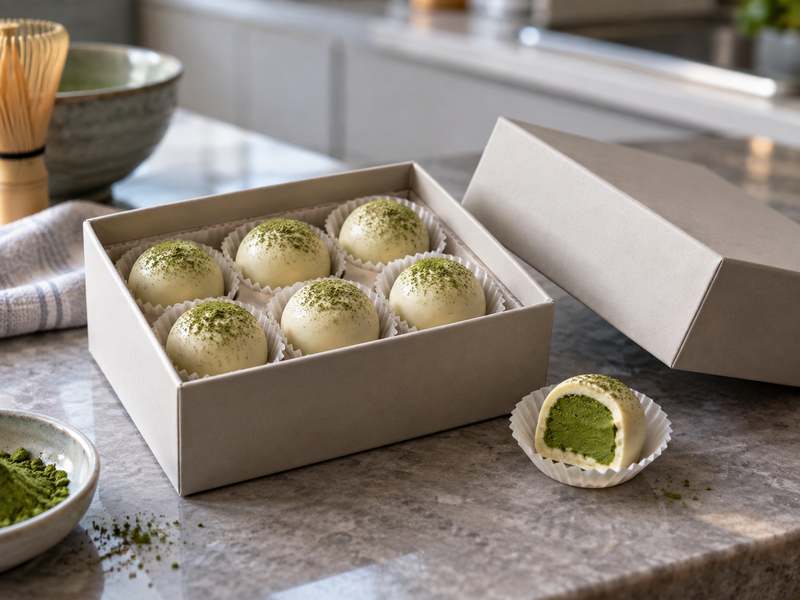
Set a cut-section reference before beginning flavor trials. Photograph the desired center-to-shell proportion alongside the intended box insert. Review these targets with the person making the batch and the person selling it. That prevents a recipe team from approving a delicate sample that the chosen distribution route cannot handle.
2. How should you choose powder and chocolate?
Evaluate the complete bite
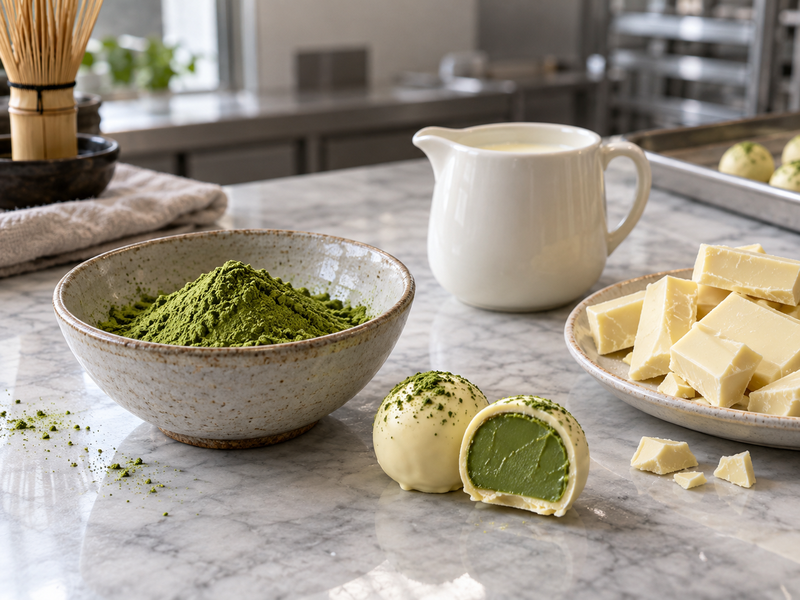
For matcha truffles, select plain matcha with a product code and ingredient declaration. Sample it at a measured dose in the chocolate you expect to purchase. Bright powder color does not establish whether tea flavor remains clear in a sweet ganache.
White chocolate is a familiar partner for matcha. Olga’s Confections’ matcha truffle recipe uses that pairing in its own formulation. For a commercial project, compare named chocolate products because changes in composition can alter sweetness, texture and processing behavior.
Request technical sheets for the chocolate candidates. Record the manufacturer, product name and declared composition beside the tea sample code. Avoid replacing one white chocolate with another halfway through a powder comparison. The tasters would be evaluating two changed ingredients at once.
The published Matcha Village chocolate guide can support the wider ingredient discussion. Send your supplier the intended center type, coating and target flavor. A powder selected for a straight-water drink may need a different dose to meet your chocolate brief; assess that through trials instead of assuming a purchasing grade guarantees the result.
3. How can you plan a measured ganache trial?
Use a fixed base and labeled variations
Choose an established ganache formula appropriate for your planned matcha truffles. Ask the chocolate supplier or your confectionery specialist to review it before adding tea. Cream, chocolate, sugars and other fats form a system; replacing one quantity with matcha by weight does not preserve its behavior automatically.
For a proposed initial flavor screen, prepare a common 200 g base portion for each variation, then add the specified tea. These amounts are experimental starting points. They neither define an acceptable finished formula nor establish storage conditions.
| Proposed variation | Base ganache | Matcha added | Observe |
|---|---|---|---|
| Control | 200 g | 0 g | Base sweetness and firmness |
| A | 200 g | 1 g | Mild tea expression |
| B | 200 g | 2 g | Flavor and smoothness |
| C | 200 g | 3 g | Bitterness and handling |
Record final weights, because added powder changes the total. Keep mixing, setting and tasting conditions consistent. Compare finished portions of equal weight so dose and portion size do not become confused.
Once a flavor candidate passes, express the complete formula in weights and percentages. Review its balance again before increasing batch size or assigning commercial handling instructions.
4. How do you disperse matcha without adding lumps?
Use an ingredient already in the formula
Sift the tea before incorporation and inspect the sieve residue. A damp clump and a foreign fragment require different responses. Keep the powder container away from steam and splashes during weighing. A dry spoon and a covered container make the work easier to repeat.
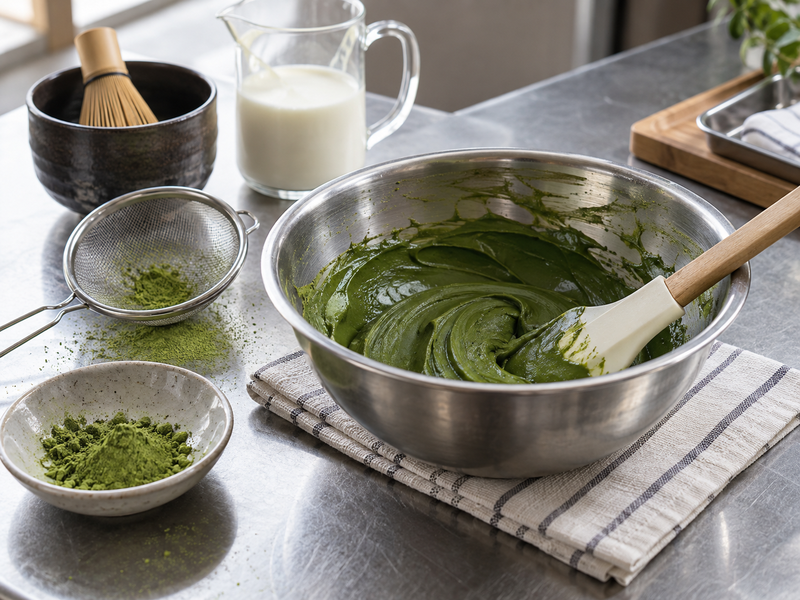
Choose a dispersion method compatible with the base recipe. A proposed comparison could disperse tea in a reserved portion of the recipe’s liquid before emulsifying, then compare it with direct incorporation under controlled mixing. Record mixing time, temperature and visible specks for each method.
Account for every gram of that reserved liquid within the original formula. Adding an unmeasured splash of water to loosen matcha changes the ganache and can invalidate earlier texture and storage work. If extra liquid appears necessary, treat it as a new formula version and have it reviewed.
Spread a small sample thinly on a plain plate to inspect lumps before portioning. Taste the set ganache too. Fine appearance alone does not guarantee a smooth mouthfeel, and an attractive surface may hide dry powder pockets inside matcha truffles.
5. What should you inspect while making ganache?
Record the mixing result before setting
Ganache preparation combines ingredients with different water and fat contributions. Valrhona’s chef guidance describes adding liquid in stages to develop an emulsion and a smooth, shiny mixture. Its advice concerns controlled preparation; follow the specific formula and chocolate manufacturer’s instructions for your product.
Keep the matcha truffles batch sheet beside the mixer. Record ingredient weights, temperatures at defined stages and the equipment used. Define how staff scrape the vessel and how long they mix after each addition. A larger bowl may leave unmixed material along its walls or under the mixing head.
| Observation | Check during investigation | Batch decision |
|---|---|---|
| Visible oil separation | Weights, temperatures and mixing | Hold for technical review |
| Dry tea specks | Sifting and dispersion | Compare dispersion method |
| Trapped air pockets | Mixer position and agitation | Review technique |
| Uneven set | Formula and tray depth | Repeat controlled trial |
Avoid repeatedly adding cream or chocolate until a failing batch looks acceptable. Record any corrective addition and treat the result as a changed formula. A visually smooth repair still needs the same product and handling review as a planned variation.
6. How can you control center size and shape?
Check consecutive portions
Choose portioning equipment that fits the approved ganache texture. A piping bag, scoop, depositor or slab cutter may suit different formats. Define the condition of the center when portioning begins. Record actual product temperature and setting history under your approved procedure.
Weigh consecutive centers at the start of a run and after a refill or pause. Keep the checks tied to the operator and equipment setting. A batch average can hide a wide range of individual pieces, which later produces uneven box weights and inconsistent bites.
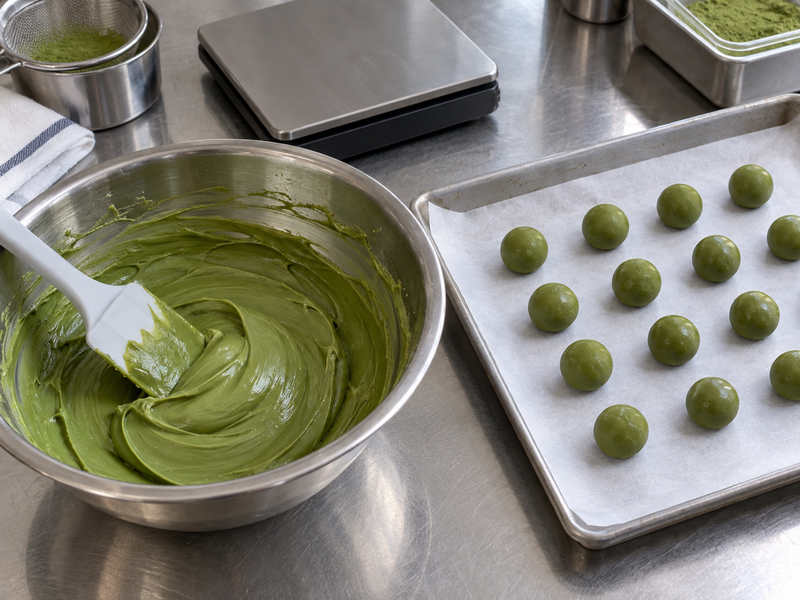
For an illustrative target of 10 g per center, ten accepted centers contain 100 g before coating. If those centers receive 3 g of coating each, their finished target becomes 13 g. Measure coating separately instead of assuming the center weight equals the sales weight.
Keep rolling contact brief and repeatable within your handling procedure. Record misshapen centers and sticking losses. If operators need frequent corrective handling, review the portioning condition or formula before adding more people to the line. Extra labor can conceal a process that still lacks control.
7. Which coating method fits the product?
Measure pickup and inspect appearance
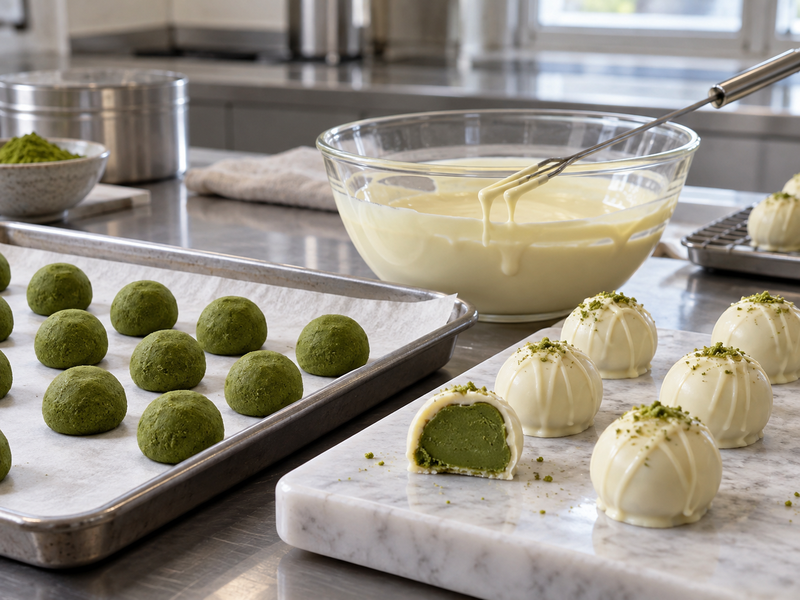
Matcha dusting gives direct tea contact but can transfer to fingers and packaging. A chocolate coating changes the sweetness, bite and finished weight of matcha truffles. Compare coatings on the same center so you can judge those differences separately from ganache changes.
For real chocolate coatings, use the manufacturer’s tempering instructions for the named product. Callebaut describes tempering as pre-crystallizing cocoa butter and provides product-related guidance. A generic temperature copied from another chocolate may not describe your material or equipment.
| Coating choice | Trial measurement | Sensory or packing check |
|---|---|---|
| Matcha dusting | Powder applied and recovered | Dryness and transfer |
| White chocolate | Coating pickup per piece | Sweetness and tea clarity |
| Dark chocolate | Coating pickup per piece | Cocoa and tea balance |
Weigh centers before coating and finished pieces afterward. Record drainage time, coating temperature and any base puddle. Cut several pieces to inspect coverage around corners and underneath.
Keep the center and coating identifiers linked. If a new shell tastes stronger, increasing matcha inside may be unnecessary; a thinner acceptable coating could change the balance. Evaluate one adjustment at a time.
8. How should you assess the finished flavor?
Taste at the intended serving condition
Give tasters coded whole pieces and record the product temperature or defined serving condition. A center assessed straight from controlled cold storage may feel different after the intended service procedure. Apply the same procedure to every sample and keep it within approved handling limits.
Ask tasters to note the opening flavor, texture during chewing and aftertaste. The surface powder may dominate the opening bite while the center determines the later impression. Distinguish dry powder sensation from bitterness; each suggests a different next experiment.
Compare the plain center with the coated version during development. If tea tastes clear in the center but disappears in the complete piece, review coating quantity and chocolate choice. If the center already tastes harsh, coating adjustments will not explain the underlying powder balance.
Keep sweetness, tea clarity and purchase preference as separate questions. A taster may enjoy a sweet confection yet struggle to identify matcha. The product team must decide which result matches the brief. Collect individual notes before discussion and repeat close comparisons using a fresh, controlled preparation. Do not convert a few internal preferences into a claim about market demand.
9. What storage and packaging work remains?
Validate the finished product and route
A set center and an intact shell do not establish shelf life. The complete formula, manufacturing controls, packaging and storage route need review before you assign commercial dates. Use a qualified food technologist or laboratory to plan appropriate assessment, which may include water activity and microbiological work.
Provide the assessor with actual ingredient specifications, formula weights and process records. Include the coating and any surface dusting. Describe intended distribution, retail display and consumer instructions. A result from a different filling or package cannot automatically support your product.
Test physical packaging alongside that work. Place finished pieces in the chosen inserts and inspect movement, contact marks, loose powder and lid clearance after representative handling. Record storage conditions during the packaging trial. Keep samples from different conditions labeled so a scuffed shell does not become an unexplained complaint later.
Review ingredient and allergen declarations for every component, including the chocolate and any decorative coating. Have the responsible person check final label copy for the target market. Keep matcha truffles under the storage and handling procedure your qualified review establishes; this article supplies no universal temperature schedule or use-by period.
10. How do you cost and approve a production batch?
Use accepted finished pieces as the denominator
Measure ingredient use, coating loss, labor and rejected pieces during a representative pilot. Chocolate left in a dipping vessel may be recoverable under your procedure or may become a loss. Record the actual outcome instead of charging only the amount visible on each truffle.
The table gives an illustrative costing structure for 100 accepted pieces. It is a calculation example, not a supplier quotation or an expected production result.
| Illustrative cost item | Batch cost | Cost per accepted piece |
|---|---|---|
| Center ingredients | USD 18.00 | USD 0.18 |
| Coating and process loss | USD 12.00 | USD 0.12 |
| Packing materials | USD 10.00 | USD 0.10 |
| Direct labor | USD 20.00 | USD 0.20 |
These lines total USD 0.60 per accepted piece before other overheads. Recalculate if the yield, box format or production method changes.
Approve one complete production version for matcha truffles covering powder code, formula, center weight, coating, handling and pack. For a Matcha Village ingredient or OEM inquiry, send that brief with your tasting notes and expected volume. Request samples and written commercial details for the proposed material before committing to a larger order.
FAQ
Q1: Can matcha truffles use milk or dark chocolate?
Yes, but develop each combination separately. Chocolate choice changes flavor and formulation needs. Use an appropriate base formula and compare the complete coated piece.
Q2: Why does the ganache feel grainy?
Check powder dispersion, ingredient weights and mixing conditions. Inspect for tea lumps and review the emulsion before changing the dose. Several faults can produce a rough sensation.
Q3: Can extra water loosen a firm center?
An extra addition creates a revised formula. Record it and have the balance and handling requirements reviewed. Do not retain earlier storage conclusions after an unmeasured correction.
Q4: Does a chocolate shell make the center shelf-stable?
An intact coating does not establish that claim. Validate the actual filling, process, package and storage route with qualified support before assigning commercial shelf life.
Q5: What should buyers send with a powder inquiry?
Include chocolate identity, proposed matcha level, center type, finished weight, target flavor and forecast volume. A cut-section photograph and coded tasting notes help explain the application.