
Matcha chocolate combines powdered green tea with a chocolate or cocoa-butter-based confection. For a maker, the hard part is preserving tea flavor and a clean green appearance while maintaining flow, snap, and shelf quality. A home recipe can set in a mold once; a commercial bar must run through tempering, depositing, packaging, and distribution repeatedly. Start with an explicit base, a weighed matcha dose, and controlled trials. Check the naming rules in each sales market before calling the finished confection “chocolate,” especially if its fat and solids differ from a regulated standard.
1. What counts as matcha chocolate?
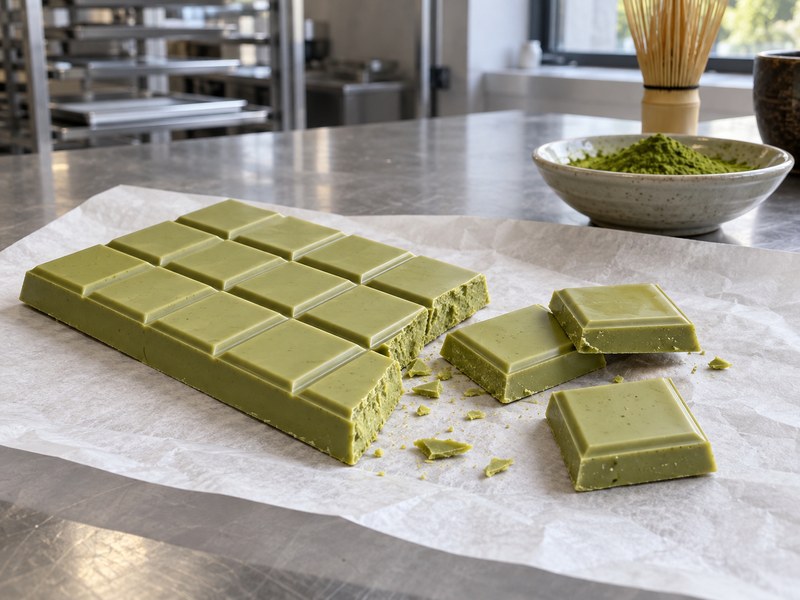
The most familiar style uses a white chocolate base so matcha can provide both green color and tea flavor. Dark or milk chocolate can also contain matcha, but cocoa’s stronger color and taste usually hide its visual effect. Some green confections use cocoa butter and sugar without the ingredients required for a local chocolate name. Others use a compound coating with vegetable fat instead of cocoa butter. All can be useful products, but their names and processing behavior differ. A product brief should identify the actual base before the team selects powder or promises a green bar.
How should a maker define the concept?
Choose the sales form. A molded tablet, coated truffle, filled bonbon, bakery inclusion, and snack drizzle place different demands on viscosity and set. Set the desired tea intensity, sweetness, shade, portion size, and expected storage route. If the product is vegan, check every component of the base and filling rather than assuming matcha makes the bar plant-based. If the confection will be sold in multiple countries, ask regulatory staff to review product identity and ingredient naming in each market. A precise name helps customers know whether they are buying white chocolate with tea or a different green confection.
| Base | Tea visibility | Processing question |
|---|---|---|
| White chocolate | High | Can it temper and flow with powder? |
| Milk chocolate | Low to moderate | Does cocoa hide tea? |
| Dark chocolate | Low | Is matcha still sensory-relevant? |
| Compound coating | Formula-dependent | What product name is permitted? |
2. Which matcha powder suits a confection?
Chocolate concentrates ingredients in a small, rich bite. A powder that tastes smooth in water can disappear under sugar and cocoa butter; a rough one can make the bar feel sandy. Seek a clean tea note at the intended dose, fine dispersion, and acceptable color after processing. Evaluate the powder in the finished base, not only in a whisked cup. Ask for a lot-linked sample, ingredient declaration, origin, storage guidance, and analytical documents relevant to the destination market. The strongest-looking powder is not necessarily the best after sweetness and fat change its flavor.
What should a blind trial record?
Make small bars from coded matcha samples using the same base, dose, tempering procedure, and mold. Score aroma when unwrapped, tea intensity, sweetness, bitterness, particle feel, color, snap, and aftertaste. Repeat after a short storage interval. If a powder performs well only at a high dose that thickens the mass, record that operational cost. Matcha Village’s pure matcha options can be assessed this way without assuming a supplier grade name predicts chocolate performance. Keep a sealed reference from the chosen lot.
3. How much matcha should a test formula use?
Screen a practical range rather than treating a teaspoon in a home recipe as a manufacturing standard. For a white-chocolate base, a trial at 1%, 2%, and 3% matcha by total batch weight can reveal the direction of flavor, color, and viscosity. These are experimental points, not guaranteed finished formulas. Replace an equal mass of another dry ingredient or account for the extra solids so comparisons remain meaningful. Taste after full crystallization and again after storage. A powder can seem vivid in a freshly mixed bowl yet taste dull in a set bar.
What signals that the dose is too high?
Watch the flow as well as flavor. Extra powder can raise viscosity, leave a dry finish, or create visible specks. More matcha may deepen green shade while making the confection harder to deposit evenly. If the low dose tastes weak, compare a different tea powder before automatically increasing solids. Cost per bar should use the accepted dose and saleable yield, including pieces rejected for poor release or streaking. Keep base chocolate, room conditions, mold, and cooling path fixed during the dose screen. Otherwise, a tempering difference can be mistaken for a powder difference.
| Screening level | Matcha in a 1 kg trial | Question |
|---|---|---|
| Low | 10 g | Does tea register clearly? |
| Mid | 20 g | Are color and mouthfeel balanced? |
| High | 30 g | Does flow or bitterness suffer? |
4. How do you disperse matcha into chocolate?
Matcha is a dry, fine particulate. Sift it before addition and keep it away from water and steam, which can upset chocolate handling and create lumps. Preblend the weighed powder into a measured portion of melted base under the recipe’s controlled conditions, then return that smooth concentrate to the main vessel. The exact method depends on equipment and batch size. A kitchen spatula may work for a small test, while a production line may need a controlled mixing or refining step. Check that no green pockets remain on a scrape test.
What should operators document?
Record the matcha lot, base lot, addition temperature, mixing time, equipment, and viscosity observations. Inspect the mass before depositing and the set pieces after demolding. If particles feel gritty, determine whether the problem is powder size, poor wetting, or a base with insufficient flow. Do not add unmeasured liquid to “fix” a thick batch. That can create a different product with new safety and shelf-life questions. A supplier may offer fineness information, but the finished bite and line behavior decide whether the powder works.
5. Why does tempering matter for a matcha bar?
Tempering, or controlled cocoa-butter crystallization, helps a suitable chocolate develop gloss, snap, and clean mold release. Matcha does not replace this step. Callebaut’s tempering guidance explains that stable cocoa-butter crystals support the familiar finished texture. The correct curve depends on the exact chocolate and equipment, so follow the base manufacturer’s instructions and validate after adding tea. A compound coating follows a different process. A bar that sets hard in a refrigerator is not proof it will resist bloom on a retail shelf.
How can a maker check the set?
Cast a small test strip and observe set time, surface gloss, snap, and release at the intended room conditions. Check the same properties after packaging and temperature cycling. If pieces show gray streaks or a soft surface, inspect temper and storage before blaming matcha. Powder addition can change how a mass feels to an operator even when the base process remains nominally the same. Record actual temperatures and handling times instead of relying on a dial alone. Run a full-size production trial after bench success because transfer lines and long holding times can change crystallization.
| Defect | Possible driver | Check before reformulating |
|---|---|---|
| Dull surface | Poor temper or cooling | Test strip and line temperatures |
| Green specks | Undispersed powder | Sifting and preblend |
| Soft snap | Base or crystallization | Manufacturer temper curve |
| Thick deposit | Added dry solids | Dose and viscosity |
6. How can color stay attractive through storage?
Matcha’s green can look fresh in a newly cast bar and muted after light or temperature exposure. White chocolate base color also matters: a yellowish base shifts the resulting shade. Define an acceptable finished range with physical samples. Test packed bars under the actual retail display, not only on a bench away from light. Foil or an opaque barrier may protect appearance better than a fully transparent window, but packaging must also suit the brand and sealing process. Any added colorant brings ingredient and label consequences.
What belongs in a color trial?
Photograph bars under fixed lighting at demold, after standard storage, and after a realistic display interval. Inspect both exposed and wrapped sides. Record the matcha dose and batch lot so a color change can be traced. If the green is important to the sales promise, agree on a rejection range before the first commercial run. A surface dusting can add initial color but may absorb moisture, transfer to packaging, or taste powdery. Test the product as it will be purchased and eaten, not only immediately after decoration.
7. What changes for filled chocolates and inclusions?
Matcha can go into a shell, ganache, cream filling, caramel, or bakery inclusion. Each placement changes flavor exposure and shelf-life risk. A tea-flavored shell gives an immediate first bite; a filling can concentrate matcha but may contain water and dairy that require separate control. An inclusion in cookie dough may be baked after the chocolate is made. Do not carry a bar’s shelf-life assumption into a filled bonbon. Formulate and validate the water-containing center as its own product, including hygienic handling and packaging.
How should the maker choose placement?
Compare two or three formats at equal serving size: a matcha shell, a matcha filling, and a mixed bar. Score tea clarity, sweetness, visual appeal, manufacturing complexity, and waste. A rich white shell may make a weak matcha center taste even weaker; a dark shell can provide appealing contrast but hide tea until the filling reaches the tongue. For foodservice inclusions, test the product after the café or bakery applies it. A chocolate chip that tastes clear alone may lose tea identity in a sweet cookie. The final application should decide the formula.
| Placement | Benefit | Additional check |
|---|---|---|
| Solid bar | Simple bite and process | Temper and color |
| Shell | Immediate tea impression | Flow and shell thickness |
| Filling | Strong concentrated flavor | Water activity and shelf life |
| Bakery inclusion | Convenient downstream use | Performance after baking |
8. How should allergens and labels be reviewed?
White and milk chocolate often contain milk; dark bases may carry other declared ingredients or cross-contact risks. Matcha itself does not erase those obligations. Request complete ingredient and allergen information for the chocolate base, tea powder, flavors, inclusions, and processing aids. Review the final ingredient order and name with the relevant market team. A green matcha coating may not meet the legal definition of white chocolate if its composition differs from the standard. Organic or origin claims need evidence covering the actual supply chain and finished product.
What should a label approval file contain?
Keep current supplier specifications, lot records, recipe percentages, allergen assessment, nutrition calculation or testing as required, and packaging copy approval. For exports, review each destination’s product naming and labeling rules rather than translating one domestic label verbatim. If a supplier changes base chocolate or matcha origin, revisit the copy. Avoid unsupported health language; the product is a confection with tea, and any nutritional claim needs a specific legal basis. A precise label helps distributors and consumers understand what they are buying.
9. How do you test shelf life and distribution?
Chocolate quality can change with heat, moisture, light, and rough handling. A matcha bar may lose its clean color or acquire stale tea notes even if it remains physically intact. Filled products add separate microbial and water-activity questions. Test the actual packaging through expected warehouse and shipping conditions. Observe bloom, snap, aroma, flavor, color, seal quality, and any transfer onto the wrapper. Do not assign a date solely from the base chocolate supplier’s shelf life; added tea and the finished process change the product.
What is a useful distribution simulation?
Use the real pack. Sample bars from the proposed retail wrapper and shipping carton, then expose them to controlled conditions representing ordinary storage and foreseeable temperature variation. Compare with a retained reference at scheduled intervals. Record changes with photos and sensory notes. If the bar goes to warm climates, include that route in the test plan and set appropriate shipping controls. A customer seeing gray bloom or a faded green bar will judge the finished brand, not the ingredient specification. Make the shelf-life decision with quality and regulatory staff using actual data.
| Study item | What to record | Decision supported |
|---|---|---|
| Appearance | Green range and bloom | Packaging and date code |
| Texture | Snap and melt | Temper and storage |
| Flavor | Tea aroma and off-notes | Ingredient and shelf life |
| Pack | Seal, scuffing, transfer | Distribution readiness |
10. How can a maker approve matcha for production?
Write a brief that names the chocolate base, finished format, target tea flavor, color range, dose range, destination market, annual volume, and required documents. Ask suppliers for lot-linked matcha samples and test them in the actual base. Run a small screening batch, then a line trial that includes tempering, depositing, cooling, and packaging. Cost per saleable piece, including rejected bars and cleaning time. Approve a physical reference and a change-control process before volume production. Matcha Village can discuss bulk matcha supply against such a brief.
What is the next practical step?
Prepare three coded matcha samples at one dose in the same white chocolate base. Taste the set bars after a day and after a short storage interval, while also checking gloss, snap, and flow records. Select a finalist, then test dose changes and the intended wrapper. Only after the finished piece passes should purchasing compare full commercial terms. A well-made matcha chocolate bar gives customers a clear tea note in a confection that looks and handles the way its maker promised.
FAQs
Q1. Is matcha chocolate always white chocolate? No. White chocolate makes green tea more visible, but milk, dark, and other confection bases can carry matcha.
Q2. Can matcha replace tempering? No. Cocoa-butter chocolate still needs a suitable crystallization process for gloss and snap.
Q3. Why does the mass get thick after matcha addition? Tea adds dry particles. Test dose, powder dispersion, and base flow before changing the recipe.
Q4. Can a home recipe be sold with its original shelf life? No. Validate the finished formulation, packaging, and distribution conditions before setting a date.
Q5. What should a buyer request from a tea supplier? A lot-linked sample, current specification, ingredient declaration, origin, storage guidance, and relevant testing.