
Matcha thumbprint cookies give a bakery a small green base with a visible filling, so the shape of the well matters almost as much as the dough. A thin bottom can leak; a shallow impression can disappear in the oven. The filling adds another choice: bake it with the cookie or deposit it after cooling. Develop those features in a deliberate order, and a tray of attractive samples can become a product another baker can repeat.
Contents: Shape · Base · Tea trial · Mixing · Wells · Filling · Bake · Pack · Yield · Approval
1. What shape should matcha thumbprint cookies have?
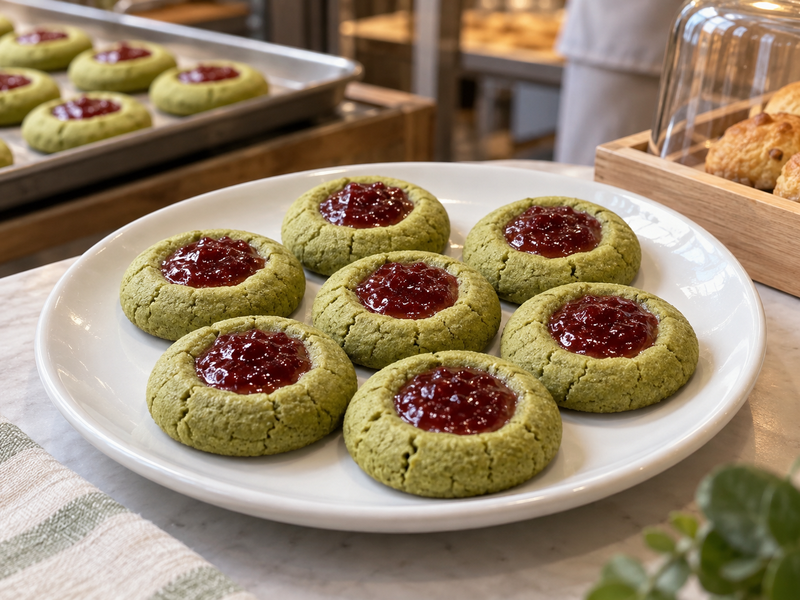
A simple round well is easier to measure than a decorative heart, and it gives a useful first production standard. The rim should be wide enough to lift without touching the filling. The floor should support the chosen deposit after baking and normal handling. Those dimensions determine how much jam or chocolate the cookie can carry.
Define the portion before the decoration
| Feature | Development check | Why it matters |
|---|---|---|
| Overall diameter | Measure cooled samples | Fits the intended pack |
| Well opening | Compare the same tool | Controls filling spread |
| Floor thickness | Cut through the center | Reveals weak spots |
| Rim condition | Inspect after handling | Shows crack risk |
The Teak & Thyme reference uses green dough with strawberry jam and a heart-shaped impression. That contrast can inspire a seasonal presentation, but the underlying well needs to function before decorative shaping is added.
Choose a portion customers can eat comfortably. If a large filled center requires several bites, jam may transfer to fingers or packaging. Test the eating experience with the actual paper cup or serving plate, including a cookie taken from the middle of a packed box.
2. Which dough ingredients should you start with?
Use a butter cookie base already proven in your kitchen for shaped or thumbprint cookies. Its flour, sugar, fat and egg balance gives the trial a known structure. Add matcha as one measured variable. A familiar base makes it easier to recognize whether a new crack comes from the tea addition or from an unrelated change in mixing.
Keep the ingredient functions visible
Flour supplies the bulk of the dough, butter affects tenderness and handling, and the chosen sugar contributes sweetness and texture. An egg yolk can be part of a particular base, but it should not be added automatically to another formula. Record the exact base and its method before beginning tea comparisons.
Purchase unsweetened matcha if you want to control the dough’s sugar separately. Check the specification instead of assuming every green powder contains only tea. The Matcha Village ingredient buyer guide explains the purchasing context for ingredient powders and blends. Use the offered product code on the trial sheet so later samples are comparable.
Select the filling at this stage, even if it will be deposited after baking. Its sweetness, acidity and texture shape the dough target. A mild white chocolate center and a tart berry jam do not ask for exactly the same tea balance.
3. How can you compare tea levels without losing the filling?
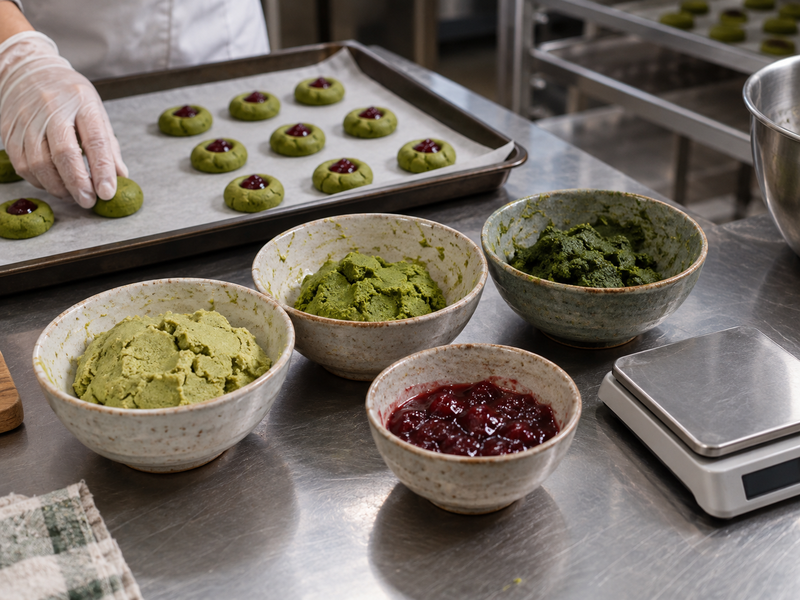
Run the first tea comparison with one filling and one deposit weight. Otherwise, a sweeter center can make a stronger tea sample seem weaker, or a larger jam portion can hide a dry crumb. Include one unfilled cookie from each batch so the dough can be assessed on its own as well.
Try a narrow dose ladder
These are proposed additions to an existing plain base, not a tested recipe. Keep all other ingredients unchanged for this first screening, then reformulate the selected version if the added powder makes the dough too dry.
| Trial | Flour in the existing base | Proposed added matcha | Main question |
|---|---|---|---|
| A | 150 g | 2 g | Is tea present beside the filling? |
| B | 150 g | 3.5 g | Does the center taste balanced? |
| C | 150 g | 5 g | Is the finish too dry or bitter? |
Do not compensate for a strong sample by changing its jam weight during the comparison. First identify the difference, then design the next trial around it. Taste cooled cookies in a mixed order and look for a useful tea flavor through the whole bite, not just a dramatic green edge around the filling.
4. What dough condition makes shaping easier?
The dough should form a smooth ball and accept an impression without a network of cracks. If it is very cold, the surface may split under the shaping tool. If it is excessively soft, the well may slump before baking. Establish a workable condition with the chosen base rather than adding flour whenever handling becomes inconvenient.
Compare the first and last portions
Sift matcha with the flour so dry clumps are removed before mixing. Scrape the bowl where butter and dry ingredients can collect. Stop at the endpoint appropriate to the base recipe; prolonged mixing is not a reliable remedy for every crumbly dough. Inspect a cut portion if the color or texture seems uneven.
During a small shaping run, compare the first cookie with the last. Hands, room conditions and waiting time can change the dough while the tray is being filled. Record any chilling or rest step and use the same step in subsequent trials. A vague instruction to chill as needed leaves too much to each operator.
If a dough cracks, test one cause at a time: condition, tool pressure, portion shape or formulation. Patching every rim with wet fingers may hide a production problem and introduce another uncontrolled variable. Keep the shaping method simple enough to repeat through a full tray.
5. How do you form a consistent well?
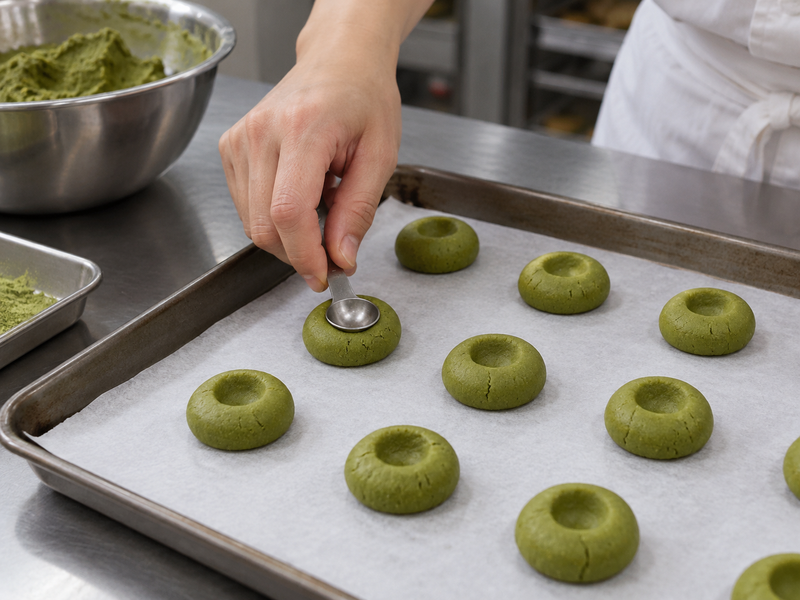
Despite the name, a rounded measuring spoon or a dedicated tool can create more uniform wells than several operators’ thumbs. The tool should be clean, suitable for food contact and sized for the intended deposit. Press into the center while keeping the dough supported on the tray, then withdraw without dragging one side of the rim.
Measure the space the filling will occupy
| Shaping choice | Likely variation | What to inspect |
|---|---|---|
| Thumb impression | Operator size and pressure | Opening and depth |
| Rounded spoon | Tool angle | Symmetry of the well |
| Heart impression | Overlapping pressure points | Thin center or cracked edges |
| Production tool | Alignment and release | Repetition across the tray |
Cut a few raw trial pieces to inspect floor thickness before committing to a tray. Then examine cooled samples, because the well may change during baking. The filling capacity should be based on the baked shape when filling after cooling, not only on the raw impression.
If the design requires a decorative heart, approve the simpler round cookie first. Introduce the decorative tool as a separate handling trial and count its rejects. That makes the labor and breakage cost of the seasonal shape visible before a large order is accepted.
6. Which filling method fits the product?
Two established approaches are useful references. Teak & Thyme deposits jam before baking. King Arthur Baking’s thumbprint recipe forms the depression during baking and fills after cooling. Neither sequence should be assumed suitable for every dough and filling combination. Choose one for the first trial and document its endpoint.
Match the filling to the sequence
For a baked-in jam, check the supplier’s application guidance and observe bubbling, overflow and the final surface. For a filling added after cooling, check depositing consistency and whether it sets or stays tacky. Chocolate, ganache, icing and fruit preparations differ in both handling and storage requirements.
Use a weighed deposit to compare candidates. A small spoonful is an unreliable unit if one filling is thick and another flows freely. Keep the rim clean and leave the intended space for any expansion or spreading observed in the trial. Overfilling can make a well-shaped cookie look irregular.
Do not infer commercial shelf life from the fact that jam or chocolate appears stable on its own. The finished cookie is a combined product, and the chosen filling can soften the surrounding crumb. Its formula, process and packaging need to be considered together when the product is approved.
7. What should the first baking trial show?
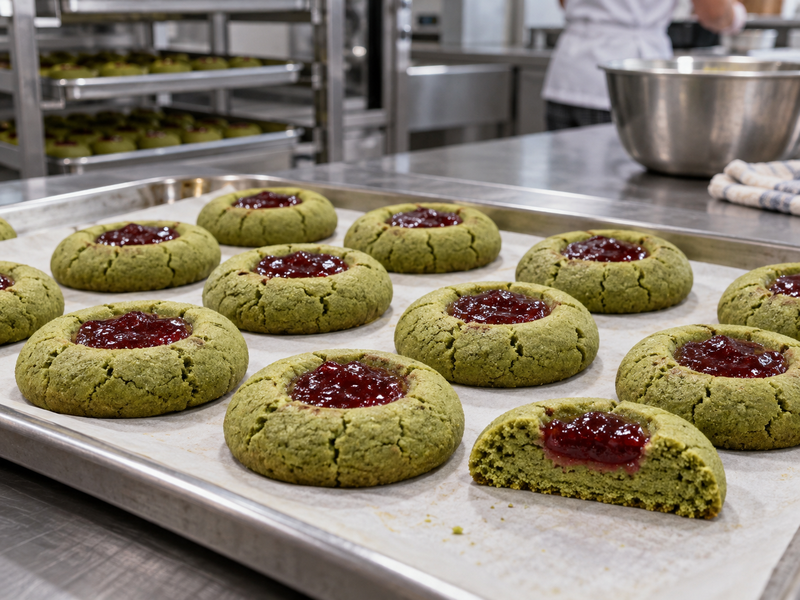
Bake a small tray before scaling the formula. Include samples from different tray positions and inspect the well after cooling. Green dough can make surface color a poor guide to doneness, so compare the underside and the cut center as well. Use the established base method as the starting point for oven settings.
Record separate dough and filling defects
| Observation | First area to investigate | Useful comparison |
|---|---|---|
| Well nearly closes | Dough spread and shaping | Raw versus cooled opening |
| Jam crosses the rim | Deposit and filling behavior | Same dough, lower deposit |
| Dark underside | Tray and oven conditions | Different tray positions |
| Thin broken floor | Impression depth | Cut center of a sample |
Let the cookies become firm enough to move before transferring them from the tray. A break during hot handling may say little about the final eating texture, but it still matters if the production routine demands immediate transfer. Adjust the workflow before making the dough unnecessarily hard.
Keep one acceptable sample photograph showing both the face and the underside. Staff can use those references when an incoming tea lot changes the shade slightly. The approval should not depend on matching a single green color while overlooking an overbaked bottom.
8. How do you check the cookie after filling and packing?
Inspect the contact area between filling and crumb during the intended quality trial. A red halo around the well, a softened floor or a sticky top may develop after the cookie initially looked successful. Compare filled pieces with unfilled controls stored under the same approved conditions to see which changes are associated with the filling.
Give the filled center enough space
Avoid packaging that presses a lid or film directly onto a tacky deposit. Measure the finished height, including the filling, and test how cookies stack or sit in inserts. If a second layer is planned, use the actual separator during the trial. A clean single-layer display does not demonstrate that a stacked gift box will arrive neatly.
Photograph the pack before and after normal handling. Look for jam transfer, rim damage and loose crumbs caught on the filling. These defects suggest different corrections: more headspace, better support or a revised dough. Adding an attractive paper liner will not address all three.
Quality observations do not establish microbiological safety. Set storage instructions and any sell-by period through the business’s product-specific validation process. Keep the decision tied to the exact filling and pack so a later seasonal flavor does not inherit an unsuitable approval.
9. Which measurements help a bakery scale the batch?
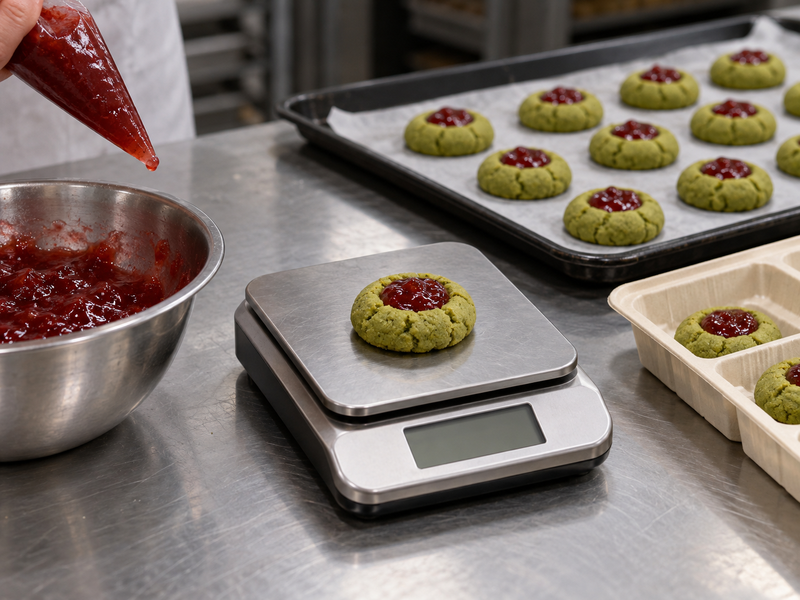
Count the cookies that remain acceptable after shaping, baking, filling and packing. Each stage can lose pieces for different reasons. Combining all rejects into one waste figure hides whether the next improvement belongs in the dough formula, the shaping tool or the packaging arrangement.
Build the cost from the finished portion
| Record | How to collect it | Reason |
|---|---|---|
| Dough portion | Weigh a run before shaping | Size consistency |
| Filling deposit | Weigh before and after filling | Cost and balance |
| Usable count | Count at each stage | Locates losses |
| Shaping time | Time the approved method | Labor requirement |
| Pack weight | Check complete sale units | Commercial consistency |
Run the selected formula with the operator who will normally make it. Have that person follow the written sheet without additional verbal corrections. Any repeated question identifies an instruction that needs to be clearer, such as whether the portion is weighed before or after scraps are patched onto the rim.
Cost the filling variants independently. A jam center, a piped chocolate center and a decorative two-color deposit may share a dough but require different labor and packaging. Keep those differences visible rather than pricing every version as the same cookie with another flavor name.
10. How should the final cookie be approved?
Approve a complete combination of dough, well, filling and pack. Record the matcha code and dose, the exact filling product, the portion weight and the shaping tool. Include photographs of a cut cookie so the approved floor thickness is visible. These details make the specification useful beyond the development session.
Set a practical change procedure
When purchasing considers a new tea, compare it in the approved dough beside the current ingredient. When changing jam, check filling behavior and the contact area again. One substitution does not require repeating every unrelated trial, but it should prompt the checks most likely to reveal its effect.
Ask suppliers for documentation appropriate to the intended market and the exact ingredients offered. Matcha Village can receive an application brief describing the baked green dough, filling type and target flavor. Request samples that can be traced to a product code rather than approving an unnamed sample bag solely on color.
Before taking a large seasonal order, make one production-sized tray with the final tool and filling equipment. Pack it in the intended sales unit, inspect the center after ordinary handling and record the actual saleable count on the approved batch sheet.
Frequently asked questions
Q1: Must the well be made with a thumb?
No. A rounded spoon or suitable shaping tool can improve consistency. Test its depth and release on the chosen dough, then use the same tool throughout production.
Q2: Can every jam be baked in the cookie?
Do not assume so. Check application guidance and run a small bake. Different preparations may bubble, spread or set differently, even when they carry the same fruit name.
Q3: Why does the rim crack during shaping?
Investigate dough condition, uneven mixing, pressure and well depth. Compare a simple round impression before changing ingredients. Adding flour or liquid immediately may create another problem.
Q4: Can the cookie use a chocolate filling?
Yes, with a filling developed for the intended deposit and serving conditions. Add it at the appropriate stage and reassess the complete product’s handling and storage requirements.
Q5: What should be tested when switching matcha suppliers?
Compare the baked color, flavor beside the filling, dough handling and finished crumb. Use the same dose and ingredient lots first so the supplier comparison is interpretable.