
Matcha tea production is easiest to assess as three linked businesses: tea cultivation, tencha preparation and powder finishing. A buyer may meet only the final seller, so the handoffs can disappear behind one product name. Ask who operates each stage for the proposed lot and what record travels with the material. The matcha traceability guide gives a practical way to connect those records to a carton code and a customer complaint.
Contents
- 1. Which three stages belong on the supplier map?
- 2. What should the grower be able to document?
- 3. How does harvested leaf enter tencha processing?
- 4. What defines the tencha processor’s responsibility?
- 5. How is tencha assessed before it moves on?
- 6. What does the powder finisher control?
- 7. Where can identity break between stages?
- 8. How should the buyer test the finished powder?
- 9. Who answers a problem after shipment?
- 10. What should the purchase approval name?
1. Which three stages belong on the supplier map?
Start with operators, not an ideal diagram
Draw boxes for cultivation, tencha preparation and powder finishing. Add packing if another company seals the final product. Some suppliers combine stages, while others buy tencha or finished powder. Ask for the actual entities and addresses handling the SKU offered to your business. A seller may explain its own facilities well but give little detail about partners. Mark those areas as open questions. The map should identify the physical route of the sample your team received, not a generic route used somewhere in the company’s portfolio.
Give each box an output. Cultivation supplies identified leaf material. The tencha processor supplies prepared tea with a code and grade. The powder finisher supplies a milled product linked to those inputs. A packer supplies the labeled unit your warehouse receives. Ask who owns records at every boundary. Once the boxes are named, you can decide which evidence is needed for an origin claim, quality approval or supply agreement. The map is a tool for dividing responsibility, not a demand that every site do all the work.

2. What should the grower be able to document?
Support the leaf-source statement
Ask whether the supplier’s origin claim refers to a specific field, a growers’ group or a broader approved area. The grower or coordinating organization should identify harvest lots and show how they enter the next stage. A buyer may receive an anonymized source record when commercial relationships are confidential. That can still be useful if the seller can demonstrate eligibility rules and a controlled connection to later tencha codes. A tea-garden photo alone cannot prove that the proposed powder used that material.
Ask what happens when a source changes. A crop may vary, and a supplier may need another approved grower. Decide whether your product can tolerate that while maintaining its label and sensory target. A single-estate retail item may need a tight boundary; a formulated drink may accept a defined group of sources. Have brand and quality approve different parts of the decision. The company materials for Matcha Village describe tea-garden resources near Hangzhou, but a specific lot still needs its own source trail before an origin statement is used.
| Grower answer | Buyer use | Record |
|---|---|---|
| Source area | Claim wording | Controlled source list |
| Harvest lot | Traceability | Picking code |
| Allowed substitute | Supply plan | Change rule |
| Transfer | Next-stage link | Delivery record |
3. How does harvested leaf enter tencha processing?
Find the intake decision
The tencha processor should know what arrived, when, from whom and under which code. Ask how staff assess leaf identity and condition before processing. If several deliveries arrive close together, how do they prevent source or grade confusion? A site may assign its own code; request the cross-reference to the grower’s code. When the processor buys from a collector, ask how the collector’s records connect to individual input lots. These practical details matter more to a buyer than an abstract statement that the business controls its supply chain.
Trace one delivery forward. Select a receipt linked to the proposed grade and ask which processing batch used it. If material was held or rejected, where was it placed and who made the status decision? Do not impose a universal harvest-to-processing time from a supplier story onto every plant. Ask the operator what its own procedure requires and how it handles a deviation. The buyer’s concern is whether material entering the tencha line is the material described in the product claim and whether that identity survives processing.

4. What defines the tencha processor’s responsibility?
Review the stage it actually performs
Yamamasa Koyamaen’s cultivation and processing description shows one producer’s route from covered cultivation through steaming, drying, selection and grinding. Use it as process context, then ask your supplier which of those operations its tencha site performs. The Japanese agriculture ministry also describes tencha as steamed and dried without rolling. Do not assume every supplier uses the same equipment or organizational boundaries.
Ask for a batch example. The record should identify input material, processing date, output code and any held material. Who decides the tencha grade before it is offered to a mill? If the processor changes its method, which downstream customers hear about it? A buyer may not need proprietary operating settings, but it should know the product identity and the rules for assigning material to the proposed powder grade. A separate tencha processor can be a sound part of supply when its records and responsibilities are clear.
| Processor duty | Evidence | Buyer question |
|---|---|---|
| Input acceptance | Receipt status | Correct material? |
| Production | Batch route | Correct process? |
| Grade | Selection record | Fit for SKU? |
| Dispatch | Transfer code | Trace intact? |
5. How is tencha assessed before it moves on?
Treat tencha as a purchased material
Before milling, tencha should have an identity, grade and status. Ask whether the powder finisher buys a specified tencha, chooses lots by sensory evaluation or blends several inputs. Request the acceptance criteria used for the proposed SKU. A supplier might check appearance, aroma and other fields; your buyer quality team should decide which information it needs to support its finished-product specification. Ask how containers are sealed and labeled during storage and transport.
Look at a rejected option. If a tencha lot does not suit the premium grade, what happens to it? Downgrading for another product may be legitimate if trace and claims remain accurate. The problem is an unclear substitution into the buyer’s approved SKU. Ask how a partial container returns to storage and whether it can later enter a different run. Following a tencha lot through selection clarifies whether finished powder consistency comes from managed inputs or simply from the name printed on a pack.
6. What does the powder finisher control?
Separate finishing from upstream claims
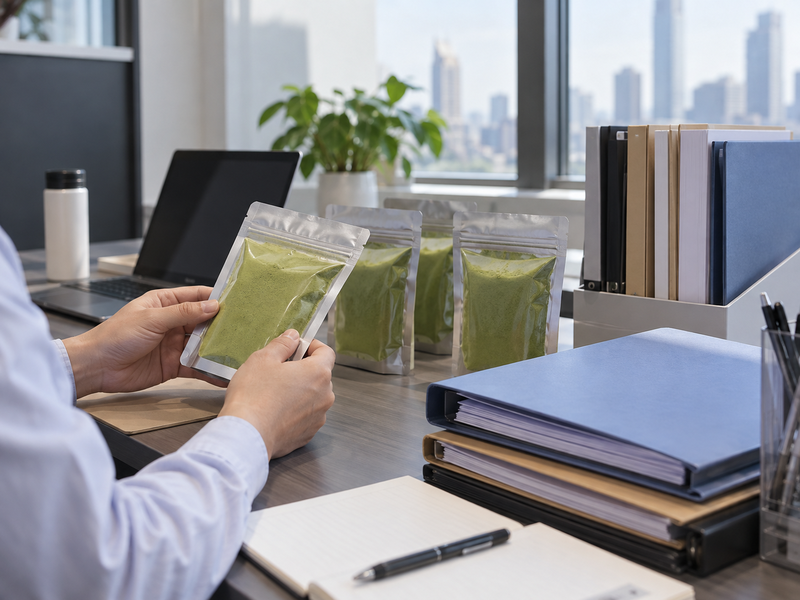
The finisher may sort, blend, mill, test and pack. Ask which activities occur on its site and which are handled elsewhere. Request a milling or production order linked to the tencha inputs and finished SKU. If a grade combines sources, ask how the blend sheet preserves each lot. A finisher can control powder texture and consistency without controlling every farm practice, so do not let its process certificate stand in for source evidence. Conversely, an excellent farm record does not replace a finishing-site review.
Test the output. Ask for a coded powder sample and specification. Prepare it in the intended drink or food under repeatable conditions. If a supplier claims a particular milling method or particle size, ask for the method and the batch record. Then judge whether the powder’s mouthfeel, color and behavior suit the application. A buyer should understand which stage could explain a later difference without pretending it can diagnose every flavor note from paperwork alone.
| Finishing output | Needed link | Buyer check |
|---|---|---|
| Blend | Tencha lots | Source claim |
| Powder | Mill run | Product identity |
| Report | Finished lot | Quality release |
| Pack | Carton code | Receiving trace |
7. Where can identity break between stages?
Review the handoffs with a carton code
Identity can fail when a processor renames a lot, a bin loses its status label or a packer uses the wrong artwork. Ask the seller to trace one finished carton backward through packing, milling and tencha intake to the source record. Codes may change between systems, but a controlled cross-reference should explain each change. Then trace forward from one tencha lot to every finished SKU that contains it. This reverse check matters when a supplier must identify affected goods quickly.
Ask about normal complexity. A blend, repack or partial container should remain visible in the trail. If records are electronic, ask who may edit them and how changes are preserved. If records are paper, check dates and signatures. A diagram can show the intended flow; an actual lot demonstrates whether the route holds together. Do not require disclosure of another customer’s commercial information. Masked examples can still show whether the supplier can retrieve and reconcile the necessary records.

8. How should the buyer test the finished powder?
Put the product in its use case
Product development should prepare a coded sample in the recipe it plans to sell. Use the same dose, liquid or food base, equipment and hold time for every candidate. Note sensory qualities and practical handling. A powder chosen for straight tea should be tasted in water; a latte powder needs milk and service conditions; a baking ingredient needs a baking trial. The source story can be useful, but it does not predict the finished result reliably enough to skip an application test.
Separate acceptance levels. A small development trial may show promise while quality documents or repeat-lot consistency remain open. Record the sample code on every note and ask for a later production lot if the order will repeat. If a new tencha source creates a difference, test it as a product change instead of assuming the grade name guarantees the same cup. This gives operations a clear role in the approval chain without asking it to decide certification, import or contract questions.
| Trial point | Method | Record |
|---|---|---|
| Dose | Weighed amount | Recipe sheet |
| Mixing | Normal equipment | Staff note |
| Sensory | Blind comparison | Panel result |
| Repeat | Later coded lot | Drift check |
9. Who answers a problem after shipment?
Name the investigation owner
When a customer reports a color shift or a package arrives damaged, the buyer needs one contact who can coordinate the entire chain. Ask whether the seller can obtain grower, tencha processor, finisher and packer records within a workable period. It should know where retained samples are kept and how it identifies related shipments. A production network can handle problems well when responsibilities are agreed beforehand. A single integrated company can still struggle if its records do not connect.
Rehearse a case. Give the supplier a hypothetical finished-carton code and ask which records it would request, who would review them and when the buyer would receive an update. Quality should separate a product complaint from a claim or labeling question. Purchasing should know whether replacement or credit discussions follow a technical decision. This exercise turns “full traceability” into a testable service expectation and shows which handoff needs improvement before volume grows.

10. What should the purchase approval name?
Keep the whole chain in the item file
Record the approved SKU, source boundaries, tencha processor, powder finisher, packer, reference sample and specification revision. State which company sells and which handles shipment documents. Add notice conditions for changes that might affect origin, cup quality or pack identity. Quality, operations, brand and purchasing should sign their own decisions. A product may pass a tasting while its source trail remains unresolved; keep that distinction visible.
Use the first delivery as confirmation. Check carton codes against documents and prepare a small sample using the approved method. If something differs, hold the affected lot and ask the named investigation contact for a response. A buying team gains confidence when it can explain the route from tea plant to powder without treating every stage as the same company’s work. That clarity makes future orders and normal problem-solving much easier to manage.
For a private-label program, add the approved artwork and the party responsible for assigning retail pack codes. A bulk powder lot may be divided across several packing runs. The buyer should be able to trace a customer-facing tin or pouch back through that division to the original mill and tencha inputs. Test the path with one finished unit before the launch inventory is released.
| Approval item | Evidence | Owner |
|---|---|---|
| Source | Defined grower route | Brand/quality |
| Tencha | Processing and transfer | Quality |
| Powder | Coded sample and report | Operations/quality |
| Shipment | Pack and offer | Purchasing |
FAQ
Q1: Does one supplier need to own all three stages? No. Each operator and handoff must be understood for the proposed SKU.
Q2: Can a mill verify farming claims alone? It needs source and transfer evidence from upstream partners.
Q3: Why evaluate tencha before milling? Its grade and identity affect the powder that can be produced and claimed.
Q4: What should a complaint code reveal? The associated packing, milling, tencha and source records.
Q5: Who should approve a new source? The buyer functions responsible for product quality, origin wording and application fit.
Final thought
Separate the work of grower, tencha processor and powder finisher, then reconnect it through lot records and a tested sample. That view gives B2B buyers a realistic way to approve a product and to solve a problem after shipment.