
Matcha traceability should let a business answer a practical question: which raw material and production records relate to the powder in this bag? A map of a tea garden and a story about harvest are useful context, but they do not identify a shipped lot by themselves. Importers, brands and food manufacturers need a chain that survives blending, milling, repacking and distribution. These ten steps show what to request, how to test the record trail and how to make claims that the documents can support.
Contents: Goal · Farm · Process · Blending · Tests · Pack · Claims · Recall · Systems · Buyer
1. What Question Must the Record System Answer?
Start from a physical pack
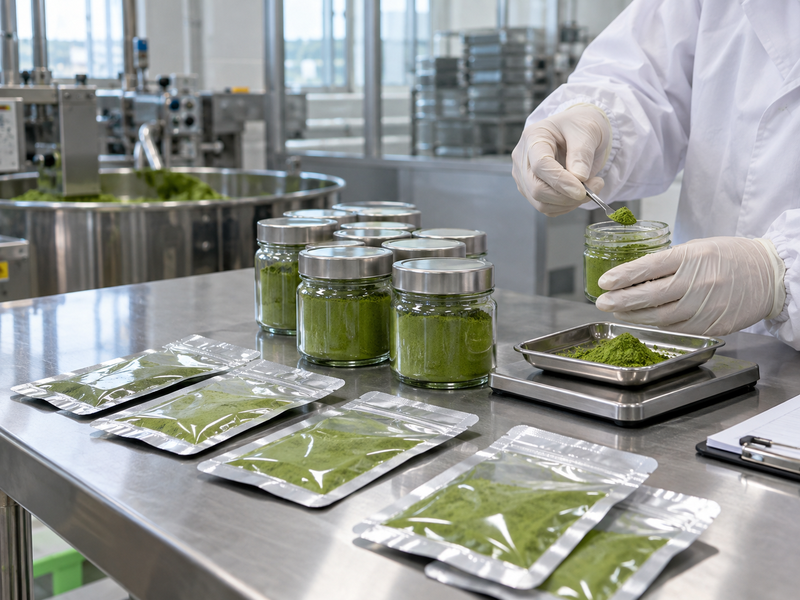
Take one bag of matcha and read its lot code. Can the supplier identify the material that went into it, the processing run, relevant tests and the customers who received other units from that run? That is a useful working test. A beautiful farm story may be true and still fail this question if it cannot be tied to the shipped powder. Decide which links the buyer needs for quality, claims and incident response. The answer may differ for a specialty single-origin tea and a blended ingredient used in a factory.
Run the exercise before a complaint. Ask for a sample record trail during supplier qualification. Note how long it takes to retrieve and whether identifiers stay consistent across documents. A system that depends on one employee’s memory is fragile. The objective is not an impressive software screen; it is an accurate connection from raw material to the pack a customer can hold. Keep the buyer’s own receiving and production records part of that chain.
2. What Raw-Material Information Should Be Kept?
Record what the supplier can verify
Tea garden, collection area, harvest period, producer and incoming material identifiers may all matter. The detail available depends on the supply arrangement. Ask the supplier which information it captures and how it verifies it. If a brand wants to name a specific origin on a pack, the records should support that level of precision. A broad country statement and a named farm claim are different promises. Do not force a level of detail that the supply chain cannot demonstrate and then print it anyway.
Check the handoff. Leaves may pass through collection, processing and storage before milling. Each transfer needs an identifier that connects the received material to the prior record. A receiving weight, date and supplier name help, but they are not enough if several incoming lots are mixed without a blend record. Buyers should ask to see how a raw lot is accepted or rejected, and how quality results are attached to it.
| Raw-material record | Question it answers |
|---|---|
| Producer or collection source | Where did material enter the chain? |
| Harvest or intake date | When was it received? |
| Incoming lot code | How is it identified later? |
| Acceptance record | Was it approved for processing? |
3. How Do Processing Steps Stay Connected?
Follow material through the actual factory
Matcha production can include leaf processing, sorting, milling and packing, sometimes at different sites. Request a process map that reflects the supplier’s operation rather than a generic industry diagram. At each step, note input lot, output lot, date, equipment or line where relevant and yield. If the material is moved into new containers, the new identifiers should point back to the old ones. A quality team should be able to explain where a sample was taken and which finished lot it represents.
Do not assume one site does everything. A company may own a farm but contract milling or packing. That can be a workable model if responsibilities and records remain clear. Ask who controls each handoff, how the contract processor reports output and how deviations are handled. A traceability claim should describe the chain actually used. “Factory direct” is a commercial description, not evidence that every step happened under one roof.
4. What Happens When Lots Are Blended or Split?
Keep the parent-child relationship visible
Blending material from several origins or harvests can help a supplier meet a consistent flavor target. It also creates a many-to-one record. The finished lot should identify all relevant input lots and their relationship to the blend. Splitting one bulk lot into many retail packs creates the opposite link: one parent lot to many packed units. Ask for a simple example from the supplier’s system. If the business cannot show those relationships, it may struggle to locate affected products during a quality issue.
Test the edge case. What if one input lot later has a problem? Can the supplier find every finished blend that used it? If a finished product complaint arrives, can it identify all possible inputs? A traceability test should cover those questions, not only a neat one-farm-one-bag demonstration. The record may be digital or paper. Accuracy and retrieval matter more than the software brand.
| Operation | Record link needed | Why it matters |
|---|---|---|
| Milling | Input to powder lot | Connects raw material to finished powder |
| Blending | All parent lots to blend | Defines affected material |
| Repacking | Bulk lot to retail codes | Finds customer units |
| Rework | Original and new lot | Prevents invisible material movement |
5. How Do Test Results Follow a Lot?
Connect the report to the sampled material
A certificate of analysis only helps if its lot identifier matches the material delivered and the sample stage is understood. Ask whether tests were run on incoming tea, milled powder, packed product or a composite. Keep the specification version and release decision with the report. If a shipment contains several lots, the buyer needs clarity about which report covers each. A broad marketing statement that a factory “tests all matcha” does not show what was measured on this lot.
Look at the date and method. Quality staff should review whether the test method, reporting unit and timing support the purchasing decision. A later blending or repacking step may need additional records. If a report is reused across several packs, the connection should be explicit. The point is not to collect PDFs for their own sake. It is to let a future investigator find the evidence relevant to the exact powder in a product.
6. How Do Packed Units Link to Bulk Powder?
Make the customer-facing code work
A retail tin, foodservice pouch or bulk carton should carry a code that identifies its packing run. The supplier should be able to connect that run to the bulk powder lot and packaging materials used. During qualification, select one finished unit and ask the supplier to show its upstream links. Then select a bulk lot and ask which units were packed from it. Both directions matter. A legible code hidden under a label that tears off in transit may be less useful than a modest code placed well.
Keep pack changes in the trail. If an inner pouch is filled on one day and placed into a branded tin later, those events should connect. If a private-label brand supplies its own packaging, it should keep print version and pack lot records. A powder may be fully traceable at the factory yet lose that connection in a distributor’s warehouse if cartons are mixed without receiving controls. The buyer’s own system has work to do.
| Finished-pack record | Question |
|---|---|
| Powder lot | Which material filled this pack? |
| Filling run | When and where was it packed? |
| Packaging lot | Which container and label version? |
| Shipment | Who received the units? |
7. Which Origin Claims Can Be Supported?
Match wording to the evidence level
“Packed in Japan,” “milled in Japan” and “grown in Japan” describe different steps. A brand should not use one as proof of another. Similar care applies to named regions, gardens, first harvest and organic status. Review documents for the exact lot and the rules of the destination market before using a claim. If the supplier blends material from several sources to maintain consistency, a single-farm story may be inappropriate even when the product is excellent.
Write plain copy. A description that states the verified growing and processing facts can be compelling without exaggeration. If origin records are incomplete, focus on tested flavor, intended use and supplier controls instead. A claim that can be traced to a lot is stronger than a more romantic sentence that cannot survive a customer question. Keep approval of marketing language tied to a specific evidence file and product version.
8. Can the Supplier Trace Forward as Well as Back?
Practice the two directions
Backward tracing begins with a finished pack and finds its inputs. Forward tracing begins with an input lot and finds every product and customer that received it. Ask the supplier to demonstrate both on a recent completed lot. Record the time, missing steps and corrective actions. A real incident may demand quick decisions, so a supplier should not need days to locate basic shipment records. The buyer should perform its own exercise from a finished food product back to the matcha ingredient and forward to customers.
Keep a response plan. Quality staff should define who places material on hold, contacts partners and evaluates affected batches. A traceability record does not by itself decide whether a recall or other action is needed. It gives the team a reliable map for that decision. If the supplier’s test reveals a missing distributor record, fix the handoff before a launch rather than assuming someone will remember the cartons later.
| Test direction | Starting point | Expected endpoint |
|---|---|---|
| Backward | Customer pack | Raw inputs and process records |
| Forward | Tea input lot | Finished packs and recipients |
| Internal | Finished food batch | Matcha lot used in formula |
9. What Tools and Audits Make Records Useful?
Prefer a working routine over a shiny platform
Barcodes, spreadsheets and enterprise systems can all help, but each depends on people scanning, entering or checking information accurately. Review how the supplier prevents duplicate lot numbers, corrects mistakes and backs up records. A buyer may ask for a supplier audit or record demonstration according to its risk program. A system that shows attractive dashboards but cannot reconcile physical inventory with recorded lots is not mature.
Check retention and access. Relevant records should remain available for the period required by the product, contract and applicable rules. If data live with a contract processor, agree on access before a problem occurs. Run periodic trace exercises and note whether corrective actions close. The system’s value appears when a new buyer or quality manager can retrieve a complete chain without calling the person who built it.
10. What Should a Buyer Ask Before Ordering?
Put traceability in the purchase process
Ask for an example lot trail, product specification, lot-linked test report and description of blending, repacking and subcontracted steps. Decide what origin detail the brand actually needs and write it into the order requirements. Agree on change notification if source, processor or pack site changes. Keep receiving checks and internal use records after delivery. The buyer’s responsibility begins when the powder arrives, not when the supplier’s truck leaves.
Try one real lot. Choose an approved sample, place a pilot order and trace its code through receipt and a finished product. If the chain can be followed both ways and the powder performs as expected, the supplier has offered evidence a buyer can use. If it breaks, identify the exact missing handoff and fix it before scale. Matcha traceability is valuable because it turns a story about origin into records that support routine purchasing and difficult decisions alike.
| Buyer request | Use |
|---|---|
| Lot trail example | Tests retrieval |
| Specification and COA | Links quality to material |
| Change notification | Protects future claims |
| Pilot order record | Tests the actual supply chain |
FAQ
Q1: Is a farm photograph proof of matcha origin? No. It gives context; lot-linked records must connect the powder to that source.
Q2: Can blended matcha be traceable? Yes. The blend record should identify the input lots and the finished output.
Q3: What code should appear on a retail pack? It needs to connect the unit to packing and powder records under the supplier’s system.
Q4: Does a COA provide full traceability? No. It reports results for tested material; the wider record chain connects that material to inputs and customers.
Q5: What should a buyer test? Trace one physical pilot pack backward to inputs and forward from its powder lot to shipments.
For a related buying decision, see Japanese matcha. The SERP reference article discusses source transparency; the lot exercise here tests whether those details stay connected to delivered material.