
A café buyer sees two green tea offers: a carton labeled “matcha tea bags” and a pouch of pure matcha powder. The unit prices look easy to compare until a sample is brewed. One produces a clear infusion; the other makes an opaque drink with powder suspended throughout. For matcha tea bags vs powder, the useful decision begins with the ingredient list and the drink you intend to sell. Matcha Nude’s comparison raises the distinction, although its product percentages and nutrition claims should not be applied to every SKU. This guide gives buyers a product specification and service trial instead.
Contents
- 1. What is actually inside each format?
- 2. How does a tea bag prepare differently?
- 3. Which format suits each menu item?
- 4. What should buyers compare on a label?
- 5. How should flavor and appearance be tested?
- 6. What does each serving really cost?
- 7. How do speed and equipment change the choice?
- 8. How should stock be packed and stored?
- 9. What claims should marketing avoid?
- 10. How can a buyer make a final specification?
1. What is actually inside each format?
Read the ingredient declaration before the front panel
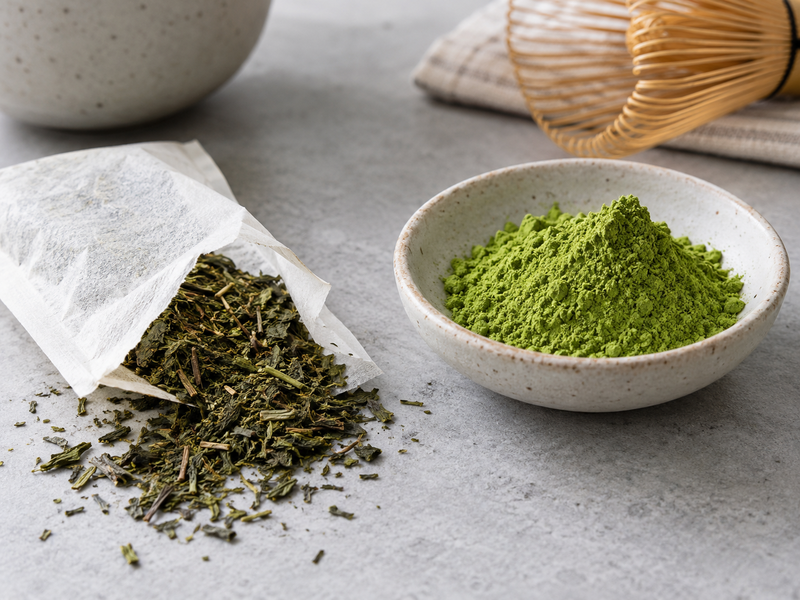
Pure matcha powder is milled tea intended to be dispersed in a drink or food. A product sold as a matcha tea bag may contain cut green tea leaf, matcha powder, other tea, flavoring or a blend. Its formula varies by brand. Do not assume all tea bags contain a particular percentage of matcha, and do not assume every green tea powder is matcha made from tencha. Japan’s Ministry of Agriculture, Forestry and Fisheries describes matcha as powdered tencha, with a distinct cultivation and processing route.
Ask for the composition: a supplier should identify each tea component and its proportion when that proportion matters to your purchase or labeling. Ask whether “matcha” appears in the ingredient list as an actual ingredient and whether the bag contains ground tea that may pass through its material. A pure powder pouch should state its composition and any added ingredients plainly. If the offer is a sweetened latte blend, compare it as a blend, not as pure matcha. The package front may sell an idea; the specification tells a buyer what material enters the kitchen.
| Format | Possible contents | Buyer check |
|---|---|---|
| Matcha tea bag | Leaf tea with some matcha | Request ingredient proportions |
| Pure matcha powder | Milled tea | Confirm raw material and additives |
| Matcha latte blend | Matcha plus other ingredients | Check sugar, milk and flavoring |
2. How does a tea bag prepare differently?
Infusion and suspension create different cups
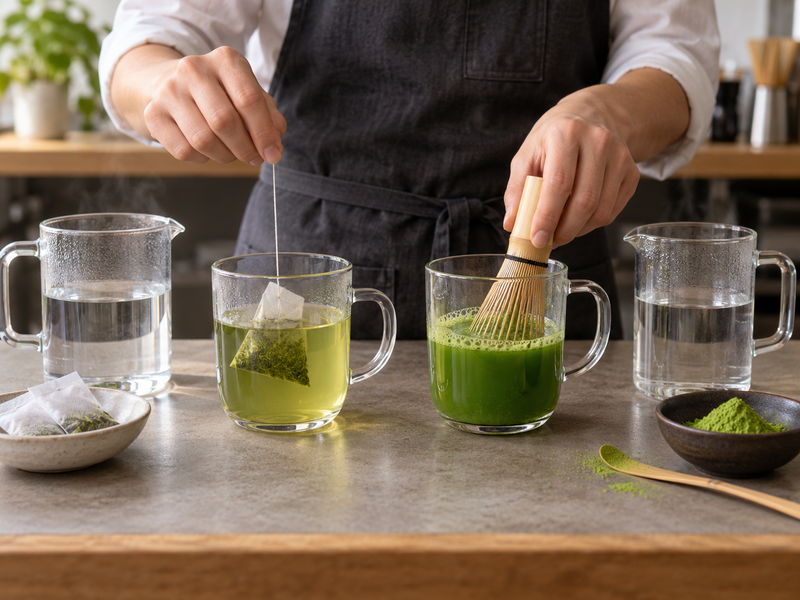
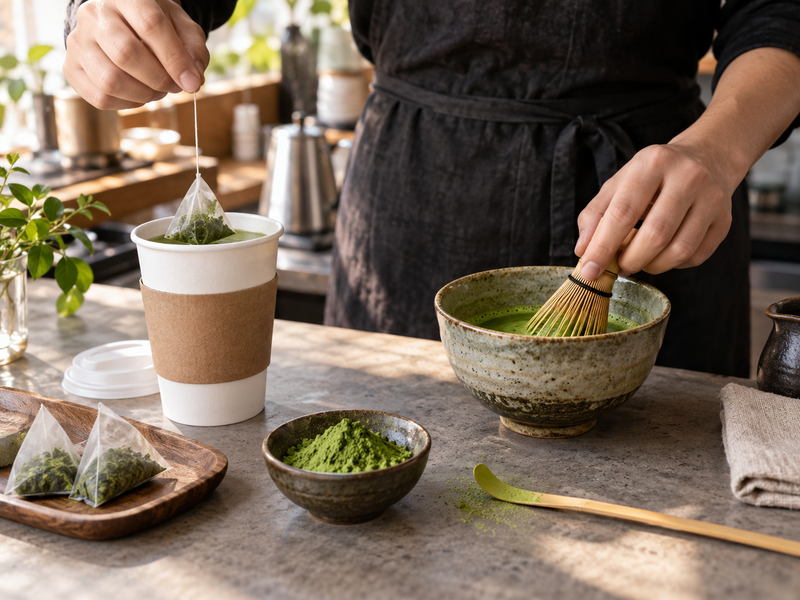
A tea bag normally steeps in water and is removed. Much of its solid tea material remains in the bag. Pure matcha powder is measured, wetted and whisked into water or another liquid; particles remain suspended in the served cup and may settle with time. Calling matcha “fully dissolved” is inaccurate for ordinary café preparation. The MAFF tea guide distinguishes matcha powder from brewed leaf teas, even though consumer descriptions sometimes use “dissolve” loosely.
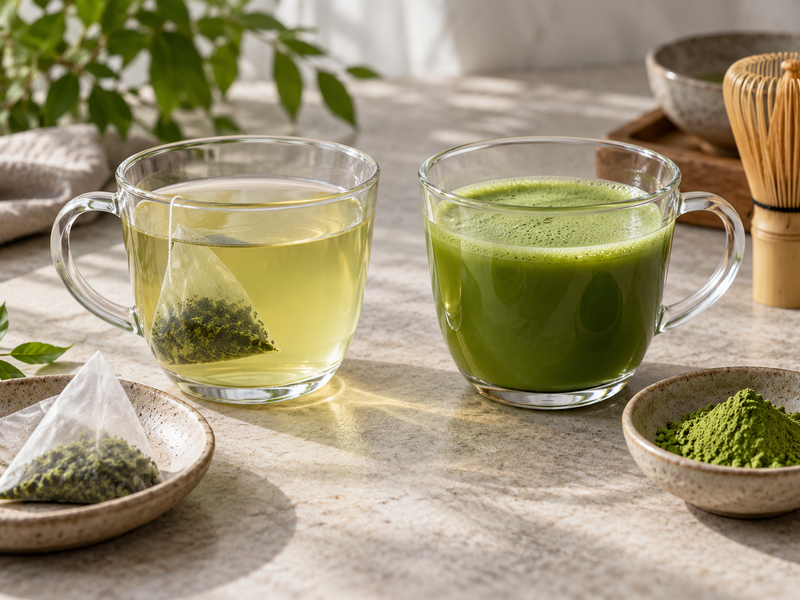
Look at the cup: a bag can produce a lighter, clearer green-tea infusion that some guests prefer plain. Powder supplies more body, visible green color and tea material in a latte. A bag containing fine matcha may release some powder into the cup, so inspect the exact product. Service time differs too: steeping takes a wait, while whisking takes active staff work. Neither format is automatically faster at a busy bar. Time from ticket to handoff, including disposal of the used bag or washing the whisk, under your actual layout.
3. Which format suits each menu item?
Start with the drink target
For a clear hot green-tea cup, a bag or loose leaf may suit the menu. For a classic opaque matcha latte, pure powder usually provides the expected color, texture and controllable tea dose. A bottled or ready-to-drink formula brings different stability and food-safety work; choosing powder alone does not solve separation. For baking, a bagged infusion may add liquid and little color, whereas powder can enter the dry formula. Test the finished product rather than assuming one format wins every application.
Write the target first: decide whether the menu promises “green tea” or “matcha,” whether the customer sees the powder, and whether staff must customize strength. A hotel breakfast station may value a wrapped bag and simple hot-water service. A specialty café may need gram-level control for iced lattes and flavored drinks. A manufacturer may buy bulk powder for repeat formulation. These are different jobs. A single purchasing price sheet cannot resolve them without an application brief and sample preparation that mirrors actual service.
| Application | Likely starting format | Test before approval |
|---|---|---|
| Clear hot tea | Bagged or loose leaf | Taste and steep time |
| Iced matcha latte | Pure powder | Tea presence in milk |
| Bakery formula | Powder | Color and flavor after baking |
| Self-serve amenity | Individually packed bag | Label and guest instructions |
4. What should buyers compare on a label?
Check both legal information and buying detail
Read the ingredient list, net quantity, allergen statement where relevant, country-of-origin information, lot code, date marking and preparation directions. Requirements vary by market and product type. The FDA’s food labeling guide is a US reference for packaged foods; importers should confirm rules in their own destination market. Ask the supplier for a specification that states bag fill weight or powder pack weight, tea composition and any additives. If an ingredient is a sweetener or milk derivative, that affects both menu wording and allergen handling.
Check claims against the SKU: an organic claim needs certification covering the product and market. A “100% matcha” front-panel claim should match the ingredient declaration. A bag labeled “matcha green tea” might contain both matcha and leaf tea; that can be a legitimate product if represented accurately. Do not let a generic supplier brochure stand in for the actual retail pack or lot. Request a sample with the same packaging and label that customers will receive. A label review before ordering is cheaper than relabeling imported cartons after arrival.
5. How should flavor and appearance be tested?
Give each product a fair preparation
Prepare the tea bag according to its directions, recording water volume, temperature and steep time. Prepare powder with a measured dose and liquid volume; include any wetting and whisking method. Taste both plain before adding milk or syrup. Then test each in its intended drink. A bag may be pleasant in hot water and vanish in a large iced latte. Powder may taste vivid in water yet become harsh at a dose chosen only for color. A fair comparison records what the customer will actually drink.
Use a blind service trial: code samples, serve at the same temperature and ask tasters about tea character, bitterness, mouthfeel and appearance. Photograph each cup under the same light at preparation and after a realistic handoff delay. Powder settling after a long wait is not the same as sand-like grit on the first sip. If a bag leaves visible particles, note whether that is intentional and acceptable. Keep the product’s lot and preparation method with the tasting record. The winning sample should survive a second test by another barista, not only a supplier-led demonstration.
| Sensory factor | Bag trial | Powder trial |
|---|---|---|
| Tea aroma | Brewed infusion | Freshly whisked base |
| Color | Clarity and hue | Opacity and green tone |
| Texture | Leaf particles, if any | Smoothness and settling |
| Milk performance | Tea presence after dilution | Tea balance at target dose |
6. What does each serving really cost?
Price the acceptable cup, not the package
Calculate bag cost per serving from carton price divided by usable bags. For powder, multiply price per gram by the approved dose and add any handling loss. Then include labor, equipment cleaning, packaging and remakes for both. If a bagged tea tastes too weak in a 16-ounce latte, two bags might be needed; that changes both price and steeping time. If a lower-priced powder needs a much higher dose, its cheap kilogram price may not produce a cheap drink.
Work through the menu: use the actual milk, cup size and selling price. A self-serve hotel cup has a different labor model from a hand-built iced latte. Ask how many drinks staff can complete in a peak 15-minute block and how many failures need remaking. Count used-bag disposal and water for rinsing tools. Avoid a claimed “servings per pouch” unless the serving dose matches your approved recipe. Present the result as a range if dose or demand is still under trial. That makes the purchasing decision transparent when ingredient prices change.
7. How do speed and equipment change the choice?
Map the service steps for each format
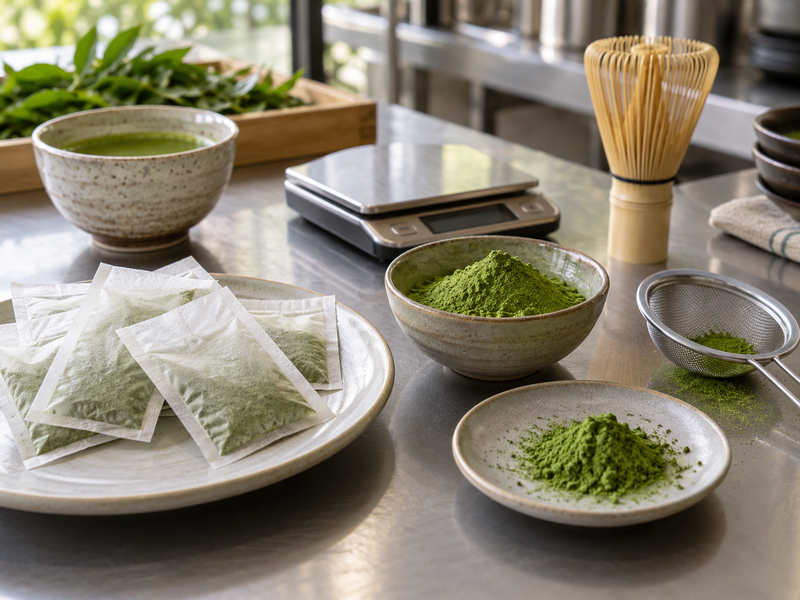
For bags, staff need storage, a cup, hot water, a timer and a way to remove or present the bag. For powder, they need a dry measured scoop or scale, a vessel, liquid, whisk or mixer and a cleaning routine. A fast whisked shot may beat a long steep when bar staff can prepare it during another drink’s wait. A bag may beat powder at an unattended meeting station because no one has to dose or clean a whisk. The result depends on staffing and layout.
Time the full cycle: start at ticket receipt and stop at a ready-to-serve cup. Include refill, cleanup and any wait that blocks a shared station. Test multiple consecutive orders and a quiet single order. If your customer wants strength options, powder often gives more direct dose control, but bag count or steep time may also be adjusted within a validated service recipe. Train staff on the approved method and confirm another shift can reproduce it. A format that looks convenient in a home kitchen can behave differently at a 40-order morning rush.
| Workflow element | Tea bag | Powder |
|---|---|---|
| Portion | Usually prefilled | Weigh or verified scoop |
| Main wait | Steeping | Active dispersion |
| Cleanup | Remove bag and cup area | Wash mixing tools |
| Custom strength | Bag count or method | Powder mass |
8. How should stock be packed and stored?
Match pack size to turnover
Tea bags have packaging around individual portions or groups; powder may arrive in tins, pouches or bulk bags. Compare protection against moisture, light, air and odors, then follow each supplier’s instructions. Keep opened powder sealed and use dry utensils. If a buyer chooses large bulk packs, determine how many working tins are opened and how quickly each turns. Individually wrapped bags may simplify distribution to hotel rooms but create more packaging per serving. Quantify that tradeoff for your operation rather than making a generic sustainability claim.
Preserve lot identity: record which lot went to each branch or product run. Do not mix old and new powder in a working tin if complaints must be traced. Inspect damaged bag wrappers and pouch seals at receipt. Where refrigeration is recommended, avoid opening a cold package before it reaches the appropriate handling temperature under supplier guidance; condensation can affect powder. Research on matcha storage conditions supports treating storage as a quality factor, but it does not supply one universal temperature or shelf life for every formula and package. Ask for product-specific guidance in writing.
9. What claims should marketing avoid?
Describe what the product does, not imagined health effects
Do not state that all matcha tea bags contain a tiny fixed matcha percentage. Products differ. Do not claim powder is “fully dissolved” when ordinary matcha remains suspended. Avoid promising a precise caffeine or antioxidant advantage without a defined serving and reliable product-specific evidence. The reference comparison makes broad nutrition claims; those are not a substitute for a compliant label or a laboratory result for your SKU. A plain statement such as “powder is whisked into the drink, while this bag is steeped and removed” tells customers something observable.
Make menu names precise: a “matcha latte” should reflect the tea ingredient actually used and the business’s local labeling obligations. If a tea bag blend provides the base, decide whether “green tea latte with matcha” is more accurate than suggesting a pure powder drink. Review allergy and nutrition statements with the appropriate regulatory team. The FDA’s allergen guidance is relevant when blends contain milk or other major allergens. Marketing should never promise a health outcome that the purchasing specification cannot support.
| Claim to review | Better evidence or wording | Owner |
|---|---|---|
| “Pure matcha” | Ingredient list and spec | Quality |
| “Low caffeine” | Defined serving analysis | Regulatory |
| “Organic” | Applicable certificate | Purchasing |
| “Quickest service” | Timed local trial | Operations |
10. How can a buyer make a final specification?
Turn the menu decision into an order brief
State the application, required tea composition, pack format, approved preparation, expected monthly volume, sensory target, lot documentation and destination market. Attach the blind tasting record and finished-cup cost. If the operation needs both a clear hot tea and an opaque latte, buying two formats may be sensible. If one format must cover both, test the compromise explicitly. For bulk powder or private-label supply, ask for a current sample and quote matched to actual use rather than choosing from a grade name alone.
Approve a cup, then a lot: request a representative production sample, inspect the pack and repeat the service test at the intended branch or factory. Record the approved dose and a tolerance for staff checks. Review the next lot against the same standard. For matcha tea bags vs powder, the decision is complete when the buyer can explain what is inside, how it is prepared, what the finished cup costs and why that format fits the customer’s drink.
For powder specifications, use our matcha green tea powder guide.
FAQ
Q1: Are matcha tea bags always mostly ordinary green tea?
No. Composition varies by product. Read the ingredient list and request proportions when they matter.
Q2: Does matcha powder dissolve in water?
It disperses as fine particles and may settle. A tea bag normally creates an infusion and is removed.
Q3: Which works better in a latte?
Pure powder often gives stronger color and tea presence, but test both in your actual milk and cup size.
Q4: Which format serves faster?
Time the complete local workflow. Bags need steeping; powder needs dosing, mixing and tool cleaning.
Q5: What should a wholesale specification include?
Include composition, pack, lot records, application, preparation method and approved sensory result.