
A café or tea brand may make a matcha sustainability claim before it knows where the leaves grew, how the powder was packed, or what the claim means. That wording can outrun the evidence. The Tea Rebellion discussion of quality, supply, and sustainability provides a useful starting point. This buyer plan turns a broad ambition into specific questions about farming, processing, packs, freight, and supplier practices. It does not assign a universal carbon score to matcha. Instead, it asks for records that support the claims a business actually intends to make.
Contents
- 1. What should matcha sustainability mean in a purchase brief?
- 2. Which farm practices can a buyer verify?
- 3. How do processing and milling enter the review?
- 4. What can certifications prove?
- 5. How should packaging options be compared?
- 6. How does freight affect a sourcing decision?
- 7. What should be asked about people and purchasing terms?
- 8. How can a buyer avoid waste after delivery?
- 9. Which claims can a brand publish?
- 10. How should the plan be reviewed each year?
1. What should matcha sustainability mean in a purchase brief?
Replace a slogan with a boundary and question
Define the product and the part of its life you are evaluating. A claim about farm chemical use is different from a claim about packaging waste or freight emissions. “Sustainable matcha” without a boundary suggests an overall environmental benefit that a buyer may not be able to support. The US Federal Trade Commission’s Green Guides summary cautions against broad, unqualified claims such as “green” or “eco-friendly” and calls for clear, specific qualifications.
Write a brief with product SKU, source region, purchase volume, end market, intended claim, and evidence required. If the brand intends to say that a pouch contains recycled material, ask for pack-specific composition and the wording approved for that market. If the aim is less powder waste at a café, measure discarded grams. Make the claim small enough to test: a buyer can verify that a particular lot comes from a certified farm more readily than that a whole product has no environmental impact. Keep environmental and social topics separate in the evidence file so one certificate does not get used to prove unrelated benefits.
2. Which farm practices can a buyer verify?
Ask about the actual growing site and period
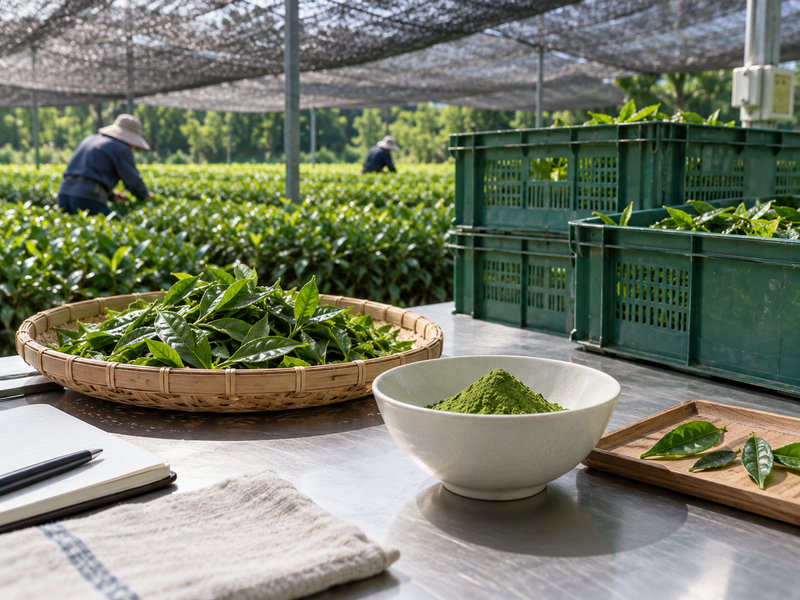
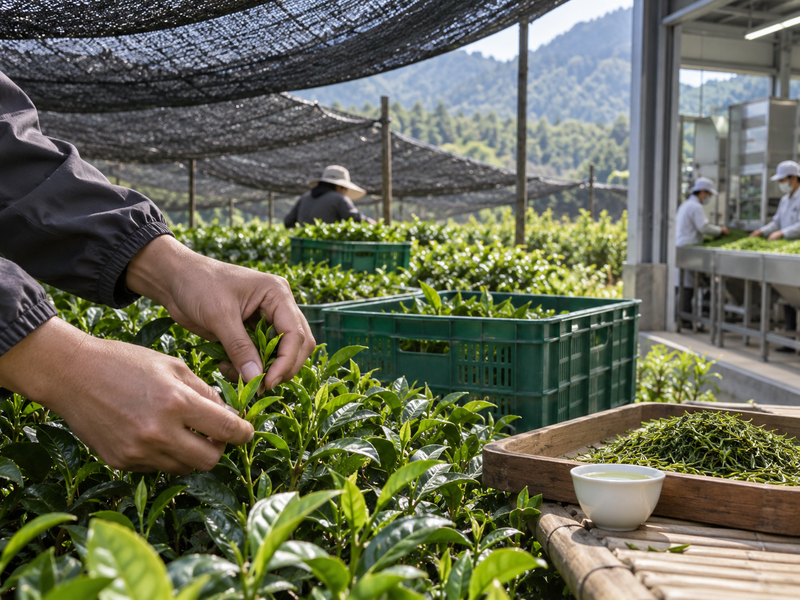
Matcha starts with tea leaves, often shade-grown before harvest. Ask the supplier which farms or growing groups supplied the lot, what cultivation system they use, and which records can support any claim about pesticide management, soil practices, water, or biodiversity. A brand story about a region is not a farm practice record. If a supplier works with several farms, request a documented method for connecting harvested leaves to the finished blend. That may be a lot map rather than disclosure of every grower’s name to the public.
Use questions that invite evidence: what practices were used, when were they recorded, who reviewed the records, and what changed since the previous season? A grower may use irrigation, shade material, fertilizer, or pest controls for sound agronomic reasons; do not label a method good or bad without context. Compare like with like: two suppliers may offer different documentation depth as well as different practices. If you cannot obtain farm-level evidence, narrow your public claim and keep the gap in the sourcing plan. An unsupported estimate of water or emissions per cup would add noise, not certainty.
| Farm question | Evidence to request | Limit of the answer |
|---|---|---|
| Where were leaves grown? | Lot-linked farm or grower-group record | Region alone may be broad |
| Which cultivation rules applied? | Current standard and audit scope | A standard is not every daily action |
| How were inputs managed? | Farm logs or verified summary | Records need date and crop link |
| What changed this season? | Change note and reason | One season may not show a trend |
3. How do processing and milling enter the review?
Follow the tea beyond the field
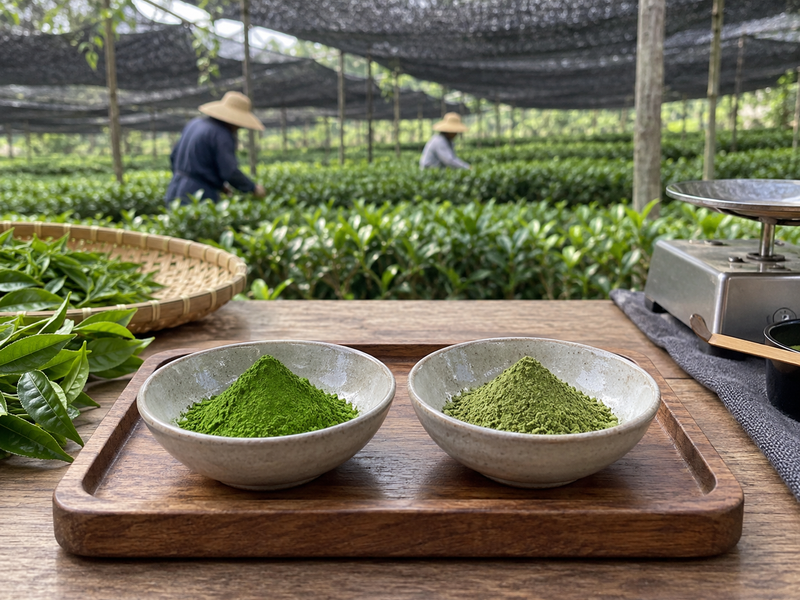
Leaf processing, drying, sorting, milling, and packing use equipment, energy, materials, and labor. A farm certificate cannot describe all of those steps. Map each site in the finished product’s route. Ask whether the supplier can provide facility-level energy or waste records, an environmental management policy, or documented improvement projects. The answer may be a measured figure, a limited internal record, or a gap. Mark which it is. A product catalogue describing a facility does not establish its environmental performance.
Look at yield and quality as well as power. Powder that fails the agreed color or flavor target may be discarded or redirected, adding material loss. A lower-energy process that produces more rejected material is not automatically a better outcome. Keep the arithmetic honest: if a supplier provides electricity use per facility but not output by SKU, avoid claiming a per-kilogram footprint for your matcha. Ask what portion of processing the data covers and whether third parties reviewed it. A practical first step is a site map with measurable inputs and losses, followed by better data in later purchasing rounds.
4. What can certifications prove?
Read scope, site, dates, and product
Organic certification can verify compliance with a defined production and handling standard. It does not by itself prove low carbon emissions, fair wages, or recyclable packaging. For US sales, USDA explains organic labeling categories and the need for an authorized certifier where certification is required. A buyer should check the operator, covered sites, product scope, current validity, and whether the purchased lot sits within the certified chain. Import rules may add shipment-specific evidence for organic goods.
Other seals may address social practices, forest management, or packaging, but each has its own boundaries. Ask the certifier’s name and public standard, not just a logo file. One certificate, one claim: cite what it actually covers. If a supplier says “certified sustainable,” request the certificate and write a more precise claim in your marketing review. Include expiration dates in the supplier file so an old certificate does not follow a new shipment automatically. When a certification is pending, label it as pending internally and avoid publishing it as achieved.
| Evidence | What it may support | What it does not establish alone |
|---|---|---|
| Organic certificate | Defined organic production and handling | Carbon or labor performance |
| Facility audit | Practices at named site | Every upstream farm |
| Packaging specification | Material makeup for one pack | Local recyclability everywhere |
| Supplier policy | Stated commitment | Measured implementation |
5. How should packaging options be compared?
Protect the powder while measuring material use
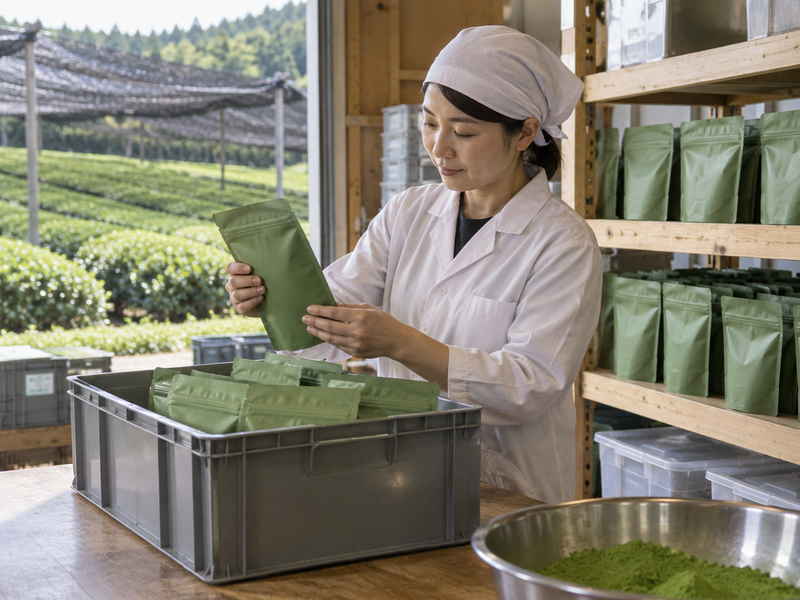
Matcha packaging must protect against light, oxygen, moisture, and handling. A thinner or simpler pack may use less material yet allow more powder to lose color before sale. Compare options using the same product and distribution route. Request structure, weight, barrier data if available, seal method, case configuration, and the supplier’s shelf-life evidence. Then run a storage and transport trial rather than assuming a material name predicts performance. Record package failure, product rejection, and grams of material per usable kilogram delivered.
If marketing wants to say “recyclable,” check whether the entire pack qualifies in the selling market and whether collection systems exist for the claimed audience. The FTC Green Guides discuss qualifications for recyclable and other package claims. Test the trade-off: a larger bulk pouch may reduce packaging per gram but may create more open-pack waste in a small café. A smaller sealed unit could fit actual demand better. Use those measurements rather than choosing a pouch because its color looks natural.
6. How does freight affect a sourcing decision?
Compare service level and spoilage risk together
International shipping choices change transit time, handling, cost, and possibly product condition. Air and sea freight should be compared with the same quantity, route, protective packaging, and delivery deadline. Ask the forwarder for the actual service path and any temperature-management options; ask the supplier how the product is packed for that route. A distant source may still deliver efficiently through consolidated freight, while a nearby stockist may hold old inventory. Geography alone is an incomplete sustainability claim.
Do not publish a carbon comparison without a defined calculation method and comparable data. A freight quote does not provide emissions. For internal decisions, record distance, mode, load size, packaging, expected arrival, and rejected-product risk. Watch the hidden loss: emergency small air shipments caused by poor forecasting can change the picture even if the normal purchase uses another mode. A longer lead time also ties up cash and may increase stock held. The sourcing plan should balance usable quality, demand, and transport rather than celebrate one leg of the route in isolation.
| Freight option | Operational question | Evidence to keep |
|---|---|---|
| Consolidated shipment | Will lead time fit demand? | Booking and delivery record |
| Express shipment | Why is urgency needed? | Cause and cost log |
| Local distributor | How old is its stock? | Lot and receipt dates |
| Direct supply | How is quality protected? | Pack and transport specification |
7. What should be asked about people and purchasing terms?
Put working conditions in the supplier conversation
Social responsibility concerns cannot be settled by a glossy farm photo. Ask which farms and facilities employ workers, how working hours and safety are managed, whether workers can raise concerns, and how the supplier reviews its own upstream partners. Request relevant policies, audit scope, corrective actions, and dates. A policy alone shows an intention; a closed corrective-action record shows how one issue was handled. Respect privacy when requesting worker information and use qualified auditors where a deeper assessment is needed.
Purchasing behavior matters too. Last-minute order changes, unrealistic price pressure, and unclear forecasts can create strain upstream. Share a credible volume forecast, agree change windows, and pay under the agreed terms. Ask what the supplier needs: a stable commitment may allow better production planning than a demand spike disguised as a permanent trend. Avoid claiming that a long contract automatically improves wages or farm income. Track the actual commercial and social measures your organization chooses, and publish only those for which you have evidence.
8. How can a buyer avoid waste after delivery?
Make the receiving and service plan part of the claim
A lot can be well produced and still be wasted through poor storage or overbuying. Count stock by lot and site, keep sealed packs under the supplier’s conditions, label opened working stock, and train staff on measured doses. Estimate expected use from drink sales and formulation grams; then compare it with powder issued. Log remakes, spills, and product rejected for quality. These records let the buyer decide whether pack size or reorder cadence needs to change.
Separate avoidable waste from product that does not meet specification. Do not quietly reclassify questionable matcha for another recipe without quality approval. Measure a week: grams received, grams served, grams discarded, and reason for discard. That is a stronger basis for a narrow waste-reduction claim than saying all matcha is “zero waste” because consumers drink the leaf. A café still uses cups, ice, milk, energy, and transport. Keep the environmental statement attached to the measured action, such as fewer discarded grams in a named period, and preserve the underlying records.
| Loss point | Record | Possible change |
|---|---|---|
| Opening too much powder | Open date and remaining grams | Smaller pack or working tin |
| Inconsistent dosing | Recipe vs actual issued grams | Scale and training |
| Transit damage | Case and seal photographs | Packaging or carrier review |
| Aged stock | Lot, receipt, and sensory result | Order cadence |
9. Which claims can a brand publish?
Write the sentence that the evidence supports
Marketing should begin with a draft claim and an evidence owner. “This SKU uses matcha certified organic by X” may be supportable if the certificate, lot, and market rules align. “Environmentally friendly matcha” reaches across farming, processing, transport, packaging, and disposal without a clear boundary. The FTC guidance advises marketers to qualify broad claims with specific benefits and consider relevant trade-offs. Other markets have their own advertising rules, so review copy where it will be sold.
Create a claims table with approved text, supporting document, product and geography, expiry or review date, and the person who signed off. Include photographs and supplier stories only when they depict the actual source or are clearly illustrative. Read the claim as a customer: would they infer more than the document proves? If so, narrow it. A certification logo on the front of a pack can imply a finished-product benefit that a farm-only certificate cannot support. Keep a record of revisions so an old web page does not continue making a claim after a supplier change.
10. How should the plan be reviewed each year?
Choose a few measures and revisit the gaps
Set a review date for every supplier and SKU. Update the source map, certificate validity, packaging specification, freight route, and waste record. Compare like periods where possible; a year with a very different order volume may make absolute figures misleading. Ask the supplier which evidence improved, which gaps remain, and whether the product or processing route changed. Record any action with an owner and due date. The plan should survive a new purchasing manager taking over the account.
Choose a short dashboard: verified source coverage, current certificates, pack material per kilogram, rejected lots, discarded powder, and emergency freight events. These are internal indicators, not a full life-cycle assessment. Close one gap at a time: if farm data is missing, establish a traceable source map before commissioning a broad emissions claim. If product loss is high, improve stock rotation before announcing a packaging win. Keep the claim register aligned with what the team can prove now, and update public copy when evidence changes.
| Review item | Evidence owner | Typical decision |
|---|---|---|
| Farm and facility map | Supplier quality | Retain or update source approval |
| Certification | Compliance | Renew or remove claim |
| Pack performance | Product team | Keep or test alternative |
| Service waste | Operations | Adjust pack size and training |
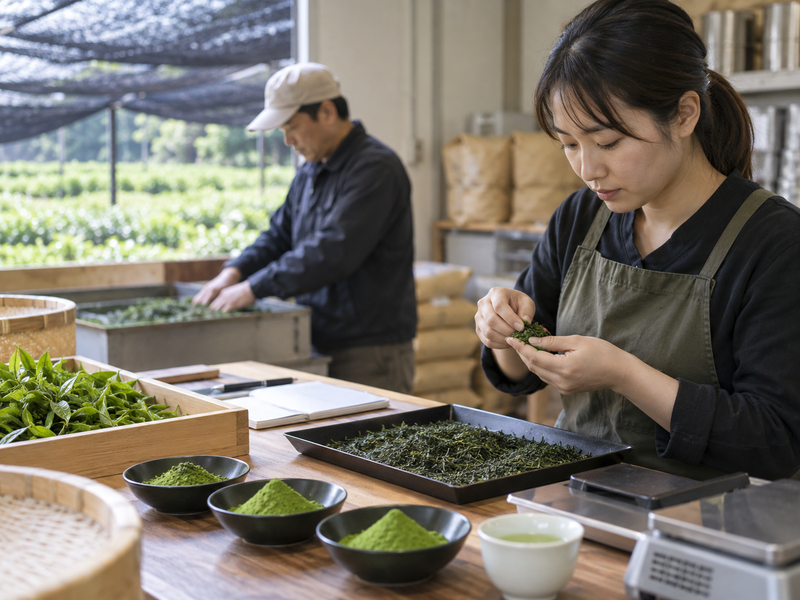
Our matcha supply chain guide maps the stages behind those claims.
FAQ
Q1: What does matcha sustainability cover? A buyer may examine farming, processing, packaging, freight, labor practices, and waste, but each claim needs a defined scope.
Q2: Does organic certification prove a matcha has low emissions? No. Organic certification addresses its own standard; a carbon claim needs different evidence.
Q3: Is paper packaging automatically the greener choice? No. Compare protection, usable product, pack material, and the actual disposal route.
Q4: Can a café call a drink zero waste because matcha leaves are consumed? No. That ignores powder loss and other drink materials. Use measured, specific statements.
Q5: How often should sourcing claims be reviewed? Review at least when a supplier, facility, lot specification, certificate, or package changes, and set a regular scheduled review.
Start the next supplier conversation with one specific claim you want to make and the record that would support it. Where evidence is missing, record the gap and narrow the wording. A matcha sustainability plan earns its value when buyers can show exactly what changed and why the claim still fits the product sold.