
A matcha supply chain links tea material, processing, powder production, packing and delivery to a commercial buyer. Purchases can stall even when one stage has available capacity. Map the functions, owners and handoffs for the proposed product so supply planning follows the order through every stage needed for release.
Table of contents
- What functions belong in a matcha supply chain map?
- How can an integrated supplier still have several handoffs?
- What can buyers take from the role of tea wholesalers?
- How should material availability be separated from order allocation?
- Why should packing capacity be checked separately?
- How should product identity survive the handoffs?
- How should storage and transport responsibilities be mapped?
- What demand information helps stage planning?
- How can an alternative route reduce disruption exposure?
- What should a supply planning review produce?
1. What functions belong in a matcha supply chain map?
Follow the product into its commercial pack
Start with the material and end with the product your operation receives. Identify cultivation and harvesting, leaf processing, material selection or blending, milling, packing, storage and distribution where they apply. One business may perform several functions, while another arrangement divides them among partners. The map should describe your proposed product’s actual route. Avoid assuming every supplier uses an identical sequence or controls every stage because it appears in a company presentation.
Record the owner of each function and the evidence available for the handoff. A buyer may need only a practical level of detail to understand order dependencies, not every internal task at a facility. Ask where the quoted delivery period begins and which stages are already complete. Material available for milling differs from finished packed stock. A useful matcha supply chain map helps purchasing ask precise questions about readiness. It also gives operations a way to distinguish a material constraint from a packing, storage or transport issue when the delivery plan changes.

2. How can an integrated supplier still have several handoffs?
Map functions even when ownership is shared
An integrated business can manage several supply stages, yet each stage still has inputs, output and a readiness condition. Material must be identified, selected and moved into the next process. Powder must become the approved pack before an order is ready for dispatch. Ask how these internal handoffs are recorded and which person confirms order status. Shared ownership can simplify communication, but it does not remove the buyer’s need to know what stage a commitment covers.
For a hypothetical ingredient order, a seller could have raw material ready while the requested pack format remains unapproved. A buyer hearing only stock available might schedule production too early. Write the readiness state beside each functional step. Matcha Village manages its supply chain from cultivation through processing, packaging and delivery. Request a proposal identifying the relevant functions for your order and the confirmed timing. The matcha supply chain plan should translate the company capability into product-specific commitments rather than treating capacity descriptions as proof that a particular shipment is ready.
| Readiness statement | Function to clarify | Buyer question |
|---|---|---|
| Material available | Before powder production | What processing remains? |
| Powder available | Before commercial packing | Is the required pack ready? |
| Order packed | Before dispatch | What shipment step remains? |
3. What can buyers take from the role of tea wholesalers?
Separate the seller name from its functions
A seller called a wholesaler may perform more than resale. In Kettl’s account of Japanese matcha production and distribution, Zach Mangan describes tea wholesalers working across purchasing, processing, blending and distribution. That is a bounded account of the Japanese relationships he discusses. It should not be used to classify every seller in another market or to conclude that a direct-from-farmer route is always superior.
Use the account to ask functional questions. Identify the parties that select the tea material, control the powder specification, pack the commercial product and handle the buyer’s order and delivery. A hypothetical importer could discover that its seller performs several of these roles while relying on another partner for export coordination. Record that arrangement and the communication route for a problem. In a matcha supply chain review, the useful detail is what the party can confirm and deliver. A label such as farm, manufacturer or distributor should lead to clarification of responsibilities rather than replace it.
4. How should material availability be separated from order allocation?
Ask what quantity is committed to your product
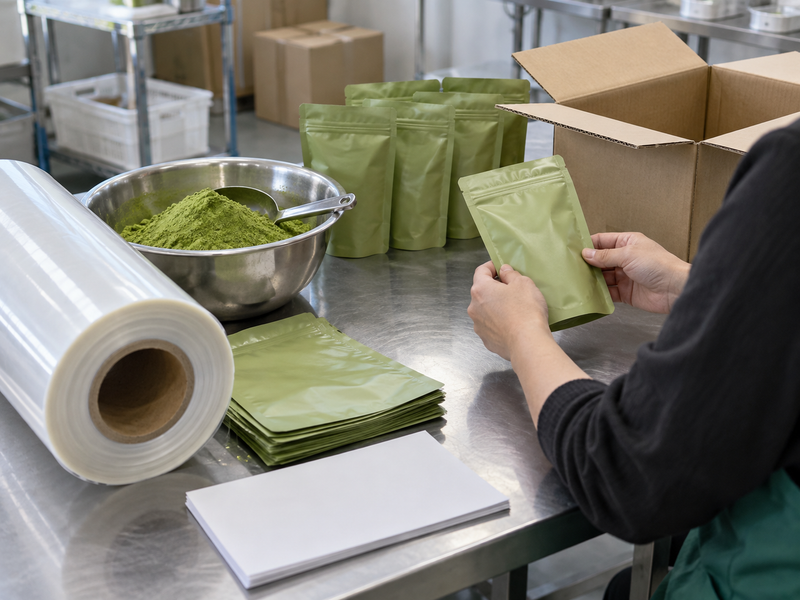
Available material can support several products or buyers. Ask whether the proposed quantity is reserved for your order and which approval or payment makes the commitment effective. Confirm the product, pack and timing attached to that reservation. A broad capacity statement cannot answer those questions. Likewise, a forecast shared with the supplier may aid planning without reserving anything unless the parties agree on its status.
Keep allocation records distinct from sales projections. A hypothetical brand may forecast future demand while committing only to its current order. The seller may propose a longer arrangement that needs separate authorization. Record the binding quantity, indicative quantity and review date. Ask what happens if the material changes before powder production or if an alternative is proposed. Technical approval may need to be reopened. Your matcha supply chain plan should show which commitments are confirmed and which depend on further action. This prevents the team from treating an annual estimate, available raw material and a dispatch-ready order as equivalent forms of supply.
| Quantity statement | Confirm | Planning treatment |
|---|---|---|
| Indicative forecast | Nonbinding or committed? | Demand assumption |
| Available material | Proposed product and remaining steps | Potential supply |
| Reserved order | Conditions and scope | Confirmed commitment |
5. Why should packing capacity be checked separately?
Review the final product stage
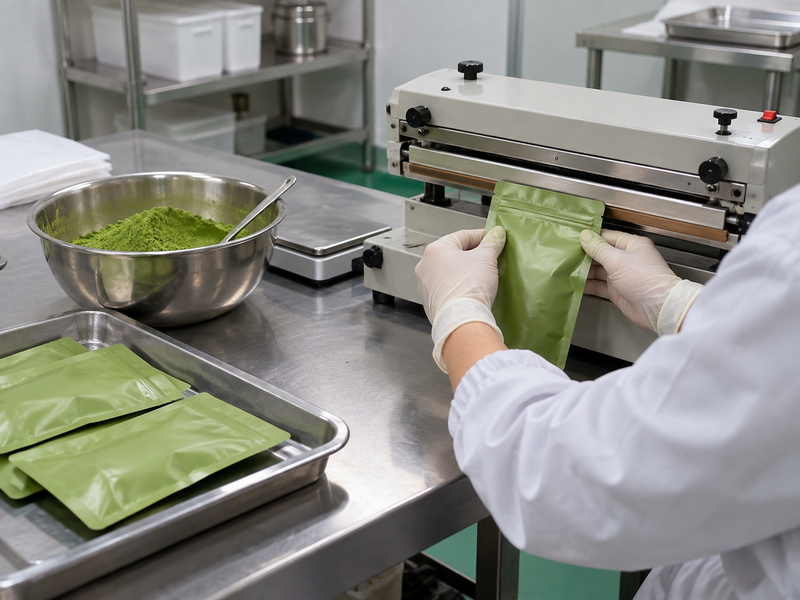
Powder availability does not establish that the requested commercial pack can be completed on time. Packing needs the right components, approved information, an available process and a release decision. Ask which inputs are ready and which remain open. A change from a standard ingredient bag to a printed retail format can alter the dependency list. Keep packing status visible rather than including it within a general statement that production is complete.
Kettl’s account discusses packing as a pressure point in the Japanese supply arrangements it describes. A buyer can use that observation to ask about its own order without assuming the same bottleneck exists everywhere. For a hypothetical retail launch, unapproved artwork or unavailable components could delay the final product even when powder is ready. The matcha private label guide provides context for these responsibilities. A matcha supply chain map should identify who approves the pack, who confirms the slot and who releases the finished units. Those answers help the buyer plan from actual dependencies.
6. How should product identity survive the handoffs?
Keep the commercial lot record connected
Ask how the supplied product is identified through the relevant stages. A buyer should be able to connect received packs with the agreed product and available lot information. Record how the supplier describes blending, repacking or a change in material where it affects the approved item. The required detail depends on the product and purchasing arrangement, but the communication route should remain clear. A missing record needs follow-up rather than an assumption that a generic document applies.
The matcha traceability article explains the value of connected identifiers and records. In your own map, mark the evidence needed at each buyer-facing handoff. A hypothetical packing partner should identify the incoming ingredient and the finished lot it produced under its agreed process. Keep that record beside the purchase and release information. Product identity and commercial ownership are related but separate questions. A matcha supply chain review should let the buyer follow both: which material or product moved, and which party became responsible for the next stage.
| Handoff | Record to connect | Question answered |
|---|---|---|
| Ingredient to packing | Incoming product and finished lot | What was packed? |
| Packing to shipment | Lot and dispatch record | What was sent? |
| Receipt to use | Delivery and release decision | What was accepted? |
7. How should storage and transport responsibilities be mapped?
Name the owner of each movement
Identify where the product waits and who controls that stage. Ask for handling and storage information for the actual product, then confirm how it applies to the proposed route. A shipment can include several transfers before receipt, so name the party coordinating each one. Keep the conditions and responsibilities attached to the agreed commercial scope. Do not assume a service described on a website applies to every order or destination.
For a hypothetical distributor arrangement, the supplier may dispatch to a local warehouse that later serves cafés. The map should show that warehouse and the onward order process. For a direct shipment, the buyer may own more of the route coordination. Record who responds when a delay or pack-condition question appears. A matcha supply chain plan should distinguish dispatch readiness, transport booking and receipt. These events occur at different stages. Operations can then plan stock and production from the status actually confirmed, while purchasing reviews any change to costs or responsibilities.

8. What demand information helps stage planning?
Share a forecast with its confidence level
Give the supplier a forecast that identifies products, pack formats and expected timing. Separate confirmed orders from likely demand and early opportunities. Explain the evidence behind each category. A recurring ingredient customer can use consumption records, while a new brand may rely on a pilot and stated channel assumptions. Keep forecast changes dated so the supplier can see which version is current. A larger number without a confidence note may create the wrong planning expectation.
Ask how the supplier will use the forecast and what response it can provide. It may support discussion of material, packing and dispatch plans without establishing a binding allocation. A hypothetical café group could share ordinary consumption plus a planned menu launch as separate lines. The supplier can then discuss each requirement on its own basis. A matcha supply chain forecast should connect demand with stages that need preparation, rather than serve as a promise of growth. Confirm any proposed commitment through the appropriate commercial process before the team relies on it.
| Demand category | Evidence | Supplier discussion |
|---|---|---|
| Confirmed order | Accepted purchase | Order readiness |
| Recurring estimate | Usage or sales records | Replenishment planning |
| New opportunity | Pilot or channel assumption | Capacity discussion |
9. How can an alternative route reduce disruption exposure?
Check shared dependencies
A second seller may rely on the same processor, packing partner or transport route as the current arrangement. Ask about the dependencies that matter to your proposed alternative. The goal is to understand whether it provides another usable route, not to demand disclosure unrelated to the purchase. Product approval, documentation and handling must still be completed for the alternative. An untested name in a contact list offers little help when the approved product becomes unavailable.
A hypothetical brand could review an alternative pack format that uses available standard components, while retaining the approved powder. Another business could assess a different product for a particular application. Each response changes different parts of the map and requires different approvals. Keep the alternative’s scope and readiness date recorded. Avoid assuming that substitution preserves flavor, claims or labeling. A matcha supply chain recovery plan becomes usable when the team knows which condition triggers it, who can approve it and which parts have already been tested.

10. What should a supply planning review produce?
End with stage decisions and owners
Review the map before a meaningful order commitment or when a stage changes. Identify confirmed readiness, open dependencies and the next evidence check. Trace a delay to the affected function where possible. A packing issue, an allocation question and a transport change need different responses. Keep unresolved causes marked as unknown. The review should produce decisions the buyer and supplier can act on, rather than a broad statement that supply is under pressure.
Use a short action record with the product, stage, owner, expected update and consequence for the buyer. Matcha Village can discuss the product and supply arrangement described in your brief; ask for confirmation of the stages relevant to the proposed order. If a delivery plan changes, review stock and customer commitments before requesting an unapproved substitute. Update the current map and retain the earlier version. The team then has a clear record of what was known, which commitment was accepted and what must happen before the next stage can be treated as ready.
| Review output | Record | Next action |
|---|---|---|
| Ready stage | Product and confirmed status | Move to next dependency |
| Open stage | Missing input and owner | Request evidence |
| Changed stage | Cost or timing consequence | Reapprove affected plan |
Map the proposed order from material through packing and receipt. Ask Matcha Village which stages are complete, which quantities are committed and which approvals remain. Give every open dependency an owner and a date for the next confirmed update.
FAQ
Q1: Does one supplier always perform every supply stage?
No. Functions may sit within one business or across several partners.
Q2: Does raw material availability confirm a packed order?
No. Processing, packing, approvals or allocation may still be unresolved.
Q3: Why check packing separately?
The required components and packing process can have dependencies distinct from powder availability.
Q4: Does a forecast reserve supply?
Only if the parties agree on a commitment; an indicative forecast alone does not confirm allocation.
Q5: Is a second seller always an independent backup?
No. Check relevant shared dependencies and complete product approval before relying on it.