
Matcha inventory can look healthy in a purchasing spreadsheet while half the stock sits open behind a café bar. The fix is to follow each lot from receiving through the working tin and into actual drinks, then compare issued powder with expected use. The First Agri inventory article discusses turnover and waste for food businesses. This matcha inventory management plan adds the daily controls a buyer and store manager can run without specialized software. Suggested count frequencies and examples are trial methods; set final limits from your supplier specifications, food-safety policy, and sales pattern.
Contents
- 1. What should a matcha inventory plan track?
- 2. How should stock be checked on receipt?
- 3. What is a useful lot record?
- 4. How should sealed and working stock be separated?
- 5. How does rotation protect usable stock?
- 6. How can a café count powder accurately?
- 7. How should expected use be reconciled?
- 8. What causes waste and unexplained variance?
- 9. How should several sites share one inventory view?
- 10. Which measures should guide the next order?
1. What should a matcha inventory plan track?
Record movement before calculating more demand
A useful record shows how much matcha entered, where it was placed, which lot was opened, how much was issued for service, and what remained at close. Separate sealed cases, opened working containers, product held for quality review, and powder lost to spills or remakes. The categories matter because a sealed kilogram and a nearly empty working tin do not have the same operational role. Counting only total kilograms hides age, location, and waste.
Choose one unit of measure, preferably grams for service and kilograms or grams for purchasing, then convert consistently. Enter supplier, SKU, lot, receipt date, pack size, quantity, and the storage instruction supplied for that product. Start with one week: if staff cannot keep the first seven days complete, a more elaborate forecast will not fix the underlying data. A simple sheet or stock card is enough when every movement has a date and owner. The FDA’s food traceability overview explains the broader value of tracking food backward and forward through a supply chain, though matcha’s specific regulatory duties depend on market and product.
2. How should stock be checked on receipt?
Make receiving the first inventory transaction
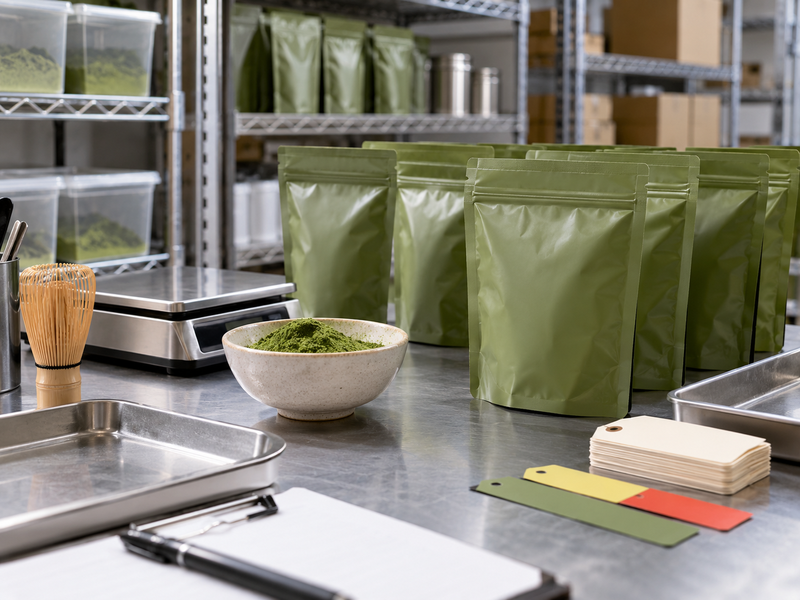
Count cases against the purchase order and packing list before they disappear into a storeroom. Verify product name, pack size, lot code, best-before information where provided, seal condition, and visible damage. Photograph exceptions while cartons are still closed. Record the quantity actually accepted, not merely the amount invoiced. A shortage on arrival should not become unexplained shrinkage at month end. If a delivery contains two lots, enter them separately even when the labels look identical.
Give the receiver a short accept, hold, or reject path. A damaged outer carton may require inspection; a wet inner pouch or broken seal may require quality review. Do not mix a held lot with approved stock while waiting for a supplier response. Take a baseline sample: record color and aroma under a consistent method if your quality plan calls for sensory checks. A purchasing team comparing later lots needs the receiving date and storage history to interpret a change. Send the lot and count to the person who maintains central stock before allocating material to stores.
| Receiving field | Why it is recorded | Who checks it |
|---|---|---|
| SKU and pack size | Confirms ordered product | Receiver |
| Lot and date code | Supports rotation and trace-back | Receiver and quality |
| Case count and net weight | Establishes accepted quantity | Receiver |
| Seal and damage status | Decides release or hold | Quality lead |
3. What is a useful lot record?
Link the material to every place it travels
A lot record needs a stable identifier that staff can read on the bag and on the inventory sheet. Keep the supplier’s lot code intact; do not replace it with an internal number that cannot be traced back. If your company adds an internal code, store both. Record received quantity, opened quantity, transfer dates, and the locations that hold or use the lot. For product developers, link trial batches and retained samples to that same identifier.
The record should also say when a lot is put on hold and who released it. A café may have only two bags open, but a chain could distribute one lot among several branches. Without a forward record, a later quality question becomes a search through invoices and chat messages. Test your trace: pick one lot and ask each store how many sealed and open grams remain. The answers should reconcile with transfers and sales. If they cannot, narrow the gap before adding new locations. The goal is practical recall and quality control, not a decorative database full of missing fields.
4. How should sealed and working stock be separated?
Open only what the service rate can use well
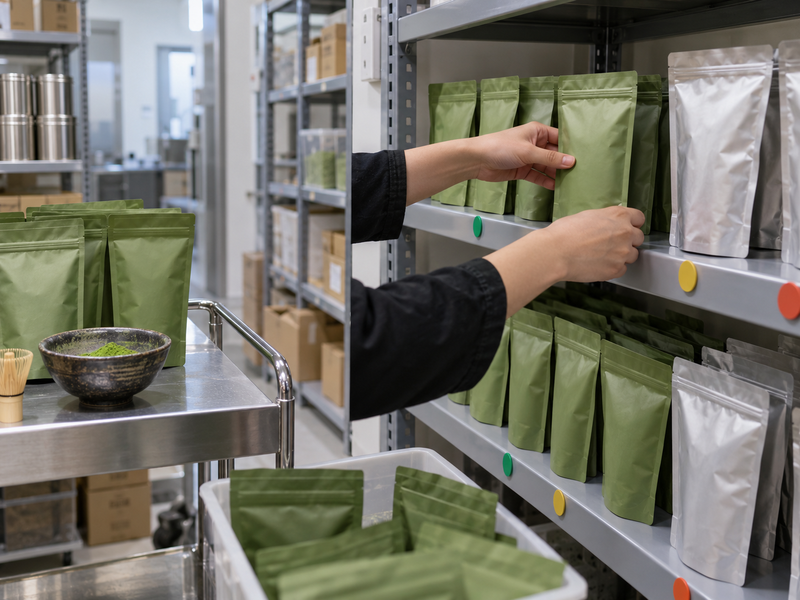
Sealed inventory should remain in its specified protective package and storage conditions. Working stock belongs in a clean, labeled container close to the bar, but every opening exposes powder to air and handling. Establish a working quantity based on realistic drinks per day and the recipe dose. A store selling a few cups daily may need a smaller working pack than a busy matcha bar. Do not decant a month’s supply into an attractive clear jar merely because it simplifies counting.
Label the working container with SKU, original lot, opening date, and the operator who filled it. Keep a record when topping up; mixing old and new lots in the same tin destroys a clean trace unless the process explicitly records both. The FDA Food Code is a model for retail food handling, but exact local requirements and product classifications must be checked. Keep the line clean: use a dry dedicated scoop and close the container promptly. Inventory control and preparation hygiene reinforce each other because a contaminated or clumped tin becomes unusable stock.
| Stock state | Suggested record | Operational rule |
|---|---|---|
| Sealed case | Lot, count, location | Leave protective pack intact |
| Open working tin | Lot, open date, starting grams | Use dedicated dry tool |
| Quality hold | Lot, reason, quantity | Block from service |
| Transfer to store | Lot, grams, sending and receiving site | Confirm receipt |
5. How does rotation protect usable stock?
Choose a rule staff can execute
Use the supplier’s date information and your internal quality standard to decide which approved lot should be opened next. First-expiring-first-out can make sense when packs have different best-before dates; first-in-first-out can help when dates are comparable. Neither rule excuses opening a questionable pack. Place older approved stock in an obvious picking position and mark held goods physically so a rushed employee cannot take them by mistake.
Review rotation when new deliveries arrive. If a fresh lot is put in front of older stock, update the shelf arrangement before the receiving shift ends. If an older lot has weak color or aroma, ask quality to evaluate it rather than selling it solely because it is next in sequence. Use a weekly shelf walk: compare the inventory sheet with actual case order and spot a forgotten half-case. For a distributor, rotate by lot at the case level and preserve codes through repacking. A customer who asks which lot filled its order should get a precise answer, not a range of likely shipments.
6. How can a café count powder accurately?
Weigh working stock instead of estimating by eye
Choose a consistent count moment, such as after close and before the next prep. Count sealed packs as units multiplied by labeled net weight. Weigh an opened working tin on a scale after subtracting the known container tare. If staff use several tins, record each separately. A visual estimate like “half a bag” can hide a large difference when powder settles or the bag folds. Check that the scale is appropriate for the small amounts you are measuring and place it on a stable surface.
Count at the same frequency for several weeks, then adjust based on sales rate and discrepancies. Daily counts may be worthwhile during launch; a low-volume site may move to a smaller cadence once controls work. Make the count reproducible: write the time, counter, scale, tare, lot, and grams. A second person should be able to repeat it. Do not count unsold prepared matcha latte base as dry powder inventory; record it separately under the applicable food-safety and waste procedure.
| Item counted | Method | Common error |
|---|---|---|
| Sealed packs | Units × labeled net grams | Missing case in another room |
| Open tin | Gross weight minus container tare | Wrong tare or wet container |
| Quality hold | Separate physical count | Included in sellable stock |
| Prepared drink base | Separate batch record | Treated as recoverable powder |
7. How should expected use be reconciled?
Compare recipes with measured stock movement
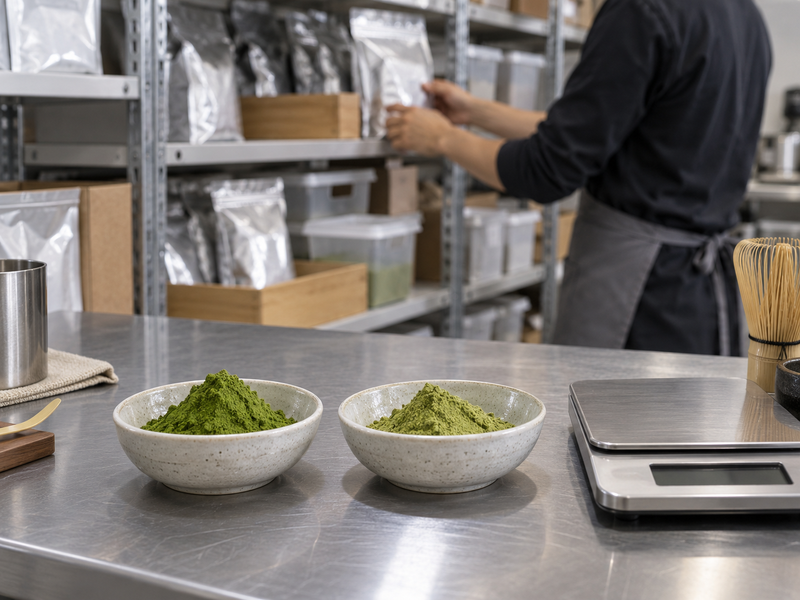
Expected use starts with drinks sold multiplied by the approved powder dose, then adds samples, training drinks, and product-development batches. Compare that total with opening stock plus receipts minus closing stock. The difference is variance; investigate it before calling it theft or waste. Dose drift, spills, unrecorded staff drinks, a wrong container tare, and a late inventory entry can all explain a gap. If the recipe uses a different dose for hot and iced drinks, calculate those lines separately.
For a simple trial, imagine 100 drinks sold at 2 g each. Expected drink use is 200 g before training or waste. If a count shows 235 g moved, record the extra 35 g and look at preparation logs and remakes. That is an arithmetic illustration, not an industry waste benchmark. Find the pattern: variance concentrated on weekend shifts suggests a process issue; the same gap across every day may indicate a wrong recipe assumption. Set a tolerance after seeing your own data, then use it to trigger review rather than automatic blame.
8. What causes waste and unexplained variance?
Categorize loss where it happens
Separate handling loss, over-dosing, remakes, aging, and damage. A scoop spilled on a counter calls for a different fix than powder discarded because a large pack sat open too long. Ask baristas to record remake reason in a short code: clump, wrong milk, wrong fruit syrup, weak tea, or customer change. Weigh the working tin at close to see whether recorded drinks explain use. Do not rely on a monthly total that erases the cause.
Observe one busy shift without changing the recipe. Are staff using heaped scoops instead of a scale? Does a new barista remake cups because matcha is not pre-wetted? Does the closing team discard a prepared base with no batch record? Make one change at a time: standardize the dose, then compare variance for another week. Track customer-facing quality as well; cutting powder until the inventory sheet looks neat can produce a weak drink and more remakes. The aim is fewer avoidable grams per accepted cup, not a lower number regardless of taste.
| Loss code | Evidence to capture | Likely action |
|---|---|---|
| Spill | Shift and station | Improve container and tool placement |
| Over-dose | Measured sample portions | Train on scale or calibrated tool |
| Remake | Drink and reason | Fix preparation step |
| Age or quality | Lot and open date | Change pack size or order cadence |

9. How should several sites share one inventory view?
Keep local counts tied to central lots
A central buyer needs to see stock by site, lot, and condition. A chain-wide number cannot show that one café is out of matcha while another has three sealed cases aging in storage. Record each transfer with sending site, receiving site, date, lot, grams, and a receipt confirmation. Do not count a transfer as consumption. If a store sends opened stock to another site, decide whether the handling and traceability policy allows it before the van leaves.
Use one product code and unit convention across sites. Let each manager record a count in the same template, then flag missing counts rather than silently treating them as zero. Watch the outlier: a site with higher powder use per sold cup may need a recipe check; it may also sell a larger drink size. Compare like with like. Central procurement should pair stock on hand with sales forecasts and incoming orders, but avoid pushing excess stock into stores merely to make a warehouse number look lower. Storage capacity, expected sell-through, and the supplier’s shelf-life information still govern the allocation.
10. Which measures should guide the next order?
Base purchases on usable stock and actual pace
Use sales by drink type, verified dose, measured waste, on-hand stock by lot, open-pack age, and confirmed incoming shipments. A reorder point can estimate when to buy, but this article’s daily records tell you whether its inputs are trustworthy. If opening dates are missing and cycle counts disagree, fix those gaps before raising the order quantity. The First Agri inventory article discusses turnover; calculate yours from accepted use and average usable stock, not all kilograms that ever passed through a warehouse.
Review a few simple measures each week: variance grams, remake grams, older lots at risk of missing their quality window, and days of cover at each site. Keep the window and thresholds specific to your own product and supplier instructions. Before sending a PO: check whether another site can use approved sealed stock, whether a pack size change would cut open-pack waste, and whether the supplier can maintain the agreed lot documentation. The next order should solve the observed constraint, not just replace last month’s quantity automatically.
| Weekly measure | Calculation or source | Decision it supports |
|---|---|---|
| Expected powder use | Drinks sold × recipe grams | Baseline demand |
| Variance | Counted use minus expected use | Process review |
| Usable stock | Approved sealed and open grams | Transfer or order |
| At-risk stock | Lot age and supplier dates | Rotation and pack choice |

Reorder points should also reflect matcha wholesale lead times.
FAQ
Q1: What is matcha inventory management? It is the record of matcha received, stored, opened, issued, sold, wasted, and left by lot and location.
Q2: Should opened and sealed matcha be counted together? Record both, but keep their quantities separate. They have different handling and quality risks.
Q3: How often should a café count working stock? Start with a frequent count during launch, then adjust after variance and sales patterns become clear.
Q4: Does a higher variance always mean theft? No. Dose drift, remakes, spills, wrong tare, and missing entries are common alternatives to investigate.
Q5: What should trigger the next order? Use verified sales, dose, waste, approved stock, lead time, and incoming shipments rather than last month’s purchase alone.
Choose one current lot and trace it from its receiving record to the working tin and the last seven days of drinks. Correct any missing link, then use the cleaned record to decide whether your next matcha order should be larger, smaller, or simply packed differently.