
Matcha supplies are the powder, preparation tools, vessels, packaging, and replenishment items needed to make or sell a defined matcha product. A home tool collection may look appealing yet slow a café line or fail a retail kit’s replacement plan. Start with the drink or product specification, then choose each item for its role in that workflow. A controlled service trial and lot-linked supplier records give a buyer evidence beyond product photographs or consumer recommendations.
For: café groups, beverage brands, distributors, and private-label buyers. Decision: which supply list produces accepted drinks with manageable labor, waste, and replenishment.
Contents: 1 · 2 · 3 · 4 · 5 · 6 · 7 · 8 · 9 · 10
1. Which matcha supplies belong in the operating brief?
Begin with the finished product
A café making a hot straight matcha, a chain serving iced lattes, and a brand selling powdered sachets need different supply lists. Define serving size, tea dose, liquid base, preparation time, equipment already on site, and expected drinks per hour before shopping for accessories. Map the whole cycle: receiving, opening, dosing, mixing, serving, rinsing, and storage all use supplies that can create delays or waste. A whisk chosen only for its appearance may fit a slow demonstration but be awkward during a queue.
Separate must-have items from attractive extras. Powder and a means of accurate dosing are foundational. Mixing tools, vessels, water control, cleaning materials, sealed storage, and replacement parts depend on the format. A branded bowl may be part of a retail gift set but does little for a bottled drink manufacturer. Write one acceptance criterion for each item: the cup is smooth after a defined mix cycle, the vessel does not splash, or the pack protects the lot through expected use. Keep the brief tied to the customer result. That makes it possible to reject a popular gadget that adds no measurable value to the operation.
2. How should teams choose the matcha powder?
Test tea in the intended recipe
A powder’s grade name cannot establish how it tastes in milk, sugar, ice, or bakery batter. Request traceable samples from several candidate lots and prepare matched cups or products at the planned dose. Check green color, aroma, astringency, mouthfeel, and sediment after the normal service wait. Taste the application: a subtle tea may suit straight matcha but disappear under a flavored syrup; a stronger one may remain present yet need more sweetness than the menu can support. Record both acceptance and grams needed per portion.
Ask for product specification, ingredient identity, origin, batch code, storage guidance, pack format, and applicable quality documents. Verify any organic or other market claim against the actual certificate and scope before printing it. Compare a second lot after the first sample passes. Agricultural ingredients can vary, so define a finished-drink color and flavor range instead of demanding a visually identical dry powder. Price per kilogram is only one input. A lower-priced tea requiring a larger dose may cost more per accepted cup. Purchasing should document the chosen grade and the conditions under which an alternate can be qualified.
| Powder screen | Fixed test condition | Decision supported |
|---|---|---|
| Water preparation | Dose, temperature, vessel | Baseline aroma and dispersion |
| Finished menu item | Base and serving mass | Consumer flavor and color |
| Held cup | Defined service delay | Sediment and stability |
3. Which preparation tools fit the menu?
Assign each tool a job
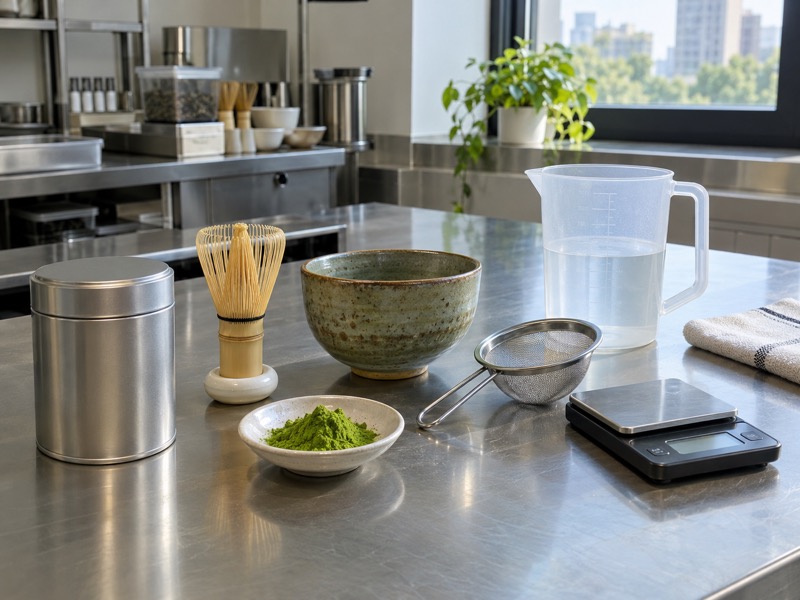
A bamboo whisk can disperse matcha in a bowl and create a particular surface texture. A handheld frother can mix small servings in a suitable vessel but may splash if used in a shallow cup. A blender handles ice and other ingredients for a shake. A shaker can travel or support simple cold preparation, provided it gives an accepted cup. Match the motion to the formula: the best tool for hot tea need not be the best tool for a thick iced drink. Test tools on the exact recipe and vessel, including cleaning after use.
The service setting changes the choice. A single café can train staff on one preparation method; a multi-site chain needs a method that survives shift turnover and equipment variation. A mobile cart faces power and water limits. A retail kit must work for an untrained buyer at home, without the café’s sink or scale. Compare accepted cups, ready-to-ready time, splash events, and replacement needs. Do not assume faster motor speed makes finer dispersion. Powder wetting, liquid volume, cup shape, and operator method often drive the result. A procurement list should state what each tool does and why that step belongs in the workflow.
| Tool | Strong use case | Test before buying |
|---|---|---|
| Bamboo whisk | Straight matcha in a bowl | Cup consistency and reset time |
| Handheld frother | Small preblend or latte base | Splashing and residue |
| Blender or shaker | Cold blended service | Clumps, dilution, cleaning |
4. What equipment specifications should buyers compare?
Write an acceptance test, not a wish list
Capacity, contact material, cleaning access, power source, durability, and spare-part availability matter only in relation to the job. Measure the vessel’s usable volume with the planned liquid fill, leaving enough headroom for mixing. Check whether a whisk head reaches the bottom without striking the cup and whether staff can clean seals or blades after a green, sticky formula. Test the awkward step: the purchase risk often appears during reset, battery replacement, or a second consecutive order rather than the first display cup.
For powered equipment, request maker instructions and local electrical suitability. Run repeated cycles under the expected load, not one demonstration. Record noise, splash, heat, foam, cup texture, and failures. For manual tools, inspect handle comfort, material finish, and replacement cost. A bowl with a useful shape in a test kitchen may be too fragile or bulky for a high-volume site. Establish an approved equipment model or performance specification, then train against it. If a supplier substitutes a different head, jug, or liner, check whether the process card still works before rolling it into stores. A commercial kit needs an operating window that another team can verify.
5. How should portions and water be controlled?
Turn “one scoop” into a measured dose
Scoop volume changes with powder density and how staff fill it. Weigh matcha during development and translate the approved mass into a practical service method only after checking portion variation. A preportioned sachet can reduce drift but may add packaging cost and waste. Record the denominator: if a formula states 1% matcha, specify whether that is mass of the finished beverage, dry mix, or a liquid preblend. The number means little without its basis.
Water temperature, volume, and quality influence preparation. Use the team’s validated target for the particular tea and menu item, then provide an operator method that can be repeated across sites. A temperature display is useful only if it measures where the water is used, not merely the heater’s setting. Calibrate scales and thermometers under site practice. Record liquid volume or mass, preparation sequence, and mix time on a one-page card. During a pilot, sample drinks from several operators, not just the person who wrote the card. A method that works only with an expert hand is a training burden that belongs in the buying decision.
| Control | Record in trial | Routine check |
|---|---|---|
| Tea dose | Weighed grams | Portion audit |
| Water | Mass and use temperature | Equipment reading check |
| Mix cycle | Tool, time, vessel | Finished-cup inspection |
6. What packaging supplies protect matcha?
Size packs to the real use rate
Matcha’s fine particles face oxygen, moisture, light, and heat whenever a pack is opened. Ask suppliers for barrier construction, seal format, lot marking, storage instructions, and shelf-life evidence. An oversized bag can look cheaper on a price list yet stay open through many shifts. Count days after opening: compare expected weekly consumption with the pack size and the site’s supported open-pack period. Choose smaller sealed units when exposure and waste outweigh the bulk discount.
At the station, use a clean, dry dosing tool and close the primary pack promptly. If powder moves into a food-grade dispenser, carry over its lot code and opening date. Storage bins, labels, and any protective outer cartons are part of the supply list, not an afterthought. For retail products, test seal integrity and ease of opening under the intended distribution route. A beautiful gift tin may still need an inner barrier pouch. Do not extend a supplier’s unopened shelf life because a pack appears intact; finished-product shelf life requires separate evidence. A buying brief should describe sealed transport, opened handling, and how operators identify the active lot.
7. How do service kits differ from retail kits?
Design for the person doing the work
A service kit supports trained operators making repeatable cups. It may include bulk tea, a scale or measured portion system, mixing vessel, tool, rinse setup, spare parts, and a concise preparation card. A retail kit supports a first-time consumer and may need smaller powder packs, clear instructions, a safe durable tool, and packaging that survives delivery. Separate the two bills of materials: a café’s most efficient setup can be a poor gift, while a photogenic consumer bowl can consume too much storage space behind a counter.
For a private-label retail kit, verify the material and labeling requirements of each component for the destination market. Include replacement and customer-support plans: what happens if a whisk arrives damaged, a battery device fails, or powder reaches a short-dated window? Test the unboxing with someone outside product development. Can that person identify the correct water volume and tool motion without a live demonstration? For a service kit, use operators from different shifts and measure ready-to-ready time. Both formats need supplier continuity, but their acceptance tests differ. Write those tests before committing artwork or packaging die lines.
| Kit route | Primary user | Acceptance check |
|---|---|---|
| Café station | Trained staff | Repeatable cup and reset time |
| Retail starter kit | New consumer | Clear instructions and safe delivery |
| Distributor bundle | Business customer | Traceable components and replenishment |
8. What defects reveal a poor kit choice?
Diagnose the system rather than blaming tea
Clumps can reflect powder condition, wetting sequence, tool geometry, or insufficient liquid. Splashing may come from an oversized frother head in a shallow cup. Grit at the end of a drink can appear even under a good-looking foam cap. A slow station may result from an awkward rinse step rather than the mixing time. Log the failed cup: note tea lot, dose, vessel, tool, liquid, operator, and the point when the fault appeared. A picture of the finished surface rarely captures the whole failure.
Run a controlled follow-up that changes one factor. Try the same powder in a different vessel, or the same tool with a measured wetting step. If a disposable filter or shaker insert seems to solve a problem, count its cost and cleaning or waste burden. A kit that needs several unlisted accessories to work is incomplete. Record remakes and staff workarounds; these often reveal where the written method does not fit the actual counter. Do not sell a tool claim such as “clump-free” on one successful sample. Define the acceptance test and document the range of operators and lots that passed it.
| Symptom | Check first | Controlled follow-up |
|---|---|---|
| Dry clumps | Addition order and powder condition | Compare wetting methods |
| Splashing | Fill level and tool clearance | Change vessel or head |
| Slow reset | Rinse access and residue | Time complete service cycle |
9. How should suppliers and costs be evaluated?
Compare usable systems
Request comparable quotes for powder, equipment, spare parts, packaging, and replenishment. Ask for lead time, minimum order, product specifications, lot documents, warranties where applicable, and change-notification terms. Price the accepted cup: include actual grams of tea, consumables, labor, remakes, and discarded open powder. A cheap whisk that breaks often can cost more than a durable one; an expensive powder may cost less per drink if it meets the flavor target at a smaller dose.
Evaluate supply continuity as carefully as the first sample. Can the powder supplier provide a second lot within the agreed range? Are replacement heads or matching vessels available when a store opens? Does the packaging format suit sales volume? A chain should model low and high demand as clearly labeled planning scenarios, then replace assumptions with store data. Do not present a hypothetical savings estimate as a validated result. Procurement and R&D should share a comparison sheet that lists pass/fail criteria before opening bids. This protects the decision from persuasive product photographs, unverified claims, or a low price that hides unusable inventory.
10. What should a pilot prove before rollout?
Run the complete workflow
Put the selected matcha supplies into a representative site or test kitchen and make consecutive orders under realistic timing. Use several operators and more than one tea lot if continuity is part of the purchase case. Record ingredient use, cup acceptance, splash and clump events, ready-to-ready time, cleaning, and equipment faults. Follow the second shift: a kit that works only for its developer has not passed a multi-site rollout test. Inspect drinks after the normal customer wait, not only immediately after mixing.
Review ingredient and component documents for the market, then freeze a bill of materials and preparation card. Set a rule for substitutions and a replenishment owner. For retail kits, add a transport and unboxing trial with the final packaging. For café kits, include station placement and end-of-shift cleaning. The decision should identify what passed, what remains unresolved, and which failures require a retest. Next, compare two candidate powder-and-tool combinations at one fixed dose and serving format, including cleanup in the clock. A consumer tool roundup can suggest categories to examine, but a commercial supply program requires its own evidence and purchasing controls.
Reference: “I Drink Matcha Every Day — These Are the Tools I Actually Use and Recommend” — Food & Wine. Its consumer tool list provides topic context; commercial selection and testing guidance here is original.
FAQ
Q1: What are matcha supplies in a café operation?
Powder, dosing and mixing tools, vessels, storage packs, cleaning items, and replenishment parts specified for a menu item.
Q2: Does every site need a bamboo whisk?
No. Test the tool that fits the drink, vessel, operator workflow, and desired surface texture.
Q3: How should a buyer compare matcha powders?
Make coded samples in the finished application at matched doses and compare traceable lots.
Q4: What should be included in a retail kit?
A suitable powder pack, safe preparation tool, clear instructions, protective packaging, and a replacement plan.
Q5: What documents should a supplier provide?
Specifications, lot traceability, relevant quality records, pack details, storage guidance, and change notices.