
A matcha supplier Singapore inquiry should identify the product family before asking for an offer. Pure tea powder and prepared milk or sugar mixes can arrive under similar menu names. Separate them in your request and name the local account handoff. GreenTea.sg’s own wholesale article lists these families separately, giving buyers a concrete starting point.
Contents
- 1. What should a matcha supplier Singapore inquiry name?
- 2. How should you separate pure powder from prepared mixes?
- 3. What can a product name tell you about ingredients?
- 4. How should you specify an origin request?
- 5. What application details help the supplier route samples?
- 6. Who approves each product family inside your business?
- 7. How should the local seller handle technical questions?
- 8. How can related tea powders stay out of a matcha request?
- 9. What should change when the supplier proposes another SKU?
- 10. What does a complete product and account brief contain?
1. What should a matcha supplier Singapore inquiry name?
Start with the ingredient you intend to buy
Write whether you want pure matcha powder, a milk-containing preparation or a sweetened preparation. A finished drink called matcha latte does not identify its purchased ingredient. Your business might buy pure powder and add milk at service, or buy a prepared mix. The supplier needs that distinction before recommending a SKU. Describe the application alongside the product family so account staff can route your question correctly.
Name the purchased ingredient separately from the menu item. Include an existing product code if you are continuing an account. For a new request, ask which family the supplier places each proposed item in and request its composition. Keep your internal ingredient brief alongside this reply; our matcha ingredient guide can help structure those questions. Avoid approving a product from a name or photograph alone. A supplier’s catalogue wording starts the conversation, while the proposed SKU and reviewed ingredient information define what your business will order.
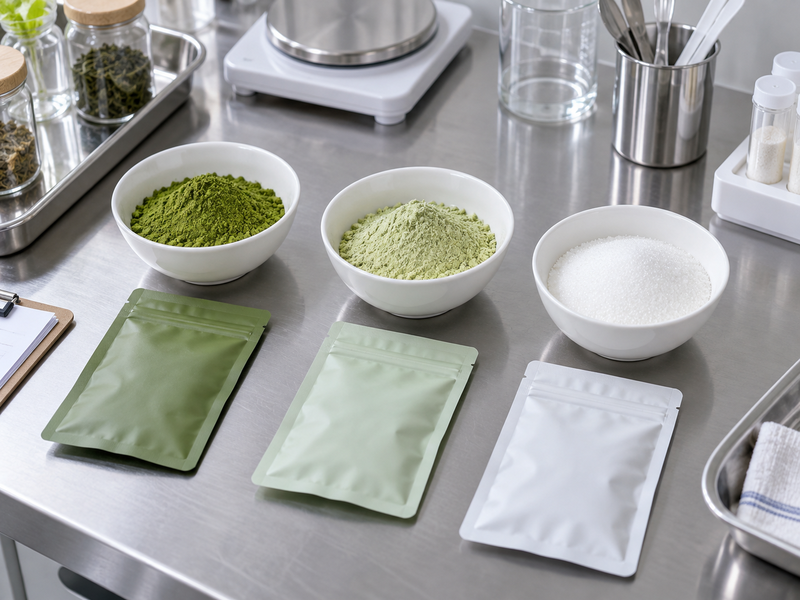
2. How should you separate pure powder from prepared mixes?
Use distinct fields for each family
Give each family its own row in the inquiry. A pure tea powder request should state that intended composition explicitly. For a milk or sugar preparation, ask for the complete ingredient information and the recommended preparation method. Generic terms such as latte powder or sweet matcha do not establish percentages or ingredient sources. Your team needs the proposed product’s own record.
Request composition for the named SKU. GreenTea.sg’s wholesale article lists pure matcha, matcha milk powder and matcha sugar powder as separate families. That is a description of its range. It does not prove the composition of every product sold in Singapore. Your matcha supplier Singapore plan should record which family you requested and which one the supplier offered. If a response crosses those families, ask why and return it to the owner of your application brief. Keep the difference visible before samples reach staff who might prepare every powder using one recipe.
| Inquiry family | Information to request | Buyer checks |
|---|---|---|
| Pure tea powder | Named SKU and composition | Fits pure-powder brief |
| Milk preparation | Ingredient record and preparation | Fits intended service method |
| Sweetened preparation | Ingredient record and dose guidance | Fits recipe design |
| Related tea powder | Tea identity and intended use | Fits separate menu request |
3. What can a product name tell you about ingredients?
Treat names as routing information
Product names can help an account team locate a range. They cannot replace an ingredient record or answer every question about a formulation. Ask what the supplier means by premium, culinary, latte or milk powder within its own catalogue. Two suppliers may use different names for products intended for similar applications. Keep each name linked to its supplier code rather than making a universal grade ladder.
Ask for the product record behind the name. Your quality owner should review composition and any application restrictions for the specific item. Do not infer allergen status from the words pure, dairy-free or tea powder without the appropriate product information. If a local seller offers imported products under a new house code, ask how that code connects with the underlying product record. Staff should be able to repeat an order without relying on a translated product nickname. A clear code, family and accepted description provide a more usable account record than a collection of promotional names.
4. How should you specify an origin request?
Keep origin and product family separate
If your project requires Japanese origin, state that condition separately from the family and application. Ask the supplier what origin information it can provide for the proposed SKU. If a named producing region is part of your brief, explain whether it is required or a preference. A request for milk preparation still needs to identify which ingredient the origin description covers.
Specify what the origin statement applies to. GreenTea.sg’s article names Japanese producing regions including Nishio, Uji, Shizuoka and Kagoshima. Those names describe its sourcing discussion. Ask for the information associated with your proposed product rather than assuming every listed region appears in every blend. For a matcha supplier Singapore inquiry, keep tea origin, local seller and any preparation or packing location in different fields. This avoids describing a Singapore account address as the tea’s origin. Your brand owner should review any intended origin wording against accepted product records before it reaches customer materials.
| Origin field | What to ask | Why it stays separate |
|---|---|---|
| Tea origin | Country for the proposed tea | Seller location differs |
| Regional request | Available supporting information | Catalogue regions differ |
| Blend description | Scope of origin statement | Several ingredients may appear |
| Local seller | Account entity and contact | Identifies service route |
5. What application details help the supplier route samples?
Describe the preparation assumptions
Tell the supplier whether staff will prepare the product as straight tea, a hot milk drink, an iced drink or an ingredient in food production. Include the equipment and ingredients your team expects to use. A prepared mix may come with supplier instructions that differ from your current recipe. Ask whether those instructions apply to the proposed SKU and request a sample that supports your intended trial.
Keep separate instructions for separate families. Staff should know which sample requires added milk or sugar and which already includes other ingredients. Confirm the preparation against the specific SKU’s instructions. Record any supplier-proposed dose and method as trial inputs awaiting your own approval. If one application spans multiple families, give each sample an identifier and its own instruction sheet. Your matcha supplier Singapore account contact can then answer a precise follow-up when a sample differs from the brief.
6. Who approves each product family inside your business?
Assign a family owner
A food development team may approve the formula while operations approves the service method. Quality should review the product record and any required information. Purchasing maintains codes and account details. When a prepared mix replaces pure powder, those decisions may change even if the finished menu item keeps the same name. Ask the relevant owners to review the proposed family before a repeat order becomes routine.
Record approval against the exact SKU. Your matcha supplier Singapore plan should distinguish approval for a particular application from permission to use an entire catalogue family. The record needs the product code, accepted composition reference, preparation conditions and owner. If several branches use the product, name the person who will issue common staff instructions. A local account team can help collect information, but internal approval belongs to your authorized people. Keep open questions attached to the family row until their owners have accepted the answers. This reduces the chance that a favourable sample preparation becomes an unrecorded product substitution.
| Approval topic | Buyer owner | Record tied to the SKU |
|---|---|---|
| Formula fit | Development | Application decision |
| Product information | Quality | Accepted composition reference |
| Service method | Operations | Staff instruction revision |
| Account code | Purchasing | Approved ordering reference |
7. How should the local seller handle technical questions?
Clarify the seller-to-buyer handoff
Ask whether the Singapore seller answers technical questions directly or obtains answers from another product owner. A local contact may manage the account while a manufacturer holds the underlying formulation information. Record the contact route and who provides the accepted response. Send questions with the supplier code and product family so the seller can locate the right record.
Keep the response tied to its source. If a distributor forwards a specification, retain its product reference and revision rather than replacing it with a local nickname. Ask how future changes will reach your team. Your account coordinator should be able to separate an application suggestion from a confirmed composition statement. When a reply needs quality approval, send it to that owner before updating internal ingredient data. The handoff is usable when staff know whom to contact and which record controls the answer. It should remain clear even when the local seller changes its assigned representative.
8. How can related tea powders stay out of a matcha request?
Create separate range rows
A supplier may offer hojicha, sencha, black tea powder and other products alongside matcha. These can support separate menus, but they should not enter an inquiry as interchangeable tea powders. Name the tea family, intended application and product code for each request. If you want a broader range discussion, tell the account contact that it includes several distinct products.
Keep each tea family identifiable. GreenTea.sg’s article lists these related powders within its own wholesale range. Use that catalogue structure as a reminder to separate inquiries, rather than treating all green or roasted powders as one ingredient. Your matcha supplier Singapore record should show which sample belongs to which request. Ask staff to return preparation notes against those identifiers. Purchasing can then order the approved family without selecting a similar-looking catalogue item. Where your brand uses several powders, keep customer-facing descriptions aligned with the accepted identity of each product; the labeling guide provides a separate record review process.
| Requested family | Inquiry description | Avoided ordering confusion |
|---|---|---|
| Matcha | Matcha SKU and application | Other green tea powders |
| Hojicha | Roasted tea powder request | Matcha menu nickname |
| Sencha | Named sencha powder | Generic green powder |
| Black tea | Named tea preparation | Shared latte designation |
9. What should change when the supplier proposes another SKU?
Review the affected fields
Compare the proposed alternative with the accepted row in your account record. Check family, composition, origin information and preparation instructions. A new pack appearance may conceal the same product, while a similar name may identify a different formulation. Ask the seller which fields have changed and provide the old and proposed codes in the question.
Return changed fields to their approval owners. If the alternative is a prepared mix, development should review its fit with the existing recipe. If the origin statement changes, the brand owner should check any customer materials that depend on it. Purchasing should wait for the recorded decision before treating the alternative as approved. Keep supplier descriptions and buyer approval distinct in the change record. Once accepted, update staff instructions and account references together. Your receiving team needs enough information to distinguish the previous SKU from the replacement without opening powder merely to identify it.
10. What does a complete product and account brief contain?
Issue a single accepted inquiry
A complete inquiry names the product family, proposed application, origin request and local account contact. It also identifies internal approval owners and the questions that remain open. Attach the relevant preparation details and request replies against those fields. Suppliers can then recommend a product or state where their range differs from your request.
Ask the seller to confirm the product-family row. Before routine buying, record the accepted SKU, composition reference, support route and staff instruction. Keep the inquiry version beside the supplier’s response so somebody covering purchasing can reconstruct what was agreed. Ask Matcha Village about pure matcha and blend options; a buyer comparing such offers should request current product-specific details. Your matcha supplier Singapore brief should preserve the same clarity regardless of seller or origin. Send the accepted request to the account contact, then route each answer to the owner who can close it.
| Brief field | Accepted information | Open item owner |
|---|---|---|
| Product family | Named family and SKU | Purchasing |
| Composition | Reviewed product record | Quality |
| Application | Approved trial method | Operations or development |
| Local account | Seller and support route | Account coordinator |
FAQ
Q1: Can a matcha latte name identify the purchased powder?
Ask whether the purchased item is pure tea powder or a prepared mix. The finished drink name cannot settle composition.
Q2: Does a milk powder name reveal ingredient percentages?
Request the named product’s ingredient information. Catalogue family names do not establish a formula.
Q3: How should a matcha supplier Singapore inquiry state Japanese origin?
Put the origin request in a separate field and ask what the supplier’s statement covers for the proposed SKU.
Q4: Can related tea powders share one ordering code?
Keep the supplier’s distinct codes and tea identities visible, even when they serve similar menu formats.
Q5: Who approves a switch from pure powder to a mix?
Development, quality and operations should review affected conditions under your internal approval process.
Send one inquiry with separate product-family rows and named approval owners. Ask the local seller to confirm the proposed codes, composition records and support route. Keep the accepted version beside preparation instructions so purchasing and service staff continue using the same identified product when the account begins routine ordering.