
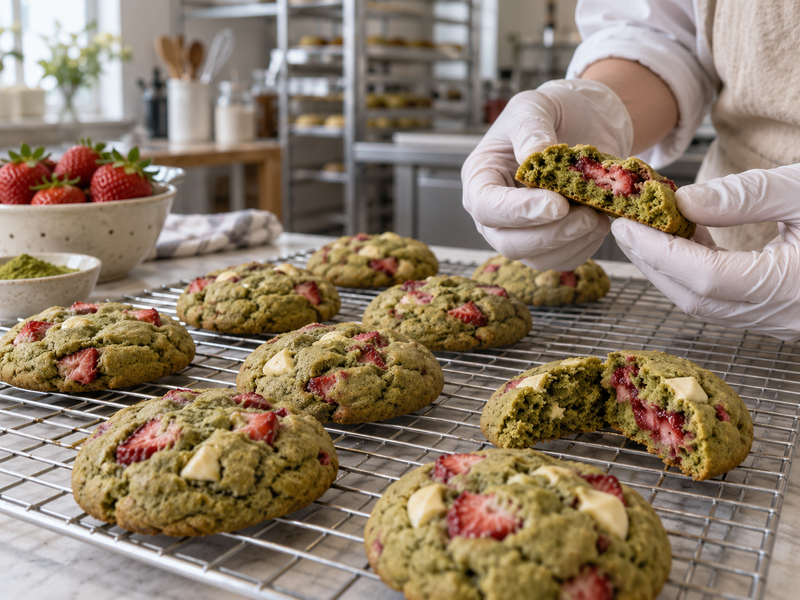
Matcha strawberry cookies can look convincing in a photograph and fail in a bakery case. A wet strawberry swirl can soften the center, while extra matcha can make a dry cookie taste bitter without making the fruit clearer. The Nio Teas strawberry matcha cookie recipe uses a green dough and strawberry puree or jam for marbling. A commercial version needs a stricter brief: recognizable tea and fruit in one bite, predictable spread, an acceptable texture at the point of sale and a portion cost the bakery can sustain. The following checks turn a small recipe idea into a controlled product trial.
Contents
- 1. What cookie should the customer receive?
- 2. Which strawberry form should be tested?
- 3. How do you choose matcha for the dough?
- 4. What should a control formula record?
- 5. How do you mix without losing the swirl?
- 6. How do you portion and chill consistently?
- 7. What proves the cookies are baked properly?
- 8. How should the cookies be packed and held?
- 9. What belongs in the cost and label review?
- 10. When is the recipe ready to launch?
1. What cookie should the customer receive?
Write the sensory target before the color target
Decide whether this is a soft bakery cookie, a crisp biscuit or a filled sandwich. Those products need different doughs and different holding tests. For a soft cookie, write down the target diameter, thickness, center texture, edge texture and visible strawberry distribution. A photograph can show the intended green and red contrast, but it cannot define how the cookie should break or whether fruit and tea register in the same bite. Taste a plain control alongside the matcha version so the team can tell whether the powder changed the base cookie.
Ask tasters to assess a center piece and an edge piece separately. A large cookie can have a soft center and a dry rim; a small one may bake more evenly but offer less visual swirl. The target might be “tender center, lightly set edge, clear strawberry note followed by mild tea, no damp fruit pocket.” That is more useful than “premium” or “delicious.” Put the target on the production card so a second shift can reject a batch for the same reasons as the developer, not according to personal preference.
2. Which strawberry form should be tested?
Compare flavor and moisture together
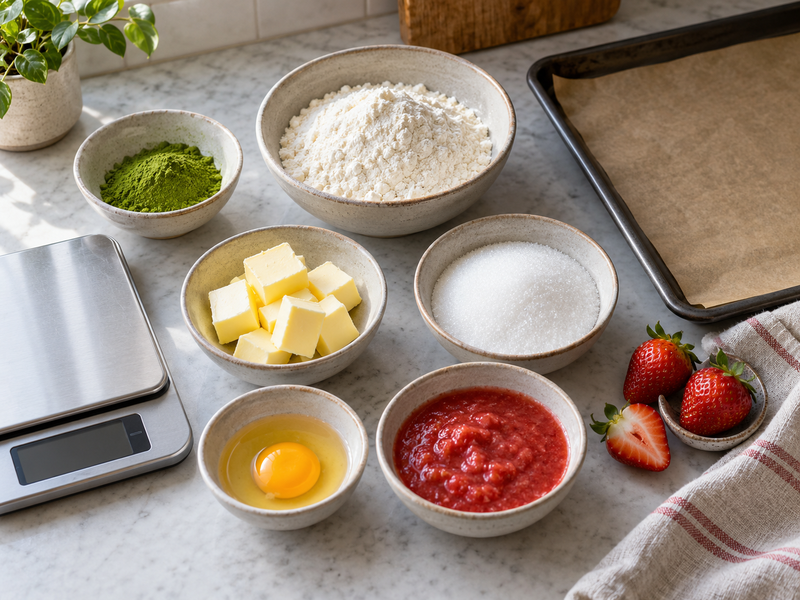
Fresh puree, cooked jam, freeze-dried fruit and flavored chips behave differently in dough. The Nio Teas recipe permits puree or jam; that is a useful home choice but a bakery should test each option separately. Puree adds water and may create soft pockets or uneven spread. Jam adds sweetness and varies by fruit content. Freeze-dried pieces are drier but may soften after packing. A chip can be consistent, yet its ingredient label and flavor may not match what the menu promises.
Choose a supplier and record the exact strawberry product, its solids or ingredient statement, lot, input weight and preparation. Make a control dough with no fruit, then equal-size trials with two strawberry forms. Judge aroma, visible fruit, texture and pack behavior after the planned holding period. If a puree creates a beautiful swirl but an underbaked-looking center, first adjust the fruit placement and amount rather than extending the whole bake until the green dough dries out. If you use fresh cut fruit, add a separate food handling assessment for the preparation and finished product.
| Strawberry option | Main question | What to record |
|---|---|---|
| Fresh puree | Does water soften the center? | Input mass and spread |
| Jam | Is sweetness too high? | Brand and fruit content |
| Freeze-dried pieces | Do they stay distinct? | Piece size and holding |
| Flavored chip | Does it taste like fruit? | Ingredient and allergen label |
3. How do you choose matcha for the dough?
Judge it after baking
Ask for a current sample of pure powder with lot and storage details. Matcha is not a substitute for green food coloring: the cookie should carry a recognizable tea note. Sift a weighed amount into the dry ingredients for each trial. If a candidate looks bright in the bowl but tastes harsh in the baked cookie, it does not meet the brief. Another candidate may look less vivid yet work better with strawberry. Taste the baked dough without the red swirl, then taste a complete cookie.
Do not compare two powders at arbitrary spoonfuls. Use the same grams per batch first, then test the accepted flavor dose for each. Calculate the cost at that dose. A higher bag price may still be reasonable if less is needed, while a cheap powder can become expensive when a large amount is required. Check the powder’s ingredient statement; a sweetened matcha mix changes the dough and may introduce allergens. Our matcha grades guide can help a buyer formulate sample questions, but the cookie trial establishes whether the lot works in this recipe.
| Powder check | Same for every sample | Compare after baking |
|---|---|---|
| Dough base | Ingredient brands | Tea flavor |
| Powder dose | Gram weight | Bitterness and cost |
| Fruit input | One chosen form | Flavor balance |
| Oven and pan | Same settings | Crumb and color |
4. What should a control formula record?
Make yield and size reproducible
A bakery formula needs ingredient weights, mixing order, dough temperature if relevant, rest time, scoop mass, tray spacing, oven setup and accepted yield. The reference recipe is written for a dozen home cookies; it does not prove a larger mixer or full rack will behave the same. Begin with a small batch that produces enough cookies to inspect immediately and after the intended display period. Record the weight of finished dough and divide by the target scoop mass. That calculation should agree with the actual number of accepted cookies.
Keep a version log. The strawberry supplier, jam formulation, flour brand, matcha lot and butter temperature can change how the dough spreads. Change one variable per test, with a reason. If every trial uses a different oven tray and a new strawberry product, no one can explain an improvement. Weigh the fruit swirl separately from the green dough. A cookie with a generous red streak may look attractive but contain more added moisture than a smaller one; both should be compared by actual input, not appearance alone.
| Formula field | Write on the card | Check during pilot |
|---|---|---|
| Dough input | Ingredient grams | Batch mass |
| Fruit input | Grams and product | Distribution |
| Portion | Dough and fruit mass | Size range |
| Oven | Setting, rack and tray | Spread and set |
| Yield | Planned and accepted | Waste rate |
5. How do you mix without losing the swirl?
Keep green dough and red fruit identifiable
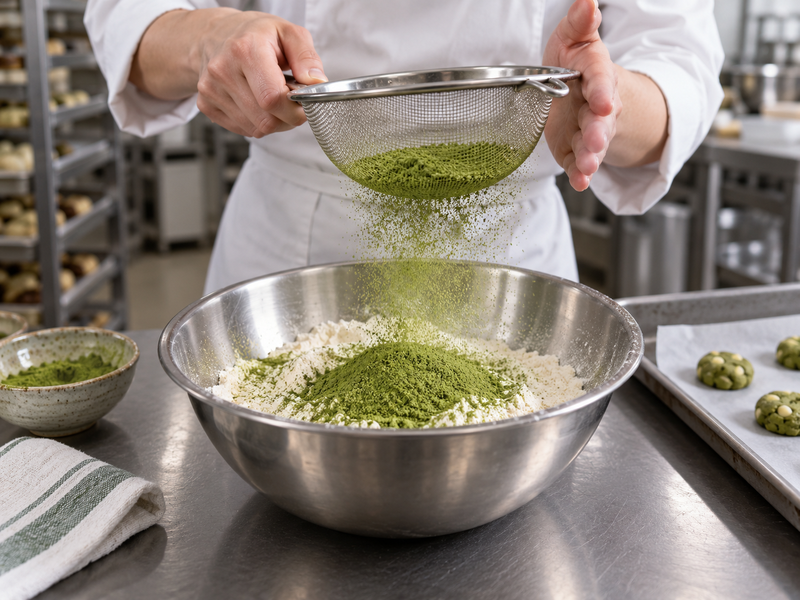
Sift matcha with the flour and other dry ingredients to reduce green specks. Cream or combine the wet ingredients according to the chosen base formula, then mix the dry ingredients only until incorporated. An overworked cookie dough may change texture, while an undermixed one leaves flour and matcha pockets. Define an endpoint that staff can see: even green color, no dry streaks and a dough that scoops without liquid pooling. The exact method depends on the fat and sugar system, so document the method tested on your mixer.
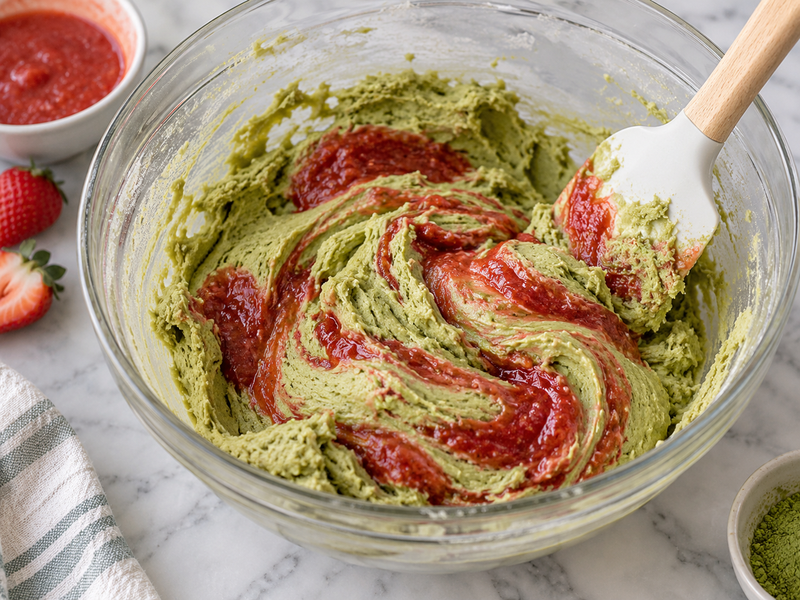
Add the strawberry component late, using a controlled number of folds or a measured top placement. The goal is a distinct streak, not a uniformly brownish pink dough. If a wet puree makes the mix slippery, try a smaller portion or a thicker strawberry component before adding extra flour to the entire dough. Extra flour may fix spread but flatten flavor. Split a pilot batch into two swirl methods and compare cut cookies after baking. The choice should be based on consistency across a tray, not the best single cookie.
| Mixing fault | Likely cause | Trial response |
|---|---|---|
| Brownish dough | Fruit fully blended | Add fruit later |
| Green specks | Matcha clumps | Sift with flour |
| Wet pockets | Excess puree | Weigh and reduce fruit |
6. How do you portion and chill consistently?
Control the shape before the oven
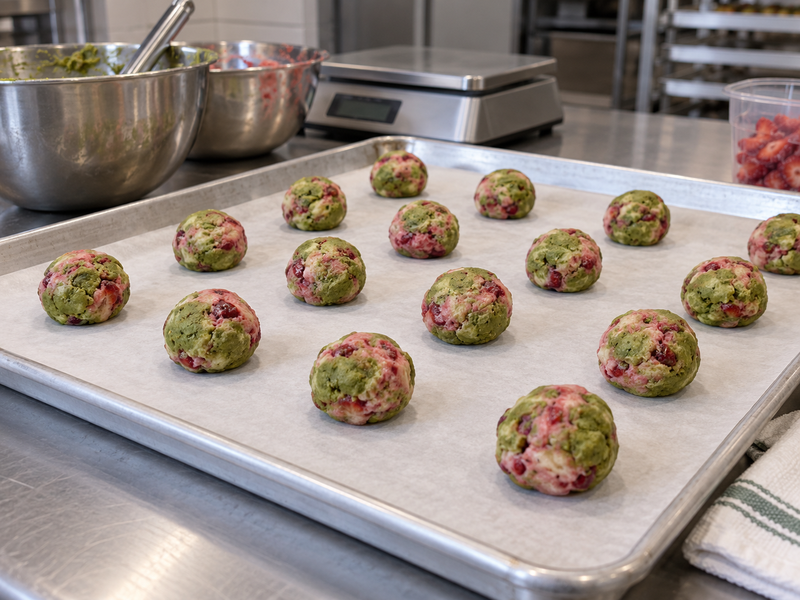
Weigh a few scoops at the beginning, middle and end of portioning. A spoonful that looks the same size can carry different amounts of dough and fruit. Define the target mass, acceptable range and spacing on the tray. The first tray may spread differently from one portioned twenty minutes later if the dough warms at the bench. A rest or chill can reduce that variation, but it must be part of the written process, with a defined time and storage condition.
When testing a chilled dough, bake a control tray immediately and another after the planned rest. Compare diameter, thickness, center texture and fruit appearance. Do not treat chilling as a universal cure for a formula with too much free water. If a scoop contains a large pocket of puree, the local dough may still soften regardless of rest. Make sure the tray pattern works in the actual oven. Crowded cookies can touch after spreading, and moving them mid-bake can damage the swirl. A simple pan diagram may be more useful to staff than a paragraph of instructions.
7. What proves the cookies are baked properly?
Check the center after cooling
Set a trial oven range, then judge the actual cookie. Look at edge set, shape, bottom color and a center cut after cooling. A strawberry streak can make one spot look glossy, so do not use color alone as proof that the entire cookie is finished. Compare multiple pieces from different positions on the tray. A back-corner cookie may bake harder than one near the door. If the centers are gummy, check fruit amount and placement, scoop mass and oven loading before simply adding several minutes to every batch.
Record the bake time that produces an acceptable center and edge in your oven, not a time copied from a home recipe. Use the same cooling rack and interval before packing. A cookie packed warm may soften from trapped moisture and make an otherwise good bake appear underdone. Taste a cookie without a visually dramatic fruit pocket as well as one with a strong swirl. The former tells you whether the base tastes of matcha; the latter tells you whether the fruit overwhelms it. Both are part of the advertised product.
8. How should the cookies be packed and held?
Test the pack in the conditions you sell
A paper sleeve, sealed pouch and open bakery case each change texture. Run a holding trial with the actual pack and intended display location. Check a cookie at cooling, at the expected sale time and after any planned delivery journey. Note whether the center stays tender, whether strawberry moisture migrates into the green dough, and whether the surface sticks to the pack. A result from an open rack does not predict a sealed pouch. Set a quality window from these observations.
Do not present a guessed shelf life as a verified safety claim. If the formula or topping contains perishable fruit or dairy components, review the handling plan for the finished product under local rules. Label test packs with production time and ingredient lot so the team tastes the intended age. If the attractive version fails quickly in a sealed pack, consider a dry strawberry component, a different pack or a shorter sale window. Choose the change that preserves the flavor brief, then repeat the holding trial.
| Pack trial | Inspect at service | Possible decision |
|---|---|---|
| Open case | Edge drying | Smaller batches |
| Paper sleeve | Fruit seepage | Barrier or formula change |
| Sealed pouch | Condensation and stickiness | Cool longer before packing |
| Delivery box | Breakage | Insert or portion change |
9. What belongs in the cost and label review?
Count accepted cookies and actual ingredients
Cost the matcha at its accepted dose, the chosen strawberry input, base ingredients, packaging, labor and rejected pieces. A version using fresh puree may look inexpensive per gram but create more waste or shorter display life. A freeze-dried version may cost more as an ingredient while producing more accepted cookies. Compare the cost per sellable cookie after the pilot, not the ingredient price of one tray. Include the labor of swirling if every cookie needs individual attention.
Review the actual labels for flour, butter, egg, jam, chocolate or any other added component. In the United States, the FDA’s guidance on food allergens identifies wheat, milk and egg among major allergens and explains why packaged and unpackaged bakery products may be treated differently. Follow the rules for the selling market. Avoid suggesting the cookie has health benefits because matcha is present. Its menu description should accurately name the strawberry component: fresh fruit, jam or flavoring can be meaningful differences to a buyer.
10. When is the recipe ready to launch?
Let a second baker repeat the result
Give the written recipe to a baker who did not develop it. The baker should be able to identify the approved ingredients, weigh the dough and strawberry component, make the swirl, portion a tray and judge the bake without coaching. Compare first and last trays for mass, diameter, visible fruit and flavor. Keep a photograph of a representative accepted cookie and its cut center. Reject a batch with large wet pockets, uneven color, raw flour streaks or flavor that no longer matches the target.
The release card should include ingredient versions and lots, formula weights, mixing endpoint, swirl method, scoop mass, tray layout, oven and cooling method, pack, quality window and allergen review. After launch, watch waste and customer comments for a week. If staff repeatedly add more jam to make the cookies look red, revisit the approved appearance standard rather than allowing an unrecorded moisture increase. The point of the pilot is a cookie that can be made again on a normal production morning.
FAQ
Q1. Is puree or jam better for matcha strawberry cookies? Test both in the chosen dough and pack. Compare fruit flavor, center texture and spread at the planned sale time.
Q2. How do you keep the red and green visible? Add the strawberry component late and use a controlled fold or placement method.
Q3. Should the dough be chilled? Compare immediate and rested trays. Include the rest only if it improves the product and fits production.
Q4. Can a matcha grade label choose the powder for baking? No. Taste candidate lots in the finished cookie at a weighed dose.
Q5. What should be recorded before launch? Weights, ingredient lots, mixing and swirl methods, portion size, bake checks, pack behavior and accepted yield.