
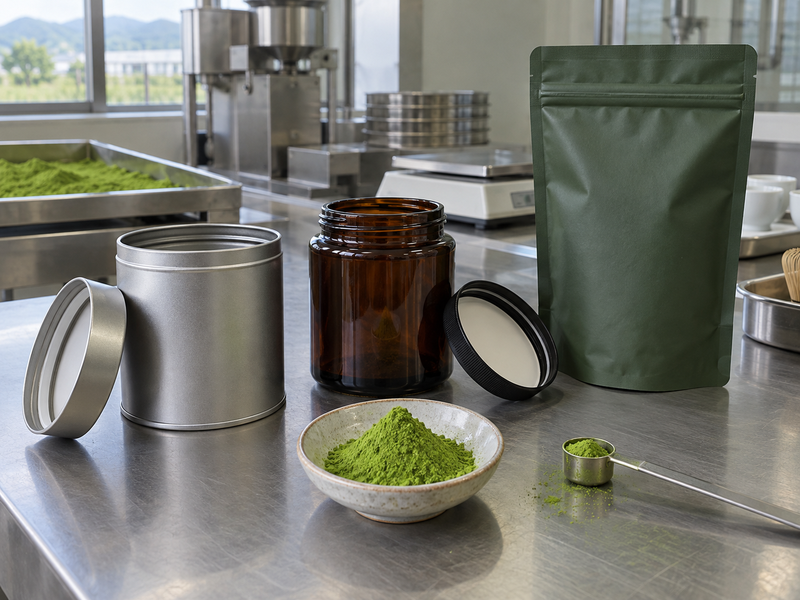
A matcha storage container has a practical job: keep tea powder within its agreed sensory standard from packing to the last serving. A handsome tin may look right on a shelf yet admit air after repeated opening. A large foodservice pouch may protect an unopened lot but become awkward at a busy bar. Light, moisture, oxygen exposure, odor pickup, and handling all affect the decision. This guide helps purchasing, quality, and operations teams choose a container by use case, test it under real conditions, and write a brief that a supplier can answer. Matcha Village supplies matcha in bulk and consumer-facing formats; the strongest package decision still comes from the buyer’s filling, distribution, and daily use conditions.
1. What must a matcha storage container protect?
Define protection in terms of the tea the customer will receive. Matcha is a finely milled leaf powder with a large exposed surface area. Its aroma and appearance can change when it is repeatedly exposed to air, light, warmth, moisture, or nearby strong odors. A published matcha storage study examined water activity and light exposure as stability variables. The package also needs to prevent contamination and survive shipping. “Airtight” is useful shorthand, but a lid that closes firmly does not tell a buyer how the package performs after fifty openings, a warehouse journey, or a warm delivery truck.
Start with the product’s planned life. An unopened retail pouch, a partly used café tin, and a bulk ingredient bag at a bakery face different exposures. Record the expected storage temperature, frequency of opening, amount removed per opening, and acceptable color and flavor at the end of use. Keep the tea’s lot code attached to the working container. If staff decant powder into an unlabeled jar, a later complaint becomes harder to trace even if the jar itself is clean. Packaging is both a barrier and a control point in the business process.
| Risk | Likely point of exposure | Control to test |
|---|---|---|
| Air | Repeated lid opening | Seal after normal use cycles |
| Light | Display shelf or clear jar | Opaque pack or controlled display |
| Moisture | Steam and cold-pack condensation | Dry handling and seal integrity |
| Odor | Shared storeroom | Closed pack and placement |
2. Which container materials should buyers compare?
Common options include opaque metal tins, multilayer flexible pouches, amber glass jars, and food-grade rigid plastic containers. None wins every application. A tin presents well in retail and can be sturdy, but its lid and inner seal determine actual performance. A high-barrier pouch can use space efficiently and protect a sealed product, but repeated scooping from a large pouch can stress the closure. Amber glass blocks some light and looks premium, yet it is heavy and breakable. Rigid plastic can be practical for back-of-house use if its food-contact suitability and closure are confirmed.
Ask for the exact material structure rather than the marketing name. “Foil pouch” can describe different layers and sealing methods. For a retail product, check tamper evidence, reseal performance, and whether the pack can stand and dispense cleanly. For foodservice, judge whether staff can close it while wearing gloves, whether powder gets trapped in the zipper, and whether the container fits the storage shelf. Fill the candidate packs with the actual matcha and run the same handling trial before choosing on appearance or unit price.
3. How should oxygen, moisture, and light barriers be specified?
Ask packaging vendors for relevant barrier data on the final structure, including oxygen and water-vapor transmission under stated test conditions when available. Numbers are useful only when they refer to the actual material, thickness, seals, and conditions proposed for the product. A strong film with a weak zipper or poor heat seal does not protect the tea as intended. Include closure, seams, and any valve or window in the evaluation. A transparent window may help merchandising while exposing part of the powder to light, so test the trade-off on a real shelf.
Barrier data does not replace product testing. Fill the package under the intended process, then evaluate seal integrity, transport damage, and tea quality over the proposed life. If a supplier proposes modified atmosphere or an oxygen absorber, ask who controls the fill, how it is verified, and whether it remains effective once opened. Avoid promising a fixed freshness period from a material data sheet alone. A matcha storage container succeeds as part of a filled and handled system, not as an empty sample held in a sales meeting.
| Specification item | Question for vendor | Trial evidence |
|---|---|---|
| Film or wall | What is the exact structure? | Material sheet for final pack |
| Closure | How does it perform after use? | Repeated-open trial |
| Seal | What are the process controls? | Filled-pack integrity results |
4. How large should each matcha pack be?
Choose a pack size that the user will finish within an acceptable open-pack period under normal operations. A low price per kilogram in a large pack can become expensive if the last third loses aroma or color before it is used. For a café, estimate daily servings from the actual dose, then calculate how long a tin or pouch remains open. Compare a large master pack with smaller sealed working packs. The latter costs more in packaging but reduces the number of days each portion is exposed.
Retail sizing has a different trade-off. A small pack may make first purchase easier and limit post-opening exposure, while a larger value pack can suit frequent drinkers. Ask the brand team how customers scoop and store the powder at home. For a bakery, matcha may be used in short production bursts rather than every day, so a series of smaller sealed bags may suit the schedule better than one large open bag. Build the forecast from use frequency, not a round weight that happens to fit an existing tin.
5. What should a café do after opening a pack?
Keep a working quantity in a clean, dry, closed container that staff can use without leaving it open beside steam or ice. Label the container with the product name, lot code, and opening date according to the site’s procedure. Use dry utensils and return the lid immediately after dosing. Do not top a new lot into an old unlabeled residue; empty, clean, and dry the container under the operation’s sanitation plan before refilling. These habits often matter more than buying a decorative jar.
Test the workflow during a rush. Can the barista measure a dose without spilling? Does powder collect in the lid thread? Can staff read the label once the container is on its normal shelf? Observe actual use over several shifts, not only a demonstration by the manager. A good storage method should be easy enough that staff follow it consistently. If a large pouch is cumbersome at the bar, store sealed stock separately and transfer a controlled working quantity into a smaller container with traceability retained.
| Opening routine | Purpose | Evidence to check |
|---|---|---|
| Record lot and date | Trace open stock | Legible label on working pack |
| Use dry scoop | Limit moisture entry | Station observation |
| Close promptly | Reduce exposure | Closure fits normal rush |
| Separate old and new lots | Preserve traceability | Stock-rotation log |
6. Should matcha be stored in a refrigerator or freezer?
Cool storage can reduce exposure to heat, but a cold pack opened in a humid room can collect condensation. The answer depends on packaging, whether the pack is sealed, how often it is opened, and the supplier’s validated storage guidance. A café opening the same tin throughout the day may find a stable, dry, cool storage area simpler than repeated trips between refrigerator and warm bar. An unopened, moisture-barrier pack held cold is a different case from a frequently opened container.
If cold storage is part of the plan, test the exact workflow. Keep the pack sealed while it returns to room temperature before opening if that is the chosen procedure, and check for moisture on the inside or around the closure. Document how long staff must wait and where the pack sits during that time. Freezing also raises questions about pack integrity, thawing, and repeated temperature cycles. Do not put a universal refrigerator rule on a label without evidence for the product and market. Request the matcha supplier’s storage recommendations and validate them with the selected container.
7. How can a business test storage life?
Set a defined trial using the actual matcha, fill process, package, and storage conditions. Keep an approved reference sample under controlled conditions. Open test packs at planned points and compare color, aroma, flavor, and preparation performance against the reference. For food safety, the quality team should define any necessary analytical or microbiological checks for the product and destination market. Sensory acceptance and safety are separate decisions. A powder can remain safe yet lose the flavor that justified its price.
Include both unopened and opened-pack scenarios. An unopened shelf-life trial does not answer what happens after a café opens a pouch twice daily. Simulate normal opening frequency and dose removal, then test the remaining tea at the expected end of use. Photograph samples under consistent light; green shifts in different camera settings are easy to misread. Record lot, pack code, fill date, opening date, storage location, and evaluator notes. When a result fails, the record should show whether the package, location, or handling needs to change.
| Trial condition | What it answers | Measure |
|---|---|---|
| Unopened pack | Proposed shelf life | Seal, color, aroma, cup |
| Repeated opening | Working-pack period | Same checks after daily use |
| Transport simulation | Distribution durability | Damage and seal integrity |
8. What matters for retail matcha packaging?
A retail pack must protect powder and communicate clearly. Check net contents, ingredient declaration, lot coding, storage instructions, and any required market labeling with qualified local review. If the product is single-ingredient matcha, the pack should say so plainly. If it is a latte mix, disclose the other ingredients. A reusable tin can give shoppers a reason to keep the container, but it may still need an inner sealed pouch or membrane for the unopened product. The post-opening experience deserves its own test.
Give customers instructions they can follow: close the pack, keep it in a cool dry place as supported by the product’s plan, use a dry utensil, and avoid strong nearby odors. Be specific about any refrigerated storage instruction if the brand chooses it. Watch for powder caught in a zipper or scoop that cannot reach the last serving. Test the full pack in consumer hands, including an elderly or gloved user if those audiences matter to the brand. Packaging that protects well in a lab but spills at every opening will prompt customers to move tea into an unknown container.
9. How should container options be costed?
Compare the cost per usable gram of matcha, not only the empty container price. Add filling cost, freight weight and cube, damage, returns, merchandising value, and the amount of tea discarded at the end of use. A premium metal tin may cost more but support retail positioning. A lighter pouch may lower freight and storage needs. A glass jar may look distinctive yet increase breakage and shipping cost. The correct choice depends on channel and how long each pack is open.
For foodservice, calculate the waste and labor effect of the container. If staff lose time opening a difficult zipper or spill powder from an oversized bag, the cheapest pack may raise cost per cup. Run a pilot with real staff and record spills, damaged closures, and days to empty. Use the same matcha lot in each option so the packaging comparison stays fair. For retail, test an order quantity that reflects actual demand; an attractive custom tin can lock cash into inventory if the minimum order quantity is too high.
| Cost line | Measure | Why it changes the decision |
|---|---|---|
| Empty pack | Unit price at order volume | Direct packaging spend |
| Fill and freight | Cost per sellable unit | Weight, space, line speed |
| Waste | Tea lost or rejected | Open-pack exposure or spills |
| Returns | Damaged packs per shipment | Channel cost and trust |
10. What should a buyer put in a packaging brief?
Describe the matcha grade and fill weight, channel, destination market, expected unopened life, planned open-pack use, distribution conditions, and visual position. State whether the container is single-use, resealable, refillable, or a secondary working vessel. Request the final material structure, closure design, food-contact documentation relevant to the market, minimum order quantity, lead time, and quality checks. For US packs, the FDA food-contact conditions of use are a useful review starting point. Ask for filled samples if possible. Empty package samples cannot show how fine tea powder behaves around a zipper or lid.
Send the same brief to the matcha and packaging suppliers so neither designs around a different use case. Matcha Village offers bulk, OEM, and private-label formats through its website; a buyer can ask which existing packs suit the projected order and which require a custom trial. Approve a matcha storage container only after it survives filling, shipping, repeated opening, and the proposed quality period. That evidence is a stronger purchasing basis than an attractive sample tin.
Frequently asked questions
Q1: Is a metal tin always the best matcha storage container? No. Its closure and use pattern matter; compare it with pouches and other formats in a filled-pack trial.
Q2: Can a clear jar hold matcha? It can, but light exposure should be tested and controlled for the planned display and use period.
Q3: Should staff refrigerate opened matcha? Follow product-specific guidance and test condensation risk in the actual opening routine.
Q4: Is an unopened shelf-life result enough for cafés? No. Repeated opening needs a separate quality check.
Q5: What should appear on a working container label? At minimum, use the site’s approved product, lot, and opening-date controls so stock remains traceable.
The best matcha storage container fits the tea’s journey and the user’s hands. Test the filled package across shipping and daily use, then set a storage instruction that the business can consistently follow.