
Matcha spread can mean a refrigerated milk jam, a fat based confectionery spread or a nut spread flavoured with tea. Those products need different ingredients and production controls. For a cafe or bakery, start by naming the format and the way customers will use it. A spread that works on warm toast may be unsuitable for a filled pastry or a retail jar. The small trials below are development suggestions, not validated formulas or evidence of shelf stability.
1. Which matcha spread is the business trying to make?
2. What should the product brief say about texture?
3. How can matcha dosage be tested without inventing a full process?
4. How should a milk jam concentration process be evaluated?
5. What tools can compare spreadability usefully?
6. Which matcha powder belongs in a spread trial?
7. Why is a jar not proof of shelf stability?
8. What should an OEM brief say about packaging and allergens?
9. How should spread defects be investigated?
10. How should the buyer approve a commercial spread?
1. Which matcha spread is the business trying to make?
Define the continuous base and selling format
A milk jam uses a dairy mixture concentrated during preparation. A confectionery spread may rely on fats and finely dispersed solids. A nut based version adds the flavour, texture and allergen considerations of its chosen nuts. Calling all three matcha cream conceals differences that purchasing and production need to understand.
Sift & Simmer’s matcha milk spread is a dairy direction using milk, cream, sugar, milk powder and tea. It is a useful reference for the milk jam concept. Its household method does not establish a commercial process or storage life for an OEM jar.
| Product format | Intended use to define | Development focus |
|---|---|---|
| Refrigerated milk spread | Toast or cafe portion | Concentration and cold texture |
| Fat based spread | Confectionery or bakery use | Fat system and dispersion |
| Nut based spread | Toast or filling | Nut texture and allergens |
| Ready bakery filling | Inside a finished product | Compatibility with the pastry |
Choose one format for the initial work. The discussion below centres on a refrigerated dairy development route while identifying decisions that require another formulation.
2. What should the product brief say about texture?
Specify the temperature and the surface
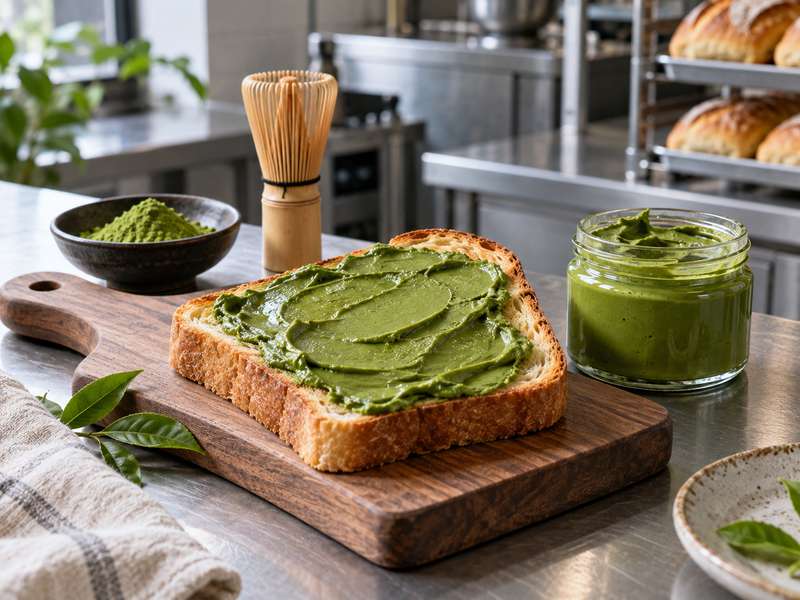
Spreadability has little meaning without a serving condition. A product taken from refrigeration may resist a knife but soften quickly on warm toast. Another may spread easily yet run out of a pastry. State whether staff will portion it cold, pipe it, spoon it or spread it directly onto bread.
Use the real application during development. For toast, choose a repeatable slice and preparation method. For a filling, use the intended pastry and portion. Record whether the spread tears the bread, forms a smooth film, slips off or leaks from the cut product. These observations are more useful than an unsupported claim that the texture is perfect.
Define the tea impression separately from consistency. A developer can make a spread thicker by changing its base, but that may also change sweetness and the amount of tea perceived in each bite. Keep a plain base control available during the first trials. Taste it beside the tea version so the team can distinguish a dairy or fat defect from a matcha defect. Approve the amount customers will actually eat, rather than judging only a tiny concentrated spoonful.
3. How can matcha dosage be tested without inventing a full process?
Add tea to an established refrigerated base
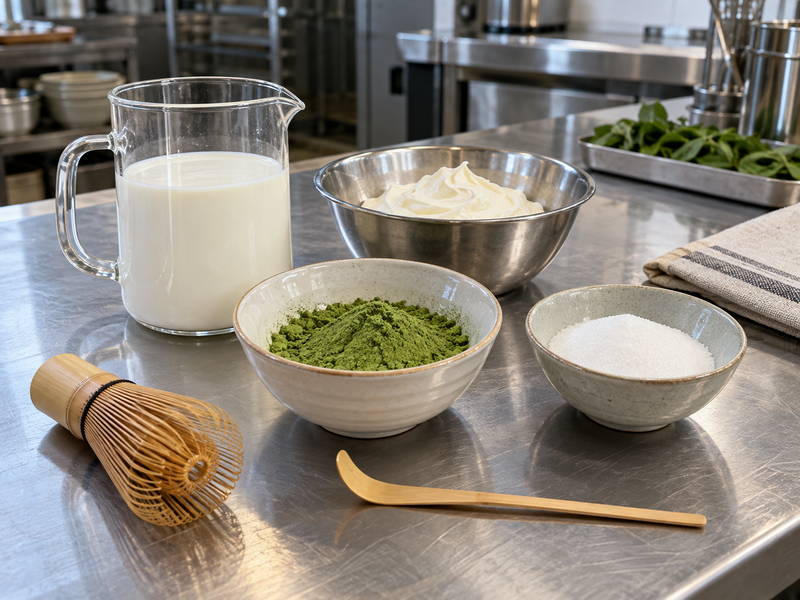
Use an existing, approved plain dairy spread base as the control where the operation has one. As an unvalidated screening plan, compare 0.5%, 1% and 1.5% matcha in the finished trial mass. This isolates tea choice before developers redesign milk solids, sugar or fat. If the business has no approved base, develop it with a qualified food technologist before planning commercial batches.
| Target trial mass | Plain base mass | Matcha mass |
|---|---|---|
| 200 g control | 200 g | 0 g |
| 200 g at 0.5% tea | 199 g | 1 g |
| 200 g at 1% tea | 198 g | 2 g |
| 200 g at 1.5% tea | 197 g | 3 g |
Sift the tea and test a controlled incorporation method compatible with the base. Do not add unrecorded water to remove lumps; extra water changes the composition and may alter texture and safety requirements. If a dispersion liquid is necessary, include it in the formula and have the process reviewed.
Taste the samples at the intended serving temperature and on the intended food. These percentages are screening points, not proven commercial recommendations. Record bitterness, tea recognition and spreadability before choosing a candidate for further development.
4. How should a milk jam concentration process be evaluated?
Record finished mass rather than colour alone
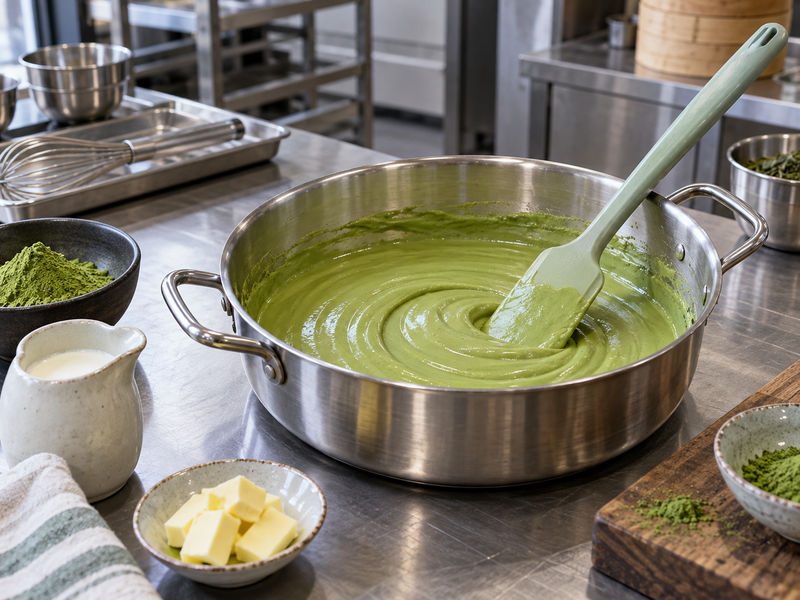
When developing a concentrated milk spread, evaporation changes the finished composition. A recipe described only as cook until thick leaves too much variation between pans, batch sizes and operators. Record ingredient inputs, vessel dimensions, heating method, agitation and finished mass. A larger surface area can change the process, so doubling ingredients does not guarantee a comparable batch.
Observe the base as it cools under the approved procedure. Its hot flow may differ substantially from the cold spreading behaviour customers encounter. Take comparison samples at consistent temperatures and evaluate them after the same defined preparation stage. If one batch is judged warm and another cold, the team may make an unnecessary formula adjustment.
Keep process validation separate from sensory development. A smooth, thick product is not automatically safe for ambient storage, and the name milk jam does not provide a preservation method. Ask the responsible technical specialist to define appropriate processing and handling for the actual dairy formula. For cafe trials, remain within the operation’s approved refrigerated preparation system. A retail jar programme requires additional work on filling, sealing, distribution and shelf life before the process can be released.
5. What tools can compare spreadability usefully?
Use repeatable application observations
A small business can begin with practical comparisons before investing in specialized texture measurements. Use equal sample masses, the same knife and the same bread at a defined temperature. Photograph the spread after a consistent stroke and note whether it drags, tears or leaves gritty streaks. Keep these observations attached to the batch record.
| Test | Keep constant | Observation |
|---|---|---|
| Knife spread | Bread, dose and temperature | Drag and coverage |
| Spoon lift | Spoon size and sample condition | Flow and cohesion |
| Piping trial | Nozzle and portion | Shape and dispensing effort |
| Filled pastry | Filling mass and pastry type | Leakage and bite |
| Warm toast | Toast preparation and delay | Melting and absorption |
These checks are comparative development tools, not substitutes for safety testing or a formal rheology specification. If a manufacturer needs an instrument value for quality release, agree on the method and sample condition with the technical team. A number without a measurement procedure is difficult to reproduce.
Taste the same application sample after recording texture. A smooth spread may still coat the mouth unpleasantly or hide the tea. The acceptable product must satisfy both the spreading job and the eating experience at the intended portion.
6. Which matcha powder belongs in a spread trial?
Check dispersion and tea finish in the base
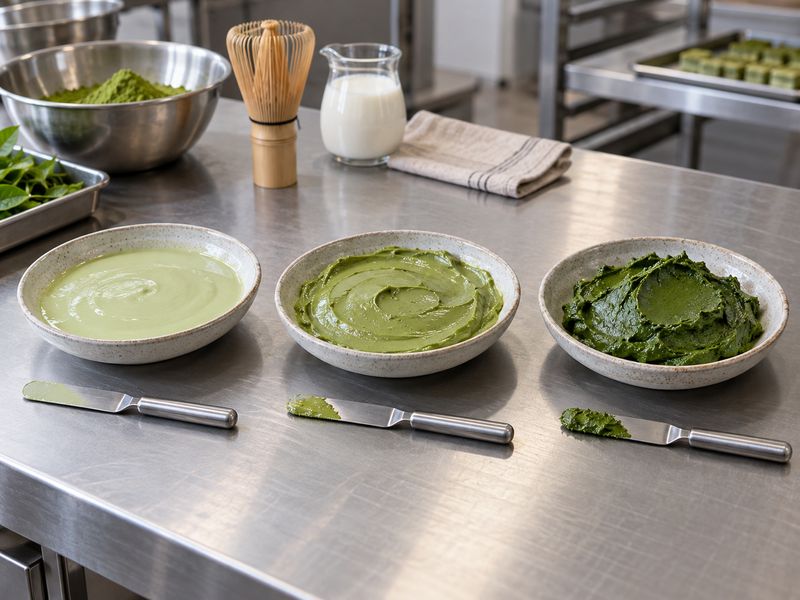
A spread exposes powder texture differently from a drink. Request samples suited to food applications and compare their behaviour in the actual base. Ask the supplier for composition and available physical specifications, including the measurement method behind any particle size statement. A single fineness claim does not guarantee a smooth mouthfeel in every fat or dairy system.
Taste each powder in the same base at the same percentage. If one sample needs more tea to remain recognizable, cost the higher dose before choosing it. Inspect for visible specks and evaluate the finish on bread. A sample that seems pleasantly strong when tasted alone may become harsh when customers eat a full portion.
Matcha Village’s ingredient buyer guide can help organize a technical sample request. State whether the spread is dairy, nut or fat based, how tea will be incorporated and whether the product is sold chilled. Ask for lot documents relevant to the destination and product. Treat any proposed blend as a separate ingredient with a complete declaration. The supplier’s general range does not prove that every powder has been validated in your spread.
7. Why is a jar not proof of shelf stability?
Measure and validate the actual product
Packaging a thick spread in a sealed jar does not establish an ambient shelf life. Water activity, acidity, processing, packaging and storage conditions interact, and appearance alone cannot answer the safety question. The FDA explanation of water activity explains that water available in a food affects stability. It is a measurement topic, not a visual judgement.
| Decision | Evidence needed | Responsible work |
|---|---|---|
| Refrigerated cafe use | Approved preparation and holding controls | Site food safety process |
| Sealed retail jar | Product and process assessment | Qualified technical team |
| Ambient distribution | Validated formulation and process | Relevant specialist review |
| Use after opening | Product specific evaluation | Shelf life programme |
Do not infer safety from sweetness or a thick texture. A change in tea incorporation that adds water may require reassessment even if the jar looks identical. Record every ingredient and processing change before commissioning tests.
For products intended for the United States, FDA guidance on acidified and low acid canned foods describes requirements for applicable commercial categories. Have a qualified specialist determine whether and how the actual product falls within them.
8. What should an OEM brief say about packaging and allergens?
Specify the use pattern as well as jar size
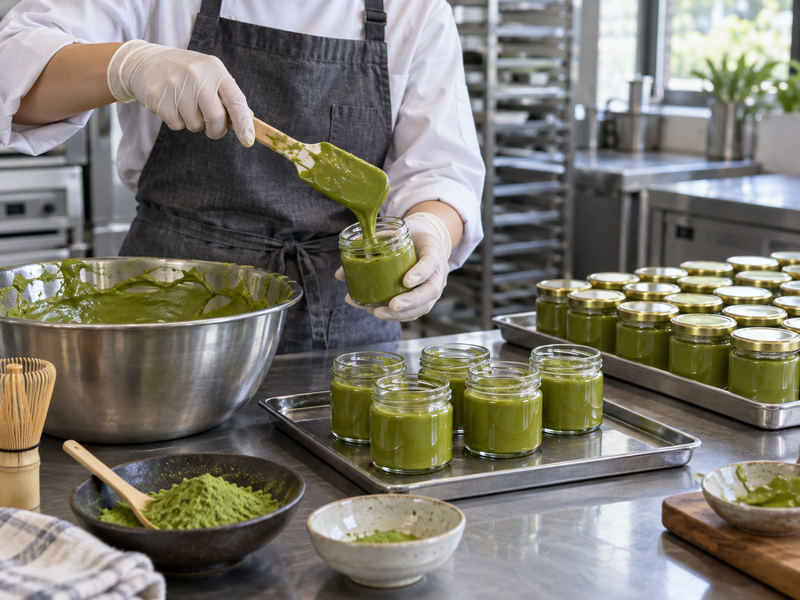
A hotel breakfast portion and a family retail jar have different opening frequency and consumption patterns. Describe who opens the product, how it is dispensed and what equipment contacts it. Include the target fill mass, closure type, storage route and intended market. The manufacturer can then assess a concrete product instead of quoting against the vague phrase premium matcha spread.
Request a full ingredient declaration for milk powders, chocolate components, nut pastes and compound ingredients. Milk, soy, nuts or other relevant allergens can enter through the base even when the tea itself contains only green tea. Review the exact formulation and the manufacturer’s handling information before making free from claims. Replacing dairy with a plant ingredient also requires a new texture and process assessment.
Ask who owns the formula and what changes require written approval. A different fat, milk powder or emulsifier can alter spreading behaviour while leaving the product name unchanged. Agree on how the OEM will communicate substitutions and retain batch records. Specify packaging artwork approval separately from technical approval, so a label design cannot accidentally become the evidence that the recipe is ready for sale.
9. How should spread defects be investigated?
Check the base before increasing tea or sugar
A gritty product can come from poorly dispersed matcha or from the base itself. Compare the plain control with the tea sample and inspect the incorporation process. Adding more cream to every batch might soften the perception while changing the composition. Diagnose the cause before accepting such a correction as part of production.
| Defect | Comparison to make | Development question |
|---|---|---|
| Green specks | Tea before and after mixing | Was powder dispersed evenly? |
| Grainy base | Plain control | Is the base process responsible? |
| Too stiff when cold | Defined temperature test | Does the base fit the use? |
| Weak tea on toast | Full portion application | Is tea dose or powder unsuitable? |
| Oil or liquid separation | Same batch over approved test period | Does formulation need review? |
Keep the tasting temperature and portion consistent when checking a correction. A warmer sample can appear smoother and more aromatic without any true formula improvement. Record the condition, then repeat the comparison at the intended service temperature.
For an OEM project, send photographs and batch details with a defect report. State how the sample was stored and tested. A clear description allows the manufacturer to distinguish a production problem from a use condition outside the approved specification.
10. How should the buyer approve a commercial spread?
Cost the saleable yield and obtain the release criteria
Calculate cost from the finished saleable mass, including concentration losses where applicable. Add tea, base ingredients, packaging, labour and any quality testing required for the product. A lower raw ingredient price may disappear when a formula produces less finished spread or requires more tea for the intended flavour.
Approve a representative pilot made with the intended equipment and packaging. Evaluate it at the defined service temperature and in the actual application. Ask the manufacturer to provide the specification, processing responsibilities, storage instructions and evidence supporting the proposed shelf life. Confirm that the label reflects the approved formula and intended market before purchasing printed packaging in volume.
Retain the sample identification and a written description of accepted colour, texture and flavour. Agree on how incoming lots will be compared and what happens when they fall outside those limits. Then send the supplier the final product brief, application photographs and expected order quantities. Request a pilot quotation that separates formulation work, packaging, testing and finished goods so the commercial decision is based on the complete project.
FAQ
Q1: Is matcha spread the same as matcha milk jam?
Milk jam is one type of spread. Fat based and nut based products use different systems and need their own formulas, handling controls and application tests.
Q2: Can tea powder be stirred into any existing spread?
It can be screened in a small trial, but dispersion, flavour and composition need checking. Record any extra liquid and review its effect on the product before commercial use.
Q3: Does more sugar make a spread shelf stable?
A safety conclusion requires product specific measurements and process assessment. Sweetness and thickness alone do not establish an ambient shelf life.
Q4: Can the same spread fill a baked bun?
Test the actual bun and processing method. Heating, moisture movement and portion size can change performance, and the finished filled product requires its own specification.
Q5: What should be sent with an OEM enquiry?
Send the intended base, application, serving temperature, packaging, storage route, target market and expected volume. Include a reference texture sample if available and request a representative pilot.