
Matcha brioche puts green tea into a dough already rich in butter and eggs. For a bakery, the challenge is keeping a clear tea flavour while producing dough that mixes, shapes and proofs reliably. A green crumb alone does not prove the loaf works. Choose the selling format, establish a plain brioche control and compare tea additions through small bakes. The development quantities here are proposed trials, not a validated production formula or a guaranteed baking schedule.
1. Which matcha brioche format should a bakery test?
2. What should a plain brioche control establish?
3. How much matcha should be tested in the dough?
4. How should butter incorporation be controlled?
5. How can shaping and proofing stay repeatable?
6. What should buyers look for in baking matcha?
7. How should baking trials be recorded?
8. How should shelf life and allergens be addressed?
9. What defects should the baker investigate?
10. How should the bakery approve a production order?
1. Which matcha brioche format should a bakery test?
Choose the portion before choosing the pan
A sliced loaf, individual bun and pull apart loaf create different production demands. A slice needs enough structure for cutting and any planned toasting. A bun needs consistent piece weight and shape. A filled product adds another ingredient, another handling step and a separate question about the finished product’s holding conditions.
Jade Leaf’s matcha brioche shows tea incorporated into enriched dough with butter added gradually. That is a useful format reference. Your bakery still needs to establish mixing and baking endpoints with its own flour, mixer and pan. Copying a household mixing time into a larger machine can produce a different dough.
| Selling format | Main production check | Customer use |
|---|---|---|
| Sliced loaf | Slice integrity and crumb | Toast or plated service |
| Individual bun | Piece weight and proof | Grab and go |
| Pull apart loaf | Joined shape and bake | Shared portion |
| Filled brioche | Filling compatibility | Separate finished product trial |
Select one format for the initial bake. Approving tea in several shapes at once makes it harder to identify whether a defect comes from dough composition or the shape’s baking requirements.
2. What should a plain brioche control establish?
Use the bakery’s working dough as the reference
Begin with a plain brioche formula the bakery already makes successfully. Record ingredient brands, flour specification, mixing sequence, dough temperature, fermentation, piece weight and pan loading. Bake a control alongside the tea trial where practical. This shows whether an unfamiliar flour delivery or oven change is affecting both products.
A dough control also helps distinguish desirable tea flavour from a general change in sweetness or butter perception. Slice samples at the same stage after cooling and compare them without toppings. Butter, jam and syrup can hide differences that customers will notice when eating the loaf plain. Keep the comparison portion consistent so a thick slice does not appear softer merely because it contains more crumb.
If there is no established brioche formula, develop that base before adding tea. A published recipe can provide a starting reference, but it still needs adaptation to commercial equipment. Record successful endpoints rather than trusting the clock alone. The baker should be able to describe the dough’s development and handling condition. Adding matcha to an unreliable base gives the team two development problems at once and makes supplier evaluation needlessly confusing.
3. How much matcha should be tested in the dough?
Express the addition against flour mass
Use baker’s percentage so the trial scales clearly. As a proposed screening plan, compare pure matcha at 1%, 1.5% and 2% of flour mass in the bakery’s approved plain brioche. These are untested development levels, not a recommended universal dosage. Start with small batches that the mixer can handle properly.
| Flour in each trial | Matcha percentage | Matcha mass |
|---|---|---|
| 500 g | 0% control | 0 g |
| 500 g | 1% trial | 5 g |
| 500 g | 1.5% trial | 7.5 g |
| 500 g | 2% trial | 10 g |
Keep the rest of the base formula unchanged for the first comparison and record any difference in dough feel. Then investigate liquid adjustment in a separate trial if required. Adding extra milk by instinct during every batch would hide the effect you are trying to measure. Record all additions, including small corrections.
Sift and distribute the matcha through the flour before mixing, or test another controlled incorporation method if the bakery’s process requires it. Check the finished dough for dry green streaks. Tea lumps should be corrected through preparation and mixing, rather than accepted as a rustic appearance in a commercial specification.
4. How should butter incorporation be controlled?
Watch dough development and temperature together
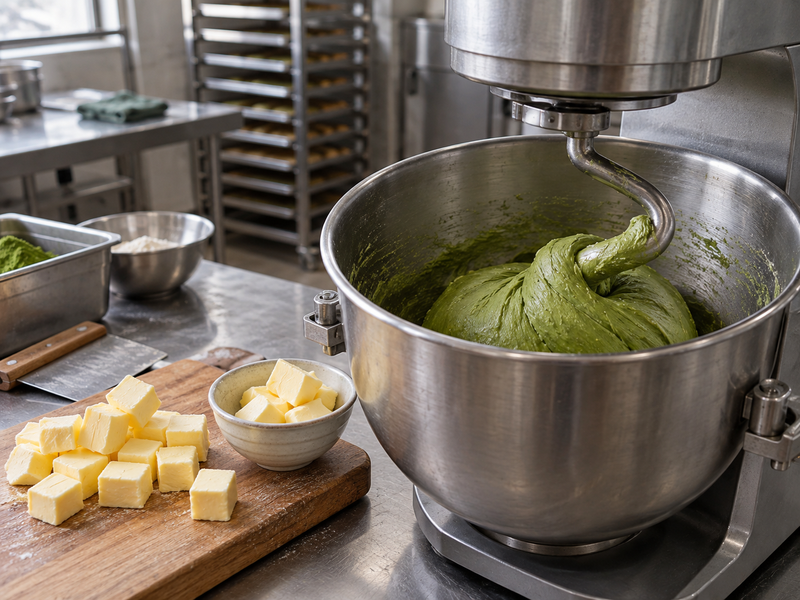
Brioche asks a mixer to incorporate substantial fat into a developing dough. Record the order of additions and the condition of the butter. Butter that is too hard may remain in pieces, while excessively soft butter can make the dough greasy during a long mix. The exact working method depends on the formula and equipment.
King Arthur Baking’s brioche guidance discusses butter consistency and the heat generated during mixing. Use that principle when writing your own procedure, without treating the publisher’s timings as specifications for your mixer. Observe the dough and measure its temperature at consistent points in the process.
Add butter in the sequence established for the control dough and allow incorporation before moving on. Stop and investigate if the tea batch behaves differently. Record mixer size, dough load and speed setting because these details explain variation when a trial moves to production. A bench mixer and a larger bakery mixer may require different operating instructions even when ingredient percentages match. Ask the baker to define an acceptable final dough condition and document it with both notes and a photograph.
5. How can shaping and proofing stay repeatable?
Control piece weight and pan loading
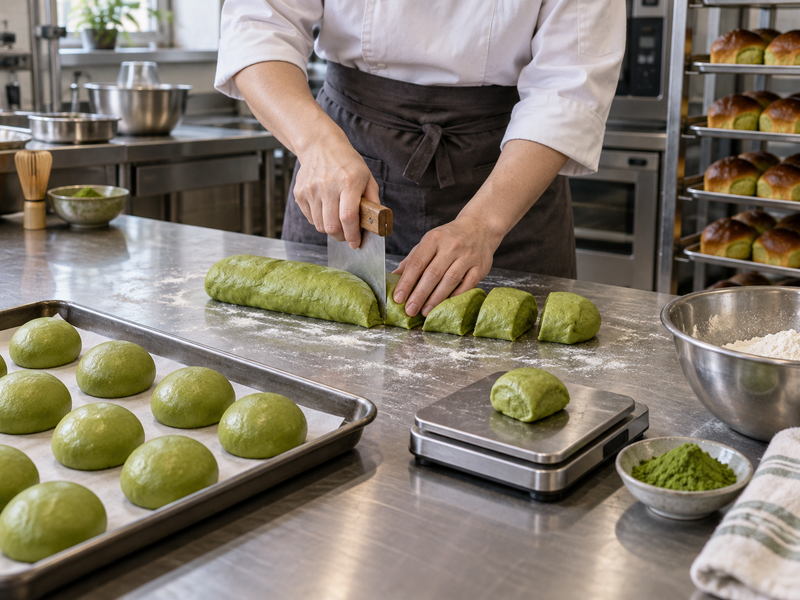
Weigh dough pieces and use the same shaping method for each trial. A tight shape and a loose shape can expand differently, making a tea dose comparison unreliable. Record dough condition at dividing and whether the approved process includes chilling. If staff need more flour to handle one trial, weigh and note the extra flour rather than ignoring it.
| Process point | Record | Reason for comparison |
|---|---|---|
| Dividing | Dough mass per piece | Equal portion and bake |
| Shaping | Method and number of pieces | Similar loaf structure |
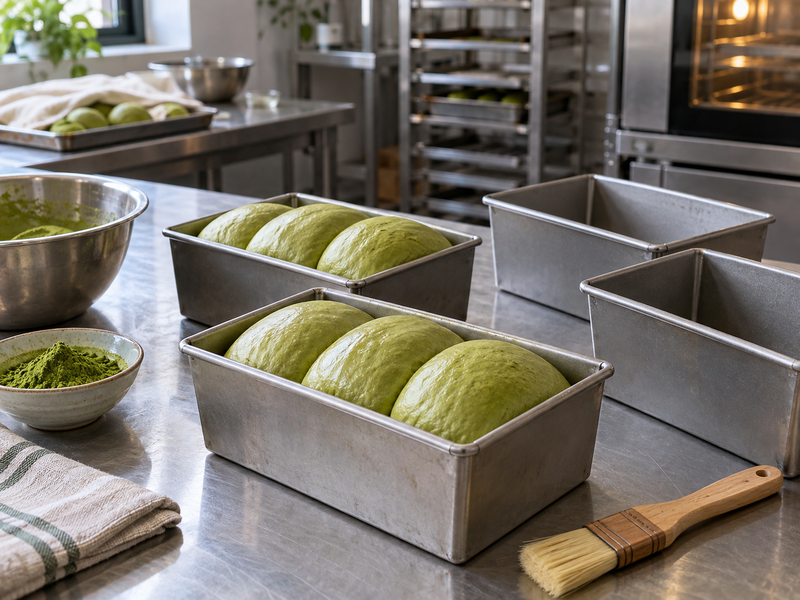
| Pan loading | Pan size and dough mass | Comparable expansion |
| Proofing | Conditions and visual endpoint | Repeatable oven entry |
| Egg wash | Product and application | Similar crust appearance |
Use the bakery’s approved proofing procedure and observe the tea dough against the control. Do not claim that matcha always accelerates or slows fermentation from one small bake. Flour, yeast, dough temperature and handling can also explain a difference. Repeat a suspected effect before changing the production schedule.
A photograph of the approved proofed dough can help staff, but pair it with written context. The image should identify the pan and dough weight. Without those details, a taller loaf may look ready even though it has a different loading.
6. What should buyers look for in baking matcha?
Evaluate after baking and cooling
Request pure matcha samples suitable for bakery trials and ask for ingredient composition and lot identification. Compare the samples at the same baker’s percentage in the same base dough. Dry powder colour can help identify obvious differences, but the baked crumb and flavour should decide the application choice.
Taste the cooled bread plain, then in its intended service. A toasted slice with a sweet spread may need a different tea impression from an unfilled bun. Keep the service comparison separate from the plain crumb assessment so a topping does not conceal a defect. Record any lingering bitterness, dull aroma or sandy perception in concrete terms.
The Matcha Village ingredient buyer guide provides a starting framework for sample requests. Share the dough type, tea percentage, baking process and intended portion with the supplier. Ask for documentation relevant to the product and destination rather than assuming a certification applies to every item in a catalogue. If a supplier suggests a different powder, run the same controlled bake before approving it. A lower cost per kilogram is useful only if the required dose and finished quality still fit the bakery’s brief.
7. How should baking trials be recorded?
Compare crust and crumb separately
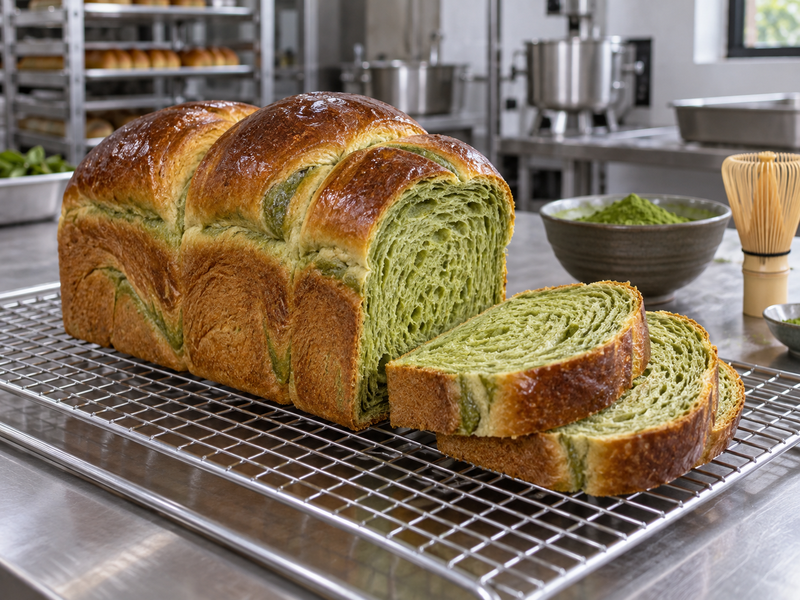
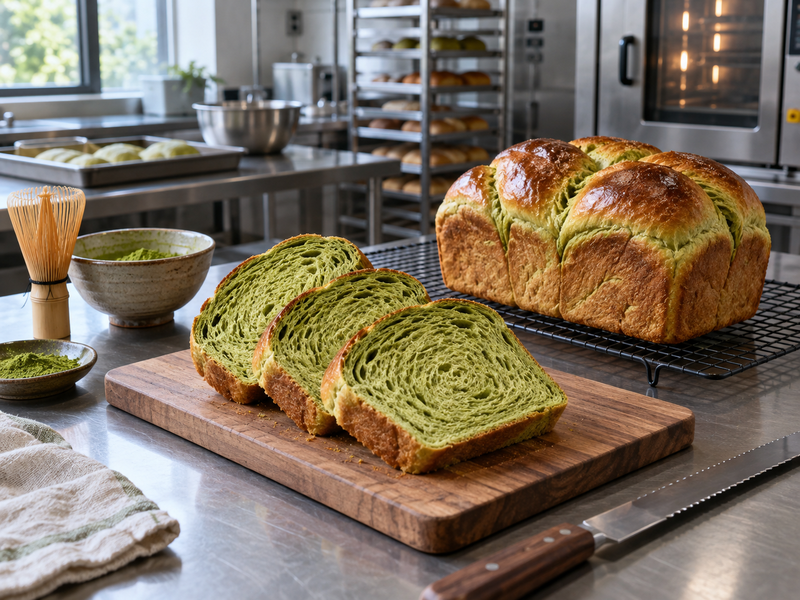
Matcha brioche has a browned exterior and a green interior, so the surface cannot serve as the only colour target. Use the approved baking process for the chosen format and record oven settings, loading and position. Check doneness through the bakery’s validated method. This article does not supply a universal time or core temperature for every loaf size.
| Trial record | Observation | What it helps explain |
|---|---|---|
| Oven load | Number and position of pans | Uneven bake patterns |
| Crust | Browning and surface defects | Appearance at sale |
| Cooled crumb | Colour, structure and moisture impression | Eating quality |
| Slice | Tearing or compression | Suitability for portioning |
| Finished mass | After the defined cooling stage | Portion yield and cost |
Cool samples through the bakery’s approved procedure before evaluating slicing. Cutting one loaf warm and another fully cooled creates an unfair texture comparison. Record the interval and conditions used for quality assessment so later trials can repeat it.
For a toasted service, use the intended toaster or griddle and approved setting. Check whether the tea flavour remains recognizable after browning. A slice that performs well plain may become dry or excessively bitter when toasted more heavily than the development sample.
8. How should shelf life and allergens be addressed?
Separate plain bread from filled products
A brioche recipe commonly includes wheat, egg and milk ingredients. Check the exact formula, toppings and supplier declarations when preparing allergen information. A dairy free replacement changes the dough and should be developed as a separate product. It cannot be assumed equivalent because the same amount of an alternative fat was added.
The FDA Food Code provides retail food safety context, with local rules governing the operation. Use your approved procedures for dough handling, cooling, packaging and display. The proposed tea trials do not establish shelf life. A filled bun may need controls different from those used for an unfilled loaf, depending on its filling and finished formulation.
Assess quality through the intended selling period under the real packaging conditions. Record crumb firmness, aroma, condensation and slicing behaviour, while keeping microbiological assessment separate from tasting. A soft crumb is not evidence of safety. For packaged distribution, ask a qualified specialist to define the testing required for the actual product and route to market. Do not copy a storage duration from a home baking page onto an export label.
9. What defects should the baker investigate?
Compare against the control batch
A dense matcha loaf may result from mixing, proofing, shaping or the formulation itself. Check whether the plain control shows the same defect before blaming tea. Record what changed between batches, including dough temperature and any unmeasured flour added at the bench. A complete batch sheet is more useful than a photograph of a disappointing slice alone.
| Defect | Check | Next controlled trial |
|---|---|---|
| Green streaks | Powder distribution | Sift and preblend tea |
| Greasy dough | Butter and mixing condition | Repeat approved incorporation |
| Uneven loaf height | Piece mass and shaping | Standardize division |
| Weak tea flavour | Dose and powder choice | Compare equal percentage samples |
| Harsh finish | Tea dose and bake | Lower tea in the same dough |
If a higher matcha dose improves colour but worsens flavour, choose the acceptable flavour level and reconsider the powder sample. Adding more sugar to cover every defect can move the product away from its intended brioche character and increase costs elsewhere.
Have a second baker repeat the leading trial. Differences in shaping or judgement at proofing may reveal instructions that are too vague. Revise the production card while the observations are fresh, then repeat only the steps that remain uncertain.
10. How should the bakery approve a production order?
Calculate saleable portions from the actual bake
Use the approved trial to measure saleable loaves or buns, trimming, slicing losses and any rejected pieces. Calculate tea cost from its baker’s percentage and the batch flour mass. Include the whole dough cost, labour, packaging and the planned service topping. A sliced loaf and an individually wrapped bun have different costs even when their dough formula is identical.
Give purchasing the selected tea code, sample lot, required pack size and expected usage. Ask for current documentation and a representative commercial lot sample where possible. Specify what sensory or appearance changes require a repeat bake before release. This gives the buyer a practical acceptance process instead of an instruction to obtain the same green powder.
Run one batch on the equipment and pan loading intended for sale. Record dough development, proofing, finished yield and staff handling observations. Once the bakery approves that result, issue the final production card and order against its measured flour and tea consumption. Retain the trial sheet and a photograph of the cooled cut loaf for the next incoming ingredient comparison.
FAQ
Q1: Can matcha be added to an existing brioche recipe?
Yes, as a controlled development trial. Start with the bakery’s successful plain formula and compare small weighed tea additions. Record any liquid or handling changes instead of adjusting them silently.
Q2: Is ceremonial grade required for brioche?
A marketing grade name does not establish baking performance. Compare suitable supplier samples in the cooled bread and select the flavour, colour and cost that fit the product.
Q3: Why is the crust less green than the crumb?
Baking browns the surface. Evaluate crust and crumb separately and choose a realistic approved appearance for the selling format rather than expecting the entire loaf to retain powder colour.
Q4: Can this dough be made into filled buns?
That requires another product trial. Filling changes portioning, baking behaviour and potentially handling requirements, so it should have its own finished product specification.
Q5: Can the suggested tea percentages be scaled directly?
The arithmetic scales, but mixing and baking performance still need a production trial. Equipment load, dough temperature and pan arrangement can change the result at a larger batch size.