
Gyokuro vs matcha is a comparison between a leaf tea normally prepared by infusion and a powdered tea dispersed into water or food. Both can belong on a specialist tea menu, but they create different purchasing, preparation and service jobs. For cafes and importers, the useful question is which format fits the intended product and operating conditions. Compare origin documents, leaf processing, preparation effort and the finished serving before discussing price. A shared green tea identity does not make the two ingredients interchangeable.
1. What is the basic difference in gyokuro vs matcha?
2. What processing information should the buyer request?
3. How should origin and product names be checked?
4. How should a cafe compare the drinking experience?
5. What equipment and staff work does each tea require?
6. Can gyokuro and matcha substitute for each other in food?
7. How should cost per service be compared?
8. What quality documents belong in a supplier review?
9. Which common comparison claims should buyers question?
10. How can a buyer choose the next sample order?
1. What is the basic difference in gyokuro vs matcha?
Begin with the form customers receive
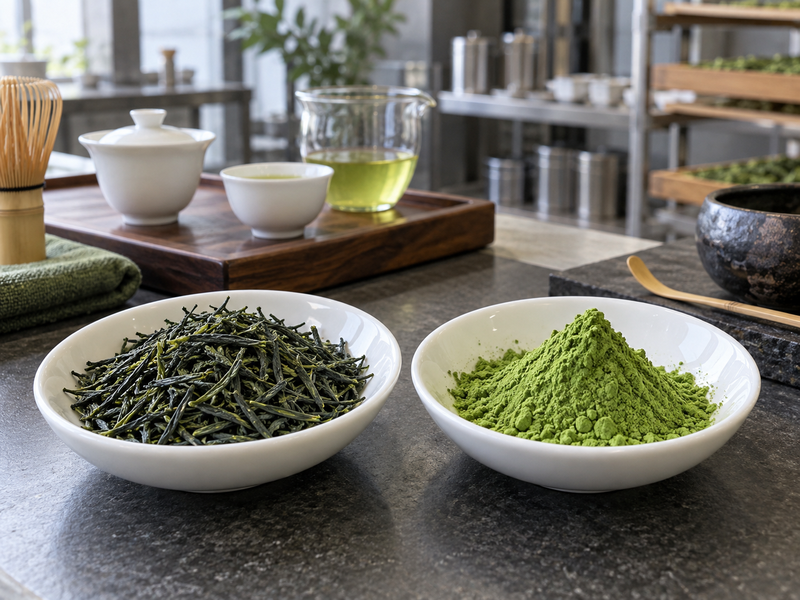
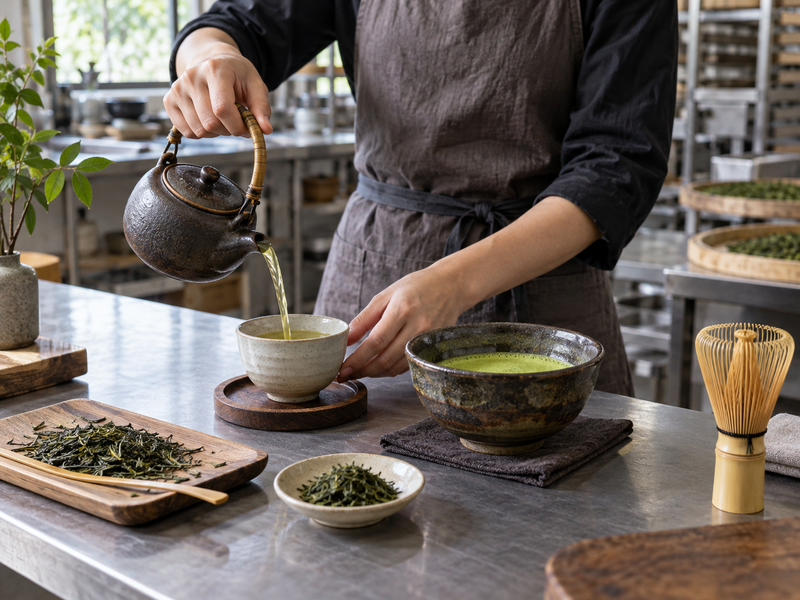
Gyokuro arrives as processed leaves that staff steep and separate from the liquid. Matcha arrives as powder that becomes part of the served drink or food. This difference changes equipment, texture and the way a business calculates a serving. A buyer should identify the intended application before requesting quotations.
| Buying question | Gyokuro | Matcha |
|---|---|---|
| Physical form | Rolled tea leaf | Fine tea powder |
| Normal drink preparation | Infuse and strain | Disperse and whisk |
| Material in the cup | Extracted infusion | Suspended tea powder |
| Typical equipment | Pot and strainer | Bowl or mixer and whisk |
Japan’s agriculture ministry describes gyokuro and matcha within its Uji tea explanation, including the relationship between matcha and milled tencha. Use that processing distinction when reading a supplier’s specification.
A menu may offer both teas for different reasons. Gyokuro can support a deliberate leaf tea service; matcha can support whisked tea and applications where powder is useful. Evaluate each against that role. Forcing both through the same latte recipe or using identical grams per cup would obscure the reason for choosing either product.
2. What processing information should the buyer request?
Ask for the route from leaf to finished product
Request a concise process description rather than relying on the product name alone. For gyokuro, ask about cultivation, harvest and leaf processing. For matcha, ask about the tea material used before milling and the finishing and packing stages. A supplier should be able to explain what is being offered without substituting broad claims about tradition for product details.
The commercial Uji Matcha Tea comparison introduces the two tea formats. Some claims on comparison pages extend into health and caffeine promises; those claims should not be copied into a purchasing specification without suitable evidence. Your order needs an identifiable product, processing information and relevant quality documents.
Ask which steps the seller performs and which are completed by other businesses. Growing, primary processing, blending, milling and packing can occur at different sites. Record those roles so a quality question reaches the correct party. If the ingredient is blended, clarify whether the blend is intended to maintain a house profile and what changes are permitted. A process description does not need to reveal proprietary details, but it should give the buyer enough information to compare like products.
3. How should origin and product names be checked?
Separate tea style from documented geography
A style name does not replace an origin declaration. Request the country of origin and any regional information needed for your intended label. If a seller claims a named growing area, ask what documents support that statement for the offered lot. The address of the packer may differ from the place where the tea was grown.
| Claim or document | What it can clarify | Follow up question |
|---|---|---|
| Country of origin statement | Product geography | Does it cover this lot? |
| Regional claim | More specific provenance | What is the evidence? |
| Packing address | Final packing location | Where was leaf grown? |
| Cultivar declaration | Claimed plant material | Is the product blended? |
| Lot code | Traceability connection | Which records link to it? |
Do not imply that a Chinese supplier sells Japanese origin gyokuro or a named Japanese cultivar unless it has supplied evidence for that product. Matcha Village is a Chinese matcha ingredient and OEM supplier; a comparison article is not proof that every tea discussed is available in its catalogue.
Use accurate origin wording in the menu and sales material. If the business wants a particular origin as part of its offer, make it a purchasing requirement before tasting. Otherwise, a preferred sample may later prove unsuitable for the planned claim.
4. How should a cafe compare the drinking experience?
Prepare each tea for its own format
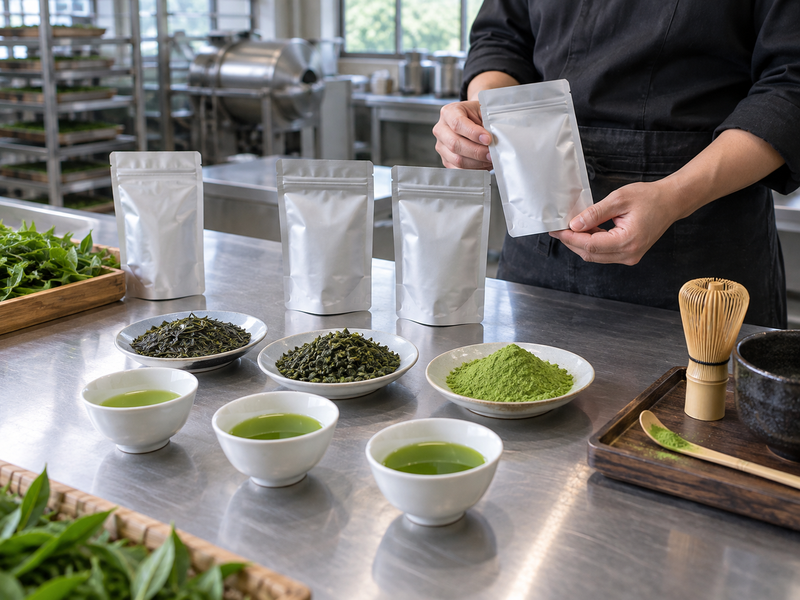
Ask each supplier for preparation guidance for its offered product and document the method used in tasting. Gyokuro evaluation should record leaf mass, water, temperature, infusion time and straining. Matcha evaluation should record powder mass, water and dispersion method. This allows repeat comparisons without pretending that both teas need the same process.
Ippodo’s introduction to Japanese tea gives primary tea merchant context for the categories. For your tasting, use its category distinctions as background and the supplier’s own instructions for the specific samples. Avoid publishing a universal flavour ranking from a few commercial products.
Taste without sugar or food during the initial comparison. Record aroma, body, finish and any unpleasant notes in language the service team can use. Then assess each tea in its intended menu role, including its serving vessel. A small specialist infusion and a larger whisked bowl create different customer experiences. The panel should judge whether each satisfies its own brief rather than choosing whichever sample happens to feel strongest. If several infusions are part of the gyokuro service, evaluate that complete service separately.
5. What equipment and staff work does each tea require?
Map the full serving sequence
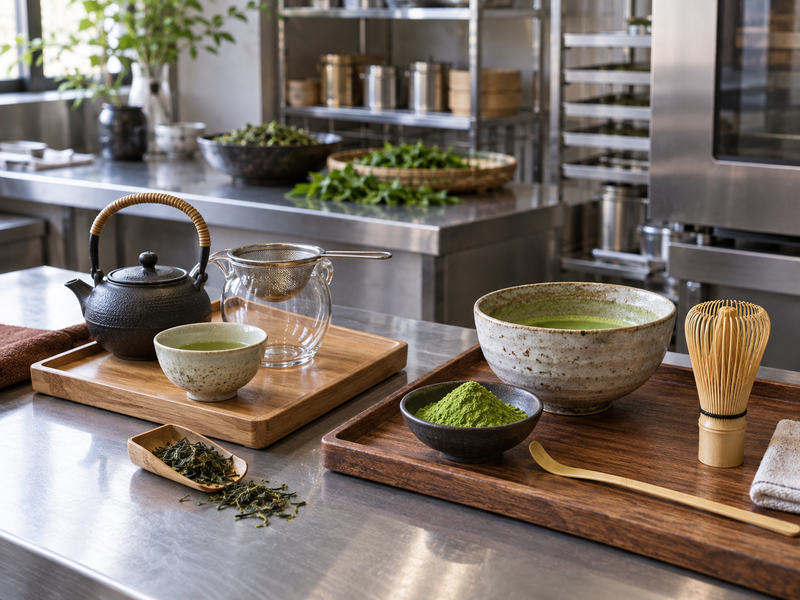
Gyokuro service involves measuring leaves, controlling the infusion and separating liquid from leaf. Matcha service involves measuring powder, managing clumps and dispersing it. Both need clean equipment and clear instructions. A manager should observe the entire sequence, including cleaning and resetting the station, before deciding which service is faster in that cafe.
| Service task | Gyokuro station | Matcha station |
|---|---|---|
| Portioning | Leaf scale or verified measure | Powder scale or verified measure |
| Preparation control | Infusion conditions | Dispersion conditions |
| Separation | Strainer or suitable pot | Usually no leaf straining |
| Between orders | Empty and clean leaf equipment | Rinse and clean mixing equipment |
| Training focus | Consistent infusion | Smooth measured dispersion |
Run a pilot using staff who will work the actual shift. Record where they wait, where utensils accumulate and whether the station can handle several orders safely. A beautiful tasting setup may need too much counter space for a busy service line.
If a business offers a second infusion, define who prepares it and how it is presented. That service has value only when it fits the customer’s visit and staff workflow. Include the relevant handling procedure rather than leaving used leaves sitting without a plan.
6. Can gyokuro and matcha substitute for each other in food?
Identify whether the application needs infusion or powder
A recipe that needs a tea flavoured liquid can investigate a leaf infusion. A recipe that needs dispersed tea solids can investigate matcha. Replacing one with the other changes water input, solids and texture. This is a formulation change and should be tested in the actual food rather than described as a direct substitution.
For example, a bakery considering a tea cream needs to decide whether flavour comes from infusing the liquid base or mixing in powder. Those routes create different processing work and ingredient losses. A developer should keep the original formula as a control, record the changed liquid and solids, and evaluate the finished cream in the pastry. No universal conversion from leaf grams to powder grams will answer every application.
The Matcha Village guide to how matcha is made offers background for buyers choosing powder applications. Ask a prospective supplier to assess your actual product brief, including heating and texture requirements. If gyokuro is the required ingredient, confirm availability and provenance separately. Do not purchase a powdered product merely because a sales page discusses both teas together; obtain the exact ingredient name and composition on the quotation.
7. How should cost per service be compared?
Include every paid step in the experience
Price per kilogram can mislead when the teas use different doses and service models. Calculate the ingredient cost at the approved serving method, then include labour, water, cleaning and breakage where relevant. If several infusions are included in one sale, count the complete service and its time. Do not assume customers always request or consume every available infusion.
| Cost item | Gyokuro question | Matcha question |
|---|---|---|
| Ingredient dose | Leaf mass per service | Powder mass per serving |
| Labour | Infusion and repeat pours | Dispersion and assembly |
| Waste | Unserved prepared tea or leaves | Spilled powder or unused preparation |
| Equipment | Pot and strainer capacity | Bowl, whisk or mixer capacity |
| Packaging | Leaf service vessel | Intended drink cup |
Use actual pilot observations to estimate daily capacity. An employee may handle an infusion while completing another order, but only if the station and timing permit it. Record that workflow rather than assigning an arbitrary labour saving.
For retail packs, compare packaging, fill mass, sampling and customer instructions separately from cafe economics. A tea that works well in a specialist service may need additional education when sold for home preparation, and that support should be reflected in the commercial plan.
8. What quality documents belong in a supplier review?
Match evidence to the offered product
Ask for a specification, ingredient declaration, origin information, lot identification and relevant test reports for the destination market. Clarify whether a report applies to the sample, a production lot or a general monitoring programme. A document with a familiar logo is not useful if the product and date cannot be connected to the shipment.
Review any certification claim at product and facility level as appropriate. Ask for current scope and validity information rather than repeating every claim printed in a supplier presentation. An organic claim, for example, requires the applicable documentation for the product and route to market. Do not infer that all items from a company have the same status.
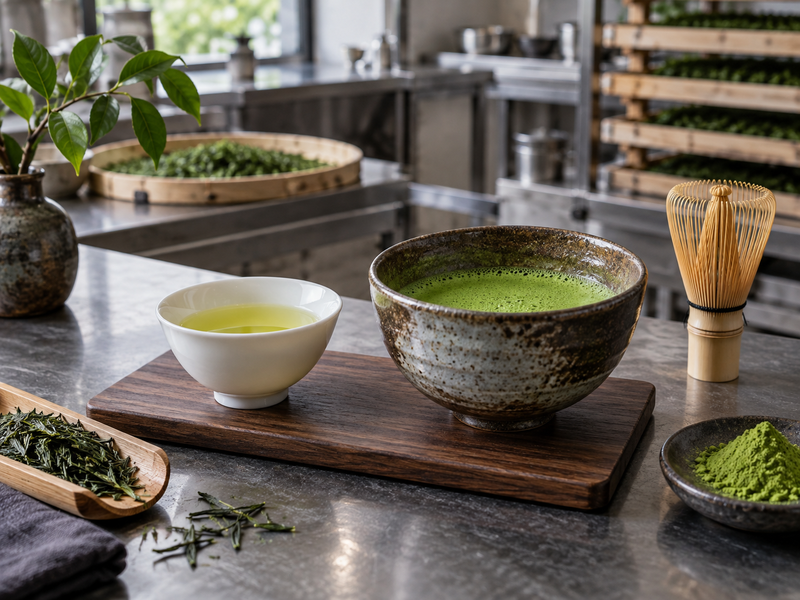
Create a receiving comparison using both documents and sensory checks. For gyokuro, inspect the leaf and prepare an infusion. For matcha, inspect the powder and prepare its intended application. Record deviations and ask the supplier to investigate before blending suspect stock into other material. Keep the approved sample identification with the purchase order so staff can compare incoming goods against an actual reference rather than a memory of a tasting session several months earlier.
9. Which common comparison claims should buyers question?
Avoid fixed caffeine and superiority rankings
Neither tea name tells you the caffeine in a particular served cup. Product composition, portion size and preparation affect that question. If the business needs a quantitative statement, obtain suitable evidence for the product and serving method. Do not repeat a fixed caffeine range from a general comparison page as though it described your menu.
| Common shortcut | Why it is incomplete | Better buying question |
|---|---|---|
| One tea is always better | Applications differ | Better for which service? |
| Darker green proves quality | Appearance has several causes | How does the sample taste? |
| Same origin means same product | Processing and lots differ | What specification is offered? |
| Powder replaces leaf equally | Solids and extraction differ | What does the formulation need? |
| Premium name proves value | Marketing terms vary | What evidence supports the price? |
Keep health language out of a purchasing decision unless the business has a specific, substantiated and lawful claim programme. A tea can be sold for its flavour and preparation experience without promising medical or cognitive effects.
Train staff to explain the physical difference in plain language. Saying that gyokuro is steeped leaf and matcha is dispersed powder answers a common customer question without creating unsupported promises about how either tea will make the customer feel.
10. How can a buyer choose the next sample order?
Order for a defined application
Write two short briefs if the business is considering both formats. The gyokuro brief should describe the intended infusion service, origin requirements, vessel and customer experience. The matcha brief should describe whisked tea or the specific food application, expected volume and desired flavour. Send them to suppliers capable of documenting the corresponding products.
Request enough sample material for repeat preparation by more than one employee. Include the supplier’s preparation guidance and lot information in the tasting file. Compare each candidate against the brief, then calculate cost per approved serving. Record any operational limitation, such as equipment capacity or staff training needs, before presenting the commercial recommendation.
Ask the preferred supplier for a representative commercial lot and the documents required for receiving approval. Confirm pack size, lead time and notification rules for substitutions. Give the cafe team a final preparation card for the selected product and have them make it without verbal coaching. Place the trial order against that product code and use the first delivery to verify the written specification and actual service result together.
FAQ
Q1: Are gyokuro and matcha the same leaf product?
They are different processed tea formats. Gyokuro is normally sold as leaf for infusion, while matcha is powder made from tencha. Ask for the specific processing and origin information on each offer.
Q2: Can gyokuro be whisked like matcha?
Intact gyokuro leaves do not behave like fine matcha powder. If a supplier offers powdered gyokuro, identify it as that separate product and test its intended use.
Q3: Which tea contains more caffeine?
A general name is insufficient for a reliable per cup comparison. Use product specific evidence and the actual serving method if a quantitative statement is required.
Q4: Does a cafe need to choose only one?
No. They can serve different menu roles, provided the business has suitable preparation equipment, staff instructions and a reason customers would order each one.
Q5: Does Matcha Village supply Japanese gyokuro?
This comparison does not establish that availability. Ask for the current product offer and origin documents. Do not infer Japanese sourcing from a supplier’s discussion of tea categories.