
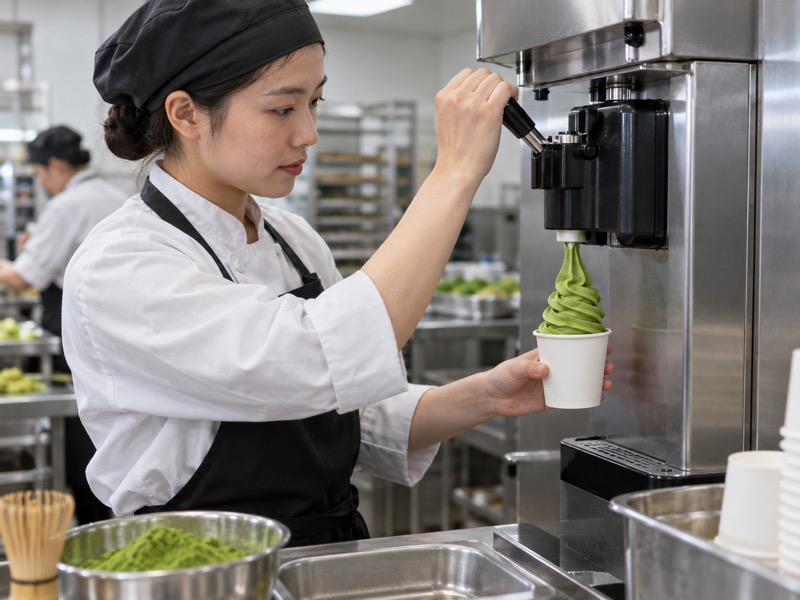
Matcha soft serve is a frozen dessert dispensed directly from a soft-serve machine with powdered green tea in the mix. The swirled shape sells the idea quickly, but a shop has to make that swirl hold its shape, taste of tea, and stay consistent during a rush. Matcha can clump in a cold base. A mix that looks bright in a bowl can appear flat under the machine’s lights, and a formula that draws well at opening may change after a quiet hour in the hopper. Crate & Barrel’s homemade matcha soft serve shows the dessert concept. Commercial service needs its own machine, food-safety, and ingredient trials.
For: dessert shops, cafés, foodservice developers, and tea buyers. Decision: whether the proposed matcha formula can be dispensed and served consistently on the equipment you own.
1. What makes a soft-serve product worth selling?
Define the actual serving
Write the target as a customer would experience it: a smooth, clearly tea-flavored swirl that holds long enough to be handed across the counter. Decide cup or cone, portion mass, toppings, and how much tea character should survive the base. A matcha-flavored mix should still taste like matcha after chocolate, fruit, or cereal is added. If the base is very sweet, the tea may become little more than green color. If the tea dose is pushed high to compensate, the final bite may taste harsh.
Set observable standards. Photograph an accepted swirl in the normal cup and light. Time how long it keeps its shape at a normal service temperature. Taste immediately and after a short wait. Record the acceptable range for color, texture, and tea finish. These are operating standards for your product, not universal standards for soft serve. A useful sample is one an ordinary trained employee can reproduce, rather than a single perfect cone made by the developer.
| Service target | Question to answer | Simple evidence |
|---|---|---|
| Flavor | Is tea still clear with the chosen base? | Blind taste in finished portion |
| Shape | Does the swirl survive handoff? | Timed cup or cone check |
| Portion | Can staff repeat the size? | Weighed servings |
2. Which matcha should go into the mix?
Choose for the frozen base
Compare named matcha samples at equal grams per kilogram of mix. A powder that tastes elegant in water may disappear in a cold, sweet dairy base. Another may look vivid but produce a dry, astringent aftertaste. Taste from the machine, not only from a test spoon before freezing. Include a plant-based base if it is planned for the menu; the same powder can read differently against oat, soy, coconut, or dairy ingredients. Keep those trials separate so a base change is not mistaken for a tea improvement.
Ask the supplier for a repeatable lot. Record sample ID, lot, origin claim if used, pack format, storage guidance, lead time, and the documents needed for the buying program. Evaluate price per accepted serving, not just price per kilogram. A stronger tea may need less powder, while a cheap tea can create more rejected batches if its color or flavor varies. Keep an approved reference sample and retest incoming tea before a full production change.
3. How should powder be added without lumps?
Disperse before chilling
Dry matcha added straight to a cold hopper can form clumps that no machine will conveniently fix. In a pilot, weigh the powder and make a smooth pre-dispersion using a measured share of the mix liquid. Use a food-safe whisk or mixer, then combine it with the rest of the base. The exact temperature and mixing method should fit the base supplier’s instructions and the shop’s food-safety process. A small kitchen blender may work for development but may not be the right answer for a larger commissary batch.
Check three samples. Inspect the top, middle, and bottom of the mixed base before it reaches the machine. Run an early draw and a late draw from the machine, then compare for green specks, bitterness, and color. If the final serving carries tea flecks, do not assume they are a desirable sign of “real matcha.” They may indicate uneven dispersion. Document the order of addition, mixing time, and permitted hold; a well-written formula should tell the next shift how to get the same result.
| Visible problem | First place to check | Trial change |
|---|---|---|
| Dark dots | Dry powder addition | Pre-disperse and screen |
| Uneven green | Holding or agitation | Sample vessel levels |
| Powdery bite | Dose and particle behavior | Compare tea samples |
4. How do sweetness and fat affect the tea?
Taste the frozen serving
Soft-serve base is more than a carrier for powder. Its sweetness, fat, proteins, and stabilizers influence body and flavor release. A rich base can make the texture pleasant while masking the tea. A leaner base may expose bitterness and feel icy. Make a small matrix with the same matcha and machine setting while varying only one base factor at a time. Do not replace dairy with a plant drink and assume equal freezing behavior or the same allergen declaration.
Use a clear dose ladder. State matcha grams per kilogram of finished liquid mix, not “a spoon per batch.” Try several levels and taste the frozen output in the intended serving cup. Identify where the tea first becomes recognizable and where the finish becomes unpleasant. That range is a trial finding for a specific base, not a universal recipe. If fruit or syrup will be added, taste the complete menu portion. A topping can make a carefully tuned base taste weak or excessively sweet.
5. What does the machine change about the result?
Test on the selling equipment
A soft-serve machine controls freezing and air incorporation according to its design and settings. A recipe that behaves well in a home freezer or batch freezer may dispense poorly from the shop’s machine. Record the base temperature at fill, machine settings, time to first acceptable draw, appearance of early portions, and texture after the machine has been idle. Ask the equipment supplier to confirm the operating limits for the model. Avoid adjusting safety or sanitation settings merely to chase a prettier swirl.
Observe the draw. A mixture can be too soft to stand, too firm to portion quickly, or inconsistent between the first and fifth serving. Compare portions by weight and height, and taste each for tea uniformity. If the product improves only after several waste servings, include that loss in the business decision. A pilot should include a busy interval and a quiet interval; both are part of normal shop life. The best formula is one staff can serve within the machine’s approved operating range.
| Machine observation | Possible cause to investigate | Record |
|---|---|---|
| Collapsing swirl | Mix balance or draw condition | Timed shape photo |
| Hard draw | Formula or setting | Portion time and weight |
| Different first serving | Idle period | First-draw comparison |
6. How should the shop handle color change?
Judge green under normal light
Matcha color depends on the actual powder, base, lighting, and time. Photograph the served product at the counter, in the customer’s seating area, and after the planned handoff period. White dairy or plant base can lighten the green. Dark toppings may make it appear dull. A product photo made under strong editing or special lighting sets an expectation that the shop may not meet. Keep a physical reference sample and a fixed-light image so a new tea lot can be compared fairly.
Protect the powder and mix. Follow the supplier’s storage guidance, keep packs closed between uses, and use an opening date. Do not leave a large open bag beside a warm machine if the weekly use is small. For liquid mix, use the shop’s validated refrigeration and food-safety procedures. If color changes in the hopper or serving, investigate tea age, base, light exposure, and hold time one at a time. Do not use color alone to judge safety or freshness.
7. What cleaning and allergen checks belong in the pilot?
Design the routine before launch
The complete formula may include milk, soy, nuts, or other regulated allergens depending on the base and toppings. Matcha itself does not remove those obligations. Map ingredients and shared equipment, then check the venue’s allergen controls and menu statements. If a dairy and a plant-based option share equipment, decide whether the operation can actually control cross-contact before describing either as suitable for an allergen-sensitive guest. Verify applicable local rules rather than borrowing a claim from another market.
Follow the machine’s sanitation instructions. The equipment supplier’s cleaning schedule and food-safety plan govern the process. Measure the time and labor required with this formula, including any residue left by tea powder. A recipe that tastes good but makes the machine difficult to clean may not be viable. Let regular staff perform the documented cleaning during the pilot and note missed steps or parts. The aim is a routine that holds up outside a demonstration day.
8. How should toppings and packaging be tested?
Test the whole portion
Choose toppings to add contrast without hiding tea. A lightly sweet component may work; a thick sauce can overwhelm the base and turn the last bite into sugar. Check whether dry toppings soften or fall off during the normal wait. A cone brings a different rate of melting and handling than a paper cup. If takeaway is offered, test the actual lid, spoon, travel time, and temperature conditions. A soft-serve swirl made for immediate eating is not automatically a packaged frozen retail product.
Photograph the real handoff. Make the standard portion at normal speed, close the lid if one is used, and inspect the appearance at the expected collection point. If a topping stains the lid or collapses the swirl, adjust the portion or packaging. In-store and delivery menus may need different products. Do not promise a stable delivery experience until a realistic route shows it can work.
| Format | Main risk | Pilot check |
|---|---|---|
| Cone | Drips during handoff | Timed service walk |
| Cup | Hidden bottom portion | Full-cup tasting |
| Lidded takeaway | Swirl touches lid | Actual packed route |
9. How should the price be built?
Cost what you can sell
Calculate matcha, base, toppings, cone or cup, spoon, labor, cleaning, and routine loss per actual serving. Weigh several normal portions instead of using a theoretical machine yield. If one employee draws a much larger swirl than another, portion variation can outweigh a small change in powder price. Include first-draw waste after idle time and product discarded under the shop’s holding rules. A product with a low ingredient cost can still be expensive to run.
Compare pack sizes with use rate. A big tea pack may have a lower unit price but stay open longer than the shop can use it at best quality. Ask for a pack that fits demand and reorder lead time. Test a backup tea in the machine before listing it as approved. The cost model should show a quiet day and a busy day, because soft-serve waste is rarely proportional to sales. Price should reflect the product the team can repeatedly serve, not a perfect batch with zero loss.
10. What launch trial proves the formula is ready?
Use a full service cycle
Run the proposed formula through preparation, fill, first draw, rush, idle time, final servings, and cleaning. Let trained shop staff perform each step from the written method. Record portion weights, shape hold, tea taste, color, machine behavior, discarded mix, and cleaning time. Compare the beginning and end of a normal operating period. If a new tea lot or base arrives during development, trial it separately rather than quietly changing two inputs at once.
Approve a repeatable method. Keep the accepted powder and base specifications, dose, mixing order, machine settings, service photos, packaging, and retest triggers in one record. The next practical step is a short supervised shop pilot with the actual machine. A matcha soft serve that tastes good in a sample cup and stays consistent through the shift has a much stronger case for the menu than a single attractive test swirl.
| Launch point | Pass question | Evidence |
|---|---|---|
| Opening | Is the first draw usable? | Weighed, photographed serving |
| Rush | Can staff serve to spec? | Timed portions |
| Idle | Does quality recover? | First-draw and later-draw taste |
| Close | Is loss controlled? | Discard and cleaning log |
A shop planning a denser frozen format can compare the matcha gelato guide.
Reference: Homemade Matcha Soft Serve illustrates the dessert. The commercial process and buying checks above are independent.
FAQ
Q1: Can a home matcha soft serve recipe go straight into a commercial machine? No. Test the formula against the machine’s operating guidance and the shop’s food-safety plan.
Q2: Why does the first serving look different after an idle period? Machine conditions and holding time may affect the draw; compare first and later servings during the pilot.
Q3: Is a brighter dry powder always better? Judge the tea in the finished frozen base and through the service period.
Q4: Can dairy and plant-based versions use one recipe? Each base needs its own formulation and allergen assessment.
Q5: What should a buyer ask the tea supplier for? An identified sample, consistent lot specification, pack and storage details, and the documents required by the business.