
Matcha snowball cookies need a tender green center, enough nut flavor to support the tea, and a white coating that survives the trip from cooling rack to gift box. A bakery can get one of those details right while missing the others. A beautiful sugar coat may hide a dry center; a delicate cookie may crumble during packing. The development work below separates those decisions so a small trial can produce useful evidence before a larger order.
Contents: Product · Ingredients · Tea · Nuts · Mixing · Baking · Coating · Packaging · Yield · Purchasing
1. What should matcha snowball cookies look and taste like?
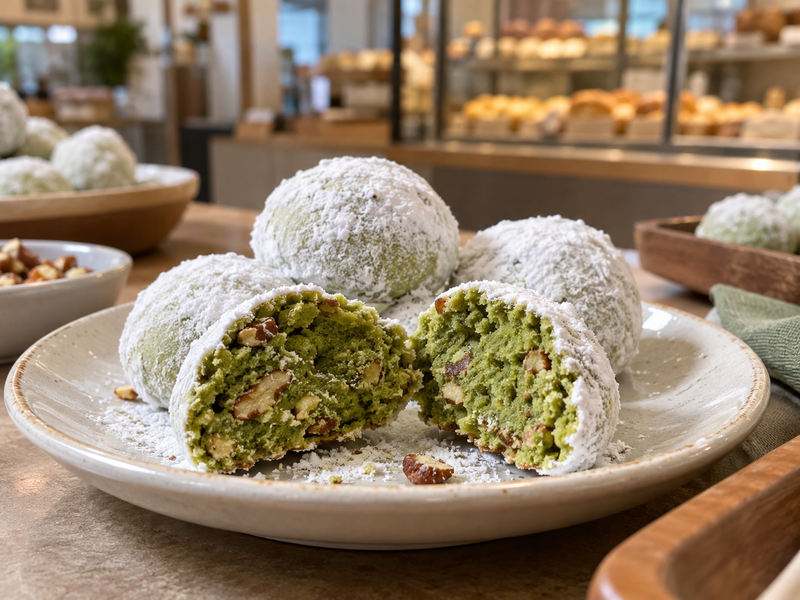
A snowball should hold together when picked up, then break with a short, crumbly bite. It does not need the spring of a cake or the chew of a drop cookie. The Kirbie’s Cravings reference recipe uses a butter, flour, nut and tea dough with no egg. That is a useful style reference, although a commercial formula still needs its own trials.
Set the eating occasion first
A small accompaniment to a cafe drink can tolerate more loose sugar than a cookie sold inside a dark presentation box. Decide whether the customer will eat it from a plate, paper cup or individual wrap. Then choose the size with that handling in mind. A large ball can require two bites and shed sugar over clothing.
| Attribute | Useful observation | Development decision |
|---|---|---|
| Surface | White coverage after handling | Coating method |
| Center | Visible green with nut pieces | Tea and nut choice |
| Bite | Breaks without becoming dust | Dough balance |
| Finish | Tea remains after sweetness | Tea dose |
Keep a photographed cut sample as well as a whole one. Exterior photographs alone cannot communicate the texture or green color a buyer should expect.
2. Which ingredients belong in the first trial?
Begin with a plain snowball formula that already works in your kitchen. Its flour, butter, sugar and nut proportions provide a more useful starting point than changing every ingredient at once. Record ingredient weights, including the sugar used outside the dough. Coating sugar is often missing from early cost estimates because it sits in a separate bowl.
Keep the first ingredient list narrow
For the first matcha adaptation, retain the established butter, flour and nut quantities. Add sifted tea as the trial variable described in the next section. Do not simultaneously replace butter with a plant fat or swap wheat flour for a gluten-free blend. Each substitution can change how the ball forms and how readily it fractures.
Use unsweetened matcha when the base formula already supplies its own sugar. A latte premix introduces extra ingredients and makes the tea dose difficult to compare. The Matcha Village ingredient buyer guide can help distinguish an ingredient powder from a prepared beverage blend. Confirm the exact product specification before calculating a formula.
Also weigh salt and flavorings rather than adding them by eye. A strong vanilla note may be pleasant, but it can make two tea samples seem more similar than they really are.
3. How much matcha should the dough contain?
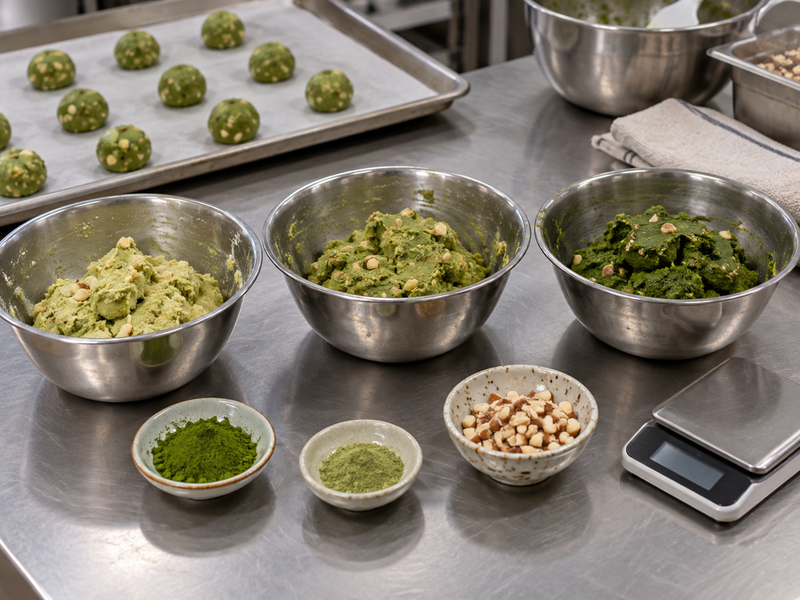
Use a narrow dose comparison to learn how your chosen tea behaves in the existing dough. The following amounts are proposed screening trials, not a tested recipe or a claim that every matcha powder works at the same concentration. Prepare three small batches from the same ingredient lots and keep the baked portion size constant.
Compare the finished cookie, including sugar
| Trial | Existing plain base using | Proposed added matcha | Question |
|---|---|---|---|
| A | 200 g flour | 3 g | Is tea identifiable? |
| B | 200 g flour | 5 g | Does tea balance the coating? |
| C | 200 g flour | 7 g | Does dryness or bitterness increase? |
These additions are deliberately simple screening points. If one is promising, refine the formula around it, including whether a small flour adjustment is needed. Record that change as a separate trial. Added powder should not quietly become a flour substitution between batches.
Taste fully cooled, coated cookies in a mixed order. A sample that tastes assertive without sugar may be balanced after coating. Look at the cut crumb under the same lighting, and record flavor separately from color. A greener sample is not automatically the one customers will prefer.
4. How do nut size and condition change the cookie?
Finely chopped nuts give small points of crunch, while nut flour produces a more uniform crumb. Large fragments can interrupt the dough where the cookie needs to hold together. A bakery buying prechopped nuts should specify the particle range it actually wants rather than accepting whatever is called chopped on a supplier label.
Separate flavor from particle size
Pecans, walnuts and almonds create different backgrounds for matcha. Select one nut for the first tea trial, then compare alternatives after the dough is workable. Check each lot for fresh aroma before mixing. Sugar and tea are poor tools for hiding a stale nut flavor, and an expensive tea purchase cannot correct that problem.
If your kitchen toasts nuts, let them cool before adding them to butter dough. Warm nuts can soften the fat unevenly and make the last portions harder to shape than the first. Record the preparation method so a later batch does not unknowingly switch from raw to toasted material.
Keep nut identification and allergen handling attached to the actual production formula. A nut-free version needs its own development and handling assessment; simply removing the nuts changes the solids and texture of this style of cookie.
5. How should the dough be mixed and portioned?
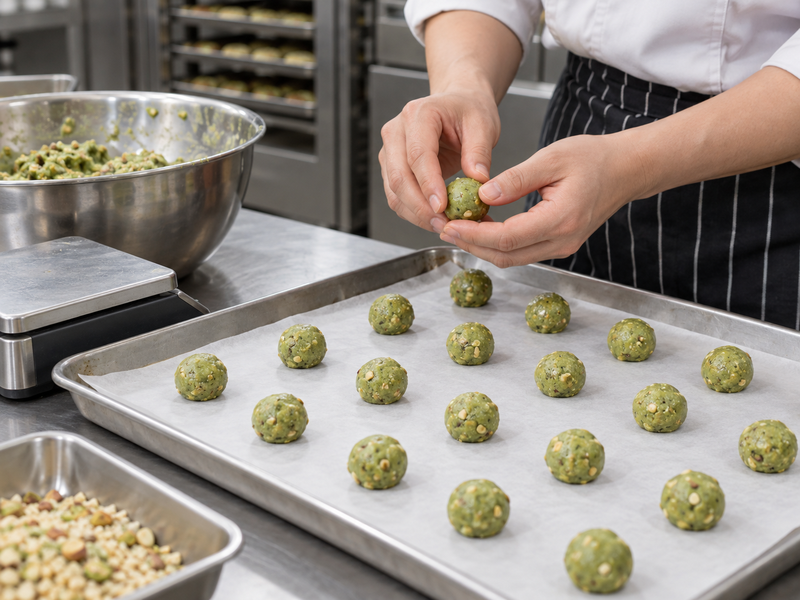
Sift the matcha with the dry ingredients before it enters the butter mixture. This makes tea lumps easier to find while the powders are still loose. Scrape the bowl thoroughly during mixing; a green outer layer can conceal unmixed butter or flour near the bottom. Use the mixing sequence established for your plain base, then observe whether the added tea changes handling.
Define a workable dough condition
| Observation | Possible issue to investigate | Next check |
|---|---|---|
| Ball splits while rolling | Uneven mixing or dry dough | Inspect a cut portion |
| Dough leaves an oily film | Fat condition or warm handling | Compare early and late portions |
| Nut pieces fall away | Particle size or weak binding | Inspect nut distribution |
| Sizes vary visibly | Inconsistent portioning | Weigh a run of portions |
Choose one portion weight for the trial and check it with a scale. A scoop helps divide dough, but the final ball may still vary if one operator compresses it more firmly. Avoid long rolling that warms the dough unnecessarily.
Keep the tray sequence visible to the baker. If the first tray waits while later trays are shaped, its dough condition may differ. Record any rest or chilling step instead of letting it become an undocumented habit.
6. How do you find a reliable baking endpoint?
Green dough makes browning harder to judge from the top. Inspect the underside and a broken, cooled cookie as well. Your oven setting, tray material, load and portion size should be written together; a temperature copied from a home recipe cannot describe a full commercial oven load.
Bake a small check tray
King Arthur Baking’s snowball recipe describes a relatively gentle bake until the cookies are set and lightly colored. Use that as context for the style, then establish an endpoint with your own base formula and equipment. A small tray allows you to compare adjacent bake times without committing the entire batch.
Let the comparison pieces cool before judging texture. A warm cookie may seem fragile even when the cooled product handles well. Conversely, a firm exterior can hide a center that does not match the intended crumb. Check several positions on the tray, especially if the oven has familiar hot spots.
Do not add extra bake time solely to make the green surface look brown. If the bottom is already dark, investigate tray position or heat distribution. Save a photograph of an acceptable underside alongside the crumb reference so another operator can recognize the same endpoint.
7. When should the sugar coating be applied?
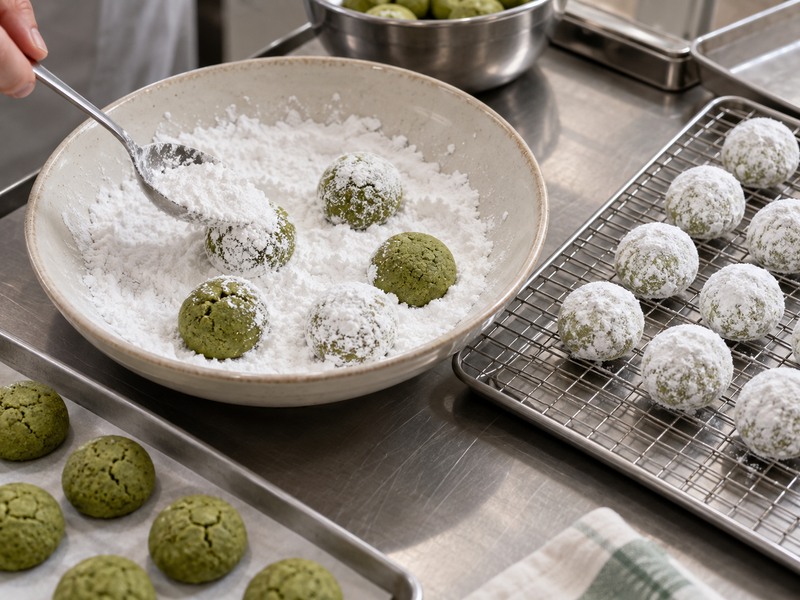
Coating timing deserves its own test. Published recipes differ: Kirbie’s Cravings coats cooled cookies, while King Arthur describes a warm coating followed by another after cooling. Those methods need not behave identically in your formula, room conditions or packing process. Compare them rather than assuming that one instruction settles the question.
Run a handling comparison
| Proposed method | What to observe | Useful comparison point |
|---|---|---|
| One cool coating | Coverage and loose powder | Immediately after coating |
| Warm then cool coating | Adhesion and patchiness | At normal packing time |
| Cool coating plus light dusting | Surface uniformity | After a transport simulation |
Use separate weighed bowls of sugar so you can estimate pickup and waste. Roll gently or spoon sugar over the cookie if tumbling breaks the edges. Remove loose crumbs from the coating station according to your kitchen procedure; green crumbs can turn a clean white finish speckled.
Assess coated samples in the package you plan to sell. Sugar that looks thick on a rack may collect on the bottom of a box during movement. The useful result is the appearance when a customer opens the pack, not the appearance before packing starts.
8. How can packaging protect the white finish?
Start with the amount of movement inside the pack. A deep box holding a shallow layer of small cookies gives them room to collide. Inserts or suitable food-contact cups may reduce rubbing, but they also add labor and material cost. Test the actual arrangement, including how staff place the lid and move the finished box.
Inspect the pack after ordinary handling
Allow cookies to cool completely before closing the package. Warm product can create unwanted moisture inside a closed pack. The cooling endpoint and the pack’s suitability should be established in your operation, especially where room humidity changes through the day. Visual appearance alone does not establish a safe or acceptable shelf life.
Look for sugar transferred to the window, grease marks, broken pieces and compressed surfaces. Carry a trial box through the expected route from packing bench to collection point. If delivery is part of the offer, include that route in the evaluation rather than approving a box that has only sat on a table.
Any proposed shelf life needs product-specific validation with the chosen ingredients, process and packaging. Until that work is complete, avoid borrowing a storage duration from a domestic recipe and printing it as a commercial guarantee.
9. What should the production team measure?
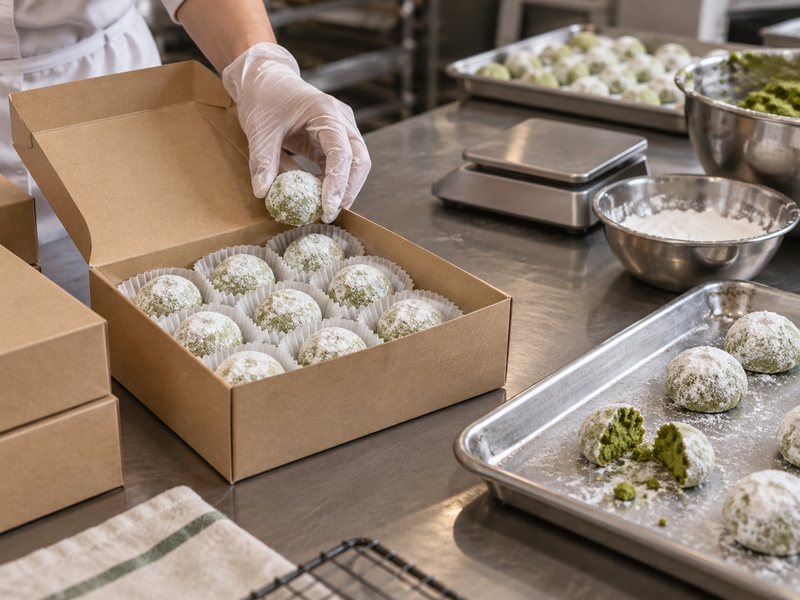
Measure the number of saleable cookies after coating and packing. Dividing dough weight by portion weight gives a theoretical count, but it misses pieces broken during cooling or lost to handling. Record those losses by stage so the team can decide whether to adjust the dough or the packing routine.
Include the coating station in costing
| Record | Why it matters | Practical method |
|---|---|---|
| Dough portion weight | Predicts size consistency | Weigh a sample run |
| Cooled cookie weight | Tracks bake loss | Compare matched pieces |
| Sugar consumed | Captures coating cost | Weigh station stock |
| Packed saleable count | Establishes actual yield | Count completed packs |
| Broken cookie count | Locates handling loss | Record by stage |
Count labor at rolling and coating separately. A formula with slightly cheaper ingredients may require much longer handling. For gift orders, also time the assembly of cups, inserts and boxes. Those costs can exceed a small difference between tea grades.
Keep tasting notes specific: powdery finish, strong roasted nut, weak tea after sugar, or crumb that breaks during lifting. Such descriptions give the next trial a clear purpose. A score labelled good without an explanation is difficult for purchasing or production to use.
10. How do you turn the winning trial into a purchase specification?
The approved ingredient is the one used in the finished cookie trial. Record the matcha supplier, product code, lot and dose alongside the butter, flour and nuts. A later substitution should trigger a small comparison bake, even when the replacement carries the same broad culinary description.
Send the supplier an application brief
Explain that the tea will be baked into a nut-rich, sugar-coated cookie and that the green center matters after baking. Ask for the ingredient information and documentation your business requires, with samples traceable to the offered product. Matcha Village’s culinary matcha guide provides context for evaluating powders in food applications; the actual cookie trial remains the basis for approval.
Attach the portion specification, approved crumb image, coating procedure and packaging choice to the production sheet. Include the acceptance checks operators can perform at the bench. Keep commercial shelf-life approval separate from a successful tasting session.
For the next production run, reserve enough of the approved tea lot for a small comparison batch. Bake it beside the incoming lot, coat both in the same session and inspect the packed samples before authorizing the larger ingredient order.
Frequently asked questions
Q1: Can matcha snowball cookies be made without nuts?
Yes, but removing nuts changes the structure and flavor. Develop that version separately with a suitable base formula and an appropriate allergen handling plan. Do not assume the original dough will behave the same way.
Q2: Why does the powdered sugar look patchy?
Check coating timing, cookie temperature, loose surface fat and handling. Compare samples at the normal packing time. Adding more sugar immediately may conceal the cause without improving the packed appearance.
Q3: Should the dough be bright green before baking?
Judge the cooled crumb as well as the raw dough. Tea source, dose and baking conditions all affect the result. A stronger raw color alone does not establish a better flavor.
Q4: Can a sweetened matcha blend replace pure matcha?
Only after reformulation. The blend adds sugar and possibly other ingredients, so equal weights do not supply equal tea. Confirm its composition before adjusting the base dough.
Q5: What is the fastest useful first trial?
Use your established plain snowball base, one nut lot and three measured tea additions. Bake a small check tray, coat the cooled samples and compare the finished bite before changing other ingredients.