
Genmaicha vs matcha compares a tea and roasted rice blend with a fine green tea powder. For a cafe, importer or food brand, the distinction affects flavour, ingredient declarations, equipment and the product customers receive. A roasted rice aroma cannot be obtained by treating ordinary matcha as a direct substitute. Start by identifying whether the genmaicha offer is a loose blend, a powder or an instant mix. Then compare each product in the intended service, using its actual composition and preparation method.
1. What is the main difference in genmaicha vs matcha?
2. How do leaf processing and rice change the offer?
3. How should buyers distinguish loose tea from genmaicha powder?
4. How should flavour be compared fairly?
5. What equipment does each service need?
6. Which format fits lattes and food manufacturing?
7. How should ingredient declarations and claims be reviewed?
8. What quality checks belong in receiving?
9. How can cost and caffeine comparisons avoid misleading shortcuts?
10. What should the final sample request contain?
1. What is the main difference in genmaicha vs matcha?
Separate the blend from the powder
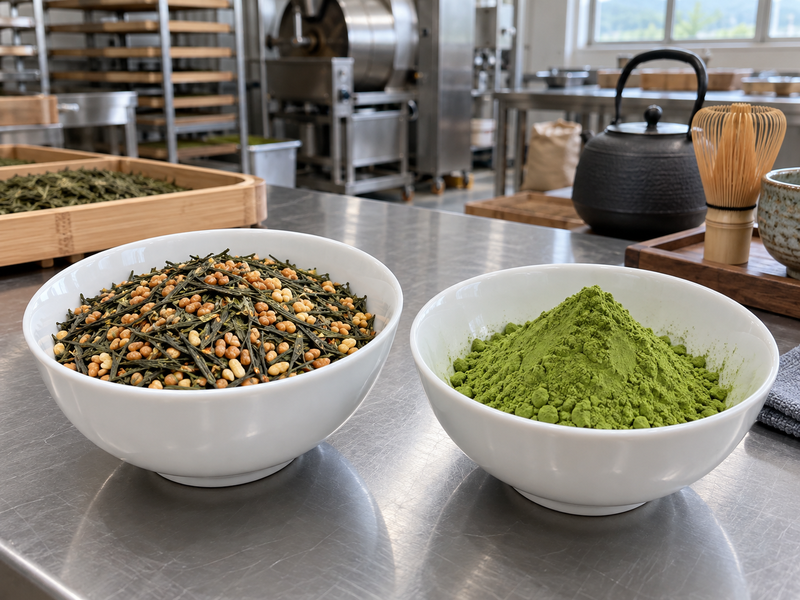
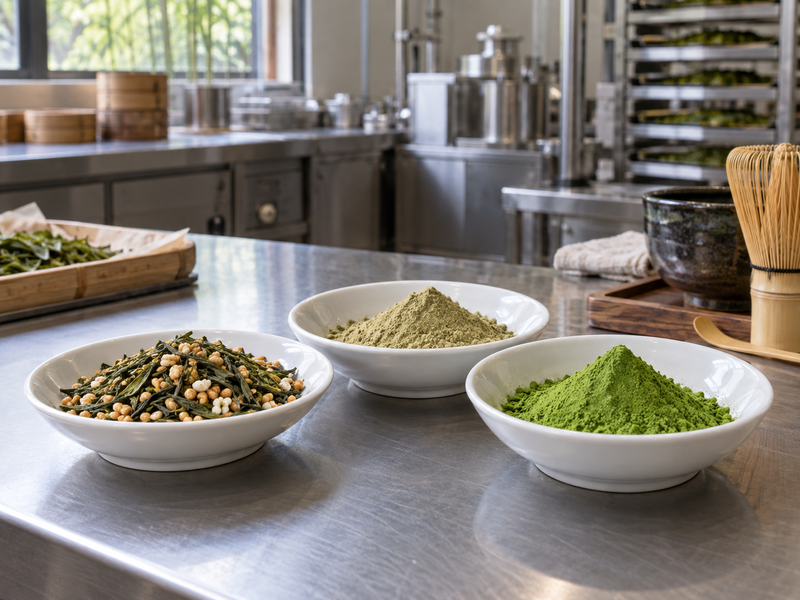
Traditional loose genmaicha combines green tea with roasted rice and is prepared as an infusion. Matcha is finely milled tea powder dispersed into the drink. A genmaicha blend can also contain added matcha, and suppliers may sell powdered or instant products under related names. The label alone may not describe enough of the product for a commercial purchase.
Ippodo describes its genmaicha as green tea combined with roasted rice. That primary product description provides a concrete example of the loose blend category. Ask other suppliers for their own composition rather than assuming every blend uses the same ratio or tea material.
| Product | Physical contents | Initial buyer question |
|---|---|---|
| Loose genmaicha | Tea leaf and roasted rice | What blend is supplied? |
| Matcha | Fine tea powder | What application does it suit? |
| Matcha added genmaicha | Leaf, rice and matcha | How much powder is included? |
| Genmaicha powder or mix | Supplier specific | What is the full composition? |
Keep these products separate in your sample log. Otherwise, a powder intended for a latte may be compared unfairly with a loose blend intended for a light infusion.
2. How do leaf processing and rice change the offer?
Ask about both parts of the blend
For loose genmaicha, request the tea type, rice specification and blending information available from the supplier. The rice contributes a roasted cereal character, while the tea contributes its own flavour. Ask whether the blend is designed to maintain a house profile across lots and what variation is acceptable. A quotation that names only green tea leaves out part of the ingredient.
The Nio Teas comparison discusses genmaicha and matcha as different tea choices. Use commercial comparison pages for category context, then verify the composition of the actual offer. A story about traditional preparation does not identify the ratio, origin or processing of the product on your purchase order.
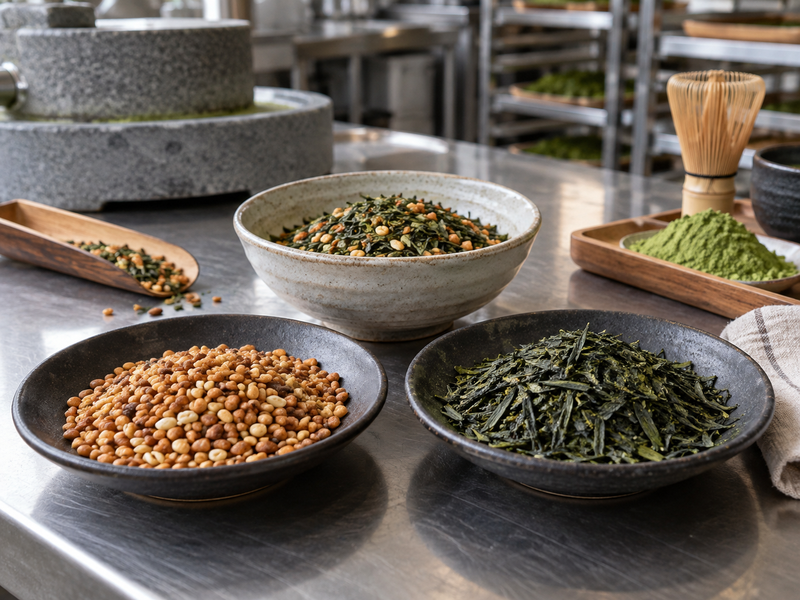
Inspect a representative dry sample. Record the appearance of leaf and rice, the presence of powder, and any obvious unevenness. Do not turn visual inspection into a claim about quality without tasting. Some blends may intentionally look different because of their ingredients. Ask the supplier to explain the expected appearance and provide a preparation method. That gives receiving staff a basis for discussing a changed shipment instead of rejecting it solely because it does not resemble a web photograph.
3. How should buyers distinguish loose tea from genmaicha powder?
Read the full ingredient declaration
A powdered genmaicha product may contain milled tea and rice, added matcha or other ingredients. An instant mix may contain sweetener or a creamer system. Obtain the complete ingredient list and intended use before setting a dosage. Products with the same flavour name can require very different preparation and labelling.
| Supplier description | Information to request | Application question |
|---|---|---|
| Loose genmaicha | Tea and rice details | Does it infuse and strain well? |
| Ground genmaicha | Milled ingredients and particle information | Is the texture suitable? |
| Instant tea mix | All ingredients and preparation directions | What dissolves or disperses? |
| Sweetened latte blend | Sugar, tea and other components | What sweetness is already present? |
| Matcha | Pure powder or blend declaration | Is it a separate ingredient? |
Ask for a sample in the form the business will buy. A supplier’s brewed demonstration may hide sediment, coarse particles or added sugar in the underlying powder. Prepare the product yourself using the supplied directions and the equipment intended for service.
If a Chinese supplier offers genmaicha powder, verify that offer directly. Do not infer a Japanese origin from the product name. Matcha Village’s Chinese ingredient and OEM role does not establish the origin or composition of every tea category discussed in a comparison article.
4. How should flavour be compared fairly?
Evaluate each product in its intended format
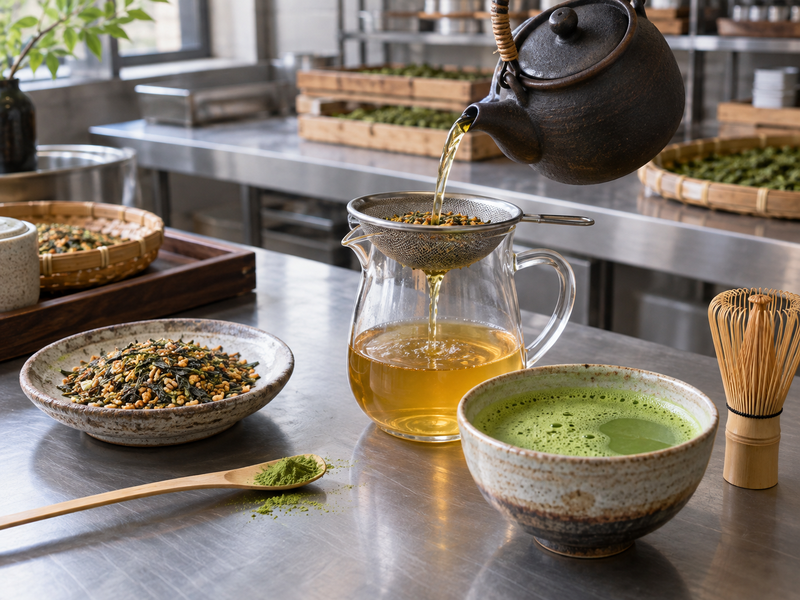
Prepare loose genmaicha by infusion according to the offered product’s guidance and record leaf blend mass, water, temperature and time. Prepare matcha through a controlled dispersion and record powder mass and water. A direct comparison should acknowledge that the resulting drinks have different body and texture. Equal grams do not automatically create equal strength or equivalent servings.
Ippodo’s genmaicha preparation guide gives a primary merchant example of a defined infusion method. Use a documented method for your samples rather than changing temperature or steeping time until a preferred product wins. If a supplier recommends a different method, record it and evaluate the complete service it produces.
Ask tasters about roasted rice aroma, tea character, finish and suitability for the menu. Record disliked burnt, stale or harsh notes without assuming they belong to the whole category. One supplier sample cannot represent every genmaicha or matcha. Taste plain during the initial comparison, then add the food pairing or milk only when it is part of the intended application. Keep the two rounds separate so you know whether a pairing improves or conceals the tea.
5. What equipment does each service need?
Include clearing and resetting the station
Loose genmaicha needs a way to measure the blend, infuse it and separate solids. Matcha needs a controlled powder dose and a dispersion method. A powdered genmaicha mix may follow another sequence entirely. Write the complete process for the specific purchased product and test it during a realistic queue.
| Task | Loose genmaicha | Matcha powder |
|---|---|---|
| Measure | Tea and rice blend | Fine powder |
| Prepare | Infuse under set conditions | Sift or disperse as specified |
| Separate | Remove leaf and rice | Keep powder in serving |
| Clean | Empty and wash infusion tools | Clean bowl, whisk or mixer |
| Train | Timing and complete pouring | Dose and smooth dispersion |
Observe whether the loose blend portions consistently from its working container. Tea and rice have different physical forms, so the business should inspect how handling affects the contents being scooped. Follow the supplier’s advice for mixing or portioning if needed rather than assuming every scoop has the same composition.
For matcha, check whether powder dust and clumps create cleaning or preparation difficulties at the chosen station. The practical choice depends on the equipment, staff and menu volume. Measure actual service time, including the reset, before claiming either tea is automatically easier to serve.
6. Which format fits lattes and food manufacturing?
Define whether the product needs an infusion or suspended solids
A latte made from a loose genmaicha infusion may need a concentrated preparation to retain its character after milk is added. That changes the recipe and service method. A genmaicha powder can provide another route, but its solids and ingredients require testing. Neither should be assumed equivalent to pure matcha at the same dose.
For bakery or confectionery development, specify whether roasted rice flavour is required and what texture the finished food can accept. An infusion adds liquid; a powder adds dispersed material. Those changes affect the base formulation and processing. Use a control batch and record all adjustments rather than replacing one ingredient name in a production sheet.
Matcha Village’s ingredient buyer guide can help structure an application enquiry. Ask the supplier to identify the exact matcha, genmaicha powder or blend available and provide relevant documents. Share the food process, desired flavour and market. If the business requires Japanese origin material, request evidence for that origin before approving the sample. A supplier’s general product range or familiarity with Japanese tea terminology does not provide the necessary product specific proof.
7. How should ingredient declarations and claims be reviewed?
Include rice, tea and every compound ingredient
Loose genmaicha contains more than tea, while pure matcha has a different composition. A sweetened mix can add several more ingredients. Build the product declaration from the supplier’s complete information and have it reviewed for the intended market. Do not write the label from a short catalogue name.
| Claim or declaration | Evidence to request | Why it needs review |
|---|---|---|
| Pure matcha | Composition statement | Distinguish tea from a mix |
| Genmaicha | Tea and rice information | Describe actual ingredients |
| No added sugar | Complete formula | Mixes may already contain sugar |
| Allergen related claim | Ingredient and handling information | Compound ingredients can differ |
| Origin claim | Product and lot documentation | Style name does not prove geography |
Avoid assuming a rice containing tea is automatically suitable for every free from claim. Review the actual ingredients and manufacturing information. The same care applies when a creamer or flavour system enters a powdered drink mix.
Ask the supplier to notify the buyer of formula changes before shipment. A replacement sweetener, rice ingredient or creamer can affect both label accuracy and drink performance. Keep the approved declaration linked to the product code so purchasing can recognize when a familiar name refers to a changed composition.
8. What quality checks belong in receiving?
Inspect the product that was specified
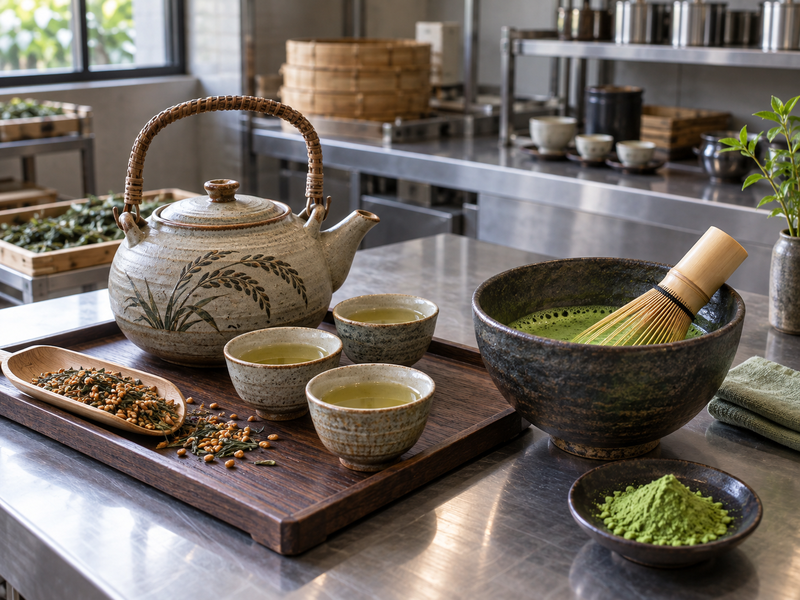
For loose genmaicha, check packaging, lot identity, dry aroma and the expected appearance of leaf and rice. Prepare a documented infusion for sensory comparison. For matcha, inspect the sealed pack and evaluate the powder in the approved drink or food. A supplier’s sample should remain identifiable in the receiving record so later staff know which reference was accepted.
Request specifications and test reports relevant to the actual ingredient and destination. Confirm whether a report is lot specific or part of a broader monitoring programme. Review certification scope and validity before making the corresponding claim. A large collection of documents is less useful than a small set clearly connected to the product and shipment.
Follow the supplier’s storage and handling instructions and protect opened material through the site’s approved procedure. This comparison does not assign shelf life to any tea or prepared beverage. Pack size should fit the rate of use so the working stock can be handled consistently. If a shipment smells stale or differs materially from the approved reference, quarantine it under the receiving process and ask for investigation before staff compensate with a larger tea dose.
9. How can cost and caffeine comparisons avoid misleading shortcuts?
Calculate the served product and support any numbers
Compare ingredient cost at the approved serving dose, then include preparation, cleaning and packaging. For a powdered mix, calculate from the mix dose rather than pretending every gram is tea. If the business wants to compare tea content, obtain composition information from the supplier. A cheaper kilogram does not guarantee a cheaper acceptable serving.
| Comparison | Required basis | Unreliable shortcut |
|---|---|---|
| Ingredient cost | Approved dose and landed price | Price per kilogram alone |
| Labour | Observed preparation and reset | Assumed speed by category |
| Caffeine | Product and serving evidence | Fixed ranking from names |
| Tea content in mix | Supplier composition | Treat all powder as tea |
| Customer value | Actual menu experience | Grade word on a label |
A roasted rice blend should not be advertised as caffeine free merely because it contains rice. The tea component remains relevant, and the final amount depends on the specific product and preparation. Obtain suitable evidence if a quantitative menu statement is needed.
Keep the cost exercise separate from health promises. A cafe can choose genmaicha for roasted flavour and matcha for its powder based service without claiming one gives a universally better physical effect. Train staff to describe the ingredients and taste accurately.
10. What should the final sample request contain?
Give suppliers a specific menu or product brief
State whether the business needs loose genmaicha, genmaicha powder, a sweetened mix or pure matcha. Describe the serving size, equipment, flavour target and intended market. If several formats are under consideration, request separate product codes and ingredient declarations. This prevents a supplier from sending whichever sample is easiest without answering the commercial question.
Ask for representative sample lots, preparation instructions, pack options and lead times. Prepare each sample using a recorded method and compare it in its intended application. Collect staff observations about portioning, infusion, powder dispersion and cleaning. Calculate the approved cost per serving after the tasting, using the actual dose selected for each product.
Select a candidate and request the commercial lot documents before ordering. Confirm the ingredient declaration, origin wording and any product claims against the approved evidence. Have a second employee repeat the service from the written card. Then place a limited order tied to the exact product code and use the incoming stock to verify the flavour and workflow before expanding the menu or manufacturing run.
FAQ
Q1: Does genmaicha always contain matcha?
No. Some blends include added matcha and others do not. Read the supplier’s ingredient declaration and specify the type required for the menu.
Q2: Can genmaicha powder replace matcha in a latte?
It can support a different drink trial, but flavour, solids and added ingredients may change. Obtain the composition and develop a separate weighed formula.
Q3: Is genmaicha caffeine free?
Do not make that assumption. Genmaicha contains tea, and a caffeine claim needs evidence for the actual product and serving method.
Q4: Is all genmaicha Japanese in origin?
The name alone does not prove origin. Request product specific origin documents and distinguish the place of cultivation from processing and packing locations.
Q5: Which tea should a cafe buy first?
Choose according to the intended menu role. A roasted leaf infusion and a whisked powder drink need different preparation. Request samples for the format the cafe can serve well and document the trial.