
A matcha shot is a small, concentrated serving of matcha mixed with water, often used as the tea base for a latte or served on its own. It can make café service more predictable because the tea dose is measured before milk, ice, or flavoring enters the cup. It can also create a new problem if the “shot” varies by barista or settles while waiting. Hummingbird High’s guide to a matcha shot for lattes illustrates the home recipe approach. A café needs a written dose, a mixing method and a realistic holding rule that work with its equipment and order flow.
For: café owners, beverage trainers, foodservice developers and matcha buyers. Decision: whether a measured shot improves the finished drink without adding delay or waste.
1. What is the shot supposed to do?
Decide on the finished drink first
Some shops use a matcha shot as a standalone drink; others use it as a pre-mixed tea component for lattes. Those are different service goals. A standalone shot needs a pleasant texture and finish in a small volume. A latte base may be intentionally concentrated so tea survives the milk and ice. Write the intended use, finished cup size and flavor target before choosing grams of tea. Otherwise the same preparation may taste strong alone and weak in a large iced cup.
Name the product honestly. A shot of matcha is not espresso and does not carry espresso’s extraction model. The powder is suspended in liquid, so the last sip and any settled residue are part of quality. If a menu uses “shot” to suggest a measured base, train staff and customers on what it contains. Avoid unverified energy or health promises. A simple description—measured matcha whisked with water—usually explains more than a dramatic claim.
| Use | Main sensory target | Check |
|---|---|---|
| Standalone | Balanced tea in small volume | Full-shot tasting |
| Hot latte base | Tea after steamed milk | Finished-cup comparison |
| Iced latte base | Tea after ice dilution | Timed cold-cup check |
2. How much tea belongs in one shot?
Weigh rather than scoop
Define tea in grams per shot and water in grams or milliliters, then state the final drink it serves. A bamboo scoop can be useful for ceremony, but its powder load varies with technique and particle packing. A small digital scale reduces that variation in development and helps set a reproducible recipe. Make a dose ladder using one tea lot, one water source, and one mixing route. Taste each candidate alone and in the finished latte. The right dose is the lowest one that meets the stated flavor target without an unpleasant dry finish.
Use the same denominator. Compare cost and sensory results per prepared shot and per final cup. A concentrated shot poured into a larger drink will not necessarily deliver the same flavor as a shot used in a smaller cup. If the shop sells more than one size, make separate recipes or test whether a measured additional shot is the simplest method. Record exact portions; “extra matcha” is hard to cost and train.
3. Which powder should be approved?
Test in the intended route
Ask suppliers for named samples and preparation guidance, then compare them at equal dose in the same shot recipe. Check color, aroma, bitterness, savory depth, visible clumps and mouthfeel. A fine powder may whisk smoothly; a different powder may deliver a clearer tea note through milk. Do not rely on ceremonial or culinary labels alone. Blind taste where possible and keep a reference sample of the accepted lot. After a new lot arrives, repeat the same short trial before changing the shop recipe.
Consider supply and pack size. The best tasting sample is not useful if its usual pack format does not fit the shop’s turnover or if lead time is unreliable. Ask for lot traceability, specification, storage guidance and change notice. Cost grams per accepted shot, including any powder discarded in sifting or remakes. An expensive tea can make sense for a plain shot while a different tea may be more efficient in a flavored iced latte. Approve each application on its own evidence.
| Powder check | Why it matters | Evidence |
|---|---|---|
| Flavor in water | Standalone quality | Blind shot tasting |
| Flavor in milk | Latte performance | Finished-cup tasting |
| Particle behavior | Smooth service | Bottom-of-cup check |
| Lot consistency | Stable menu | Reference comparison |
4. How should the powder be mixed?
Build a smooth suspension
Matcha powder does not fully dissolve. Start with a weighed amount, sift when needed, and add a measured volume of water suitable for the tea and service method. Whisk or mix until there are no visible lumps and the shot is uniform. Compare a bamboo whisk, electric frother and shaker only if those tools are actually available to staff. Each has a different cleaning and service cost. A device that makes one beautiful shot but takes too long during a rush may not be the right operational tool.
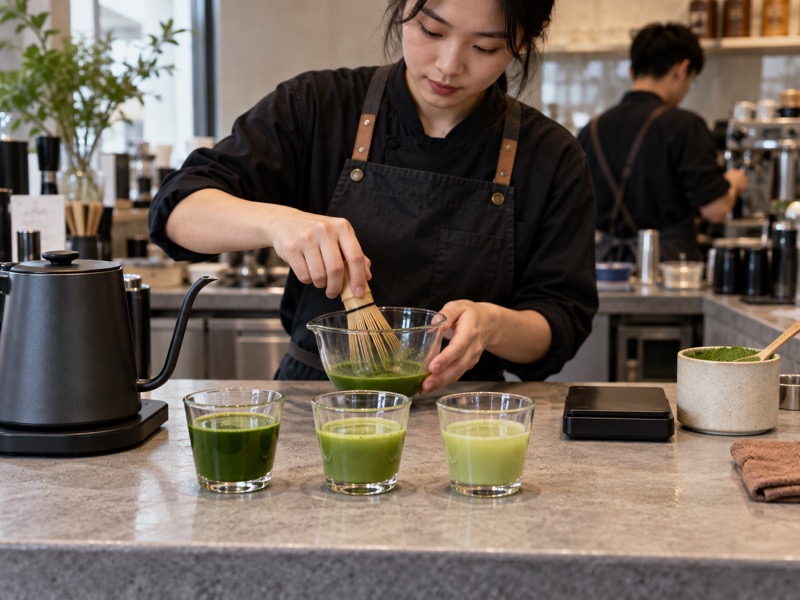
Inspect the last sip. Pour the shot into a clear vessel during development and observe whether tea settles. Taste the whole portion. If the shot feeds a latte, pour it at the intended stage and watch for streaks or dark clumps. Write the method in steps that can be taught: dose, liquid, order of addition, mixing time and visual endpoint. Train employees to remix a short-held shot only when the shop’s validated hold routine permits it.
5. What water and temperature should be used?
Test with the shop’s supply
Water affects both taste and the way powder disperses. Use the shop’s actual filtered or potable water in trials rather than a laboratory bottle that will not be used at service. Test a practical temperature range within supplier and equipment guidance. Very hot water can change tea aroma and make the shot unpleasant to handle; water that is too cold may make clumps harder to remove with a given tool. The correct setting is the one that produces the target flavor and fits safe service.
Record a usable cue. Baristas need a temperature or equipment method they can repeat, not “warm water.” If a hot-water tap varies through the day, check the range during opening and rush periods. For iced drinks, decide whether to prepare the shot with warmer water before chilling or use a cold-mix route. Taste after the shot enters ice and milk. A preparation that seems fine in isolation can become a dull or bitter drink after dilution.
| Variable | Trial comparison | Record |
|---|---|---|
| Water source | Shop supply vs approved alternate | Taste and dispersion |
| Temperature | Practical service range | Flavor and handling |
| Final dilution | Hot vs iced cup | Tea strength after service |
6. Can shots be prepared in advance?
Validate the hold
Pre-making shots can shorten a rush, but suspended tea may settle and color or flavor may change. Prepare a small batch under the proposed method. Sample immediately and at timed intervals from the top and bottom of the holding vessel. Record temperature, appearance, aroma, taste and any remix step. Apply the shop’s food-safety process to the water, vessel and any added ingredients. Do not borrow a storage limit from a home recipe or use visual appearance as a safety test.
Separate components when useful. A shop may find it easier to pre-weigh dry powder and mix each shot to order. Another may use a short-lived liquid pre-mix with documented agitation. Compare both routes on actual service time and loss. If the liquid batch needs constant correction or leaves heavy sediment, it may save fewer seconds than expected. Label any prepared vessel with formula and time so the team can trace a problem to the correct batch.
7. How should a shot enter a latte?
Decide the order of assembly
A matcha shot can be poured into milk, over ice, or into the cup before other ingredients. Each route changes the visual layers and the mixing effort. Test the order in the actual cup and lid. A layered drink may photograph well but leave a strong tea layer followed by plain milk unless the menu tells the guest to stir. If the shop wants a uniform latte, build that into the assembly method. If layers are intentional, taste the first, middle and last sips.
Keep size-specific recipes. A single shot may be enough for one cup but not a larger size. Measure final drink volume including ice and any syrup. Use the accepted tea dose to calculate the cost of a double-shot or larger cup. If customers add espresso, fruit, or cold foam, test the complete drink again. The shot is a stable component only when the full menu recipe around it is stable.
8. What should staff training cover?
Make the method visible
Teach the team to recognize a smooth shot, a clumpy one and a shot that has settled beyond the approved hold. Put the scale, water source, mixing tool, powder and cup near each other in the bar flow. Show the correct dose and final visual endpoint in a short card or photo. Then watch several staff prepare five consecutive shots. Measure time and weight variation. A single demonstration by a trainer does not show whether the routine works during routine staffing.
Taste alongside the team. Staff can learn to spot a weak or harsh shot before it reaches the customer. Train them on the accepted tea’s normal aroma and finish. When a new lot arrives, hold a short comparison with the reference sample. This is also a chance to check whether equipment has changed or water settings drifted. Avoid adding a new control that no one has time to use; simplify the sequence until the checks that catch real defects fit the shift.
| Training item | Pass condition | Check method |
|---|---|---|
| Dosing | Within shop tolerance | Five weighed shots |
| Mixing | No visible clumps | Clear-vessel inspection |
| Service | Fits order flow | Timed rush trial |
9. What does each shot cost?
Include powder and time
Calculate the accepted tea grams multiplied by the actual purchase cost, then add cups used for pre-mixing, labor, cleaning, and routine loss. A pre-made batch that is discarded at close may cost more than measured shots made to order. A powder with lower price per kilogram may need a higher dose to taste clear in milk. Use the final menu cup as the commercial unit and allocate the shot cost to it. Staff variation in tea scoops can change margin and taste at the same time.
Watch rework. If clumpy shots are remade, count them. If a double-shot option is offered, price the additional tea and service step. Compare the cost of a scale and mixing tool against reduced waste and training time rather than treating equipment as free. The most efficient shot is one that meets quality with a routine the team can repeat, not merely the one with the fewest ingredients.
10. What pilot should approve the shot?
Test the full service day
Run the proposed shot at opening, during a rush, after an idle period and near close. Include more than one trained employee. Compare standalone shots and the finished drinks they feed. Record dose, water, mixing time, clumps, sediment, taste, visual layers, prepared-shot loss and order time. If a hold is proposed, test it explicitly with the shop’s food-safety controls. Ask staff which step causes hesitation or rework. Those observations are more useful than an attractive sample photo alone.
Sign off the route. Keep the tea code, lot standard, dose per cup size, water method, mixing tool, hold rule, assembly order and retest triggers together. The next action is a short controlled shift trial, followed by one clear adjustment to the step that fails most often. A measured matcha shot earns its place when it makes the café’s finished drinks more consistent and easier to serve.
| Pilot stage | Question | Evidence |
|---|---|---|
| Opening | Is the first shot in spec? | Weighed, tasted sample |
| Rush | Can staff repeat it? | Timed consecutive drinks |
| Hold | Does it remain acceptable? | Timed top/bottom samples |
| Close | How much is discarded? | Waste log |
The matcha drinks guide covers other service formats that can use a prepared matcha base.
Reference: How To Make The Perfect Matcha Shot For Matcha Lattes is a home-recipe reference. The café controls above are independent.
FAQ
Q1: Is a matcha shot the same as espresso? No. It is a measured suspension of powdered tea in water, made by mixing rather than extracting through coffee grounds.
Q2: Can a matcha shot be served alone? Yes, if the dose and taste are designed for a small standalone serving.
Q3: Why does a shot settle? Matcha particles remain suspended and can separate over time; test the intended hold and remix method.
Q4: Should every latte size use one shot? Only if finished-cup tests show the tea remains clear at each size.
Q5: What should a buyer compare between teas? Taste in the shot and latte, particle behavior, accepted dose, lot consistency and cost per serving.