
The word “complete” on a matcha set box tells buyers very little. One set contains tea and working tools; another contains accessories but leaves the customer without powder or usable instructions. Before approving a retail order or café training kit, inspect each piece against a real drink and record the result. Nio Teas explains what can be in a matcha set. A matcha set checklist gives buyers a way to test the pieces and packaging instead of trusting the word on the box.
This checklist takes the next step: it asks what each item should do, which evidence to request, and when an optional extra should be removed. Use it with an assembled sample, not a catalog montage assembled from unrelated products. For a closer look at a commonly overlooked component, use our matcha sifter checklist alongside this inspection.
Contents
- 1. Does the matcha powder fit the stated drink?
- 2. Is the bowl stable and usable?
- 3. Does the whisk fit and arrive intact?
- 4. Can the scoop portion tea sensibly?
- 5. Does a sifter improve this set?
- 6. Is a whisk holder useful here?
- 7. Will the tea container protect the powder?
- 8. Can a new user follow the recipe card?
- 9. Does the insert protect every component?
- 10. Are care and replacement details clear?
1. Does the matcha powder fit the stated drink?
Taste from the proposed commercial specification
The tea is not a decorative filler. If a set claims to make a straight bowl, prepare the included powder with water and judge aroma, flavor, texture, and color in that use. If the package teaches a latte, test the same tea in the listed milk and serving size. Check net weight, lot identification, shelf-life information, storage directions, and the seal on the actual retail pack.
Ask which documentation supports origin, organic, or other product claims; a supplier’s general brochure is not a substitute for the specific tea in the set. A tools-only set can be legitimate, but its listing should say clearly that matcha is not included. For a multi-market launch, review the appropriate label and language for each destination before artwork approval. Record the accepted tea sample and recipe so a later reorder can be compared against something tangible.
| Powder check | Acceptance question | Record |
|---|---|---|
| Recipe fit | Does it taste right in the promised drink? | Tasting notes |
| Pack | Does the seal survive handling? | Pack sample and format |
| Identity | Can the lot be traced? | Lot and product code |
| Claims | Are they supported for this tea? | Current documents |
2. Is the bowl stable and usable?
Inspect the inside as closely as the outside
Measure a bowl’s useful interior width rather than relying on its outside diameter. The proposed whisk must move freely at the printed water level. Place the bowl on a normal counter and check its foot for wobble. Fill it with water, lift it as a customer would, and pour if the product page shows a latte. Look for rim chips, rough interior glaze, or shapes that trap powder during cleaning. These are observable acceptance points, not claims that one traditional shape guarantees a better cup.
If the bowl is handmade, agree on a realistic range of variations for size, color, and finish. Test enough samples to see the range, then photograph an average example for the listing. A single attractive prototype should not stand in for a production shipment with inconsistent usability.
3. Does the whisk fit and arrive intact?
Check structure and service life
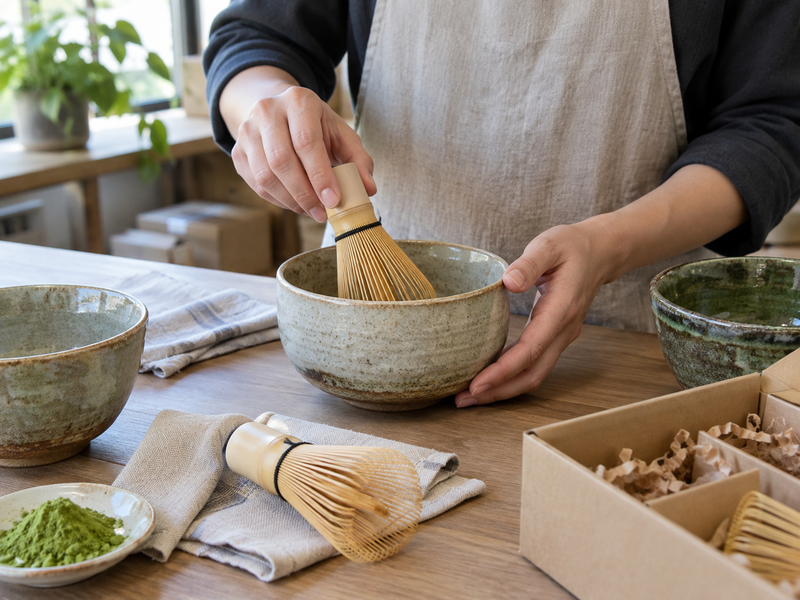
Remove the whisk from its sleeve without forcing the tines. Look for damage, uneven handling marks, or packaging pressure. Make several cups with the actual bowl and tea, then inspect how the tines behave. A bamboo whisk needs an appropriate cleaning and drying routine; that advice should arrive with the set. If the kit includes a shaped holder, confirm the holder fits that whisk rather than assuming all holders share one size. Request replacement availability and the supplier’s process for damaged arrivals.
In a café, a whisk is a working consumable, so replenishment matters more than a permanent display promise. Keep one approved sample for receiving checks. If a subsequent shipment changes whisk profile, retest its fit inside the bowl instead of approving it solely because the product name stayed the same.
| Whisk point | Quick trial | Follow-up |
|---|---|---|
| Tines | Inspect before and after use | Define damage threshold |
| Bowl pairing | Whisk at normal fill level | Record approved pairing |
| Storage | Try supplied holder or case | Confirm dry fit |
| Reorder | Request spare-item terms | Plan replacement stock |
4. Can the scoop portion tea sensibly?
Treat the scoop as a transfer tool
A bamboo chashaku can move powder neatly from container to bowl. It is not a scale. Powder density, scoop shape, and how full a user makes it all affect the dose. If the recipe says “two scoops,” weigh multiple samples using the exact scoop and tea, then give the customer a realistic approximate range or a gram target. Check whether the scoop fits through the included tea-pack opening without scraping or spilling. Inspect edges and finish for clean handling, then ask how it should be washed and dried.
Some buyers may prefer a small measuring spoon, but volume measures also vary with powder packing. For café recipes, specify the mass used in training and use the scoop only for transfer. If the set does not include a scoop, the preparation card must not quietly depend on one.
5. Does a sifter improve this set?
Test the benefit against the cleaning cost
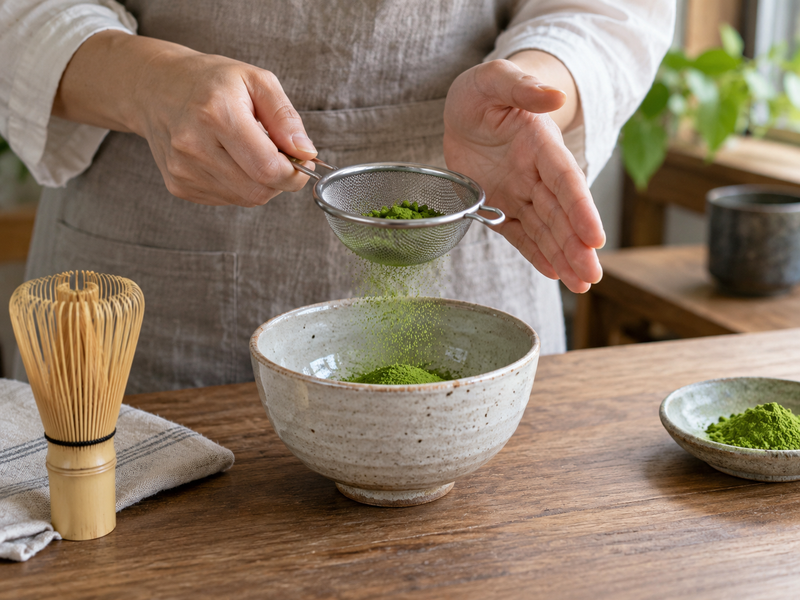
Fine powder can form dry clumps. A sifter may help them break apart before mixing, but its value depends on the powder and workflow. Make several cups with and without the proposed sifter under the same recipe. Note texture, preparation time, powder left behind, and how long the mesh takes to clean and dry. A café may already own an appropriate sieve; adding another to every training kit wastes space. A home starter set may benefit from a compact one if the powder commonly clumps.
Inspect the sifter’s food-contact material, mesh attachment, and edges. The printed instructions should show where it enters the sequence. If no meaningful improvement appears, remove it and spend the budget on better tea, a better bowl, or a clearer recipe card.
| Sifter trial | Observe | Decision point |
|---|---|---|
| With supplied tea | Dry clumps and texture | Is the cup noticeably improved? |
| During use | Speed and spills | Is the extra step manageable? |
| After use | Residue and drying | Can users clean it easily? |
| In box | Fit and protection | Does it add shipping risk? |
6. Is a whisk holder useful here?
Check fit and storage reality
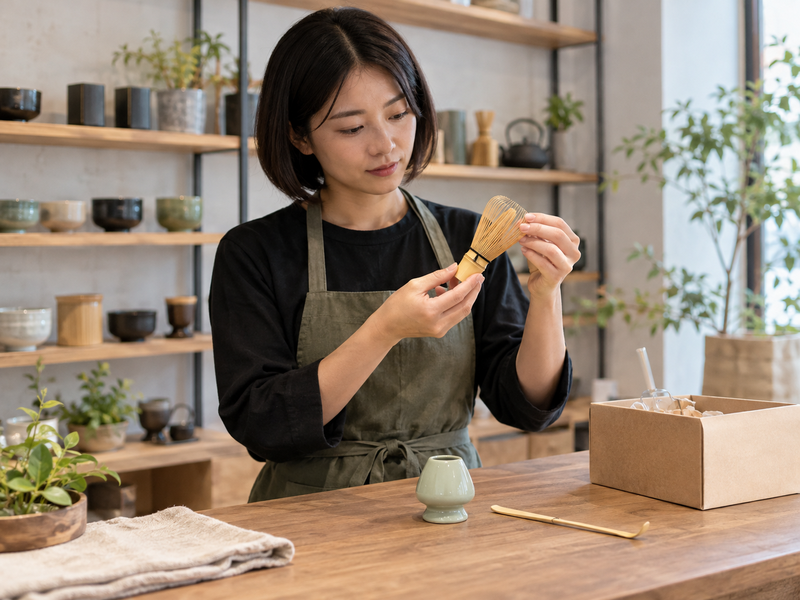
A whisk holder can support a bamboo whisk’s shape while it dries or rests between uses. It is not a reason to store a damp whisk in a closed gift box. Test the actual whisk on the actual holder after rinsing according to the maker’s guidance. Does the base stand securely on a shelf? Does the holder touch the tines in a way that bends them? Can a home user find a safe place for it near the sink?
A café might prefer another drying setup that fits its cleaning program and storage space. If the holder is ceramic, inspect its glaze and packing protection as another breakable object. An accessory that adds cost, weight, and replacement problems should earn its place by solving a clear user problem. If you remove it, provide workable drying advice instead of leaving a gap in aftercare.
7. Will the tea container protect the powder?
Separate presentation from food storage
A decorative tin can make a set feel complete, but its role must be clear. Is matcha packed directly inside a food-suitable container, or does the tin simply hold a sealed pouch? Check closure, cleanliness, labeling, and the directions for storing tea after opening. The outside of a tin may look sealed while its lid still admits air easily. Do not promise a particular shelf life based on appearance alone.
If the kit uses a foil pouch, test whether a scoop can enter and whether the pouch can be closed without powder collecting in the seal. For a gift range, consider how long it may sit before opening; shelf life should be assessed for the final packed format and sales channel. Keep tea and tools apart in the insert so a damp accessory cannot touch an opened food pack later.
| Container question | What to inspect | Why it matters |
|---|---|---|
| Direct food contact? | Material and product records | Appropriate use |
| Seal after opening? | Repeated open-close trial | Powder protection |
| Label visible? | Lot and storage details | Traceability |
| Scoop access? | Actual pack opening | Less waste and spillage |
8. Can a new user follow the recipe card?
Conduct an uncoached trial
Hand the finished sample to a person who has never seen the set. Ask them to prepare the main advertised drink while a team member silently records where they hesitate. The card should identify every supplied item, state what the user must provide, give quantities in familiar units, and show the order of actions. If the box includes no tea, the card should not begin with “use the included matcha.” If it includes a sifter, explain how and when to use it.
Avoid vague endpoints such as “whisk to perfection”; describe a practical result, then tell users how to adjust the next cup. Include safety around hot water and separate cleaning notes for bamboo, ceramic, metal, and powered pieces. A novice’s pause at the same step twice is a copy or design defect, not evidence that customers should read more carefully.
9. Does the insert protect every component?
Test a filled pack through its route
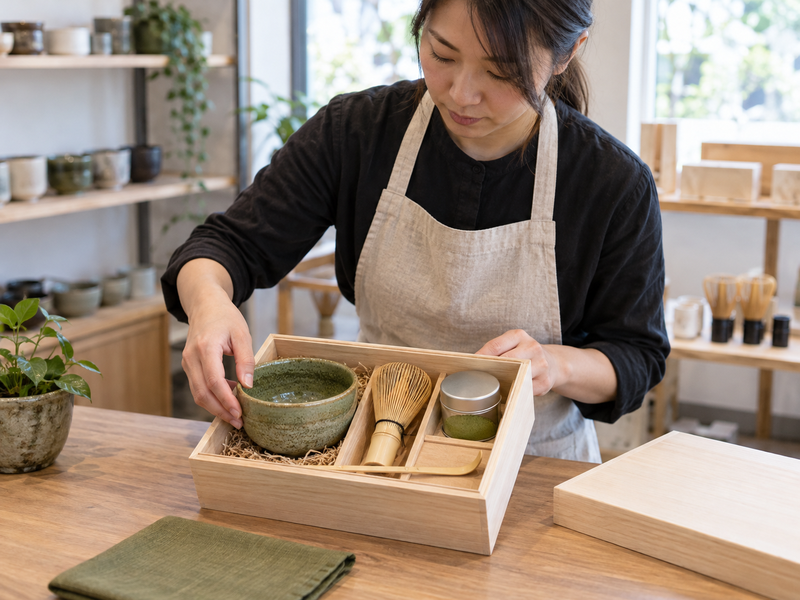
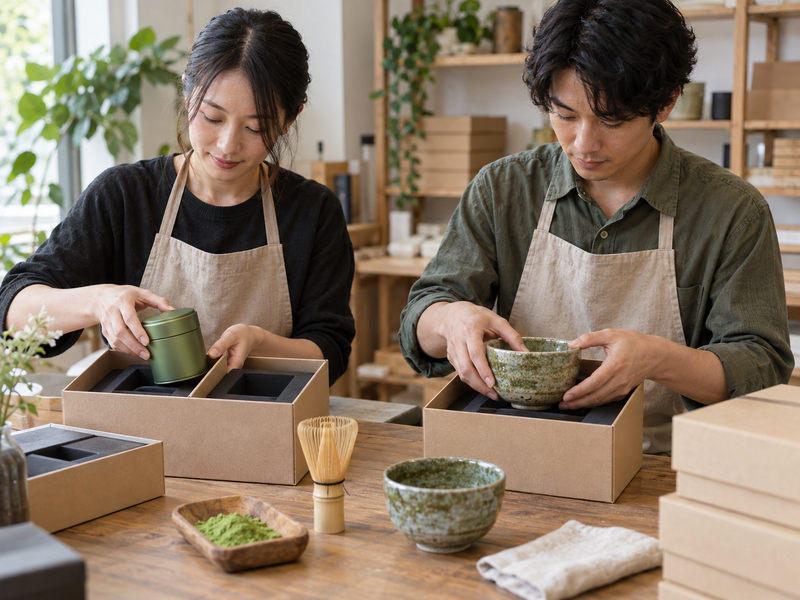
Inspect how the tray holds the bowl, whisk, scoop, tea pack, and any small parts when the box is turned or lightly handled. A neat opening display does not prove the ceramic will survive parcel shipping. Pack production-style samples in the proposed outer carton and test them through the route used by the business. Record damage by item and position. Check whether powder sachets are crushed, bamboo tines are pressured, or a loose scoop scratches glaze.
Reopen the box as a customer would: are sharp edges exposed, is the recipe easy to find, and can the set be stored again after use? Ask the packaging supplier for the actual material specification if any environmental claim will appear on the box. Returns and replacement costs belong in the total purchase decision, not just the factory unit price.
| Pack check | Failure to watch for | Evidence to keep |
|---|---|---|
| Inner tray | Component movement | Packed sample photos |
| Outer carton | Bowl impact | Route test record |
| Tea position | Crushed or punctured pouch | Inspection log |
| Repacking | Damp tool near food | User trial notes |
10. Are care and replacement details clear?
Sign off the whole life of the set
The initial unboxing is only one stage. Ask who supplies replacement whisks, bowls, and tea. Check how customers report a broken arrival and what staff will tell them about care. A single “hand wash” line for all materials may be inadequate; use the component maker’s directions and test them with the assembled product. For a café, train staff to inspect whisk tines and bowl surfaces at a sensible interval under its own hygiene program. For a retail brand, provide a readable care card and a route to compatible refills.
Matcha Village can discuss powder formats and tea-and-tool combinations for a program, while the buyer should approve current samples and documentation for every final item. Sign off the set only when the cup, box, claims, cleaning, and replacement plan agree.
Final thoughts
Use this matcha set checklist with a real sample. Test the tea in the promised drink, pair the bowl and whisk, question every optional extra, and have a beginner follow the card without help. Then verify packaging, care, and replacements before ordering volume. A set does not become complete through its number of objects. It becomes useful when those objects work together and the customer knows what to do with them.
FAQ
Q1. What must every matcha set include? Contents depend on its promise. A ready-to-make set needs tea, a vessel, a mixing method, and a way to portion it; a tools-only set must say tea is separate.
Q2. Is a whisk holder necessary? Not always. Include it when it fits the supplied whisk and solves a real drying or storage need.
Q3. Can a scoop replace a scale? A scoop transfers tea but does not measure a fixed mass. Use weight for repeatable café recipes and as the reference for consumer scoop guidance.
Q4. Why test an assembled sample? Individually approved components may not fit each other or survive in the final pack.
Q5. Which records should buyers keep? Retain the approved set, tea and component specifications, label evidence, recipe trial, packing results, and replacement terms.