
Matcha sago is a spoonable dessert built from small cooked pearls and a tea-flavored liquid, often with fruit or coconut ingredients. A cafe needs each serving to contain the same balance of pearls, liquid and additions. Begin by identifying the pearl ingredient, then develop the matcha base around its cooked texture rather than copying a bowl photograph.
1. What does matcha sago mean on a cafe menu? · 2. How should the pearl ingredient be specified? · 3. What should a pearl-cooking trial establish? · 4. How can the matcha liquid be developed without too many variables? · 5. How should pearls, fruit and jelly be proportioned? · 6. What prevents early and late servings from differing? · 7. How should fruit quality be handled in a matcha dessert? · 8. Which holding and packaging checks are needed? · 9. How should a cafe calculate cost per cup? · 10. What belongs on the final preparation sheet?
1. What does matcha sago mean on a cafe menu?
Describe the ingredients customers will receive
The name sago is used in dessert menus that may contain tapioca pearls. Read the ingredient declaration before deciding how to describe your own product. Do not assume a package’s familiar front label identifies the starch source precisely enough for procurement or menu claims.
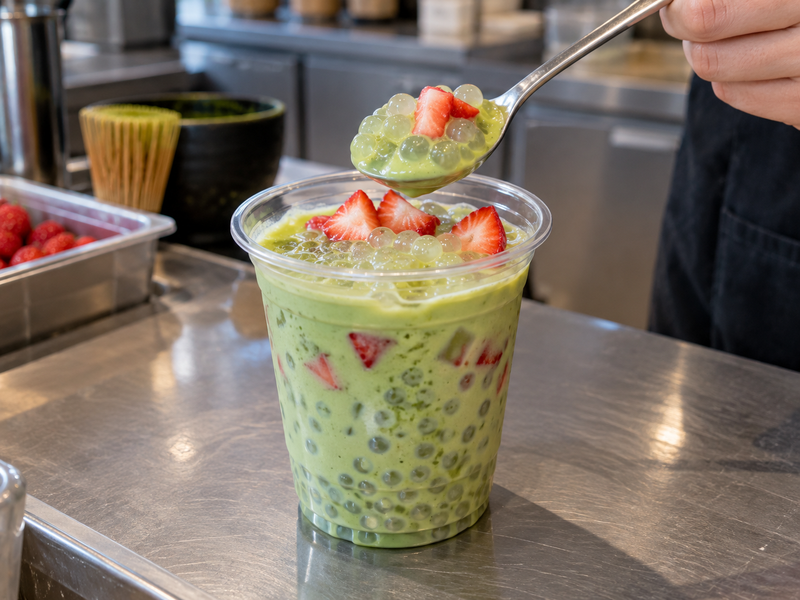
Bites by Bianca’s strawberry matcha sago uses small tapioca pearls with matcha, coconut milk, strawberries and coconut jelly. It is a useful example of a mixed dessert format. You can develop a simpler version first so the tea base and pearl texture are easier to judge.
Decide whether customers should drink part of the base or eat the entire serving with a spoon. That choice changes the intended proportion of liquid to solids and the utensil supplied.
Write a plain menu description naming the major components. A customer expecting a smooth pudding may be surprised by distinct pearls and firm jelly pieces. The photograph and wording should make that texture clear without relying on an unfamiliar dessert name to explain everything.
2. How should the pearl ingredient be specified?
Record starch identity and size
Bob’s Red Mill’s small pearl tapioca page identifies its pearls as tapioca starch derived from cassava. That manufacturer description helps distinguish a particular tapioca product from ingredients sold under other names.
Order by supplier product code, ingredient declaration and pearl size. Small white pearls and large drink pearls should not be exchanged merely because both are called tapioca. Their preparation and the eating experience need separate evaluation.
| Pearl specification | What purchasing records | What the kitchen checks |
|---|---|---|
| Starch identity | Ingredient declaration | Accurate product description |
| Size | Supplier grade or sample | Spoonful texture |
| Preparation method | Current instructions | Cooking consistency |
| Pack size | Opened-bag usage | Practical batch planning |
Retain a dry sample and a photograph of the approved cooked pearls. The receiving team can then spot an obvious substitution before a large batch is prepared.
If a supplier changes instructions or product composition, run another cooking comparison. A familiar-looking pearl is not evidence that the established method remains appropriate. Keep the preparation instruction with the ingredient specification rather than relying on staff memory.
3. What should a pearl-cooking trial establish?
Separate the dry amount from usable cooked yield
Follow the selected supplier’s preparation instructions, including any required soaking, boiling or resting steps. Do not assume the short method from one recipe fits every small pearl. Record dry weight, water use, pot size and actual cooking load.
Inspect more than the surface of a few pearls. Take samples from the pot, assess the center under the approved procedure and compare texture after the planned cooling step. A translucent appearance is useful information but should not replace a complete cooking standard.
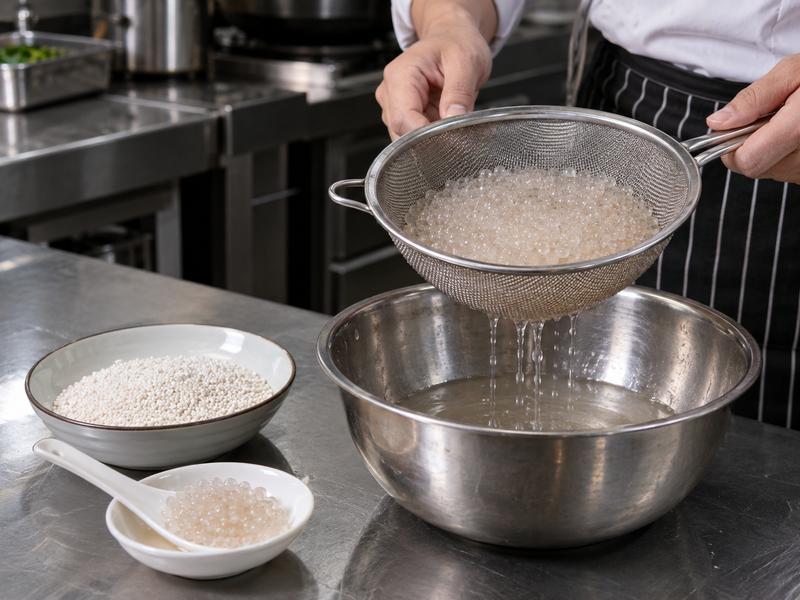
Weigh the cooked pearls after a consistent draining procedure. This usable weight is the number needed for portioning and costing. If one batch drains briefly and another sits much longer, their recorded yields may not be comparable.
Keep draining water away from the finished dessert base unless the recipe intentionally includes it. Unrecorded carryover changes the liquid-to-solid balance and can make the first servings different from later ones.
During development, reserve a small plain sample before mixing with matcha. It allows the team to distinguish a pearl-preparation problem from a change caused by the finished liquid or storage conditions.
4. How can the matcha liquid be developed without too many variables?
Choose one milk or coconut base first
Select the intended base product and record its composition. Canned coconut milk, coconut beverages, dairy milk and oat drinks are different ingredients. A substitution can change sweetness, body and flavor before matcha is added.
For an unvalidated first comparison, prepare identical 500-gram portions of your chosen sweetened liquid base and add 3, 4 or 5 grams of matcha. These are proposed trial levels. Reserve part of each measured base for dispersing the tea so no extra unrecorded liquid enters the comparison.
| Base detail | What to keep fixed | Observation |
|---|---|---|
| Liquid product | Supplier and ingredient list | Body and background flavor |
| Sweetener | Product and measured amount | Tea balance |
| Matcha addition | Weighed trial level | Tea intensity |
| Serving condition | Approved chilled condition | Flavor at consumption |
Sift the tea and make a smooth dispersion before combining it with the remaining base. Inspect a thin smear or small glass for dry specks.
Taste the liquid alone, then add the same cooked-pearl portion to each sample. A base chosen from a spoonful of liquid alone may taste different once the dessert contains substantial solids.
5. How should pearls, fruit and jelly be proportioned?
Build a serving by weight before choosing a scoop
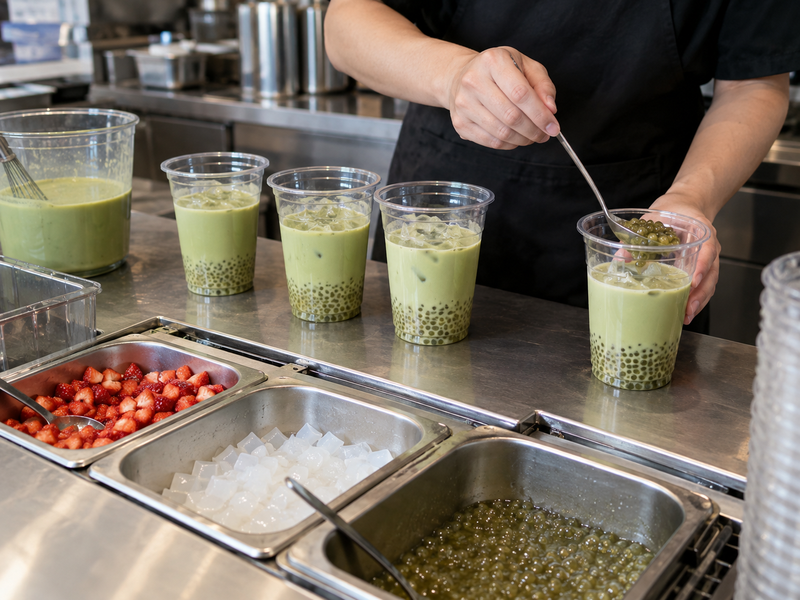
Start with the simplest acceptable dessert: the approved liquid and cooked pearls. Add fruit or jelly only after that balance works. Each extra component changes portion cost, eating texture and the amount of free liquid in the cup.
As a proposed assembly trial, compare 40 and 60 grams of drained cooked pearls with 150 grams of the same liquid base. These are unvalidated serving examples. Evaluate the spoonful balance and cup fit before setting the final portion.
If fruit is added, specify its prepared weight after trimming. Cut pieces to suit the spoon and container rather than the cutting board photograph. Jelly should also be evaluated as a drained ingredient if its packing liquid is not part of the recipe.
Test one addition at a time. A cup containing strawberries, coconut jelly and several other toppings can make it difficult to understand why the matcha seems weaker or the liquid seems thinner.
Once the serving is selected, choose a portioning tool and check its delivered weight. A scoop that works for dry jelly pieces may not deliver a repeatable mixture of pearls and liquid.
6. What prevents early and late servings from differing?
Design the mixing and portioning sequence
A large bowl of finished dessert is not automatically uniform throughout service. Pearls and other solids can be distributed unevenly, while staff may take more liquid from the surface. Test the serving method from the first cup to the last.
One option is to portion solids and liquid separately. Another is to combine them using a defined mixing and scooping routine. Compare both during a small service trial, including the labor each requires.
| Serving approach | What to measure | Practical concern |
|---|---|---|
| Separate components | Pearl and liquid weights | More handling steps |
| Mixed batch | Solids in early and late cups | Uneven distribution |
| Preportioned cups | Finished weight and appearance | Storage and staging |
| Added toppings | Prepared weight per cup | Portion creep |
Do not stir so aggressively that the approved pearl texture is damaged. Observe the utensil, container shape and number of portions handled during the pilot.
If the mixture thickens or changes during the permitted service period, record that behavior instead of adding milk by eye. Any corrective addition changes every later serving and belongs in a revised, validated procedure.
7. How should fruit quality be handled in a matcha dessert?
Assess fruit inside the finished cup
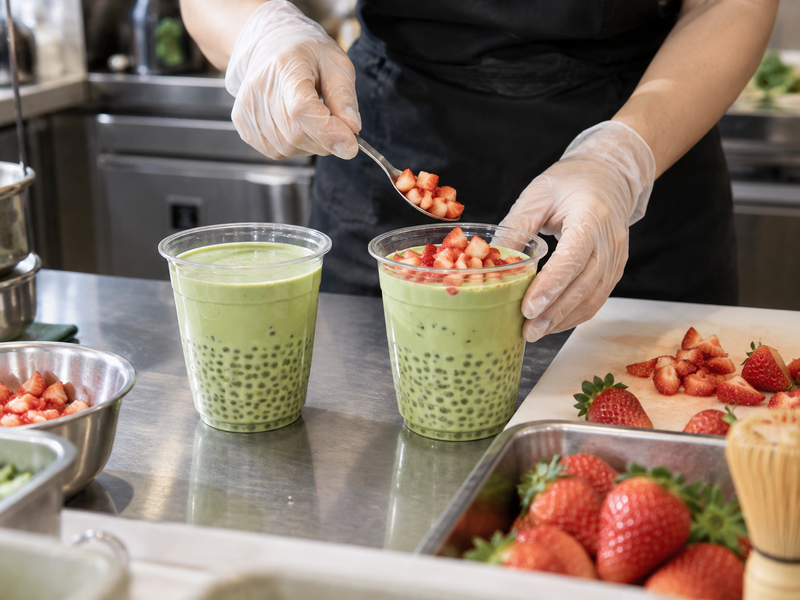
Fruit that tastes good alone may dominate a lightly flavored tea base. Compare the complete spoonful, including pearl and liquid, before approving a fruit variety or preparation style. Keep the tea dose fixed during this comparison.
For fresh fruit, record prepared yield and the appearance of cut pieces after the intended handling process. Follow the kitchen’s approved washing, cutting, cooling and storage procedures. Do not transfer a whole-fruit shelf-life statement to a mixed cut-fruit dessert.
If frozen fruit or a fruit preparation is chosen, assess the thawed or ready-to-use ingredient in the actual cup. Its liquid contribution should be included in the formulation rather than treated as incidental.
Check whether color spreads into the green base during the planned service interval. That may be acceptable for a deliberately mixed dessert, but it can conflict with a photograph showing clean layers. Decide whether the menu promises a layered presentation or a stirred one.
Limit decorative pieces to what staff can prepare consistently. A labor-intensive fruit shape can slow assembly without improving the spoonful the customer receives.
8. Which holding and packaging checks are needed?
Distinguish texture observations from shelf life
Assess the complete dessert in the proposed cup, lid and chilled handling route. Check whether pearls remain pleasant to eat, whether the liquid separates visually and whether the lid clears any toppings. Record the condition and elapsed interval for each observation.
The inspiration recipe’s home-storage advice does not establish a cafe’s commercial holding period. That requires assessment of the actual recipe, process, hygiene controls and distribution conditions.
| Check | What to observe | Product decision |
|---|---|---|
| Pearl texture | Firmness and surface condition | Acceptable service window |
| Liquid appearance | Separation or visible specks | Mixing method |
| Cup fill | Headspace under the lid | Portion and container size |
| Transport | Leakage and component movement | Closure suitability |
Treat a change to milk, sweetener or fruit as a reason to review the existing product assessment. Different ingredients can alter both the eating experience and the handling requirements.
Freezing is also a separate development route. Do not assume a dessert approved for chilled service will thaw into the same pearl texture. Start with the sales channel you can evaluate properly rather than advertising several storage options at launch.
9. How should a cafe calculate cost per cup?
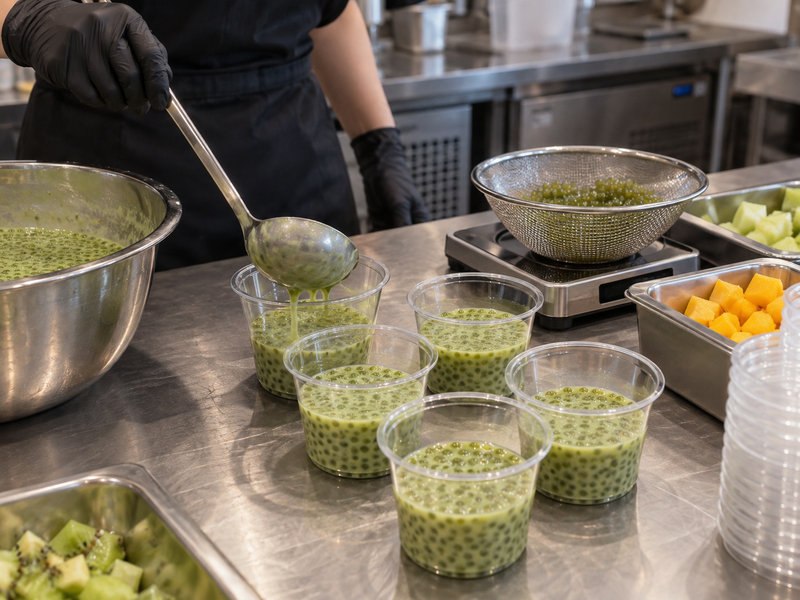
Use drained and trimmed ingredient weights
Calculate pearls from usable cooked yield and fruit from prepared yield. Record packing-liquid losses for jelly and the amount of matcha liquid remaining after portioning. These quantities make the cost sheet closer to the actual service result.
For a hypothetical example, a cooked batch that supplies twenty 50-gram pearl portions contains 1,000 grams of usable pearls. If only 900 grams remain after the chosen draining and handling process, it supplies eighteen such portions. These figures explain the calculation, not a recommended yield.
Include cups, lids, spoons, labels and assembly labor. A layered cup with separate solids may cost more to assemble than a mixed bowl even when ingredient quantities are identical.
Use the site’s matcha solubility article when discussing powder dispersion with the ingredient supplier. Send Matcha Village the selected liquid base and serving format. Request Chinese matcha samples for that application, then judge them in complete cups at the intended chilled condition rather than relying on a warm water tasting.
10. What belongs on the final preparation sheet?
Separate cooking, base mixing and assembly
Create distinct instructions for pearl preparation, tea-base mixing and cup assembly. Each needs its own measured outputs and observations. A single paragraph telling staff to combine everything leaves too much interpretation during a busy shift.
Include the exact pearl product, the drained portion, the liquid dose and the topping weights. Photograph a completed cup with the lid closed and a spoonful showing the intended balance of solids.
| Working record | Responsible station | Release question |
|---|---|---|
| Pearl cooking log | Hot preparation | Is the batch correctly prepared? |
| Matcha-base sheet | Beverage or dessert prep | Is dispersion consistent? |
| Cup assembly standard | Service counter | Does every cup match? |
| Handling instruction | Shift lead | Are approved conditions followed? |
Review the customer description and ingredient claims together. Honey, dairy ingredients or purchased jelly can affect statements that may have been true of a simpler base. The word coconut on the menu should not substitute for a complete ingredient check.
Run one small service batch and compare the first, middle and last cups for pearl weight, liquid amount and appearance before approving routine production.
FAQ
Q1: Are all pearls sold as sago the same ingredient?
No. Check the starch source, size and supplier instructions. Menu terminology alone is not a purchasing specification.
Q2: Can large boba pearls replace small pearls directly?
They need a separate preparation and serving trial. Their size changes both cooking and the spoonful experience.
Q3: Should extra milk be added when the batch looks thick?
Use only an approved adjustment procedure. An unmeasured addition changes later portions and makes the cost and recipe records inaccurate.
Q4: Is coconut-based matcha sago automatically vegan?
No. Check sweeteners, jelly and every other component, including any dairy ingredients or honey.
Q5: Can the dessert use a recipe blog’s refrigerated storage period?
No. Establish the permitted holding period for the actual commercial process, formulation and packaging.