
A buyer receives three reports that the same matcha tastes bitter. One came from a sealed retail tin, one from a café latte and one from a product test using hot water. Treating all three as proof of a defective lot would be premature. Ignoring them could be worse if the issue involves packaging or contamination. A sound matcha quality complaints process captures the evidence, protects affected stock, reproduces the symptom and closes the case with a documented decision. Matcha Times’ diagnostic article discusses common sensory symptoms; this guide focuses on the investigation a B2B buyer can run with its supplier.
Contents
- 1. Which complaints need immediate escalation?
- 2. What information belongs in the intake record?
- 3. How should affected stock be held?
- 4. How can you reproduce the reported symptom?
- 5. How do you compare retained and customer samples?
- 6. Which documents should the supplier provide?
- 7. How should you investigate color, taste and texture?
- 8. When should you test rather than taste?
- 9. How do you decide on correction and disposition?
- 10. How can the next lot be protected?
1. Which complaints need immediate escalation?
Separate quality dissatisfaction from possible harm
An unexpectedly dull green color, weak tea aroma or mild grit can start a quality investigation. A report of illness, foreign material, suspected allergen, broken package seal or chemical odor needs immediate review under the company’s food-safety and incident procedures. Do not ask a café to keep serving a suspect lot while a supplier debate continues. Put affected units on hold, identify distribution locations and ask the qualified food-safety lead to assess risk. The FDA’s Reportable Food Registry guidance explains reporting duties for certain serious food risks at registered facilities; local legal obligations may differ.
Act on the strongest signal: a sensory complaint can reveal a safety issue, and a safety concern may have no obvious taste or color change. Customer health information should be handled carefully and escalated through the correct channel. The FDA’s consumer and industry complaint page shows US reporting routes for food problems. For routine color or taste dissatisfaction, log the case and investigate under a stated response timeline. For suspected harm, activate the more urgent pathway before waiting for a laboratory result or commercial approval.
| Report | Immediate action | Who leads |
|---|---|---|
| Off flavor only | Record and hold affected units as needed | Quality team |
| Broken seal | Quarantine lot segment | Quality and packaging |
| Foreign material | Stop use and preserve evidence | Food-safety lead |
| Illness or allergen concern | Escalate incident procedure | Food-safety and legal teams |
2. What information belongs in the intake record?
Capture facts while the product still exists
Ask for product name, lot or batch code, pack size, purchase and opening dates, storage conditions and quantity affected. Record the exact observation in the customer’s words before converting it to a reason code. “Tastes bitter after 20 minutes in a latte” tells an investigator more than “bad flavor.” Request photographs of the package, seal and prepared product where useful. Ask whether the customer has unopened units from the same lot and can preserve a sample under appropriate conditions. Do not ask them to ship a leaking or potentially hazardous sample without a safe procedure.
One form is enough: include the customer’s preparation details only when the issue could depend on use: powder mass, liquid amount, temperature, milk or sweetener, mixing tool and time between preparation and observation. A manufacturer may need its formula and production date instead. Record how many units show the symptom and how many were inspected. Distinguish “three complaints from one café” from “three independent cafés across a distributor.” The case should have one owner, a date received and a promised next update. A clear acknowledgment often prevents the customer from repeating the same story to sales, warehouse and quality staff.
3. How should affected stock be held?
Stop movement without losing traceability
Identify where the suspect lot went: warehouse, branches, distributors, customers and sample stock. Mark remaining units as on hold in both the physical space and inventory system. Separate the hold from a recall decision. A quality hold prevents further movement while the team assesses facts; a recall follows the company’s formal risk and legal process when required. Do not quietly swap stock and erase the original lot trail. Keep counts for units received, sold, returned, held and used in testing.
Check related lots carefully: the same packaging run or raw material may cover more than one printed code. Ask the supplier how its batch structure works before assuming the issue ends at a single carton. The FDA’s traceability lot-code explanation describes why links among records matter for locating affected food. Its specific rule applies to listed foods under defined conditions, so do not claim that matcha automatically falls within it. The operational principle remains useful: a business should be able to trace a suspect lot through receipts and onward shipments. Release held stock only through a documented quality decision.
| Inventory position | Required record | Decision owner |
|---|---|---|
| Warehouse | Lot, quantity, location | Quality hold owner |
| Retail branches | Units on hand and sold | Branch manager |
| Distributor | Shipments and recipients | Account team |
| Retained sample | Seal and storage history | Laboratory or quality lead |

4. How can you reproduce the reported symptom?
Use a controlled preparation alongside the customer’s method
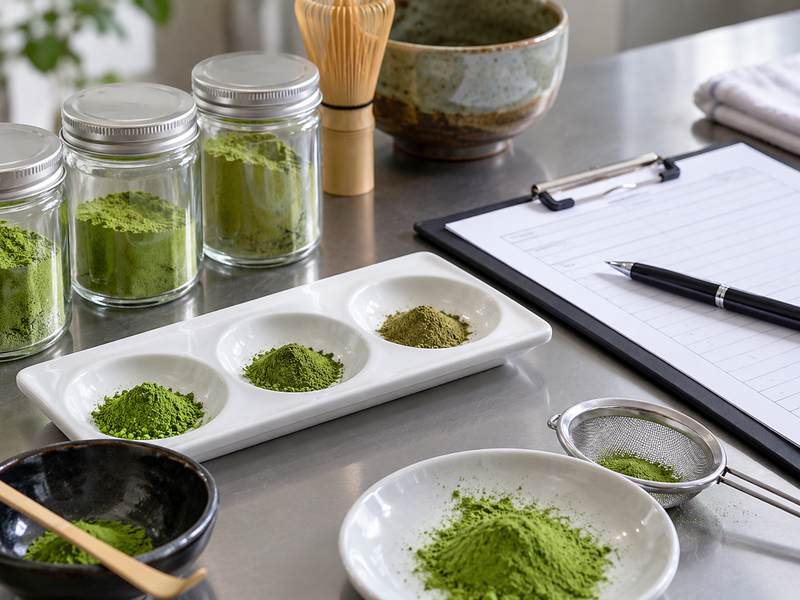
For sensory complaints, prepare a control using a written recipe with measured powder, liquid, temperature, tool and time. Then reproduce the customer’s reported method as closely as practical. Blind-code samples when comparing them so the team does not favor a brand or a known lot. Record observations separately before discussion. A bitter cup prepared with a much larger powder dose does not by itself prove a batch defect. Likewise, a properly prepared control does not dismiss a customer whose stock has a damaged seal.
Keep the question narrow: if color is disputed, compare powders under the same neutral light before adding milk. If grit is disputed, test texture in the customer’s application after the same whisk or industrial mixing cycle. If aroma differs, open comparable sealed packs at similar temperature. Do not taste a product suspected of contamination, foreign material or chemical exposure. Those cases move to an appropriate analytical and safety assessment. The goal is to distinguish a product property from storage, preparation or recipe effects, not to argue that the customer used the product incorrectly.
5. How do you compare retained and customer samples?
Build a fair three-way comparison
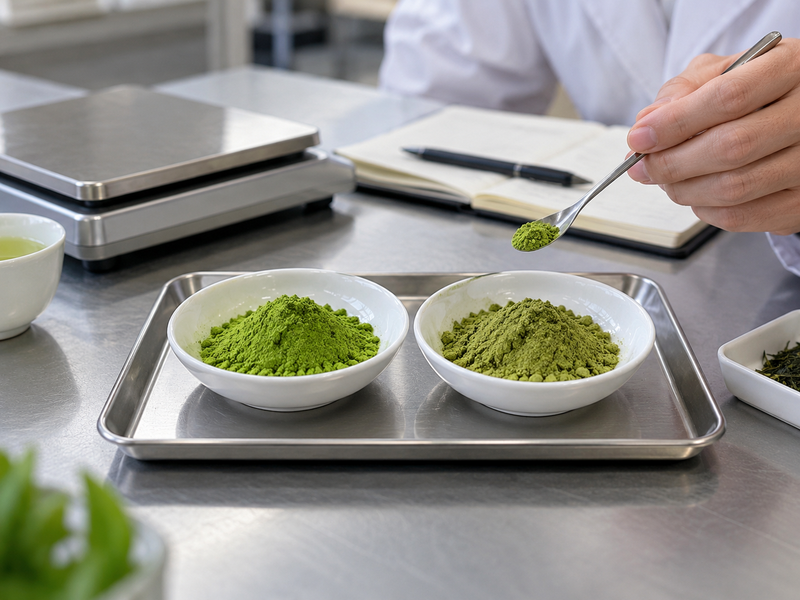
Compare the complaint sample with an unopened unit from the same lot and a released comparison lot when available. Record where each sample was held and whether its seal remained intact. A retained sample stored by the supplier can be useful, but it may not reflect heat, light or damage encountered in distribution. A customer’s opened tin shows actual use conditions but may have absorbed moisture after opening. Neither source tells the whole story alone. Examine packaging condition and product under a consistent method, then decide what further evidence is needed.
Look for patterns: if both the unopened customer unit and supplier retain show the same unusual color, investigate the lot and its specification. If only an opened counter tin shows the symptom, examine exposure and handling without ruling out a packaging issue. If complaints cluster in one shipping route, check transit conditions. Document uncertainty honestly. A single visual comparison cannot establish cause. If the claim involves a regulated parameter, use an appropriate laboratory method and chain of custody. Keep enough material for a repeat test if your procedure requires it; do not consume the entire retained sample in a tasting meeting.
| Sample | Strength | Limitation |
|---|---|---|
| Customer opened pack | Shows real use condition | Handling history may vary |
| Customer sealed pack | Same distribution route | May be unavailable |
| Supplier retain | Controlled lot reference | Different transport history |
| Comparison lot | Shows expected profile | Seasonal variation possible |
6. Which documents should the supplier provide?
Request records linked to the complained-of lot
Ask for the current product specification, certificate of analysis where supplied, lot definition, manufacturing and packing dates, packaging specification and storage guidance. Request any deviation or change record relevant to the symptom. If the complaint involves color, the agreed color standard or approved reference sample is more useful than a general “premium green” promise. For grit, ask how fineness or sensory texture is specified and checked. If it involves a safety concern, the qualified team should decide which test and production records are necessary.
Match documents to the purchase contract: a certificate of analysis is only useful if its lot number matches the stock in question and its methods and limits correspond to the agreed specification. Do not assume every COA includes pesticide, heavy-metal and microbiological results; review the actual document. Ask Matcha Village which lot-linked test reports and traceability records are available for the order under review. The supplier should also state when it will provide an investigation update and who owns corrective action. A sales assurance without a lot-linked record leaves the buyer unable to defend its own disposition decision.
7. How should you investigate color, taste and texture?
Convert adjectives into repeatable observations
“Brown” can mean an opened powder has darkened, a latte looks olive under warm lighting or the delivered lot differs from a previous harvest. Photograph samples under controlled light with a color reference if your business uses one. Taste complaints need a fixed preparation and blinded notes. Texture complaints need the same dispersion method and serving interval. Matcha Times’ symptom overview lists color, bitterness, clumps and sediment as common reports, but each symptom can have more than one cause.
Test the actual application: a powder that passes a water tasting may still perform poorly in an acidic beverage or dairy formula. Compare against the agreed approved sample, not an idealized social-media photo. Research on matcha storage conditions supports attention to color and packaging history, yet it cannot identify the cause in one complaint without lot evidence. Record the severity and frequency: a few fine particles that settle after a long wait differ from hard grit in every freshly mixed cup. This level of detail makes a supplier response testable.
| Symptom | Controlled observation | Next question |
|---|---|---|
| Dull color | Compare powder under same light | Lot or exposure pattern? |
| Bitter cup | Fixed dose and temperature | Product or recipe effect? |
| Hard clumps | Inspect sealed and opened packs | Moisture or mixing issue? |
| Grit | Standard dispersion and timing | Particle or process issue? |

8. When should you test rather than taste?
Escalate claims that sensory review cannot answer
Do not use tasting to investigate suspected microbial contamination, pesticide residue, heavy metals, undeclared allergen or chemical odor. Define the question and select a qualified laboratory with a suitable method and sample plan. Keep chain-of-custody records, lot identifiers and sealing details. If the supplier and buyer test different samples or use different methods, their results may not be comparable. Ask the food-safety lead to interpret any result against the correct legal and contractual limits for the destination market.
Avoid the quick negative: a result from one small sample may not prove an entire lot safe. Sampling design matters, especially when a contaminant may be unevenly distributed. Equally, a failed result needs confirmation and a documented risk response, not a sales-led argument about whether the number “looks close.” For a consumer illness report, follow the company’s incident process and applicable reporting channels promptly. The FDA’s food problem reporting information is a US starting point; overseas buyers need local requirements too. Put commercial credits on a separate track from the safety decision.
9. How do you decide on correction and disposition?
Close the case with evidence and an owner
Write the conclusion as “confirmed,” “not confirmed” or “inconclusive,” followed by the evidence and limits. Assign a disposition for each stock location: release, rework if legally and technically permitted, return, destroy or continue hold. Explain the customer remedy separately. A replacement shipment may settle a commercial claim while the root cause remains open. If preparation caused the issue, supply a tested recipe or training note without dismissing the customer’s experience. If the lot missed specification, agree on containment and supplier corrective action.
Look for recurrence: identify what control failed and how the next lot will be checked. A packaging leak may require a new seal test or transit check. A recipe mismatch may require a clearer application specification at purchase. Set a due date and verify action with new evidence. Do not mark a complaint “resolved” when a supplier merely says it will be more careful. Track days to acknowledgment, days to disposition and repeat complaints by lot. Keep correspondence and test results together, so an account manager can explain the decision accurately months later.
| Outcome | Stock decision | Follow-up evidence |
|---|---|---|
| Handling issue confirmed | Release unaffected units | Revised training check |
| Specification failure | Hold or reject affected lot | Supplier corrective action |
| Safety concern | Formal incident path | Qualified risk assessment |
| Cause unresolved | Maintain justified controls | Additional sampling plan |

10. How can the next lot be protected?
Turn complaint findings into incoming checks
Write the accepted sensory profile, application test, packaging condition and lot-linked documentation into the purchasing brief. Keep a sealed approval sample where appropriate and compare incoming material under the same method. Train receiving staff to photograph damaged cartons, confirm lot codes and hold unexplained substitutions. Review repeat complaints by product and customer application; a powder chosen for a plain bowl may underperform in a sweet, milky drink without being defective.
Close the loop with the buyer: tell the customer what was found, what remains uncertain and what action will follow. Do not offer a technical certainty the evidence cannot support. Ask the supplier to confirm any process or packaging change before the next shipment. For businesses buying matcha at scale, the most useful complaint record contains a lot, a sample, a reproducible method and a dated decision. Those four items make a fair supplier conversation possible and protect the next order from the same avoidable dispute.
Escalated cases need the records described in our supplier corrective action guide.
FAQ
Q1: What details should a matcha quality complaint include?
Record the lot, pack condition, symptom, quantity affected, storage history and preparation method where relevant.
Q2: Does bitter matcha prove a supplier defect?
No. Compare a controlled cup and lot reference before assigning cause; dose and recipe can change taste.
Q3: Should suspect stock stay on sale during review?
Follow the quality hold and food-safety procedure. Suspected harm needs immediate escalation.
Q4: Can a COA resolve every complaint?
No. It covers only listed tests and methods; sensory and packaging issues need other evidence.
Q5: When is laboratory testing needed?
Use qualified testing for safety or specification questions that sensory checks cannot answer.