
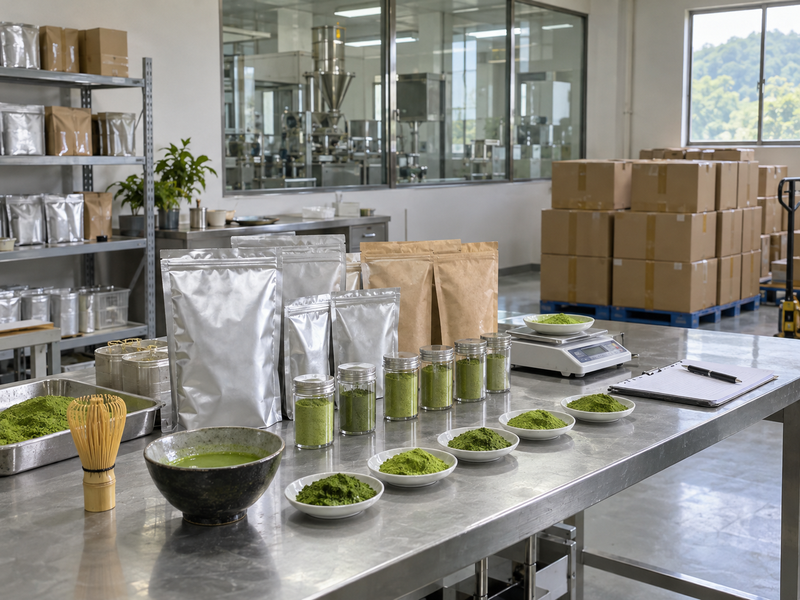
A wholesale matcha supplier should be evaluated on more than a price sheet and a green sample. A café chain needs a repeatable cup, a brand needs claims it can substantiate, and a distributor needs stock it can trace and replenish. The supplier may be a manufacturer, exporter, importer or reseller; each model can work if the responsibilities are clear. The costly surprises usually appear after approval, when a later lot, a different pack or a delayed shipment tests the original promise.
This guide gives buyers a qualification process they can run before a large order. It treats the supplier relationship as a chain of evidence: business identity, product fit, manufacturing control, lot records, commercial terms and response to problems. Matcha Village is itself a B2B manufacturer and supplier. Its perspective here is that a serious buyer should ask the same difficult questions of every candidate, including us.
1. What business is actually selling the matcha?
Identify the legal seller, production site, packer and exporter. They may be one company or several. Ask who owns the specification, who issues the invoice, who can investigate a quality complaint and who carries the inventory. A polished website does not tell you whether the company mills tea, blends ingredients, repacks imported powder or only brokers an order. None of those roles is automatically disqualifying, but the chain must be visible enough to manage changes and trace lots.
Request a business address, commercial contact, product catalog and a simple explanation of the supply path. If the seller claims a region or certification, ask how that claim applies to the exact product offered. Compare the answer with the pack label and documents. A buyer does not need every trade secret, but it does need a named party responsible for the powder it receives. If responsibility moves between firms, put handoff and complaint contacts in writing.
| Role | Question | Evidence |
|---|---|---|
| Legal seller | Who contracts and invoices? | Company details and quote |
| Manufacturer | Where is powder produced? | Site and product scope |
| Packer | Who seals and codes bags? | Pack specification |
| Exporter or importer | Who manages documents? | Shipping responsibility |
2. How can the supplier prove product fit?
Send an application brief before requesting samples. State whether the matcha will be whisked in water, mixed into milk, baked, frozen or blended with protein. Include target dose, sweetness, color, pack size and destination market. Ask for production-representative samples with product and lot codes. Test each under a fixed recipe and compare with an approved benchmark. A powder selected by appearance alone can fail when heated or mixed with a particular plant milk.
Ask whether the offered product will remain the same after the trial. Some suppliers send a small premium sample but quote a blended commercial grade. Request a sample from a normal production lot and, when possible, a second lot to see variation. Keep the winner as a retained reference. If the product needs adjustment, document the revised formula and repeat the test before approving it. The supplier’s ability to discuss a failed cup constructively is part of qualification.
3. What should a buyer ask about capacity and continuity?
Do not accept a single annual tonnage claim as proof that your order will ship on time. Ask for normal lead time for the exact product and pack, seasonal constraints, planned capacity allocation, raw material coverage and the process for a forecast increase. A small brand should also ask about minimum order and whether the same product can be bought in manageable sealed units. A large chain should ask how volume growth affects lot consistency and how changes in blend or source are approved.
Use a realistic rolling forecast rather than a speculative promise. If demand doubles, how much notice does the supplier need? If one lot is delayed, can it offer an approved alternate without silently changing the cup? Request examples of how a recent shortage or quality hold was handled, without asking for another customer’s confidential records. A supplier who explains constraints plainly may be safer than one who promises unlimited stock at every price.
| Continuity question | Buyer input | Supplier answer to record |
|---|---|---|
| Normal lead time | First and repeat volume | Production plus release time |
| Seasonal change | Forecast peaks | Allocation or reserve plan |
| Alternate lot | Approved cup standard | Change notification and trial |
| Emergency order | Minimum viable quantity | Available pack and delivery term |
4. Which quality records matter for each lot?
Start with a product specification and lot-specific certificate of analysis. Check product code, lot number, methods, units and results against the agreed limits. Add the documents required for the destination market, customer or claim: these may include relevant certifications, origin information and test reports. Do not assume every certificate shown on a website covers the powder in your quotation. Ask whether testing is performed in-house or by an external laboratory and how out-of-spec results are handled.
Quality records should be available before stock is released, not after a customer asks a difficult question. A supplier should also explain how it samples and retains production lots. A batch code that appears on a bag but cannot be linked to raw materials, packing and shipment is weak traceability. See the supplier certification guide for document scope, and keep the customer’s actual requirements in the contract rather than relying on generic marketing language.
5. Can the buyer trace a bag through the supply chain?
Pick a sample carton and ask the supplier to trace its code backward to production and forward to the shipment. The explanation should show where the tea or ingredient lot, milling or blending event, packing event and outbound case are recorded. A distributor may add a domestic warehouse code; ask how it maps to the original supplier lot. Traceability is most useful when staff can perform it promptly under pressure, so ask for a demonstration or a redacted example rather than a promise that “everything is traceable.”
Check what happens if stock is repacked into smaller bags or private-label tins. The mapping must survive that step. Agree on complaint reporting: what information should a café or retailer send, and how quickly will the supplier begin an investigation? A buyer can test its own side by following a shipped lot to one store or production batch. Weak internal records cannot be fixed by a strong supplier alone.
| Trace step | Record expected | Common break |
|---|---|---|
| Raw material to powder | Manufacturing batch link | Undocumented blend change |
| Powder to pack | Pack date and inner-bag code | Mixed lots in one case |
| Pack to shipment | Case and pallet record | Relabel without mapping |
| Buyer warehouse to customer | Lot-level pick history | Only SKU tracked |
6. What should a site or process review cover?
If an audit is appropriate for the order, focus on the processes that affect your product: raw material receipt, storage, milling or blending, allergen controls where relevant, packing, label verification, retained samples and nonconforming stock. A remote document review may be enough for a small pilot; a larger private-label program may justify a site visit or independent audit. Use qualified food-safety staff for formal assessments. A sales tour is not the same as an audit, but it can reveal whether the seller understands its own process.
Ask what parts are outsourced. If a different company mills or packs the powder, find out how the supplier approves and monitors that site. Review change control: will the buyer be told if the plant, ingredient source or barrier pack changes? Keep findings proportionate to the contract. A small buyer needs a reliable product and records, not a 200-question audit copied from an unrelated factory category.
7. How should commercial terms be compared?
Normalize the quote by product, pack, delivery basis, currency, minimum order and included services. Check whether sample testing, export documents, labels and freight are charged separately. Ask how long the price is valid and what changes at the next volume tier. A very low first-order price can be misleading if the repeat price, lead time or pack differs. Calculate cost per accepted drink or finished unit with the tested dose, not merely price per kilogram.
Clarify payment timing, claims procedure, replacement process and responsibility for damaged goods. Ask who pays for a retest if a lot is disputed and how the parties will agree on a sample. A transparent term sheet reduces friction later. For a buyer importing directly, the landed cost and customs responsibilities must be understood before comparing against a domestic distributor’s delivered price. Use a finance or logistics colleague when the terms are unfamiliar.
| Quote line | Compare on the same basis | Risk if omitted |
|---|---|---|
| Product and grade | Approved code and sample | Wrong powder |
| Pack | Inner mass and case count | Open-pack waste |
| Delivery | Named term and destination | Surprise freight or duties |
| Repeat price | Normal reorder tier | Unsustainable margin |
8. What does a fair first-order pilot look like?
Use a commercial lot and the intended pack, even if the quantity is modest. Confirm that the documents arrive, the bags survive shipment and the powder performs in ordinary service. Record order-to-ready-stock time, including quality release. Put the powder into a normal shift or factory trial rather than relying only on a development cup. Keep a retained sample from the delivered lot. If the first lot differs from the approved sample, investigate before changing the recipe.
Tell the supplier the decision criteria in advance. It should know whether the critical issue is iced-latte dispersion, bakery color, a certification scope or replenishment time. A pilot is also a service test: how clearly does the supplier answer technical questions, and how quickly does it address damage or a missing document? A perfect sample paired with confused commercial execution is not a successful pilot.
9. Which warning signs deserve a pause?
Pause when the seller cannot identify the product code or actual manufacturer, refuses to link a COA to the offered lot, gives changing answers about pack size, or promises certifications without scope. Other warning signs are a sample that cannot be repeated, a price that excludes necessary work without saying so, and an urgent push to buy a large quantity before a normal trial. None of these automatically proves bad intent; they show an information gap that a buyer should close before committing.
Do not confuse slow answers with dishonesty. A technical question may need a factory or laboratory response. Set a reasonable deadline and see whether the supplier follows through. Keep all offers on the same checklist. Buyers can be swayed by a friendly salesperson or a prestigious origin story, but the commercial lot must still meet the specification. A documented pause is cheaper than an untraceable shipment of powder nobody wants to use.
| Signal | Follow-up | Proceed when |
|---|---|---|
| Sample has no lot code | Request production-linked sample | Identity is documented |
| Certificate is generic | Request product and lot scope | Requirement is supported |
| Pack changes after quote | Repeat handling and stability review | Buyer approves new pack |
| Lead time is vague | Ask for production and shipping plan | Forecast can be supported |
10. How should the relationship be managed after approval?
Keep a current forecast, approved sample, specification and contact list. Review every production lot against the receiving plan. Track accepted lots, complaints, on-time delivery, pack damage and response time. If the supplier changes a source, formula or pack, run the agreed change process. A low complaint count can mean a good supplier, or it can mean stores have no easy way to report issues; check the reporting path too.
The best wholesale matcha supplier is the one that can deliver the accepted product and explain what changed when it cannot. Matcha Village welcomes B2B buyers who bring a target application, expected volume and document requirements to its contact team. The same qualification method should be used for every candidate. It turns a confident sales pitch into a decision a purchasing team can defend months later.
FAQ
Q1. Should a buyer choose a factory or a distributor?
Either can work. Compare the actual product, responsibilities, stock access, documents and service terms.
Q2. Is a sample enough to approve a supplier?
No. Check the first commercial lot, pack, records, delivery and response to ordinary problems.
Q3. What is the most important document?
A product specification linked to the approved sample and supported by lot-specific records is a strong starting point.
Q4. How many lots should be tested?
At least the commercial lot received; for a long program, testing more than one lot gives better evidence of consistency.
Q5. When should an approved supplier be reviewed again?
Review after material changes, repeat complaints, delivery problems or a scheduled performance cycle.