
Matcha dust on a filler’s frame is visible product loss and a cleaning burden. Dust on ledges above an open packing line raises a more serious question about the room design. A useful matcha production dust control plan starts with a walk through every point where powder leaves a closed container, then assigns containment, capture and cleaning checks to each point. The Matcha Seeker packing-line guide mentions dust extraction and housekeeping alongside filling equipment. The plan below turns those broad suggestions into a site survey and commissioning brief. Equipment and hazard decisions need qualified local review.
Contents
- 1. Where does powder leave containment?
- 2. How should the room map record dust?
- 3. Which transfers can be enclosed?
- 4. Where should local extraction be evaluated?
- 5. How can the line stay cleanable?
- 6. What should a housekeeping routine measure?
- 7. How should worker and fire risks be reviewed?
- 8. How can a capture system be commissioned?
- 9. What should buyers ask equipment vendors?
- 10. What belongs in the operating plan?
1. Where does powder leave containment?
Walk the product path with the line running
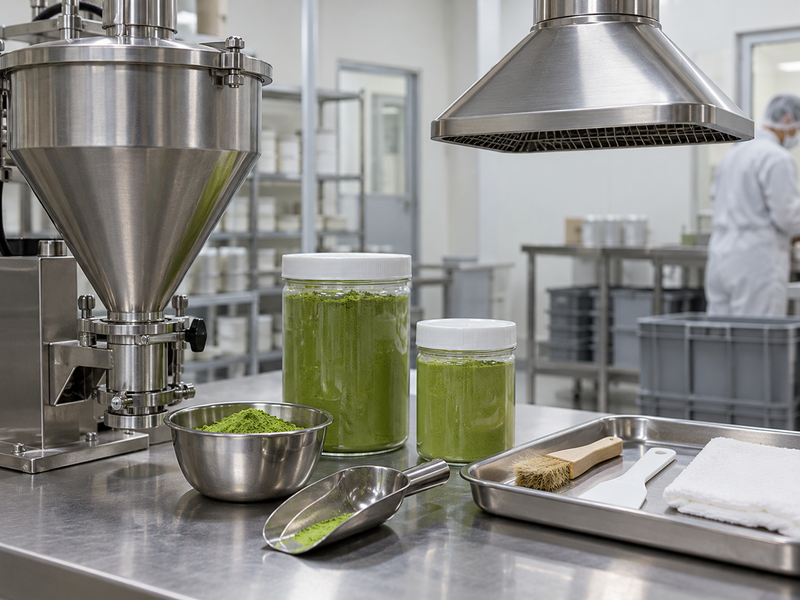
The packing-line reference identifies feeders, fillers and transfers as places where fine powder may escape. Trace a real batch from incoming bag to blender, intermediate bin, hopper, filler, reject station and finished pack. Mark every lid opening, manual pour, drop and connection change. A tidy idle line can hide the short plumes produced when an operator empties a sack or removes a full bin. Watch at normal production speed and during startup, refill and shutdown.
Record powder lot, pack size, transfer height and operator action at each point. Photograph settled residue after a defined run length, with permission under site rules. Note whether an exposed point sits near open packaging or a finished-product path. The first intervention may be a shorter, better fitted transfer, rather than a larger room fan. Follow the last kilogram. Bins often behave differently as their contents run low, and a filler that looks clean when full may throw dust during the final refill. Treat the map as evidence for a later engineering review, not a claim that a visual survey proves air quality.
| Transfer point | Observe | Record |
|---|---|---|
| Bag opening | Pour height and bag collapse | Dust on nearby surfaces |
| Blender charge | Lid gap and feed route | Operator position |
| Hopper refill | Spill and displaced air | Refill frequency |
| Filler discharge | Nozzle and sachet opening | Product on machine frame |
2. How should the room map record dust?
Mark surfaces and traffic, not only machines
Put the product flow on a simple room drawing and add people, carts, raw material, waste and finished goods. Mark high ledges, cable trays, exposed beams, floor joints and equipment undersides where dust can settle. Distinguish powder that leaves during normal operation from residue created during cleaning or maintenance. The map should show where operators stand so an engineer can evaluate capture without pulling dust across a breathing zone.
Use a repeatable observation window: the same SKU, line speed and number of bags processed. Record visible deposits and photographs at defined locations before cleaning. A photograph alone does not measure exposure or combustible-dust risk, but a series can show whether a control reduced deposits. Include doors and make-up air routes because airflow changes when staff open a loading door. Mark the hidden ledge. A clean floor can coexist with accumulation above the line. The OSHA combustible dust overview lists food powders among materials that can present dust hazards, while the status of this particular powder and installation needs specialist assessment.
| Room-map layer | Question | Owner |
|---|---|---|
| Open product | Where can dust reach tea or packs? | Quality lead |
| Worker path | Where does staff cross a plume? | Safety lead |
| Dust ledges | What cannot be reached for cleaning? | Maintenance lead |
| Air movement | What changes with doors open? | Ventilation designer |
3. Which transfers can be enclosed?
Shorten the exposed path before adding airflow
Check whether powder can move through a sealed connection between bags, bins, blender and filler. A fitted charging port, lidded intermediate bin or docked hopper can reduce the time powder remains open. The right connection must also permit inspection, lot change and cleaning. Ask staff to demonstrate a normal changeover; a cover that must be removed for every refill may offer little benefit during real work.
Compare one enclosed or partly enclosed transfer with the current method using the same batch mass. Weigh material lost to spills and cleanup, record transfer time and inspect residue at the marked sites. Watch for product bridging or trapped material inside the new route. Seals and gaskets should be accessible and specified for food contact where applicable. Test the changeover. A device that controls dust during a continuous run can become a spill source when disconnected. The FDA’s current good manufacturing practice overview identifies plant design, equipment maintenance and sanitary operations as part of food manufacturing controls; the site must apply its own requirements.
4. Where should local extraction be evaluated?
Capture near the release point
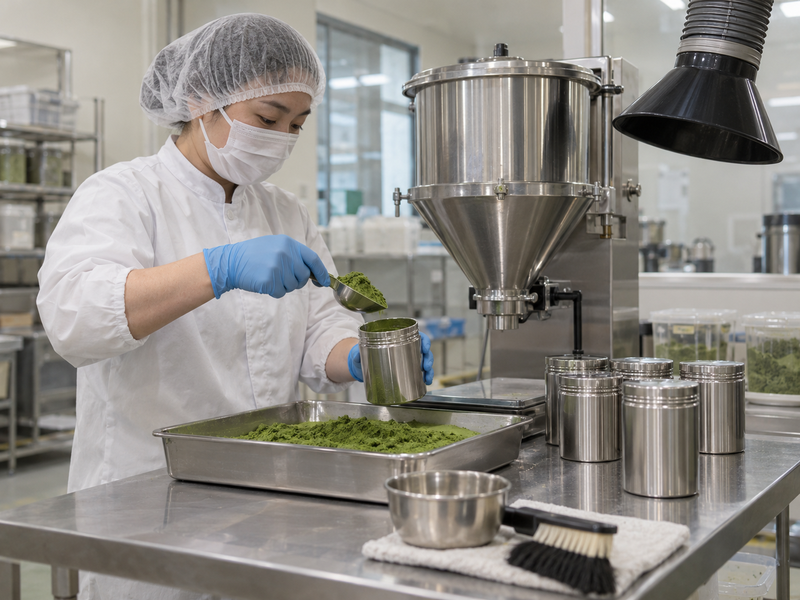
Local extraction may help at bag dumping, blender charging and filling where enclosure alone cannot contain a release. A qualified designer should select hood shape, position, ducting, filtration and discharge arrangements after reviewing the room and dust properties. Airflow that is too weak may miss the plume; airflow that pulls product from an open dose can cause giveaway or fill variation. A proposal should state both a capture objective and a product-loss check.
Ask the vendor to demonstrate performance while an operator performs the hardest normal task, not merely with an empty machine. Record visible plume, residue at fixed locations, fill-weight variation and noise. Include filter access and maintenance space in the drawing. A system that cannot be cleaned or serviced will deteriorate. Test the operator’s reach. If the hood blocks safe handling, staff may move it out of position. OSHA’s hierarchy of controls treats engineering controls such as local exhaust as measures that still require inspection and maintenance; PPE should not substitute for feasible source control.
| Extraction question | Evidence requested | Why it matters |
|---|---|---|
| Capture position | Layout and live demonstration | Plume enters hood |
| Product loss | Dose and waste comparison | Tea is not drawn away |
| Filter service | Access and replacement plan | Performance can be maintained |
| Air balance | Site review | Doors and adjacent rooms behave as planned |
5. How can the line stay cleanable?
Design access into every dust control
Containment can create hidden pockets if panels, guards and ducts are difficult to open. Walk around a proposed machine with the people who clean it. Can they reach the filler frame, underside, hopper seam and floor below without improvising tools? Are product-contact parts removable under a written procedure? Record each point that requires a ladder, machine move or production shutdown. That list belongs in procurement before a machine arrives.
For a pilot, time a full changeover from stopped line to verified clean condition. Record residues found after the first cleaning pass and where they collect. Match the cleaning method to powder behavior, equipment design and the site’s approved sanitation program. Wet cleaning can create residues if equipment is not designed to dry fully; dry methods also need a safety review. Open the guard. A gleaming exterior tells little about powder trapped at a gasket or behind a panel. Keep documented lot separation and final inspection so dust control does not create a new cross-contact or traceability problem.

6. What should a housekeeping routine measure?
Record accumulation and cleaning effectiveness
Set a cleaning schedule by actual accumulation rates rather than a generic “daily” label. Use the room map’s marked locations and inspect them after defined production quantities. Record which deposits appear first, how long removal takes and whether residue returns quickly. Include high surfaces, behind equipment and under conveyors, not only the floor. A supervisor should sign off the result and investigate repeated deposits at one point.
The OSHA technical manual on combustible dust calls for housekeeping audits that examine hidden accumulation. It also discusses efficient collection systems. The site safety team should approve cleaning tools and methods; sweeping or blowing dust into the air can make an exposure problem worse. A vacuum should be selected for the assessed environment and maintained to its approved specification. Look after cleaning. Residue that reappears immediately may signal a failed seal or poor capture, not careless cleaners. Escalate a recurring source rather than increasing cleaning frequency indefinitely.
| Inspection point | Frequency basis | Escalation trigger |
|---|---|---|
| Filler frame | Per run quantity | Fresh deposit after correction |
| Elevated ledge | Site risk review | Visible recurring layer |
| Bin docking seal | Each changeover | Leakage or damaged gasket |
| Collection equipment | Vendor and site plan | Reduced performance |
7. How should worker and fire risks be reviewed?
Separate product quality from hazard assessment
Visible dust can suggest both product loss and worker exposure, but neither can be quantified by color on a table. Assign a qualified safety professional to assess exposure, powder combustibility, ignition sources, electrical classification and fire or explosion protection as applicable. OSHA’s combustible-dust material includes food powders in its examples, but that does not establish the hazard characteristics of a specific matcha or blend. Sugar-containing blends may also differ from pure matcha. Obtain material data and site-specific testing or assessment where the professional requires it.
Document the actual process: room volume, equipment, dust collection route, maintenance tasks and likely upset conditions. Ask staff where they see plumes and when controls are bypassed. Do not set a universal safe dust-layer thickness or choose a collector from a generic web article. Put the specialist in the room. A review based only on a vendor drawing can miss overhead accumulation and the bag-dumping task that happens beside the line. Follow the jurisdiction’s worker and fire requirements before commissioning equipment.
8. How can a capture system be commissioned?
Verify performance during realistic production
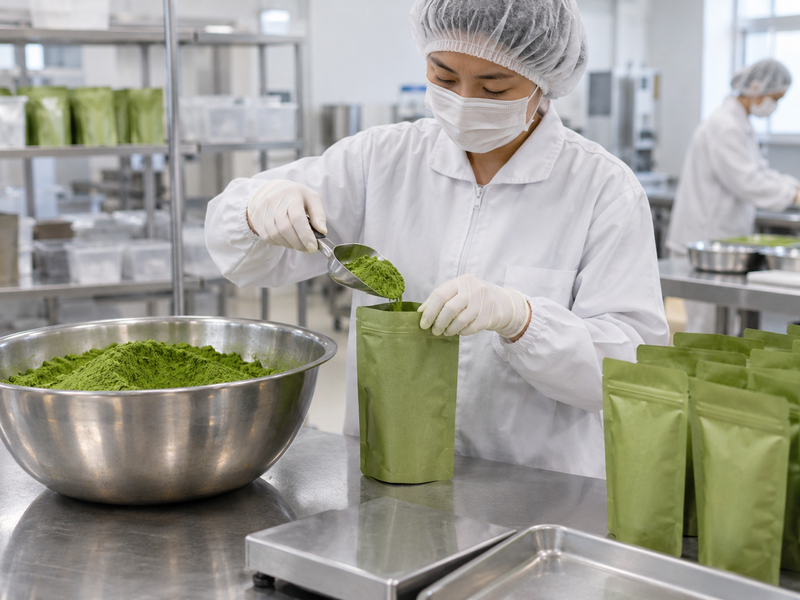
Commission with the powder, package format and line speed the site intends to use. Define a baseline before installation: transfer loss, fixed-location residue photographs, cleaning minutes, fill variation and operator observations. After installation, repeat the run with equivalent materials and tasks. A specialist should perform any exposure or system measurements required by the safety plan; the production team’s visual checks do not replace them.
Challenge the system at startup, hopper refill, bag change and end of run. Record hood position, filter condition, pressure or airflow indicators where fitted, door position and maintenance actions. Keep acceptance criteria in the vendor contract or commissioning protocol rather than arguing about “low dust” after installation. If product is being pulled away, record that tradeoff and request a design adjustment. Watch the refill. Dust control often looks strongest in steady operation and weakest during brief manual interventions. Retest after a major process or equipment change.
| Commissioning condition | Measure or observe | Record |
|---|---|---|
| Steady fill | Residue and fill data | Baseline comparison |
| Hopper refill | Plume and operator task | Capture response |
| Filter loading | Indicator trend | Service point |
| Door open | Airflow effect | Site operating rule |
9. What should buyers ask equipment vendors?
Make the request for quotation specific
Provide material description, powder or blend variants, estimated batch size, package format, line speed, room drawing and cleaning method. Ask vendors to mark every open transfer and state what containment or capture is included in their price. Require drawings for access panels, filter changes, utilities and waste collection. A simple list of machines does not show whether a line can be safely operated or cleaned.
Request a test using representative matcha and the intended packaging. Ask for measured throughput, fill variation, visible deposits after a defined run and changeover time. Separate what the vendor will deliver from work assigned to the building contractor or site engineer. The packing-line reference discusses dust extraction among several equipment choices, but its suggested settings are not a site specification. Our matcha filling-machine selection guide offers related buying checks. Price the interfaces. Missing ductwork, access space and commissioning can cost more than a small saving on the filler.
10. What belongs in the operating plan?
Give each control an owner and a test
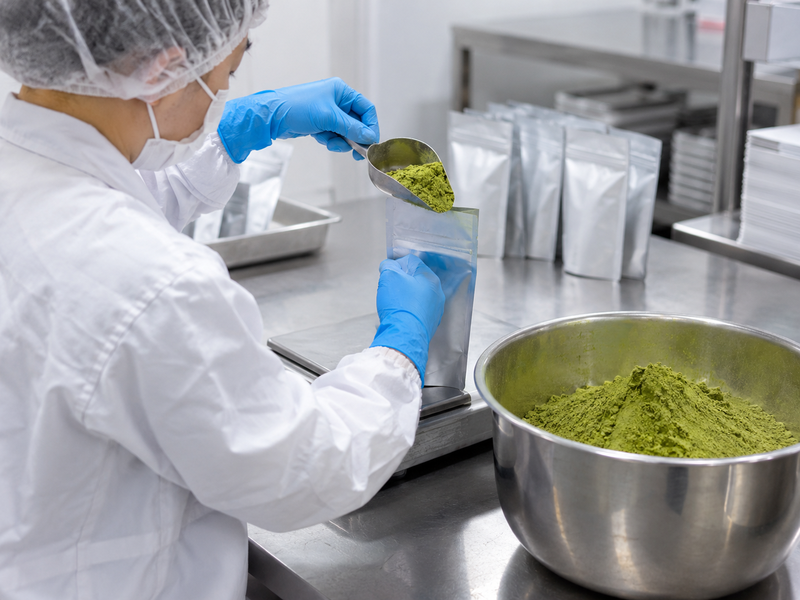
The final plan should contain the room map, transfer-point list, approved control at each point, vendor drawings, hazard review, commissioning results, cleaning method and inspection locations. Name who checks seals before a run, who reads system indicators, who cleans elevated surfaces and who may stop the line when capture fails. Include the lot and product variants tested because a new blend can behave differently.
Keep a change log for hopper parts, filters, powder formula, bag size and line speed. When a change alters dust generation, repeat the relevant observations and obtain the site’s safety review before assuming old controls still apply. Matcha Village can discuss powder and blend specifications with buyers, but the packing-room design belongs to the operator and qualified engineers. Close the loop. A control plan works when a repeated deposit triggers a named response and a documented retest, not another note in a cleaning book.
FAQ
Q1: Where does matcha production dust control start? Map every open transfer during an actual run, including refill and shutdown.
Q2: Is room ventilation enough? A qualified designer should evaluate source enclosure and local capture against the site’s process and hazards.
Q3: Can staff use any vacuum for matcha dust? Select cleaning equipment through the site’s hazard assessment and approved sanitation plan.
Q4: How should the result be checked? Compare defined production runs, residue points, product loss and required specialist measurements.
Q5: When should the plan be reviewed again? Review it after material, speed, transfer or equipment changes and when deposits recur.