
The phrase “matcha Nespresso pods” describes a shopper’s intended brewer, not a single capsule specification. Buyers developing a third-party matcha capsule must identify the exact machine family, prove mechanical and beverage performance on named models, and state compatibility without implying a relationship with Nespresso. Matcha powder also needs a different evaluation from coffee extraction: the buyer cares how much powder reaches the cup, how it disperses, and how the capsule behaves during brewing. The consumer guide to matcha capsules shows demand and common questions; this article supplies a trial plan a brand or café buyer can use with a capsule manufacturer.
Contents
- Which brewer system is the capsule intended for?
- What must a capsule supplier specify first?
- How do you build a useful machine test matrix?
- How should powder recovery be measured?
- What beverage-strength checks matter?
- How do you detect clogging or machine stress?
- What seal and storage checks belong in the trial?
- How should compatibility claims be written?
- What should buyers compare across prototypes?
- When is a capsule ready for a pilot order?
1. Which brewer system is the capsule intended for?
Name the machine family and model
Start by separating Nespresso Original and Vertuo. Nespresso’s official Vertuo capsule page describes a system that uses machine-read capsule barcodes. Its official FAQ explains that the Original and Vertuo capsule systems are different. A statement that a matcha capsule works in a “Nespresso machine” therefore lacks the detail needed for a purchase decision. Ask the supplier to name the precise machine models and capsule geometry tested, then identify exclusions.
| Buyer question | Required answer | Why it matters |
|---|---|---|
| System | Original, Vertuo, or another | Different capsule interfaces |
| Model | Named brewer models and versions | Fit can vary |
| Brew setting | Button or cup program used | Changes delivered beverage |
| Exclusions | Untested or failed machines | Prevents broad claim |
Do not infer Vertuo compatibility from an Original-shaped prototype. Do not assume a capsule works with all Original machines because it entered one brewer. The practical starting point is an exact, dated compatibility matrix, with one row for each machine and setting the brand intends to mention.
2. What must a capsule supplier specify first?
Freeze the prototype before testing
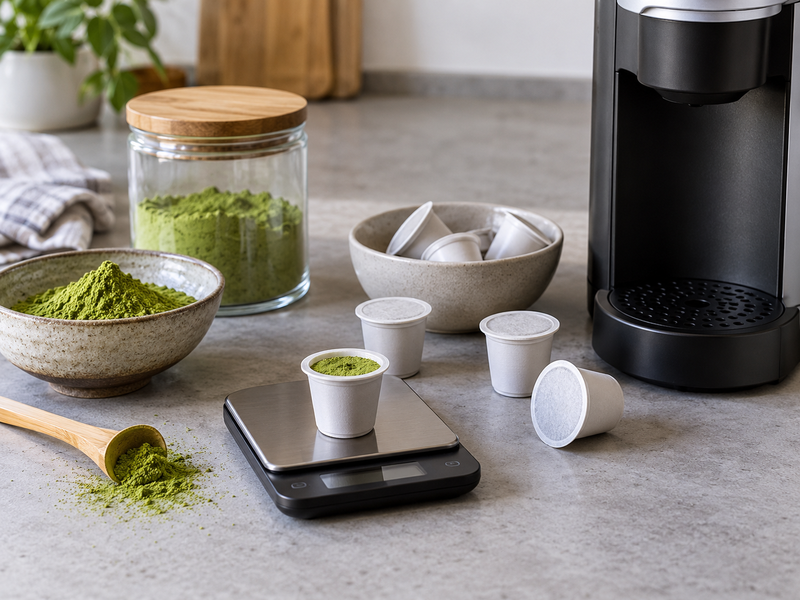
Obtain a specification for capsule shell, lid or foil, intended machine family, filled mass, matcha grade and particle characteristics, headspace, seal method, and case packaging. Record the lot of powder and capsules used in each trial. A successful drink made with one prototype does not validate another shell, foil, fill weight, or powder batch. Ask the supplier to document whether its product is a dry powder capsule, a blend with other ingredients, or a different formulation entirely. The ingredient and allergen review must follow the actual formulation and destination market.
| Specification element | Record before test | Change control question |
|---|---|---|
| Shell and lid | Supplier, material, dimensions | Does it alter machine fit? |
| Powder | Grade, lot, fill mass | Does flow or taste change? |
| Closure | Seal method and inspection | Does leakage risk change? |
| Pack | Secondary barrier and units/case | Does distribution change? |
Request a signed sample and a revision code. A buyer should be able to order the same item that passed its trial. If the supplier cannot describe the structure and formulation with enough precision to repeat it, the buyer cannot interpret later complaints or compare batch performance.
3. How do you build a useful machine test matrix?
Test more than one perfect brew
Choose the models actually used by customers, staff, or pilot locations. Include more than one unit of a model when practical, because wear and maintenance can affect real use. Define machine cleaning status, water conditions, brew program, cup volume, capsule orientation, and a repeat count before testing. Run a reference capsule appropriate to the machine to check that it operates normally; do not modify the brewer to make a matcha prototype work. Record each trial’s completion, leaked powder, unusual noise, error message, capsule ejection, and cleaning needed afterward.
| Matrix field | Example record |
|---|---|
| Machine | Make, model, serial or asset ID |
| Condition | Cleaned date and observed state |
| Program | Selected button or volume |
| Result | Complete, partial, failed |
| After-use | Ejection, residue, cleaning |
Test after several sequential brews as well as from a cold start. A capsule that succeeds once but leaves residue that disrupts the next cup is weak for café service. Keep machine-model results separate; an average success rate across incompatible and compatible machines conceals the problem. The capsule guide raises the existence question, while the matrix answers whether a specific third-party product performs on the buyer’s equipment.
4. How should powder recovery be measured?
Track where the filled matcha goes
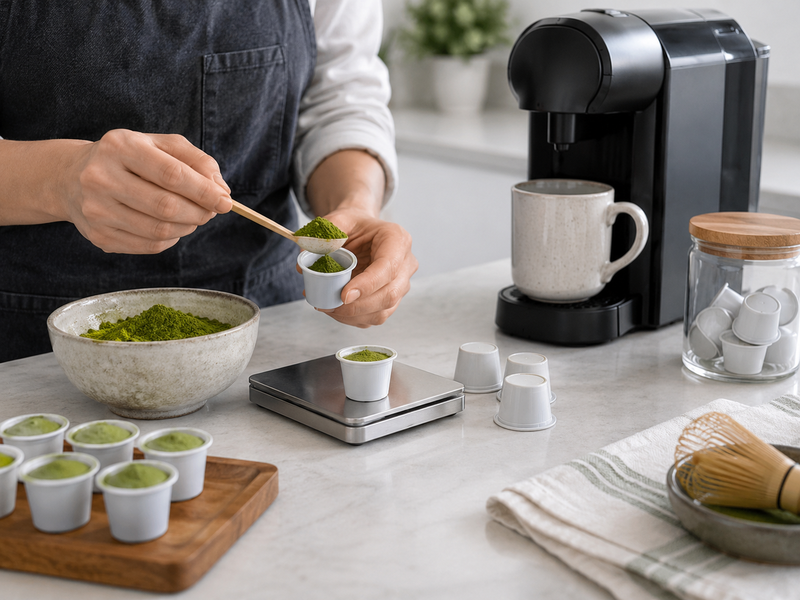
Weigh the filled capsule and its empty components using a repeatable method, then estimate the powder mass loaded. After brewing, inspect and weigh residual material in the spent capsule under a defined drying or separation procedure if the test method requires it. Collect and examine beverage sediment and any powder lost in the capsule chamber or drip tray. The objective is not to invent a universal extraction percentage; it is to compare prototypes under the same method and find where usable powder is left behind.
| Powder path | What to observe | Buyer decision |
|---|---|---|
| Cup | Color, dispersion, sediment | Is drink acceptable? |
| Spent capsule | Residual powder | Is recovery consistent? |
| Machine chamber | Loose powder | Is cleaning burden acceptable? |
| Drip tray | Leakage or fines | Is there a defect? |
Matcha is a suspended powder beverage, so a clear cup is not the goal. Define the desired preparation: a straight short cup, a base for a latte, or a concentrate to whisk or stir further. State the method in the trial report. If the product requires a second step, the customer instructions should say so rather than implying a finished café drink from one button press.
5. What beverage-strength checks matter?
Judge the drink customers will make
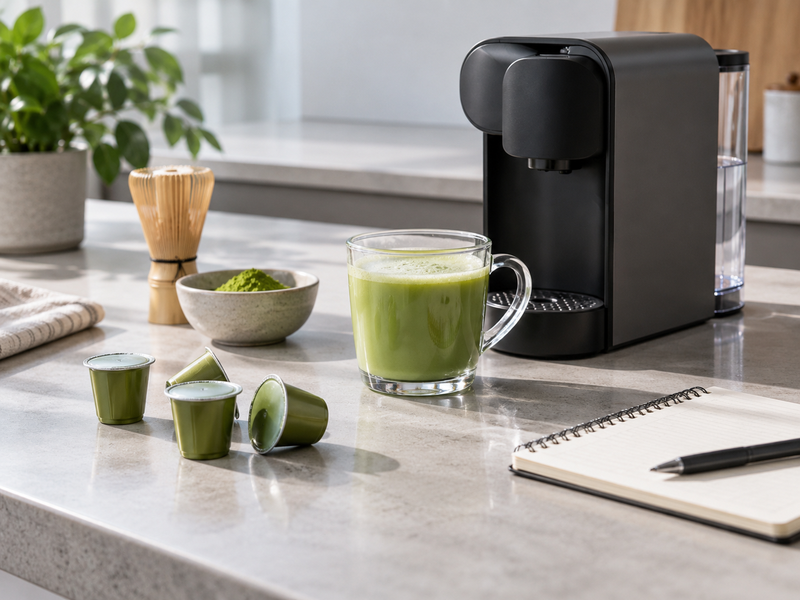
Set the target cup volume and preparation before comparing prototypes. Record delivered volume, temperature at a defined point, visible clumps, sediment after a fixed time, and a structured sensory assessment for aroma, bitterness, color, and mouthfeel. For a latte base, test the capsule output after the milk or alternative is added in a fixed ratio. A capsule can brew cleanly but make a weak drink at the machine’s default long setting. Conversely, a concentrated short output may be useful if the instructions tell the customer how to finish it.
| Beverage criterion | Test condition | Acceptance owner |
|---|---|---|
| Delivered volume | Named machine program | Product team |
| Powder dispersion | Same stir and wait time | Product team |
| Sensory profile | Blind comparison if possible | Trained panel/buyer |
| Latte performance | Fixed milk ratio | Café or brand team |
Use the approved matcha specification and a control preparation made from the same powder lot. This helps distinguish a capsule-delivery problem from a raw-material difference. Keep taste thresholds as buyer-defined product decisions. Avoid presenting an untested health or nutritional advantage as a reason to select one capsule.
6. How do you detect clogging or machine stress?
Watch the brewer before and after the cup
Record whether the machine pierces, pumps, completes the cycle, ejects, and returns to ready state normally. Note unusual resistance, interrupted flow, repeat button presses, leaks, error messages, or powder deposited near the piercing and outlet areas. After a defined series of brews, inspect accessible parts according to the machine’s instructions and record cleaning time. Do not dismantle or alter a customer’s brewer for a routine trial. If a prototype repeatedly fails, stop that machine test and investigate the capsule rather than forcing it through.
| Signal | Why it matters | Response |
|---|---|---|
| Interrupted flow | Possible blockage or fit issue | Stop and inspect |
| Capsule not ejected | Mechanical mismatch | Record model and unit |
| Powder at chamber | Containment failure | Examine seal and puncture |
| Rising cleaning time | Poor service fit | Compare design alternatives |
Use a buyer-set failure threshold before the trial so a few successful cups do not outweigh repeat failures. Have the capsule supplier review physical evidence from failed units. Machine compatibility is a measured claim for the exact model and prototype; it should be rechecked after shell, lid, powder, or filling changes.
7. What seal and storage checks belong in the trial?
Protect the capsule before brewing
Inspect capsule lids, seams, dents, and case packaging on receipt. Test the supplier’s seal integrity method on production-equivalent units, and check for powder leakage after shipping simulation or an actual pilot delivery. The capsule may also need a secondary barrier or pack design appropriate to the matcha and intended storage conditions. Ask for product-specific stability evidence before setting a shelf life; this article does not assign one. Keep the first-open feature of any retail carton separate from the capsule seal itself.
| Check point | Evidence |
|---|---|
| Incoming capsules | Damage and seal inspection |
| Filled units | Recorded closure checks |
| Distribution | Post-transit leakage and fit trial |
| Storage | Product-specific quality assessment |
Run brews using units from the beginning and end of the proposed storage period when the buyer’s validation plan requires it. A fresh prototype may fit and taste well while a poorly controlled pack ages differently. The site’s quality information can guide supplier questions, but capsule-specific tests should be requested from the actual maker.
8. How should compatibility claims be written?
State the tested models and independence clearly
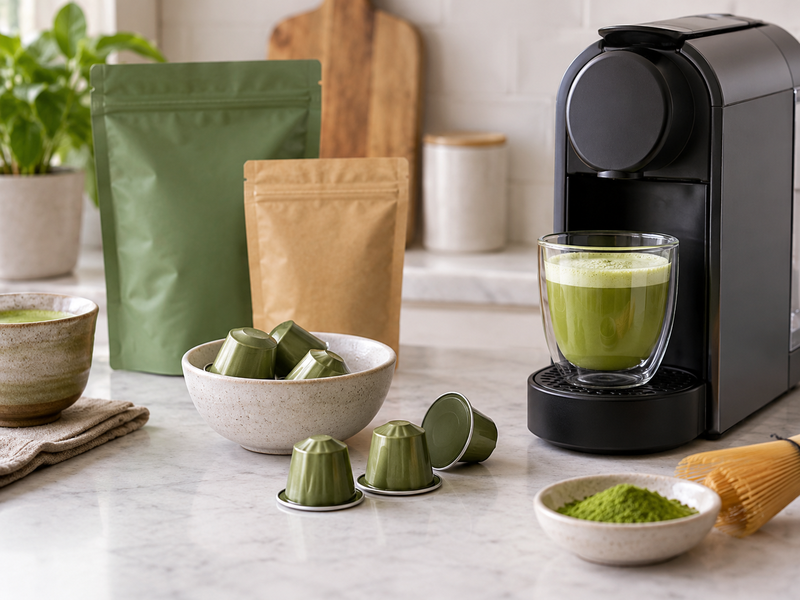
Use a factual third-party statement tied to the tested system and model list, such as “compatible with the listed Nespresso Original machines,” only if the evidence supports it and legal review approves the wording for the market. State that the capsule is made by the named third-party brand and is not made or endorsed by Nespresso. Do not use Nespresso branding, capsule artwork, or logos in a way that implies an affiliation. Avoid “works with all Nespresso machines,” especially because Nespresso’s official materials distinguish Vertuo’s barcode-based system.
| Claim element | Good evidence | Risky shortcut |
|---|---|---|
| System named | Tested Original models | “All Nespresso” |
| Model list | Dated test matrix | One-machine inference |
| Brand identity | Third-party maker stated | Implied official product |
| Instructions | Tested brew program | Generic cup promise |
Have counsel or a qualified market reviewer assess trademark and label use. A compatibility statement is a factual product claim that should remain accurate as machines and capsule designs change. Put the exclusions where a buyer can see them before purchase, not only in a technical file.
9. What should buyers compare across prototypes?
Score service performance as well as taste
Compare prototypes under the same machine, powder lot where possible, brew setting, cup recipe, and test count. Score mechanical completion, powder recovery, beverage acceptance, post-brew residue, seal defects, unit cost, and supply reliability. A prototype with excellent flavor but frequent eject failures is not ready for a café route. A cheaper shell that requires staff to clean the machine after every few drinks may cost more in practice. Keep the raw observations alongside summary scores so a weighted total does not hide a critical failure.
| Criterion | Prototype A | Prototype B | Minimum acceptable result |
|---|---|---|---|
| Machine completion | Buyer fills in | Buyer fills in | Buyer sets before trial |
| Cup profile | Buyer fills in | Buyer fills in | Approved sensory target |
| Residue/cleaning | Buyer fills in | Buyer fills in | Service standard |
| Delivered cost | Buyer fills in | Buyer fills in | Commercial target |
If a supplier proposes a different matcha grade to improve flow, test its sensory and specification effect separately. Do not quietly trade away the approved product identity to fix a capsule problem. Ask for a revision-controlled sample from the selected design before issuing a pilot order.
10. When is a capsule ready for a pilot order?
Close the test gaps in writing
Approve a limited pilot only when the capsule specification, machine list, brew instructions, quality checks, and claim wording have named owners and recorded results. State the pilot quantity, lot traceability, acceptance sample, defect handling, and feedback channel. Ask pilot sites to log machine model, setting, failed cycles, residue, and customer preparation problems. Set a review date and a threshold for stopping or revising the design. A pilot is a controlled commercial test, not proof that every machine or usage condition has been covered.
Before full rollout, compare pilot results with the bench trial and investigate deviations. If the supplier changes shell, lid, fill mass, powder, or sealing process, decide which trials must be repeated. Keep the public compatibility statement aligned with the validated model list. For buyers sourcing matcha itself, the site’s bulk wholesale page is a commercial starting point; capsule manufacture and machine compatibility must be established with the specific third-party supplier.
FAQ
Q1. Are Original and Vertuo capsules interchangeable? No. Treat them as separate systems and check the exact machine model.
Q2. Does one successful brew prove compatibility? No. Repeat trials across named machines, normal use, and sequential brews.
Q3. Should a matcha capsule produce a completely clear drink? No. Assess powder delivery and dispersion against the intended matcha beverage.
Q4. Can a third-party brand use “Nespresso” in a compatibility statement? Seek market-specific legal review and use only accurate, clearly independent wording supported by model tests.
Q5. What should a buyer request before a pilot order? Ask for the capsule specification, dated machine matrix, beverage and residue results, seal checks, instructions, and approved claim wording.