
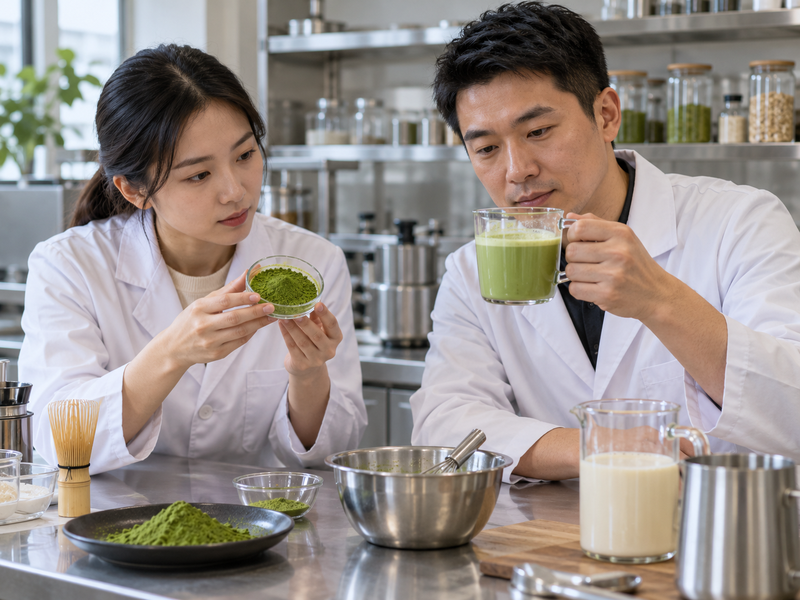
A café can buy pure matcha powder for a vegan drink and still serve a non-vegan cup. Milk, whipped topping, honey, and flavored syrup may enter during assembly. A retail brand faces a different problem: a pouch called “matcha” might contain milk powder or a creamer with ingredients that need review. Matcha powder vegan claims work best when buyers separate the leaf itself from formulated products, production controls, and the final recipe. This guide turns that distinction into a purchasing and menu check.
Contents
- 1. Is pure matcha powder vegan by its ingredients?
- 2. Why can a matcha latte fail a vegan menu claim?
- 3. Which blend ingredients deserve closer review?
- 4. Does an allergen statement prove a product is vegan?
- 5. How can buyers verify a vegan certificate or logo?
- 6. How should a café test vegan matcha recipes before launch?
- 7. What should a vegan retail brand ask an OEM supplier?
- 8. How should vegan claims be written on menus and packs?
- 9. How does powder selection affect cost and consistency?
- 10. What controls keep a vegan matcha program accurate over time?
1. Is pure matcha powder vegan by its ingredients?
Pure matcha is finely ground tea leaf. A product whose ingredient list contains only matcha has no intentional animal-derived ingredient in that list. That is a useful starting point, but a buyer still needs to confirm that the specification and delivered product match. The phrase “matcha powder” also appears on flavored mixes, sweetened latte powders, and blends. Those products require a full formula review. A front label is too broad a source for a vegan claim.
Read the actual declaration. Request the ingredient statement, product code, and specification for the exact grade under consideration. Compare the sample pouch, technical sheet, and quotation. For a private-label project, approve the printed ingredient line only after formula sign-off. If a supplier offers pure powder and latte premix under one brand, use distinct stock codes and storage locations. A buyer should not transfer the pure powder's status to the premix. The same rule applies when a café changes from weighing powder to using a convenient ready-to-mix product.
| Product form | Likely ingredient scope | Buyer action |
|---|---|---|
| Pure matcha | Ground tea leaf | Verify single-ingredient specification |
| Sweetened blend | Tea and sweeteners | Review all inputs |
| Latte premix | Tea, creamer, other inputs | Review full formula and allergen line |
| Café drink | Powder plus service ingredients | Audit finished recipe |
2. Why can a matcha latte fail a vegan menu claim?
The drink contains more than powder. Cow's milk is an obvious example, but a café may add dairy foam, condensed milk, honey, chocolate sauce with milk, or toppings made with gelatin. A plant milk swap does not fix those additions. Even a pre-prepared matcha base can contain milk powder or a non-vegan flavor component. Check each ingredient and every preparation step in the approved recipe, including optional toppings and seasonal substitutions.
Map one finished cup. List the ingredients in order of use, from powder and water through milk, syrup, topping, and garnish. Then check labels against the actual stock delivered to the store. A chain might have a vegan base recipe but allow local stores to substitute syrups when stock runs out. That change needs a controlled approval process. Staff should know whether a shared pitcher or dispenser requires cleaning under the brand's vegan policy. The claim on the menu refers to the served drink, not just to the tea ingredient purchased by headquarters.
3. Which blend ingredients deserve closer review?
Creamers are an obvious review point because some use dairy proteins even when much of the fat comes from plants. Flavors, emulsifiers, colors, glazing agents, and vitamin carriers may require supplier statements to establish their source. This does not mean each ingredient is necessarily animal-derived. It means a buyer cannot infer origin from a familiar chemical name or from a marketing phrase on the front of the bag. Where a customer requires a formal vegan certification, use that program's criteria and accepted evidence.
Ask for a formula-level answer. The supplier should identify each ingredient and subingredient, its source declaration, and the formula revision that was reviewed. If a flavor house changes its carrier or a creamer supplier changes composition, the finished blend may need another check. Agree on change-notification rules before production. For a product sold across several markets, translate the approved formula into each market's required ingredient and allergen labeling format with local regulatory review. Vegan status does not remove the need to declare allergens correctly.
| Input | Why review it | Useful evidence |
|---|---|---|
| Creamer | May contain milk protein | Detailed specification |
| Flavor | May contain carrier subingredients | Supplier declaration |
| Sweetener | Source or processing may matter to policy | Source statement |
| Topping | Finished drink can change status | Recipe and pack label |
4. Does an allergen statement prove a product is vegan?
No. Allergen controls and vegan criteria answer different questions. A product can avoid declared milk ingredients and still have another animal-derived input. Conversely, an allergen precaution such as “may contain milk” can describe possible cross-contact rather than a deliberate ingredient. A buyer must read the actual statement and understand the chosen vegan standard before using a claim. Food safety and allergen labeling rules for the destination market still apply regardless of a vegan positioning.
Separate three records. Keep the ingredient declaration, allergen assessment, and vegan claim approval as distinct documents. Ask whether the manufacturer has shared equipment with dairy products and what cleaning, scheduling, and verification steps are used. A vegan certification agency may set its own threshold or process rules for cross-contact. An uncertified brand should write its own policy and have qualified reviewers test it against customer expectations and local law. Avoid promising “dairy-free” merely because a recipe is described as vegan; that phrase may carry separate allergen implications.
5. How can buyers verify a vegan certificate or logo?
A vegan logo can be useful evidence only if it covers the exact product and the organization issuing it is acceptable to the buyer. Check the named company, product code or range, manufacturing site, validity dates, and conditions of use. Some programs certify a finished product, while others may review ingredients or a manufacturing process. Read the scope. A certificate for pure matcha should not be attached to a new latte blend without review.
Match the pack to the permission. Private-label artwork often changes after an OEM formula is approved. Confirm whether the certifier authorizes the buyer's brand and the intended packaging. Keep approval correspondence with the final print proof. If the supplier only offers a self-declaration, ask what records support it and decide whether that is enough for your retail customer. A supermarket, foodservice distributor, and direct-to-consumer brand may have different acceptance criteria. The final claim should follow the strictest relevant contract and market requirement, not the most attractive logo available.
| Certificate element | Comparison point | Action on mismatch |
|---|---|---|
| Product name | Order and label | Ask for corrected scope |
| Manufacturer | Actual production site | Confirm legal entity and address |
| Date | Production and shipment | Obtain current evidence |
| Logo permission | Final artwork | Hold printing pending approval |
6. How should a café test vegan matcha recipes before launch?
Start with the finished recipe, not a supplier brochure. Make the drink with the actual powder, plant milk, syrup, water, ice, and service tools the store will use. Evaluate dispersion, color, taste, and stability after the expected handoff time. Some plant milks foam or separate differently; a recipe that works with dairy may need a new mixing order. The choice of powder grade should follow the target drink, since a delicate tea profile can disappear under strongly flavored milk or syrup.
Include the busy shift. Ask several baristas to make the same cup from written instructions. Watch for unapproved substitutions, shared scoops, and topping errors. If the vegan version shares a blender or pitcher with dairy drinks, decide how equipment is cleaned and how the menu describes cross-contact under local rules. Store training should identify which ingredients are approved by code, not by memory of a package color. A supplier sample may taste fine in a test kitchen; repeat the trial after the production SKU and final recipe are frozen.
7. What should a vegan retail brand ask an OEM supplier?
Request the exact formula, subingredient information where needed, allergen assessment, manufacturing and packing sites, vegan evidence, shelf-life basis, and packaging specification. Ask who controls substitutions and how quickly the buyer is notified. For pure matcha, confirm that the quoted product contains only tea and that the packing site uses the approved label. For blends, ask whether alternative creamers or flavors are proposed when ingredients become unavailable. Price flexibility is helpful only if a revised formula goes through the same approval route.
Follow one production lot. Ask for a mock document pack that ties ingredient lots to finished product code and pack date. Inspect how rejected or obsolete printed pouches are kept away from production. A startup brand might begin with a small run, then expand to several flavors. Each flavor needs a separate ingredient and claim review, even when the base matcha is unchanged. Put approval responsibilities into the supply agreement: who signs formula revisions, who approves artwork, and who may release finished goods for shipment.
| OEM question | Why it matters | Record to retain |
|---|---|---|
| Exact formula revision? | Prevents silent substitutions | Signed specification |
| Which packing site? | Connects goods to approved process | Site details |
| Which logo may appear? | Controls claim use | Written authorization |
| How are changes reported? | Protects repeat orders | Change clause |
8. How should vegan claims be written on menus and packs?
Use language that accurately describes the finished item and the evidence behind it. “100% matcha” on a powder pack addresses composition; “vegan” addresses a different promise. A drink made with plant milk may still require review of syrup and toppings. Avoid broad claims such as “all matcha drinks are vegan” if some recipes use dairy. On packaged products, compare front claims with the full ingredient list and allergen statement before printing.
Make choices unambiguous. A café menu can identify a vegan recipe by its approved build rather than relying on a verbal milk swap. A distributor's catalog should distinguish pure powder from dairy-containing latte premix with separate codes and descriptions. Online listings must match the current physical pack, especially after a formula change. If cross-contact warnings are required or useful under local law and policy, review their wording with a qualified adviser. Vegan language should not hide allergen information or imply that a product is suitable for everyone with a milk allergy.
9. How does powder selection affect cost and consistency?
A vegan positioning does not tell buyers which matcha grade to buy. For a straight tea drink, aroma and mouthfeel may be exposed. In an oat latte or frozen dessert, color retention, dispersion, and flavor through other ingredients may matter more. Set an application brief with target taste, dose range, packaging size, and budget. Test two or three grades in the same recipe and record the outcome. Compare cost per finished serving rather than cost per kilogram alone.
Watch the handoff. A powder that needs extra whisking or sieving can add labor in a café. A powder that settles heavily may create consumer complaints in a bottled beverage. For a retail pouch, oxygen and moisture protection affect color and aroma during storage. Ask the supplier for batch-level specifications and a process for handling out-of-range lots. Trial both an opening sample and a later production lot. A stable vegan menu depends on repeatable supply as much as on a one-time ingredient declaration.
| Application | Powder trial focus | Cost lens |
|---|---|---|
| Straight tea | Aroma and mouthfeel | Cost per prepared cup |
| Plant-milk latte | Flavor through milk | Dose and waste |
| Frozen dessert | Color and texture | Inclusion level |
| Retail pouch | Pack stability | Yield and returns |
10. What controls keep a vegan matcha program accurate over time?
Maintain an approved-product list that includes powder, plant milks, syrups, toppings, and any premixes used in a finished drink. Keep formula versions, supplier declarations, certificates where used, artwork approvals, and store recipes in one controlled location. Review them when a supplier, ingredient, packing site, or service procedure changes. A recurring calendar check catches expired documents; a change notice clause catches changes between scheduled reviews.
Put receiving into the loop. Staff should compare delivered item codes with the approved list and flag substitutions. A brand team should check marketplace pages after every packaging update. A café chain should sample stores for recipe compliance and ask whether staff understand the difference between plant milk and a complete vegan build. If an unexpected ingredient is found, hold affected stock, identify lots and channels, and correct the claim with appropriate professional advice. Clear internal codes and simple recipes prevent most confusion before it reaches customers.
Pure matcha can fit a vegan product, but the finished SKU and finished drink determine the claim. Confirm ingredients, production evidence, recipe additions, and packaging language before launch. Ask the supplier for one approved code with a complete document set, then repeat the same checks when the formula or service build changes.
FAQ
Q1: Is unsweetened pure matcha powder vegan?
Its sole ingredient is tea leaf, which is plant-derived. Confirm that the commercial SKU matches the single-ingredient specification.
Q2: Does oat milk make every matcha latte vegan?
No. Syrups, toppings, premixes, and other recipe components also need review.
Q3: Does “may contain milk” mean milk is an ingredient?
Not necessarily. It may describe potential cross-contact; assess the full label and your chosen claim policy.
Q4: Can a vegan certificate for pure matcha cover a latte premix?
No automatic transfer applies. Have the finished premix reviewed under the certification program.
Q5: What should a buyer request from a supplier?
Ask for the exact ingredient specification, allergen information, claim evidence, manufacturing sites, and change-control terms.
For a consumer overview of plain matcha, see this vegan matcha explainer. For commercial sourcing context, see our café powder guide.