
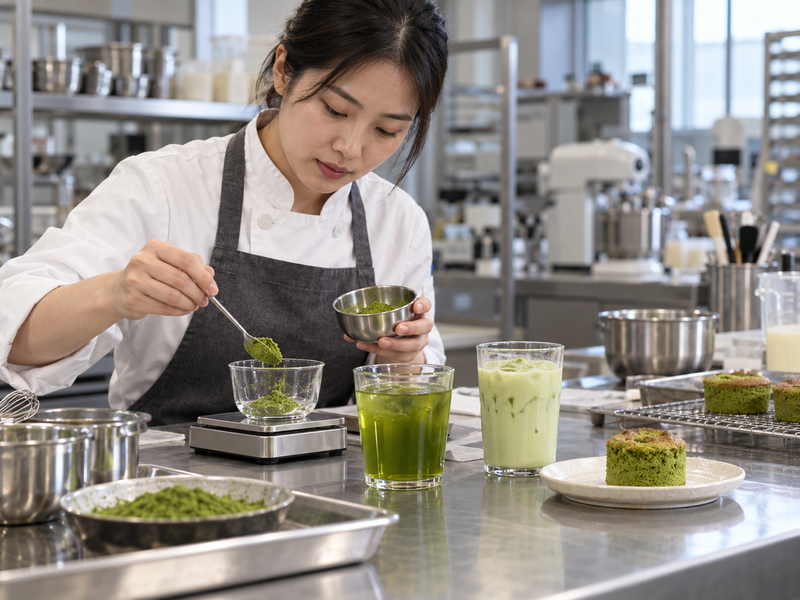
A purchasing team can approve a matcha sample that tastes excellent in water and disappoints in its first commercial recipe. Milk can mute the tea, sugar can hide bitterness, and a cold process can leave visible clumps. Learning how to use matcha powder for a business means designing around the finished application. This guide covers preparation, recipes, scale-up, and supplier questions so a café, bakery, or beverage brand can move from a promising sample to a repeatable product.
Contents
- 1. What does matcha powder contribute to a recipe?
- 2. How should matcha be mixed for a smooth drink?
- 3. What starting ratios should a product team test?
- 4. How is matcha used in hot and iced café drinks?
- 5. How can bakers use matcha without losing color or flavor?
- 6. What changes for ice cream, yogurt, and chilled desserts?
- 7. Can matcha work in bottled or powdered beverages?
- 8. How should a business choose a matcha grade?
- 9. What storage and handling preserve matcha at work?
- 10. How does a trial become a repeatable purchasing specification?
1. What does matcha powder contribute to a recipe?
Matcha supplies tea flavor, green color, and fine suspended solids. It behaves differently from a brewed tea extract because the powder remains in the finished food or drink. That can give a full tea character, but it also means settling, clumping, and mouthfeel deserve attention. Heat, light, air, ingredient acidity, and holding time can change the appearance and flavor a buyer saw in the dry powder. Testing should start in the complete product, not in a tasting bowl alone.
Define the job. A straight tea drink may put aroma and bitterness balance first. A sweet latte may need stronger tea character to stand through milk. A baked item may need color after heat and a flavor that survives butter and sugar. Write a short brief listing application, processing conditions, target sensory profile, pack format, and cost per serving. Then request grades that fit that brief. A supplier can suggest options, but your own trial should decide which one works under the conditions customers will experience.
| Application | Main challenge | Trial observation |
|---|---|---|
| Water-based tea | Exposed aroma and mouthfeel | Taste immediately and after standing |
| Milk drink | Flavor dilution | Compare final cup at target dose |
| Baked food | Heat and color change | Check after cooling |
| Frozen dessert | Flavor through fat and cold | Taste at serving temperature |
2. How should matcha be mixed for a smooth drink?
Start with a measured powder dose and a small amount of liquid. Mixing into a concentrated slurry can help wet particles before the rest of the drink is added. A whisk, frother, shaker, or mixer can work, but each should be tested with the intended volume and vessel. Some teams sieve powder before mixing; others avoid that added service step by choosing a method and powder that disperse reliably. The aim is a reproducible cup with acceptable preparation time, not a single visually perfect demonstration.
Test the actual station. Use the water temperature, cup, milk, and ice available in the store. Record order of addition, mixing time, and whether residue remains on the vessel wall or cup bottom. A cold drink may benefit from a warm or room-temperature slurry, but the process must fit food-safety and service requirements. For a high-volume café, compare several staff members using the same written method. If the drink needs a long rescue whisk to remove clumps, fix the method or powder before launch rather than asking staff to improvise at rush hour.
3. What starting ratios should a product team test?
There is no universal ratio for every grade, serving size, or recipe. A practical trial uses the supplier's suggested starting point, then compares a small range of measured doses under identical conditions. Express powder as grams per serving or as a percentage of the finished formula, not as a vague scoop count. Hold milk, sweetener, water, and ice constant while changing one variable. Record both immediate taste and taste after a realistic handoff or hold period.
Keep the test honest. A higher powder dose can improve tea presence but increase bitterness, sediment, and cost. A lower dose may look green in a clear cup yet taste mostly of milk. For an iced latte, weigh the ice and evaluate after some melt. For a bakery item, calculate powder as a share of total batter and judge the cooled product. Use blinded samples if possible so price or color alone does not dominate selection. Once the dose is chosen, calculate cost per finished unit and write the formula by mass for scale-up.
| Trial variable | Hold constant | Record |
|---|---|---|
| Powder dose | All other ingredients | Flavor, color, cost |
| Mixing method | Dose and recipe | Clumps, time, cleanup |
| Water temperature | Dose and equipment | Aroma and dispersion |
| Hold time | Finished recipe | Settling and color |
4. How is matcha used in hot and iced café drinks?
A hot drink can use measured water to disperse powder before milk is added. An iced version needs a method that prevents dry powder from floating on cold liquid. Write separate recipes for each size and temperature. Extra milk or ice in a large cup changes concentration; scaling the powder and sweetener together may still need a taste adjustment. Evaluate the cup at the service counter and after a realistic delivery interval if takeout is a major channel.
Build for staff, not a photo. A café should document powder grams, water volume, milk volume, sweetener, ice, tool, and mixing sequence. Train staff with a reference cup and a simple visual check for clumps and fill level. If toppings or flavored syrups are offered, test each combination rather than assuming the base grade suits everything. A strawberry syrup can mask delicate tea; a vanilla cold foam can add sweetness that calls for a different dose. Review allergen and vegan claims on the complete drink. A measured recipe also helps purchasing forecast powder usage from expected sales.
5. How can bakers use matcha without losing color or flavor?
In baking, matcha competes with flour, fat, sugar, cocoa, and oven heat. Its dry color may not predict the finished product. Test several grades at the same inclusion level in the actual cookie, cake, or filling. Compare batter or dough handling, baked color, flavor after cooling, and appearance after the intended shelf life. A highly prized drinking grade may be a poor economic choice if the oven erases the difference. A culinary grade may perform better when its flavor is designed for a sweet matrix.
Change one thing at a time. Replacing part of the flour with powder can affect hydration and texture. Adding matcha to a white chocolate ganache differs from adding it to a butter cookie because fat, moisture, and processing temperatures change how flavor appears. A bakery should trial the powder in its own recipe rather than copying a consumer recipe's spoon measurement. Keep a control batch without matcha and photograph samples under consistent light. For wholesale cakes, inspect slices after chilled display. For shelf-stable cookies, check package protection and flavor through the proposed sell-by period.
| Baked application | Trial point | Commercial consequence |
|---|---|---|
| Cookie | Color after bake and storage | Visual consistency |
| Cake | Batter balance and crumb | Texture and yield |
| Cream filling | Dispersion and sweetness | Smooth finish |
| Chocolate | Heat and fat interaction | Flavor and appearance |
6. What changes for ice cream, yogurt, and chilled desserts?
Cold products suppress some aromas and can make sweetness feel different from a room-temperature tasting. Matcha should be evaluated in the finished frozen or chilled product at serving temperature. Pre-dispersing powder before it enters a larger mix may reduce specks, but the method must fit the manufacturer's process and hygiene controls. Watch for sediment, grittiness, color shift, and uneven distribution through a batch. The grade chosen for a straight drink may not deliver enough flavor through dairy fat or a sweet plant base.
Run a process trial. Test a small batch with the intended homogenization, freezing, or mixing sequence. Check the product immediately and after representative storage. A swirl or topping may need a different concentration from a fully mixed base. For yogurt, acidity may change the visual result, so inspect the final cup rather than a powder slurry. For foodservice soft serve, consider whether the powder disperses in the prepared mix without blocking equipment or creating dark streaks. Record dose by mass and confirm that the selected powder remains available in commercial pack sizes.
7. Can matcha work in bottled or powdered beverages?
Yes, but a packaged drink requires more than a good café cup. Powder may settle during distribution, and color and flavor can change under heat, light, oxygen, or the product's acidity. A ready-to-drink manufacturer must develop the formula and process together, then validate shelf life, food safety, and label compliance for its market. A dry beverage mix raises different questions: powder flow, blend uniformity, caking, and consumer dispersion. A supplier sample cannot replace the manufacturer's stability work.
Design the acceptance test. For a bottled drink, define acceptable sediment, flavor, and color at release and through storage. Test the actual bottle, processing conditions, and distribution temperature profile. For a dry mix, sample several points in a batch to check uniformity and run a consumer-style mixing test with the intended water or milk. Matcha may require a different grade or particle profile in each format. Ask the supplier for batch specifications and a change-control process so later lots do not drift outside the recipe's operating window.
| Format | Technical question | Validation step |
|---|---|---|
| Bottled drink | Will solids settle? | Stability trial |
| Heat-treated drink | Does color survive process? | Pilot production |
| Dry latte mix | Is blend uniform? | Multi-point sampling |
| Single-serve sachet | Does it disperse for consumers? | At-home method trial |
8. How should a business choose a matcha grade?
The usual grade labels are useful shorthand but not universal technical standards. Ask for a specification covering origin, intended application, sensory profile, particle behavior, color, packaging, and relevant testing. Then compare candidate powders in one controlled recipe. A premium drinking powder may earn its cost in a straight tea service, while a blend for sweet milk drinks may prioritize a stronger flavor and more forgiving cost. Name your acceptance criteria before looking at supplier prices.
Buy the result. Score samples on the target product rather than on dry-powder brightness alone. Ask whether a grade can be supplied repeatedly at the required volume and pack size. Check lot-to-lot variation, lead time, and how the supplier handles out-of-spec stock. If organic, kosher, or other claims are planned, request documents for the exact product and site. Include commercial constraints such as minimum order quantity and landed cost. A grade that wins a blind tasting but cannot arrive reliably during peak season is not a sound production choice.
9. What storage and handling preserve matcha at work?
Matcha is vulnerable to moisture, heat, light, and air exposure. Keep unopened packs according to the supplier's validated instructions and local food-safety requirements. Once opened, seal promptly, use clean dry tools, and record opening dates. A small café may favor smaller packs if a large bag stays open for weeks. A factory may use larger packs efficiently but still needs controlled staging between warehouse and production line. Avoid letting condensation form when moving chilled stock into a humid room.
Plan the working pack. Decide how much powder a station uses before a pack is depleted and how many times it is opened. Dispensing into an unlabeled jar may look convenient but can break lot traceability. Keep the original lot information or a documented transfer record. Rotate stock by an appropriate date-based rule and check color and aroma when opening a new lot. If a pack arrives damaged or damp, hold it for quality review. Storage is part of recipe consistency, not only a warehouse concern.
| Handling point | Control | Problem it prevents |
|---|---|---|
| Receiving | Inspect seals and lot | Damaged stock use |
| Opening | Date and code record | Lost traceability |
| Service | Dry scoop and tight lid | Moisture pickup |
| Rotation | Use approved stock order | Stale inventory |
10. How does a trial become a repeatable purchasing specification?
Once a recipe works, convert its success into written acceptance criteria. Record the supplier code, sample lot, approved dose, mixing method, sensory target, packaging, shelf-life requirements, and test documents. Set reasonable limits with the supplier for measurable properties that matter in the application. Also document the complaint route: what the buyer sends when color, dispersion, or flavor differs and how the supplier investigates. A retained reference sample can help, provided it is stored appropriately.
Scale in stages. Run a pilot with commercial ingredients and equipment before placing a large order. Compare the pilot with the bench sample, then review yield, labor, waste, and cost per unit. Train production or café staff on the exact sequence. After launch, collect feedback on clumps, sediment, color, and taste by lot. If a new grade is proposed, repeat the application trial rather than substituting by name. The best way to use matcha powder commercially is to make a specific finished product consistently, even when operators and lots change.
Matcha works across drinks and foods when the powder grade, dose, mixing method, process, and storage match the finished product. Begin with a written application brief, test measured recipes under real conditions, and carry the approved code into purchasing. Ask suppliers for samples and batch specifications that support the trial you actually ran.
FAQ
Q1: Should matcha be mixed with water before milk?
A measured slurry often helps wet powder evenly. Test it against your equipment and final recipe.
Q2: Can the same grade serve drinks and baking?
Sometimes. Compare both finished products before choosing a shared grade.
Q3: Why does matcha settle in a bottled drink?
Powder remains as suspended solids. A manufacturer must test formulation, processing, and storage behavior.
Q4: Is a brighter dry powder always better?
No. Judge color, flavor, and stability in the finished application.
Q5: What should a supplier receive before recommending a grade?
Share the recipe type, process, target taste, dose range, packaging, annual volume, and market requirements.
A small-scale preparation overview is available from Milk Street. For commercial sourcing context, see our café powder guide.