
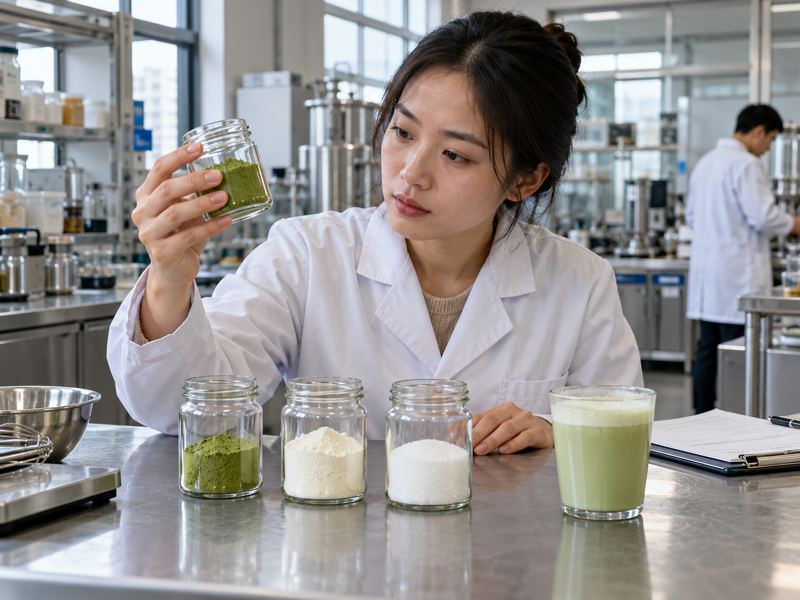
“Matcha powder” can mean a single tea ingredient or a sweetened product built for instant lattes. A product buyer who mistakes one for the other can set the wrong dose, cost a recipe inaccurately, or approve misleading label copy. This guide explains how to read matcha powder ingredients, separate pure tea from formulated blends, and request the records needed for commercial use. The aim is a clear buying and formulation decision, not a health claim.
Contents
- 1. What are the ingredients in pure matcha powder?
- 2. What can be added to a matcha latte powder or blend?
- 3. How should a buyer read an ingredient statement?
- 4. Why does the tea percentage matter in a blend?
- 5. Which allergens and diet claims need attention?
- 6. How do ingredients change beverage performance?
- 7. How do ingredients affect bakery, dessert, and dairy formulas?
- 8. What supplier documents should accompany matcha ingredients?
- 9. How should brands write accurate matcha product labels?
- 10. What checklist should a buyer use before approving a SKU?
1. What are the ingredients in pure matcha powder?
One tea ingredient
Pure matcha powder is finely ground tea leaf material. Its ingredient statement should identify tea only. The exact wording can vary by market and supplier, but there should be no sugar, creamer, flavor, carrier, or added color in a genuinely single-ingredient product. Ask for the supplier's current ingredient declaration for the offered SKU. A photograph of a green powder, a “ceremonial” grade name, or a front-pack purity claim does not replace that declaration.
Start with the item code. A supplier may sell pure matcha, matcha latte powder, and flavored matcha blends under closely related names. Confirm that the sample, quotation, specification, and ingredient statement all refer to the same item. If they do not, stop label and recipe work until the mismatch is resolved. A change of SKU can change sweetness, allergen handling, and the percentage of tea in a finished drink.
| Product description | Ingredient expectation | Next check |
|---|---|---|
| Pure matcha | Tea only | Confirm specification and lot |
| Matcha latte powder | Tea plus other components | Review full formula and allergens |
| Matcha blend | Multiple named ingredients | Check proportion and intended use |
| Ready-to-drink matcha | Complete beverage formula | Review label and process |
2. What can be added to a matcha latte powder or blend?
Read the complete list
Commercial matcha mixes can include sugar or other sweeteners, milk powders or creamers, plant-based ingredients, flavors, stabilizers, and carriers. The actual formula varies by product. These additions may make a café drink faster or help a packaged powder dissolve consistently, but they also change how much matcha is delivered per scoop. A 20 g serving of premix cannot be compared directly with 20 g of pure tea powder. Request the full ingredient statement and the tea percentage or a sufficient composition breakdown for the buyer's costing and labeling needs.
Ask what job each addition does. Sugar may set sweetness, a creamer may create body, and a stabilizer may help a prepared drink hold its texture. Those functions can be useful. They also limit the operator's ability to control sweetness or choose its own milk. In a retail product, all ingredients and allergens need correct market-specific declaration. In foodservice, staff need enough information to describe the drink honestly and handle allergens.
3. How should a buyer read an ingredient statement?
Check identity and order
Read the exact product name and item code at the top. Then read every listed ingredient, including components of any compound ingredient where applicable. In many markets, ingredient order reflects quantity by weight at the time of formulation, but the exact legal rules depend on the jurisdiction and product. Have a qualified label reviewer apply local requirements. The buyer's practical task is to identify whether tea is the only component and, if not, what else will affect flavor, claims, and allergens.
Compare three documents. The supplier declaration, the product specification, and the actual pack should agree. If a specification says “100% matcha” while a draft pack mentions sugar, resolve the discrepancy before purchase. For private label, establish which party owns the final ingredient wording and who approves changes. Save the approved version with a date and the corresponding SKU so future packaging runs do not reuse old text.
Ask about hidden complexity
A broad term such as “flavor” or “creamer” can contain components that matter for allergen or claim review. Ask the supplier for the detail necessary under the target market's rules and the buyer's own policy. A plant-based claim does not automatically answer questions about shared equipment or cross-contact. Likewise, “unsweetened” requires checking both added sugars and other sweetening ingredients under the applicable standard. Do not guess from taste alone; request the supporting formula or declaration.
| Ingredient-list signal | Possible effect | Buyer follow-up |
|---|---|---|
| Sugar near top | Sweetness and low tea share | Confirm tea content and dose |
| Milk component | Dairy allergen | Check declaration and handling |
| Flavoring | Changed tea profile | Obtain allowed wording |
| Carrier or stabilizer | Texture or dispersion | Test finished application |
| Tea only | Recipe flexibility | Verify lot and quality |
4. Why does the tea percentage matter in a blend?
Compare real tea dose
The percentage of matcha in a premix determines how much tea enters a serving at a given powder dose. If a buyer wants a tea-forward latte, it needs enough information to evaluate whether the prescribed scoop will deliver that result. The supplier may treat its full formula as confidential, but a commercial agreement can still specify tea content or performance criteria. Without either, a buyer cannot compare two mixes fairly or explain why one tastes weak despite a large serving size.
Do the arithmetic before tasting claims. For a hypothetical premix containing 20% matcha, a 15 g serving would contain 3 g of tea. That is a calculation example, not a claim about any offered product. A pure powder serving at 3 g contains 3 g of tea, before milk, sugar, or other ingredients are added separately. Compare the cost of complete finished drinks, including those other inputs and labor. The cheapest bag may not make the cheapest approved cup.
5. Which allergens and diet claims need attention?
Review every component
Single-ingredient tea has a different allergen profile from a latte mix that contains milk powder, soy ingredients, or other additions. A finished café drink can contain allergens from milk, syrups, toppings, or shared equipment even when the matcha itself is pure. Review the full formula and the site's handling procedure. For retail packs, the declaration and precautionary statements must follow local requirements and evidence. Do not copy a supplier's broad claim without checking the exact SKU and production conditions.
Vegan is a formulation question. Pure tea comes from a plant, but a matcha latte blend may contain dairy components. A drink made with plant milk may still include a dairy-based premix. Check the ingredient list and any certification or cross-contact requirements relevant to the buyer's claim. “Gluten-free,” “non-GMO,” halal, kosher, and organic each require their own support and may have different rules in different markets.
Keep claims and certificates aligned
Matcha Village lists support for organic and food-safety certifications and a range of tests. A buyer should request current documents for the exact product, production site, and target market. A certification for pure tea may not cover a new sweetened blend. A finished product using the ingredient may need its own certification process. Assign someone to verify scope and validity before artwork goes to print.
| Claim area | Product question | Evidence route |
|---|---|---|
| Vegan | Any animal-derived ingredient? | Formula and relevant controls |
| Dairy allergen | Any milk component or cross-contact? | Ingredient and site information |
| Organic | Is this SKU certified? | Current scoped certificate |
| Halal or kosher | Does certification cover the product? | Current scoped certificate |
| Gluten-free | Does product meet target-market rule? | Appropriate testing and controls |
6. How do ingredients change beverage performance?
Test the finished drink
Pure matcha gives a formulator direct control over tea dose, milk, and sweetness. A premix may disperse faster or produce a familiar sweet profile, but its behavior depends on all included ingredients. Test each candidate in the actual drink and cup. Note clumps, foam, sediment, sweetness, tea visibility, color, and taste after a realistic wait. A powder that dissolves easily in water may still separate in cold milk or clash with a flavored syrup.
Compare at an equivalent target. Do not insist on equal scoop weights when comparing pure tea with a blend. Build each drink to the same target sweetness and tea impression, then record the complete recipe and cost. If the premix requires no separate sugar, subtract that step and ingredient. If its tea note is too weak, calculate the extra powder needed and the added sugar that arrives with it. That tradeoff can make a premix hard to tune.
7. How do ingredients affect bakery, dessert, and dairy formulas?
Separate flavor from processing
In baking, pure matcha allows the formulator to adjust tea without adding unplanned sugar or dairy. A matcha premix can change the dough's sweetness, solids, moisture balance, and allergen profile. In ice cream or yogurt, added sugars and stabilizers can interact with a base that already contains them. Test the full formula, not a spoonful of powder. Record the version and processing conditions so the result can be repeated.
Taste after the real process. A powder with pleasant dry aroma may lose distinction after baking, freezing, or combining with chocolate. Color may change during heat exposure or storage. Matcha grade, dose, process temperature, and other ingredients all contribute. If a product developer changes the tea powder, rerun the stability and sensory checks relevant to the product. Do not assume equal green appearance at mixing predicts equal shelf appearance.
Calculate cost by batch
Compare cost at the approved recipe, including all ingredients that a premix contributes or displaces. If a bakery switches from pure matcha plus sugar to a sweetened blend, account for the sugar already present before adding the usual recipe amount. For a private-label dessert mix, decide who owns the exact formulation and who can approve a substitute. The ingredient statement on the final pack must reflect the actual recipe, not the original development sample.
| Application | Pure powder advantage | Blend question |
|---|---|---|
| Cookies | Independent tea and sugar control | Will sweetness change dough? |
| Ice cream | Tea dose can be tuned | Do added solids affect texture? |
| Yogurt | Clear ingredient identity | Will flavoring clash with base? |
| Latte powder | Flexible house formula | Does mix save enough labor? |
8. What supplier documents should accompany matcha ingredients?
Build a file for the exact SKU
Request the full ingredient statement, product specification, lot identification, relevant certificate of analysis, packaging and storage guidance, and traceability information. Depending on market and buyer policy, additional test results or certification documents may be needed. Check dates, product codes, facility names, and scope. A certificate for a different grade or production site does not automatically cover the offered material. Keep the approved files together with the sample record.
Ask about change notification. If a premix supplier changes a sweetener, flavor, milk powder, or carrier, the alteration may affect taste, allergens, label copy, and cost. If a pure-tea supplier changes source or processing in a way that affects the specification, a buyer may need to retest. Put material-change notice and approval into the commercial agreement. A quarterly price conversation is too late to discover that a formula changed during the last shipment.
9. How should brands write accurate matcha product labels?
Name the product customers will receive
Use a product name and description that match the formulation. A single-ingredient retail powder can say so when the records support it. A sweetened latte mix should disclose its other ingredients and allergens under destination-market rules. A café menu should make clear when a drink includes sweetened powder or milk components that a customer might not expect. Avoid using tea culture imagery to imply a geographic origin that the supply documents do not support.
Review the claim, then the image. Words such as “pure,” “organic,” “vegan,” and “sugar-free” carry distinct implications. Each needs its own evidence and legal review where applicable. Product imagery can also mislead if it shows an unsweetened whisked bowl while the SKU is a sweetened instant mix. Keep the final approved artwork, ingredient statement, and supplier evidence together. If the formula changes, stop using old artwork until the label team approves a revision.
Explain origin without assumptions
Matcha can be produced outside Japan. Matcha Village is a China-based supplier with tea resources in the Hangzhou area, so buyers should describe origin accurately for products sourced there. If a finished mix is blended or packed in another location, distinguish tea origin from blending and packing location as required by local law. Do not infer origin from a grade name or visual style. The invoice, certificate, pack, and product page should tell a consistent story.
| Label field | Source to confirm | Typical failure |
|---|---|---|
| Product name | Actual formulation | Calling a premix pure tea |
| Ingredients | Approved supplier declaration | Old SKU wording |
| Allergens | Formula and site controls | Missing milk component |
| Origin | Traceability and trade records | Implied wrong country |
| Claims | Certificates and legal review | Scope not covering SKU |
10. What checklist should a buyer use before approving a SKU?
Run four separate approvals
Confirm identity: the item code, full ingredient list, tea content where needed, and intended use. Confirm compliance: relevant files, testing, allergen review, certificates, and destination-market label requirements. Confirm performance: controlled tasting and a pilot in the actual drink or food. Confirm commercial fit: pack, lead time, minimum order, price, and change control. The same person need not own every gate, but the decision record should show who signed each one.
Use a saleable sample. A promotional sachet may not represent the material available for the first production run. Ask for a sample traceable to the quoted product and keep a retained portion under suitable storage. Compare the first incoming commercial lot against it. If the product is a custom blend, require an approved formula version and a process for future changes. That avoids an unplanned ingredient change after menu boards or retail cartons have been printed.
Send a clear request to the supplier
Tell the supplier whether the goal is pure tea for flexible formulation or a ready-to-use blend. Describe the end application, target market, customer, expected volume, packaging, sensory target, and required documentation. Matcha Village can discuss both matcha grades and custom blends. A useful first exchange includes the exact ingredient declaration and a representative sample, followed by a controlled application trial. The buyer can then negotiate price against a product that genuinely fits the recipe and label.
FAQ
Q1: Does pure matcha powder contain sugar?
No. A genuinely pure powder contains tea only; check the offered SKU's ingredient statement.
Q2: Is matcha latte powder the same ingredient as pure matcha?
Usually not. A latte powder may contain sweeteners, dairy or plant components, and other ingredients.
Q3: Why does tea percentage matter in a premix?
It affects tea dose, taste, cost, and how the buyer compares products fairly.
Q4: Can a vegan drink use any matcha premix?
No. Check the complete premix formula and relevant production controls before making that claim.
Q5: What should a buyer verify before approving label copy?
Match the exact SKU, ingredient declaration, allergen information, origin, and claim evidence to the final artwork.
For a formal description of straight matcha and the products outside that scope, see the ISO matcha technical report. Apply the supplier checks above to the exact SKU under review.
For supplier approval and repeat-order questions, see our bulk matcha supplier guide.