
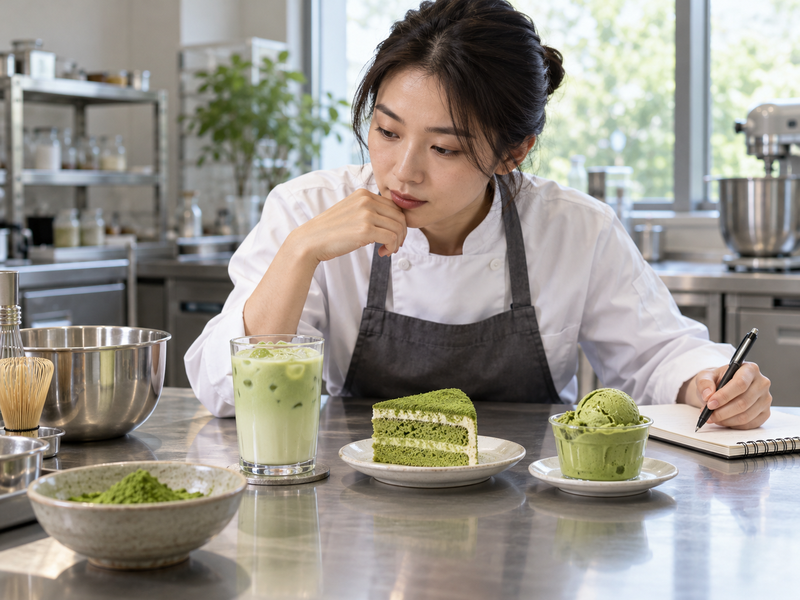
A café bakery wants one matcha powder for lattes, cookies, and frozen desserts. Its first sample makes a strong latte but turns dull in the oven; a second bakes well but tastes harsh in a lightly sweet drink. “Culinary matcha powder” is a useful sourcing category, yet the label alone cannot resolve that trade-off. Commercial buyers need a cross-application trial and a specification tied to the products they actually sell. This guide shows when one grade can serve several recipes and when a second grade earns its inventory cost.
Contents
- 1. What does culinary matcha powder mean in a commercial brief?
- 2. Which candidates belong in a cross-application trial?
- 3. How should culinary powder be tested in milk drinks?
- 4. What changes in smoothies and chilled beverage mixes?
- 5. How should a bakery evaluate powder after heat?
- 6. Can the same culinary grade work in frozen desserts?
- 7. When is one grade enough, and when are two worth carrying?
- 8. Which specifications matter for a culinary purchase?
- 9. How should price be compared across culinary candidates?
- 10. How does a trial become a repeatable order?
1. What does culinary matcha powder mean in a commercial brief?
Suppliers often use “culinary” for matcha intended to be mixed into food or formulated drinks. The term does not impose one universal standard for leaf source, particle size, color, bitterness, or processing. One supplier's culinary grade may be pleasant in milk; another may be designed mainly for sweet baked goods. The buyer should translate the label into a product code, specification, and application trial. A comparison of ceremonial and culinary categories can be a starting point, as Golde's overview shows, but a brand's own recipe decides suitability.
Describe the finished products. List each intended application, serving size, recipe sweetness, process temperature, hold time, and target cost. State whether the powder must carry a specific origin or certification claim. Ask the supplier which of its codes it recommends for each product and why. A strong, slightly bitter powder might remain clear in a sweet latte while dominating a plain tea service. A more delicate powder may taste elegant in water but disappear in a butter cake. Use the term “culinary” to open a technical conversation, not to close a purchasing decision.
| Buyer application | Desired contribution | Likely stress |
|---|---|---|
| Milk drink | Clear tea flavor | Milk and sweetener mask aroma |
| Baked cake | Green crumb and tea note | Oven heat and fat |
| Frozen dessert | Flavor at serving temperature | Cold suppresses aroma |
| Dry mix | Even color and dispersion | Blend and storage behavior |
2. Which candidates belong in a cross-application trial?
Request representative commercial-lot samples from two or three culinary grades and perhaps one higher-priced comparison grade. Ask for exact codes, ingredients, origin statement, pack size, storage guidance, relevant documents, and available volume. Keep samples sealed and test them soon after opening under the same conditions. A laboratory sample can support development but should not stand alone for production approval. Check whether the quoted grade will be supplied from the same process route and whether later lots can be compared against the chosen reference.
Avoid a false contest. Blind-code powders before tasting. Use equal doses for the first screen, then adjust each candidate within a commercially reasonable range. If one grade needs much more powder to achieve the same tea flavor, compare cost per finished serving. If a candidate looks brightest dry but loses its color in cake, record that loss rather than awarding a win at the sample table. A cross-application trial should leave room for different winners. Force-fitting one powder into every product can create more labor, waste, and complaints than carrying two controlled SKUs.
3. How should culinary powder be tested in milk drinks?
Use the café's actual milk or plant milk, sweetener, water, ice, cup size, and mixing method. Test flavor, bitterness, clumps, sediment, color, and preparation time. A powder may taste balanced in a warm small cup and weak in a large iced drink after dilution. Prepare drinks at target dose and after a realistic handoff interval. If the chain offers both sweet and unsweetened versions, test both. Sweetness can hide bitterness in one recipe and leave it exposed in another.
Make operators part of the trial. Ask several staff members to follow the same written build. Record powder grams, liquid volumes, mixing tool, order of addition, and remakes. A grade that requires a long whisking step can add service cost. A grade that disperses well but tastes weak may need a higher dose. Compare the finished cup blindly rather than reading the grade name. If a supplier recommends a drinking grade for milk drinks, include it as a benchmark and decide whether the sensory gain justifies a separate inventory code. The choice should reflect the menu promise and price point.
| Milk-drink check | Trial method | Commercial consequence |
|---|---|---|
| Tea presence | Taste finished cup | Perceived value |
| Dispersion | Inspect after standard mixing | Service time and remakes |
| Ice dilution | Taste after normal wait | Delivery quality |
| Cost | Powder grams per saleable cup | Menu margin |
4. What changes in smoothies and chilled beverage mixes?
A smoothie contains fruit, yogurt, protein, or other strong flavors that can overwhelm matcha. Cold temperature also changes perceived sweetness and tea aroma. Trial the powder in the complete formula at serving temperature. Check whether powder sticks to a blender wall, forms dark specks, or settles after a short hold. If the product is prepared in batches, test the maximum planned hold under a food-safety procedure. A café can adjust a single cup easily; a packaged chilled beverage needs a more formal stability and processing plan.
Test the surrounding ingredients. A banana smoothie may need more tea presence than a lightly sweet oat drink. Acidic fruit can shift visual appearance. A protein blend may change viscosity and mask a powder's mouthfeel. Change one variable at a time: powder candidate, dose, or sweetener, rather than all three. Record whether the product remains acceptable after transport to the customer. If the drink is bottled, include manufacturing, packaging, and shelf-life validation; a blender test is only an early screen. A culinary label cannot predict performance through a chilled distribution chain.
5. How should a bakery evaluate powder after heat?
Baking can change green color and tea flavor. Test candidates in the actual cookie, cake, or filling at equal initial dose. Keep flour, fat, sugar, pan, oven profile, batter weight, and cooling fixed. Judge the cooled product and its planned sale-day condition, not merely raw dough or fresh batter. A powder that tastes assertive in water may work well after heat; another may become flat. The bakery should record both cut interior and exposed surfaces because ordinary browning can make them look different.
Protect the experiment. Photograph samples under fixed lighting and use blind tasting. Inspect crumb or cookie texture, since more dry powder can change the formula's water balance. If a stronger matcha dose dries the product or raises bitterness, consider adjusting the base recipe or selecting another grade. Do not disguise a weak powder with added green color while claiming matcha supplies the appearance. For a cream filling that is not baked, test separately: its fat and sugar may make a different candidate preferable. A finished cake slice can contain two matcha applications with distinct performance needs.
| Baked item | Observe after processing | Follow-up if weak |
|---|---|---|
| Cookie | Color, bitterness, crispness | Dose or grade trial |
| Sponge cake | Cut crumb and tea aroma | Batter and oven review |
| Cream filling | Smoothness and sweetness | Mixing and formula review |
| Packaged slice | Color through display | Packaging test |
6. Can the same culinary grade work in frozen desserts?
It can, but cold suppresses some aromas and changes perceived sweetness. Test ice cream, soft serve, or frozen plant desserts at the actual serving temperature. Disperse matcha using the manufacturer's validated mixing method and inspect the finished texture for specks or grit. Check color after freezing and representative storage. The powder's dry appearance will not show whether its flavor remains clear through fat, sugar, and cold. A grade selected for hot lattes may need a different dose or may lose its advantage here.
Run a pilot batch. A spoonful mixed by hand into a small bowl does not mimic homogenization, freezing, or repeated machine cycles. Record powder inclusion by mass, mix viscosity, equipment behavior, yield, and sensory result. For a swirl, sauce, or dusting, test that component separately because its exposure and moisture differ from a fully mixed base. Review ingredient and allergen claims on the final dessert, especially when moving between dairy and plant bases. Compare the candidate's cost per finished portion after processing loss, not simply its price per kilogram.
7. When is one grade enough, and when are two worth carrying?
One grade is attractive when it meets every product's minimum sensory, process, documentation, and cost requirements. It simplifies storage, staff training, forecasting, and lot checks. Two grades can be justified when a single option creates a visible or costly compromise, such as a bakery grade that makes a harsh unsweetened latte or a drinking grade whose subtle flavor disappears in cake. The decision should come from a cross-application scorecard, not a preference for fewer stock codes.
Calculate the trade-off. Compare one-SKU and two-SKU scenarios using expected volume, dose, pack sizes, opening life, minimum order quantities, and rejected product. A second powder adds inventory and changeover work. It can also reduce dose, remakes, or waste in a high-volume application. Make the decision by product line rather than by a single vague score. If the café sells hundreds of lattes and a few seasonal cakes, optimize the drink first and decide whether cake can use the same powder acceptably. A bakery-led business may reverse that priority.
| Choice | Operating benefit | Cost to test |
|---|---|---|
| One grade | Simpler purchasing and training | Compromise in weak application |
| Two grades | Better application fit | Inventory and changeover |
| Custom blend | Potential tailored result | Development and MOQ |
| Seasonal substitute | Supply flexibility | Reapproval and consistency |
8. Which specifications matter for a culinary purchase?
Write the specification around what the business can actually test and use. Include exact product identity, ingredient composition, pack format, lot code, shelf-life basis, storage instructions, relevant test documentation, and application characteristics. Color, moisture, particle behavior, and sensory profile may be useful, but a value needs a method and an agreed limit. “Vibrant green” and “fine powder” are descriptions, not release criteria. For cross-application supply, define which finished product acts as the acceptance benchmark.
Tie the sheet to a sample. Retain an approved commercial lot, recipe instructions, and photographs taken under controlled light. Ask the supplier how much normal variation to expect and how it notifies buyers of changes in source, blending, milling, or packaging. If organic, kosher, halal, or another claim is planned, verify the exact product and operator scope separately. A certificate for a site does not settle taste or dispersion. A food-safety test report cannot prove that the powder will keep a cake green. Separate each decision in the approval file so a passing result does not stand in for unrelated evidence.
9. How should price be compared across culinary candidates?
Start with cost per accepted finished item. Powder price per kilogram matters, but dose, yield, waste, labor, and packaging can change the outcome. A low-priced grade may need more grams per latte; a high-priced grade may save dose but need a separate SKU. A bakery powder may produce more rejected slices if its color shifts in storage. Compare candidates under the same commercial recipe and include realistic loss, not just ideal bench yield.
Price the supply route. Ask for minimum order quantities, lead time, pack sizes, freight terms, forecast capacity, and document costs. Smaller packs may protect quality at a low-volume café; bulk bags may suit a beverage plant that empties them quickly. If a supplier offers a custom culinary blend, request a development sample and a written rule for future ingredient changes. Model a delay or seasonal shortage and determine whether an approved alternate grade exists. A cheap quote is not useful if the powder arrives after a launch or changes the finished product unexpectedly.
| Cost input | Measure | Hidden effect |
|---|---|---|
| Dose | Grams per accepted unit | Higher use rate |
| Labor | Mixing and cleanup time | Service throughput |
| Waste | Rejects and stale open packs | True yield |
| Logistics | MOQ, freight, lead time | Stock risk |
10. How does a trial become a repeatable order?
Freeze the winning product code, recipe version, acceptance method, pack format, and document list. Run a pilot at normal equipment scale, then compare the first commercial lot with the approved trial. Train staff to recognize the correct SKU and prepare the reference product. At receiving, check lot and pack identity before the powder enters production. If a later lot performs differently, hold it and compare under the same application method before changing the formula or accusing the supplier.
Keep both sides informed. Purchasing should communicate volume forecasts; R&D should share application results; quality should maintain specifications and lot records. Ask the supplier for change notices covering source, blend, process, and packaging. Review the one-grade versus two-grade decision when the menu changes or an application grows. A powder chosen for sweet lattes may be the wrong foundation for a new unsweetened tea line. Repeatable supply comes from an exact code, representative commercial samples, and tests that mirror what customers actually consume.
Culinary matcha powder should be selected by finished-product performance. Test candidate lots in milk drinks, chilled products, bakery items, and desserts at realistic doses and process conditions. Then choose one or two approved grades using cost per accepted product, supply continuity, and documented specifications. Ask suppliers for commercial-lot samples tied to the quoted code before volume ordering.
FAQ
Q1: Is culinary matcha powder always lower quality?
No universal grade standard applies. Evaluate each supplier's code in the intended recipe and against a written specification.
Q2: Can one powder serve lattes and cakes?
Yes, if it meets both products' flavor, color, process, and cost requirements in controlled trials.
Q3: Should a café choose culinary powder only by dry color?
No. Taste and inspect the finished drink after standard mixing and a realistic wait.
Q4: Why might a bakery use a different grade from a café?
Oven heat, fat, sugar, and storage can change which powder performs best.
Q5: What should a buyer request before ordering?
Ask for the exact product code, commercial-lot sample, specification, pack size, relevant documents, and change-notification terms.